In recent years, buzzwords like Scandi-chic, Nordic design , and hygge lifestyle have been almost ubiquitous in the fashion and interior design world. The hype surrounding this blend of minimalism, functionality, and coziness has been enormous, and Scandinavian design has simply been the dominant trend of late.
Interior design in Scandinavian style. Photo by Minh Pham @minhphamdesign, via Unsplash
To be honest, I caught the Nordic bug like countless other people, and my living room as well as my balcony have since undergone a minor overhaul.
After intensive study of the topic and its history, I was able to discover a wealth of facets and long-standing traditions in the philosophy of life and work in Scandinavian culture, which inspired me to write this article.
Scandinavian design is so much more than just the collection of furniture, rugs, throws, and sleek lamps in a room. From electronics and fashion to decorative objects and luxury accessories like Watches , and from architecture to interior design, Nordic design, and especially elements of Scandinavian minimalism, have found their way into every aspect of our lives.
Let's delve deeper into the question: What is Scandinavian design? Let's explore Nordic minimalism, its origins and influences, and get to know remarkable designers and brands from Northern Europe.
Let's take a step back and start at the very beginning…
What is design?
"Successful design is the combination of vision, processes, creativity and technical skill to create a product idea, service or brand that skillfully attracts the attention of consumers."
(Quote from the New Zealand Government's Design Taskforce, translated from English)
Design is not a concept that is easy to define. However, it can be simplified to say that design is a central component of what we understand as innovation today. Design encompasses not only the aesthetic aspects of a product, but also its technological aspects, performance, and character.
The actual act of creation involves not only designing the appearance of the product, but also considering and integrating a range of inputs in creating the form and function of a product, as well as in its manufacture, marketing and communication to consumers.
The term design first originated in the English language and referred to a broad and far-reaching process that spanned the entire production and life cycle of a product: from the idea, through production, to distribution and marketing.
Interestingly, in most Scandinavian languages, the interpretation of "design" was limited to the aesthetic (and perhaps ergonomic) aspects of a product: that is to say, its form. Even though the two approaches have blended over the decades, the focus on aesthetics has persisted in Scandinavian product design to this day.
The term "design" has become an omnipresent buzzword in recent decades. Designer goods are now extremely accessible, readily available everywhere, and sold in brick-and-mortar stores, online, and, increasingly in recent years, via social media to consumers of all ages and for almost every budget.
Designer products are available at rock-bottom prices as well as at astronomical sums that few of us can afford. Over the decades, it has become clear that consumers increasingly judge products by their design, and less so by their function or purpose.
Product design by companies and manufacturers has increasingly been understood as providing firms with a competitive advantage and a unique image with high brand recognition. At the same time, it contributes to improving manufacturing workflows and production processes, and supports functionality in an elegant and skillful manner.
Decision-makers quickly recognized that design was not merely cosmetic, but a significant industrial resource and a driving force for job creation.
Design quickly became an important component of products, expressing aesthetic aspirations, artistic ambitions, and the representation of desires and dreams. A rapidly expanding professional design industry was the logical consequence.
Why is design important?
Design offers significant advantages for companies, brands, and products:
Increases the value (utility) of the product for the user
Enhancing the aesthetic, symbolic, and visual quality of the product, taking into account the psychological and aesthetic needs of consumers
Improving the product's manufacturability by simplifying the structure, taking into account material selection, production processes, and assembly
Promoting rational standardization leads to lower unit costs
Promoting lower environmental impact through better integration of energy-saving features, increased durability, aesthetics, timelessness, recyclable parts, etc.
Increases a product's marketing potential by taking buyer behavior into account and making a purchase decision easier
It helps companies to tap into new markets by enabling products to be adapted to local and/or cultural conditions
Improves communication of the company vision and strengthens the brand in the perception of consumers
Enables greater product differentiation from the competition, e.g. through the visual qualities of the product
The Scandinavian Case – Design Evolution in the Nordic Countries
As briefly mentioned, people in the Scandinavian countries have a special approach to design. This continues to influence products from Norway, Finland, Sweden, and Denmark and has made the Scandi style known even in the most remote corners of our planet.
The Scandinavian design movement in its current form probably originated at the beginning of the 20th century and flourished in the Nordic countries from the 1930s onwards.
Originating with the Danish "Selskabet for Dekorativ Kunst" (Association for Decorative Arts), which launched its magazine Skønvirke (literally "Graceful Work") in 1914, the title became the name of a newly emerging Danish art and craft style that could compete with contemporary trends such as Art Nouveau. The latter was initially often reserved for the social elite, while Skønvirke promoted local craftsmanship and democratic design freely accessible to all social classes.
From the 1930s onwards, designers such as Alvar Aalto (Finland), Arne Jacobsen (Denmark), Josef Frank (Sweden) and Maija Isola (Finland) began producing their work, establishing a “golden age of Scandinavian design”.
Her works were inspired by concepts from Constructivism, Functionalism, and in some cases, Surrealism.
The art movement reached its provisional peak in connection with international recognition in the 1950s to 1970s, when the Lunning Prize was awarded to outstanding Scandinavian designers.
The term “Scandinavian design” is believed to have first appeared in 1951 as the title “Scandinavian Design for Living” of an exhibition of home accessories and furniture in a London district.
From 1954 to 1957, the traveling exhibition "Design in Scandinavia" toured Canada and America with overwhelming success. Simultaneously, similar joint exhibitions took place in the fashion capitals of Milan in the 1950s and Paris in 1958 ("Formes Scandinaves"). These further contributed to making "Design made in Scandinavia" a globally sought-after label.
The often rigid notions of style and good taste, coupled with a persistent focus on simple functionality, remained controversial. Over the years, the term became associated with connotations that, for some northerners, became an undesirable label.
Eventually, the trend experienced a sharp decline and was even declared dead in the 1980s. However, designers, brands, and products from the Nordic region are now experiencing a phenomenal revival.
Whatever the artistic merits of the Scandinavian Way of Design may be, it can no longer be denied that outside the Nordic countries, "Scandinavian Design" has become a commercially strong and valuable brand – similar to "Paris Fashion", "Made in Italy" or "Swiss Watches".
It stands for modern design with high quality and a touch of "coziness" .
Scandinavian design for modern design with a touch of coziness. Photo by Devon Janse van Rensburg @devano23, via Unsplash
Scandinavian design is essentially characterized by a minimalist, clean approach that seeks to combine functionality with beauty. Its focus is on simple lines and bright spaces, free from clutter and unnecessary elements.
Scandinavian design is characterized by a minimalist, clean approach. Photo by Kara Eads @karaeads, via Unsplash
These principles extend to all areas of design, from architecture to electronics, but are most often mentioned in connection with interior design and the furnishing of living spaces. This type of interior design includes furniture as well as textiles, ceramics, and lighting.
Typically, there is nothing superfluous; the unnecessary is consistently removed and the design is reduced to the essential elements of each product.
The most frequently used colors are subtle and monochromatic: light, warm white with black and natural tones – striking colors are used only for accents. Elegant pink, gray-blue, and colors rooted in nature – such as sage – are most popular in Scandinavian design.
This clear yet warm theme, combined with the calming nature of a spacious, light-filled room free of any clutter, is partly the reason why Scandinavian design is so popular.
This type of Nordic minimalism allows people to bring peace and comfort into their homes. Rooms designed according to this interior design philosophy feel inviting and full of vitality without being intrusive.
Given the pronounced tendency towards utilitarianism, it should come as no surprise that sustainability is now an essential part of modern Scandinavian design.
The Nordic design principles of craftsmanship, quality, and enabling a better everyday life are a natural cornerstone for a form of product development that naturally seeks to return to a slower, local or regional production of high-quality products designed for longevity.
Famous Scandinavian designers
Over the decades, a large number of internationally highly respected Nordic product creators have emerged, some of whom are worth briefly mentioning:
Kaare Klint (Denmark, 1888–1954)
Kaare Klint is widely known as the father of modern Danish furniture design. He designed his first piece of furniture at the tender age of 26, having been immersed in the world of design as the son of an architect. During his impressive career, he inspired numerous Danish designers, including the talents of Børge Mogensen and Jens Risom.
Poul Henningsen (Denmark, 1894–1967)
Poul Henningsen achieved international iconic status with a series of lighting fixtures in the 1920s, when the light bulb was considered high technology. Some of his world-famous lamps are still being manufactured almost a century later.
Arne Jacobsen (Denmark, 1902–1971)
The architect Arne Jacobsen was one of the most prolific designers of Scandinavian modernism, selling millions of his Ant Chair made of plywood. He was influenced by Mies van der Rohe and Charles and Ray Eames.
Finn Juhl (Denmark, 1912–1989)
Finn Juhl was recognized for, among other things, introducing Danish design to America. He made his American debut in 1951 at MoMA in New York. The iconic, sensual forms of his designs earned him numerous awards, some posthumously.
Hans Wegner (Denmark, 1914–2007)
Hans Wegner is a master of 20th-century Danish modernism. Although he created many iconic pieces, Wegner was particularly known for his chairs, designing more than 500 models throughout his career, including the famous Peacock Chair.
Børge Mogensen (Denmark, 1914–1972)
Børge Mogensen began his career as a cabinetmaker and teaching assistant at Kaare Klint before establishing his own business in 1959. Throughout his career, he won several design awards and was celebrated for his high-quality craftsmanship and the classical influences that inspired his modern designs.
Jens Risom (Denmark, 1916–2016)
Jens Risom emigrated from his native Denmark to the USA in 1939. At the age of 23, he attended business school and designed furniture for Kaare Klint. His Risom chair was one of the first produced by Knoll and is still manufactured today.
Philip Arctander (Denmark, 1916–1994)
The iconic Clam Chair by Danish architect Philip Arctander is now one of the most sought-after objects in the auction and antiques scene, fetching astronomical prices of tens of thousands of dollars.
Niels Otto Møller (Denmark, 1922–1988)
Niels Otto Møller's furniture repertoire may be modest compared to that of his more prolific contemporaries, but this only speaks to his uncompromising approach. Each design took approximately five years to complete, making his collections true treasures.
Verner Panton (Denmark, 1926–1998)
Verner Panton (not to be confused with Pantone) apprenticed with Arne Jacobsen and subsequently established himself as an avant-garde designer, known for his flowing futuristic forms and the use of plastics in bright colors.
Gertrud Vasegaard (Denmark, 1913-2007)
Known for her tea service, which has been included in the Danish cultural canon. A renowned ceramicist and designer for Royal Copenhagen.
Nanna Ditzel (Denmark, 1923-2005)
A furniture designer who worked primarily in the fields of furniture, jewelry, tableware, and textiles. She notably designed jewelry for Georg Jensen and furniture for Frederica.
Josef Frank (Sweden, 1885–1967)
The Austrian-born architect Josef Frank became a Swedish citizen in the 1930s and is best known for his colorful fabric designs for the Swedish company Svenskt Tenn.
Greta Grossman (Sweden, 1906–1999)
Although Greta Magnusson-Grossman has spent the last 50 years of her life in California, she has established herself as a young designer in her home country of Sweden.
She combined Scandinavian and Californian modernist aesthetics and opened a store on Rodeo Drive in Los Angeles, where she sold Swedish designs to prominent figures such as Greta Garbo and Frank Sinatra.
Alvar Aalto (Finland, 1898-1976)
Alvar Aalto was a Finnish architect and designer. His creative work encompassed architecture, furniture, textiles and glassware, as well as sculpture and painting. Notable works include the Kunsten Museum of Modern Art in Aalborg, the Model 60 stacking stool, and the Aalto vase.
Tapio Wirkkala (Finland, 1915-1985)
Tapio Wirkkala was a Finnish designer and sculptor, and also a significant figure in post-war design. His work ranges from plastic ketchup bottles and metal goods to glass, ceramics, and plywood in various styles.
His success as a glass designer began in 1946 when he designed the Kantarelli vase for Iittala.
Jac Jacobsen (Norway, 1901-1996)
Jacobsen originally worked in the textile industry before developing the Luxo-L1 pendant lamp in 1937. Today, the lamp serves as an example of classic lamp design in various museum exhibitions around the world.
Tias Eckhoff (Norway, 1926-2016)
Trained in ceramics, but ultimately working in a multidisciplinary field, Eckhoff was one of Norway's most versatile designers. His work includes a remarkable collection of cutlery.
World-class Scandinavian brands
Driven by wonderful designers, a multitude of renowned and popular world-class brands have developed in the Nordic countries.
Simplicity, functionality, and elegance – these are the hallmarks of Danish, Swedish, Norwegian, and Finnish brands. Denmark, in particular, is known for its sleek lines and refined design. Danish brands are also most likely to offer a touch of luxury and sophisticated glamour.
Denmark stands out as the only Nordic country to celebrate its own Fashion Week.
Some of the most popular brands include:
Bang & Olufsen
The well-known Danish manufacturers of consumer electronics, particularly high-end headphones and speakers, are positioned in the premium segment. According to the company, B&O places great emphasis on ease of use combined with exceptional design, in addition to the highest quality standards.
For nearly three decades, design pioneer Jacob Jensen shaped the vision of Bang & Olufsen. A style-defining partnership developed between product creator and brand, cementing the company's reputation as a world leader in sound and design.
Bang & Olufsen BeoPlay A1 studio photo by REVOLT @revolt, via Unsplash
HAY
The Danish brand HAY was founded in 2002 and has produced a wide range of modern, functional pieces over the past 15 years. HAY collaborates with a number of established and emerging Nordic designers and studios, resulting in an interesting and diverse product range.
HAY's household goods are playful yet high-quality, with a palette that includes pastel and neutral tones as well as brass and silver, with all kinds of textures and patterns in between.
One of the contemporary design creators who has significantly shaped Danish design for the past 25 years is Jakob Wagner.
He gained fame, among other things, through his collections for major brands such as Bang & Olufsen or the aforementioned HAY.
He has already won the prestigious iF Product Design Award . His works, characterized by a passion for aesthetics and functionality, have repeatedly earned him the title of Designer of the Year.
Nordgreen
It was only in 2020 that he won the Red Dot Award in Product Design – now in his new role as chief designer of the Scandinavian Watchesbrand Nordgreen
Here we see the created in 2020. Watchesdesign by Jakob Wagner,
Seeking inspiration, the creator turned to nature, meticulously designing each component, which ultimately merged together in an almost organic way. The designer's subtle signature remains recognizable and helped the Watchesbrand Nordgreen achieve worldwide renown.
How well Jakob Wagner's Danish-influenced creative work fits with the philosophy of the Watchesbrand and its passion for sustainable practices is demonstrated by the company's exemplary Corporate Social Responsibility (CSR) program :
What does Nordgreen stand for?
At Nordgreen, respect and responsibility are paramount, and in all my experience with this brand, this claim doesn't seem like mere lip service. I believe the company when it says that transparent and responsible business practices are in its DNA and permeate all areas of the business.
The following self-commitments are particularly noteworthy:
CO2 neutrality – emissions from office operations and mail order are offset by planting new trees.
Environmentally friendly packaging – All packaging is FSC-certified and the inner packaging is made from recycled PET bottles.
Giving Back Program – Partnerships with charities around the world
Sustainable production – production facilities abroad follow Danish standards
Incidentally, the topics of sustainability, social responsibility and ecology are deeply rooted in Danish corporate values in general.
But after this brief digression into the company's philosophy and values, let's return to the heart of the matter: the design. As Watches enthusiast, I couldn't resist taking a closer look at one of these timepieces.
I wanted to examine it more closely, to feel the shapes in my hand and the watch on my wrist. So I chose a model and ordered it.
I didn't have to browse for long, because my choice quickly fell on the striking reddot award winner "Pioneer" - Military Watch with black dial and stainless steel mesh bracelet in matching anthracite.
If I were a woman, I would probably choose the "Unika" model in rose gold from the women'sWatches . Its distinctive character makes it stand out even among hundreds of Watchesdesigns.
It might not be easy to grasp and understand why I chose this particular model, and so quickly at that. However, I suspect it perhaps appeals to my longing for sensuality, order, and aesthetics. The rounded shapes in a monochromatic, dark color scheme, devoid of unnecessary embellishments, immediately resonated with me.
The sensual element continues seamlessly into the tactile experience. The watch feels incredibly good to the touch. The case isn't completely smooth, but it appears very finely polished, providing a fantastic tactile sensation. The domed sapphire crystal seems extremely robust, giving me confidence that unsightly scratches will hopefully be a long time coming.
The case width and depth are ideal for me, as I have a tendency towards rather striking Watches with a substantial case. This does make the watch a bit heavier, but that doesn't bother me at all. Besides, I like large gears on the movement.
A nice extra feature is the removable and interchangeable straps. I could easily imagine a 3-link bracelet in anthracite-colored stainless steel or a silicone strap looking very good on this model in the future.
All in all, a truly successful example of Danish product design. Incidentally, this is my first Scandinavian designer product outside of furniture and decorative objects, and a wonderful new experience that has broadened my horizons in this regard.
But there are more Nordic brands with a global reputation. So on with the beat…
BoConcept
BoConcept has been designing, developing, and producing furniture in Denmark since the 1950s and is now represented in over 65 countries worldwide. Their focus extends beyond aesthetics, placing particular emphasis on craftsmanship and high-quality materials.
Muuto
The name is derived from the Finnish word "muutos ," meaning "new perspectives." This is the overarching principle that the Scandinavian brand applies to all its designs.
Normann Copenhagen
The beauty of Normann Copenhagen 's products lies in their extraordinary simplicity. Browsing their extensive catalog of homeware, one notices how all their pieces have been stripped of embellishments or superfluous details.
MENU
When a brand can make something as mundane as a dustpan and brush look elegant and aesthetically pleasing, they truly know what they're doing. MENU has collaborated with a select group of designers to create several collections of high-quality everyday accessories. Their aim is to enhance your daily experience through good design.
&Tradition
The Danish brand &Tradition combines old and new to create its sophisticated range of Scandinavian homeware. By using classic materials and reimagining their uses, the brand has conjured up a diverse collection of lamps , rugs , vases , and furniture
ferm LIVING
In just under a decade, the brand has produced a huge selection of modern homeware. It mostly draws on traditional Nordic design principles and adds its own unique and contemporary touch. Even rather ordinary items like a simple clothes rack receive a very sleek redesign.
New Works
The brand's love for sculptural forms and original materials is shared by the world-renowned designers and artists with whom it collaborates to realize its vision. The designs move delicately between old and new, channeling Scandinavia's strong history of craftsmanship and materiality.
Design House Stockholm
Design House Stockholm 's homeware collection is diverse and versatile, thanks to the numerous designers from around the world who have contributed to it. Each designer adheres to overarching Scandinavian design principles in their creations, yet adds their own personal touch.
WOUD
Mia and Torben Koed founded WOUD in 2014 after each having worked for other furniture brands for 30 years. WOUD offer a simple, uncomplicated design while simultaneously providing high functionality.
by Lassen
Brothers Mogen and Flemming Lassen were two pioneering Danish architects of the 20th century. The brand continues the unique, modernist style of Scandinavian design that the two brothers established. Their flagship product, the Kubus candle holder, was designed by Mogen himself in 1962.
Stelton
Stelton has made an invaluable contribution to making Danish design known outside of Denmark. As the story goes around the campfire, the brand began in the 1960s with the marketing of a stainless steel gravy boat, sales of which skyrocketed both locally and in the USA.
Today, Stelton is extremely successful around the globe with its constantly evolving design worlds and an extensive collection of elegant, Nordic kitchen utensils.
Nordic Product Design inspiration from our online shop
Owner and Managing Director of Kunstplaza . Publicist, editor, and passionate blogger in the fields of art, design, and creativity since 2011. Graduated with a degree in web design from university (2008). Further developed creative techniques through courses in freehand drawing, expressive painting, and theatre/acting. Profound knowledge of the art market gained through years of journalistic research and numerous collaborations with key players and institutions in the arts and culture sector.
Category for interior architecture, interior design, room design, home design, commercial furnishing, product and material innovation.
Here you'll find everything an interior designer's heart desires. We present the latest trends and developments in the world of home design, as well as innovative products and materials for creating unique spaces.
Our goal is to provide our readers with inspiration and help them creatively redesign or completely transform their living spaces.
We place great importance on ensuring that our articles are not only esthetically pleasing but also include practical tips.
We also introduce you to successful interior designers – from newcomers to the most well-known names in the industry – so you can be inspired by their projects and get to know their working methods.
Whether it's about making the most of a small space or furnishing your home with new furniture in the trendy industrial style: With us, you will find all the information you need on the topic of interior design!
Art Dictionary and Glossary
Like any subject area, art a wealth of subject-specific terminology, expressions, abbreviations and foreign words.
In this section, we would like to introduce you to some of the most important and common terms from time to time.
Here you will learn and deepen your understanding of a range of information, definitions, liturgical terms, notes, common technical terms and their abbreviations, as well as concepts from art theory, art history and art philosophy
We use technologies such as cookies to store and/or access device information. We do this to improve your browsing experience and to display (non-)personalized advertising. If you consent to these technologies, we can process data such as browsing behavior or unique IDs on this website. Refusal or withdrawal of consent may adversely affect certain features and functions.
Functional
Always Active
Technical storage or access is strictly necessary for the legitimate purpose of enabling the use of a specific service expressly requested by the subscriber or user, or for the sole purpose of carrying out the transmission of a message over an electronic communications network.
Preferences
The technical storage or access is necessary for the legitimate purpose of storing preferences that were not requested by the subscriber or user.
statistics
Technical storage or access that is solely for statistical purposes.Technical storage or access that is used solely for anonymous statistical purposes. Without a subpoena, the voluntary consent of your internet service provider, or additional recording by third parties, the information stored or retrieved for this purpose cannot generally be used to identify you.
marketing
Technical storage or access is required to create user profiles, to send advertising, or to track the user on one or more websites for similar marketing purposes.


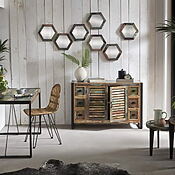


 J-Line "Live" chair in coastal style, rattan + plastic (black/white)
195,00 €
J-Line "Live" chair in coastal style, rattan + plastic (black/white)
195,00 €