Why is “feel-good art” like that of Friedensreich Hundertwasser a perfect everyday therapy ?
For the average Central or Northern European, there are often reasons to cheer themselves up with colorful and somewhat eccentric art. Even in summer, there are so many gloomy days in our latitudes that it's helpful to brighten one's mood with a few artistic touches.
In winter, many people also suffer from "seasonal affective disorder ," also known as SAD in medical terminology. This low mood, caused by a lack of light, is usually only temporary and not a true depressive disorder.
A pick-me-up through the enjoyment of art is certainly not a bad choice. Can art really have a positive effect here? Yes, it definitely can. It is now undisputed that art is capable of positively influencing one's mood.
even used successfully in the treatment of severe depression . Those who are simply suffering from a bad mood can also combat it with simple means. For those experiencing a "normal" mood,non-medicinal remedies are often sufficient. Those suffering from the winter blues very rarely need art therapy .
Nevertheless, he will most likely feel better if he engages more with art (this was already investigated in a 2009 study of 50,000 Norwegians suffering from winter darkness).
Friedensreich Hundertwasser many works that richly offer us this artistic encouragement . Incidentally, he didn't begin under that name, and the evolution of his name tells us a great deal about the artist:
Friedensreich Hundertwasser is not only one of the most important Austrian artists of the 20th century, but also a true visionary in the field of environmentally friendly architecture. With a body of work full of color, organic forms, and a deep connection to nature, he developed a distinctive artistic language that is both fascinating and inspiring.
Friedensreich Hundertwasser was born on December 15, 1928, in Vienna; his baptismal name was Friedrich Stowasser. His father, Ernst Stowasser, had seen little of life beyond a brief stint as a technical official before beginning his military service in the First World War at the age of 20. He ended his service in November 1918 with various decorations, but also weakened by illness.
At the end of the 1920s, in addition to his poor health, he also faced unemployment; even before his father's death in December 1929, Friedrich's mother Elsa bore sole responsibility for the small family.
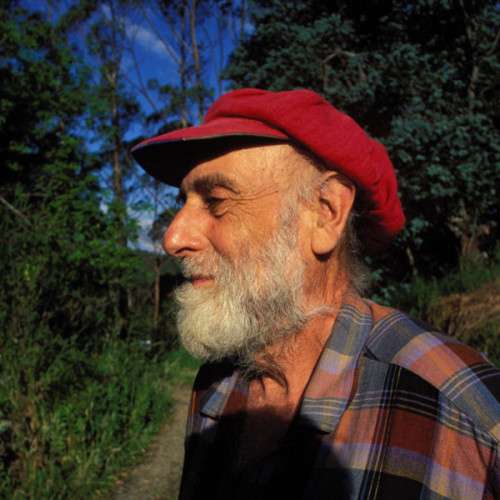
Friedensreich Hundertwasser in New Zealand in 1998 ; by Hannes Grobe, [CC-BY-SA-2.5], via Wikimedia Commons
The single mother fostered the artistic talents of the quiet and sensitive child; Friedrich was enrolled in the Vienna Montessori School in 1936, whose art teachers attested to his "extraordinary sense of form and color" .
But Elsa was Jewish, and she sensed the threat even before the "Anschluss" of Austria. By family decision, Friedrich, who was half-Jewish (his father had been Roman Catholic), was baptized Catholic, transferred to a state school in Vienna where he was less exposed than at the private school, and even joined the Hitler Youth after Austria's annexation in 1938.
When Hundertwasser was later accused of collaborating with the Nazis because of this game of hide-and-seek, he was quite surprised by these accusations. After all, it had enabled him to help his mother and other close relatives escape the terror, while about 80 more distant relatives were deported and killed in 1943.
Friedrich also saved himself in this way during the Nazi era; he probably only remained mentally healthy because his mother kept the fate of his other relatives away from the little boy for as long as possible.
His artistic pursuits also helped him through this terrible time. In 1948, Friedrich passed his Matura (high school leaving exam) at the Horn Gymnasium in Vienna and began his artistic training Vienna Academy of Fine Arts
Fritz Stowasser became the cosmopolitan and successful artist Friedensreich Hundertwasser
Globality cannot only be defined as the often inhumane expansion of international corporations, but can also manifest itself, especially in art, as an artist's genuine interest in the cultures of the world; in this sense, Hundertwasser developed as an artist and global citizen.
While still at the academy, he reaffirmed the beginning of his development as an artist by using the Slavic “Sto” (= hundred) in his name to form his artist name Hundertwasser.
Because he quickly found his studies in Vienna too restrictive, he embarked on his first major journey through Italy in April 1949. There he met other adventurous cosmopolitans, and in 1950 he traveled to Paris with the French painter René Brô, where the friends created two murals that are still preserved today.
He attends his second academy, the “Ecole des Beaux Arts” , and again finds the academic environment unappealing, leaving the Ecole on the first day of classes.
In 1951, he traveled to Morocco and Tunisia, and the pursuit of an academic art education receded further into the background when Hundertwasser was invited to exhibit for the first time Art Club Vienna
After a brief, rather abstract period, he painted his first spiral in 1953, thus initially finding his style. In the same year, he returned to Paris and worked in Brô's studio, but was also able to exhibit for the second time at the Art Club Vienna. Exhibitions in Paris and Milan followed between 1954 and 1956.
In the summer of 1956, Hundertwasser embarked on his first sea voyage as a sailor, from Sweden to England; in 1957 he bought “La Picaudière” , a farm in Normandy, and published the “Grammar of Seeing” .
In 1958 he married Herta Leitner and published his “Mould Manifesto against Rationalism in Architecture” : the first fundamental statement against the restriction of architecture to functionalism and right angles and the first draft of his alternative building philosophy, in which he postulated, in addition to curves, bright colors and ornaments, the ecological integration into nature and a co-creation by the inhabitants.
Hundertwasser House in Vienna; by Webmaster HwH [CC-BY-SA-3.0], via Wikimedia Commons
In 1959, he was honored at the São Paulo Biennial and, together with Ernst Fuchs and Arnulf Rainer, founded the "Pintorarium" as a universal academy for all creative disciplines. By this time, Hundertwasser had achieved such renown that he was appointed lecturer at the Hamburg University of Fine Arts. However, when he, along with Bazon Brock and Herbert Schuldt, painted an "Endless Line" on the walls of a studio, it led to a scandal and the end of Hundertwasser's teaching position.
In 1960, he divorced Herta and exhibited in Paris, where he published the “Nettle Action” about “…how to live independently.” During this time, Hundertwasser also worked for his contracted gallery in Paris and exhibited in Vienna; he had learned Italian, English, and French on his travels, spoke passable Arabic, Czech, Russian, and Japanese, and made frequent use of his miniature paintbox, which he always carried with him.
Hundertwasser now definitively became a global citizen, exhibiting and being honored in Tokyo in 1961, and marrying the Japanese woman Yuko Ikewada in 1962 (divorced in 1966). The name Friedensreich also originates from this period, initially as a Japanese translation of "Friedrich" into "Friede" and "reich" (rich), later adopted into his native language.
This year he also paints on a small island in the south of Venice and has great success with his first retrospective in the Austrian Pavilion at the Venice Biennale; in 1963 he studies Greek classicism on site.
Hundertwasser's work is becoming increasingly sought after: in 1964 he appears for the first time at documenta (III) in Kassel, the Kestner Society in Hanover organizes a major retrospective (which subsequently enjoys success as a traveling exhibition in Amsterdam and Stockholm, Bern, Hagen and Vienna), and publishes the first complete catalogue of his oeuvre. In 1966, "Unhappy Love ," the first documentary film about Hundertwasser by Ferry Radax, is filmed.
Hundertwasser's Forest Spiral in Darmstadt ; by Heidas [CC-BY-SA-3.0], via Wikimedia Commons
In 1967, Hundertwasser set off again, this time to Uganda and Sudan, while the traveling exhibition visited galleries in Berlin, Geneva, London, and Paris. Hundertwasser delivered his first nude speech “for the right to a third skin” in Munich, followed in 1968 by his second nude speech in Vienna and the reading of his architecture boycott manifesto “Away from Loos,” in which he vehemently attacked the Austrian architect Adolf Loos, a legendary pioneer of modern architecture who championed functionalism.
Hundertwasser then prepared the catalogue for a museum exhibition at the University of California and sailed from Sicily to Venice on the wooden ship “San Giuseppe T”.
Until 1972, he converted this ship into his "Regentag" , worked with Peter Schamoni on the film"Hundertwasser's Regentag" , on the graphic portfolio "Regentag" and on other graphic works. During this time, he also lived on the "Regentag".
Friedensreich Regentag Hundertwasser conquers the world with the “Regentag”
During the construction period on and around the ship, Hundertwasser designed a poster for the 1972 Munich Olympic Games , demonstrated on television (“Wish for Something”) for roof afforestation and individual facade design, published a manifesto on window rights and tree obligations, and became the first European painter whose art was transformed into woodcuts by Japanese masters.
But the ship “Regentag” (Rainy Day) is now ready for the great voyage that the artist then embarks upon. One day on the ship, he notices how vibrant the colors are in the rain; the rainy days become his best working days and thus the days on which he is happiest, and “Regentag” is incorporated into his artist name.
In the 1970s, his traveling museum exhibition was shown in Cape Verde, New Zealand and Australia; he planted “tree tenants” through windows at the Triennale di Milano , and exhibited in New York and at the Albertina in Vienna.
With the “Regentag” he sailed to Israel, Tunis, and Cyprus, published the manifesto “Humus Toilette” in Munich, designed a postage stamp for Austria, and initiated a world traveling exhibition that was shown in 27 countries and 43 museums until 1983. A second world traveling exhibition featuring his graphic work was shown in 15 countries (over 80 museums and galleries) until 1992.
The “Regentag” crossed the Atlantic, sailed through the Caribbean to the Pacific, and landed in New Zealand in 1976. In December 1977, Hundertwasser reached Paris and gave a speech before UNESCO; he remained in the Waldviertel region of Austria until the winter of 1978, then continued on to Venice.
There he published his peace manifesto and designed the peace flag for the Middle East , with a blue Star of David and an Islamic green crescent, intended as a symbol of reconciliation between the Jewish and Arab peoples.
From there he travelled to Senegal as a guest of the President, in 1979 to New York, San Francisco and Tahiti and in 1980 to Qatar, Sri Lanka and the Maldives, returning to New Zealand again and again in between.
He designs “coin objects” made of copper, gold, and silver, which are minted at the Austrian Mint and which he describes in 1979 as “something like an entrance fee to paradise.” He begins his illustrated book “Ao Tea Roa” about New Zealand; his early ecological manifesto from 1952, which was directed against “bluff civilization,” is supplemented in 1979 by the manifesto “Shit Culture. The Sacred Shit,” which he reads aloud himself on the shores of Lake Zurich.
Lasting works – A jack-of-all-trades leaves us a more colorful world and the experience of life-affirming art
A few more names have since been added; the artist now calls himself Tausendsassa Friedensreich Regentag Dunkelbunt Hundertwasser. Tausendsassa because he obviously considers himself one, Dunkelbunt because he preferred this “utmost concentration of saturated color”.
His work theory, his personal convictions, and his ideas about architecture are also complete and waiting to be presented to the world.
Hundertwasser House in Vienna
In 1980, Hundertwasser produced his first designs for the Hundertwasser House in Vienna . That same year, Hundertwasser Day was celebrated in Washington, D.C., and the first of a total of 100 trees were planted in Judiciary Square. Hundertwasser gave speeches in the U.S. Senate and other locations in the city, as well as in Berlin, Vienna, and Oslo, addressing ecology, ecological architecture , and opposing nuclear power. In 1981, he traveled to India, Nepal, and New Zealand.
The facade of the Hundertwasser House in Kegelgasse in Vienna's 3rd district, Landstraße. Photo by C. Stadler/Bwag, CC BY-SA 4.0, via Wikimedia Commons
He receives the Grand Austrian State Prize and the Austrian Nature Conservation Prize, gives further speeches against nuclear power and about (false) art as well as lectures on the environment, architecture and art; in 1981 the artist is appointed to the Vienna Academy of Fine Arts, where he is to head the master school for painting.
Many wonderfully colorful architectural designs followed, including the 1982 facade of the Rosenthal factory (Selb), the plans for the conversion of the coal washing plant at the Maximilian colliery in Hamm, and ceramic tongue-shaped tiles for the Rupertinum school in Salzburg (a tongue-shaped tile is a ceramic surface under the windowsill that looks like a large tongue). In 1983, the "architecture doctor," as he now called himself, designed the facade of a silo in the Danube port of Krems with his tongue-shaped tiles.
At the International Garden Exhibition in Munich, a model of a high meadow house was built. He was involved in the construction of the Hundertwasser House in Vienna, which was completed in 1986. In 1987, he redesigned the Palais des Beaux Arts in Brussels for Europalia, and designed the new interior for St. Barbara's Church in Bärnbach, Styria, and the Heddernheim daycare center in Frankfurt. In 1988, he took on the design of the Spittelau district heating plant in Vienna and, alongside his travels, helped build the church in Bärnbach, which was consecrated in September.
TV report: I was there! A visit to the Hundertwasser House
A report by students of the “Neue Schule Magdeburg” – the student group presents the Hundertwasser House in Magdeburg. Produced as part of the project “I was there – TV reports” by the Open Channel Magdeburg under the direction of Stefan Rakebrand.
KUNST HAUS WIEN
In the early 1990s, further architectural realizations followed (Kunst Haus and Agip petrol station in Vienna, rest stop in Bad Fischau, textile factory in Vorarlberg, residential project “In den Wiesen” in Bad Soden, Germany and the Winery Napa Valley in California) and architectural projects (design of the town of Griffen in Carinthia and the thermal village in Blumau, Styria, as well as the courtyard of a residential complex in Plochingen, Germany).
While these projects were gradually realized, Hundertwasser repeatedly traveled to New Zealand and took on further commissions, e.g. the redesign of part of the University Hospital Graz, two fountain projects (in Zwettl and Linz), in 1994 also two architectural projects for the Budapest city fathers and in 1995 the redesign of a grammar school in Wittenberg.
The Kunsthaus Wien, , is a true masterpiece by the artist. The museum displays an extensive collection of his works and offers an insight into his diverse artistic output, ranging from paintings and prints to architectural models.
Kunst Haus Wien. Hundertwasser Museum photograph by Afifa Afrin (August 2021), CC BY-SA 4.0, via Wikimedia Commons
The building's facade is designed in a bold and unconventional style, just like its interior spaces – a true homage to Hundertwasser's love of nature and detail.
Founded in 1991, the KUNST HAUS WIEN museum offers an inspiring art experience. Hundertwasser's vision of an urban oasis has become a reality here. Following the artist's philosophy, an existing building, a disused Thonet furniture factory, was transformed.
Through its commitment to sustainable practices in its exhibitions and operations, the cultural institution received the Austrian Ecolabel in 2018. This makes the KUNST HAUS WIEN the country's first "Green Museum" and continues Hundertwasser's pioneering critical exploration of humanity's role in the natural cycle.
Hundertwasser House in Plochingen ; by Anita Hummel / Carl Williams (contributed by Speagles) [GFDL) or CC-BY-SA-3.0], via Wikimedia Commons
Green Citadel in Magdeburg
In 1997, the architectural projects Wald-Spirale in Darmstadt, Hohe Haine in Dresden, the market hall in Altenrhein, Switzerland and the Mitsui Outlet Park in Osaka, Japan began.
In 1998, Hundertwasser's frieze "Atlantis" was installed in the Lisbon Metro; in 1999, he worked on the "Green Citadel" in Magdeburg, the Ronald McDonald House in Essen, the planning of the Uelzen train station, and helped build the Kawakawa Public Toilet in New Zealand, which he redesigned.
The Green Citadel in Magdeburg opened in 2005 and is one of Hundertwasser's last major projects. It reflects his philosophy of "equal rights for windows ." Every window in the Green Citadel is meant to have the right to its own form and style, giving the building a distinctive and vibrant appearance.
Death and final journey to New Zealand
Hundertwasser was working on architectural projects for Tenerife and Dillingen in the Saarland when he died of heart failure on a ship in the Pacific Ocean on February 19, 2000. He was finally able to travel to New Zealand , where he was buried in his own garden under a tulip tree.
In addition to his architectural work, Hundertwasser continually designed books, stamps, and architectural models , held exhibitions, received awards and honors, and gave speeches and lectures; for example, he is credited with what is believed to be the first manifesto against genetic engineering (1999). Hundertwasser almost designed a Boeing once, but instead of an aircraft, it was intended to be a Danube riverboat, which today, as the Hundertwasser ship MS Vindobona, brings more color to the waterways (the Regentag, like its creator, was permanently moored in the Danube near Tulln in Lower Austria).
Hundertwasser art in our online gallery
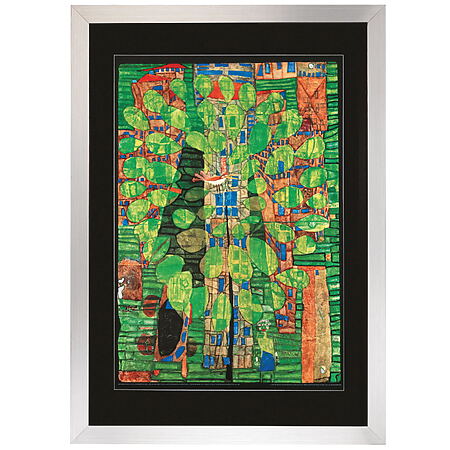
You can also find artworks by Friedensreich Hundertwasser for sale in our online gallery. Among them is his famous work “The Great Way” as a high-quality reproduction. Here is a selection:
Our literature recommendations for the architecture doctorate:
Hundertwasser – For the Future
Hundertwasser championed a paradigm shift in ecology and sustainable building practices early in his life, and articulated his views forcefully. This is demonstrated in the book "Hundertwasser for the Future," published by Hatje Cantz. It compiles quotations from 50 years of Hundertwasser's speeches, writings, manifestos, letters, and public actions, interspersed with vibrant photographs of his architectural works and paintings.
Hundertwasser Architecture: For building that is in harmony with nature and people
“A house must be a living, organic unit that evolves and constantly changes,” was one of Friedensreich Hundertwasser’s aims for a more nature- and people-friendly architecture. His success justifies his vision: forested roofs, organic forms, colorful facades, uneven floors, irregularly placed windows, gilded onion domes – Hundertwasser’s architecture is unmistakable.
Publisher: Taschen Verlag (March 21, 2018)
Language: German
Hardcover: 320 pages
ISBN-10: 3822885940
ISBN-13: 978-3822885949
Friedensreich Hundertwasser 1928–2000
This unlimited standard edition consists of the first volume of TASCHEN's Limited Edition Friedensreich Hundertwasser 1928–2000 and offers a comprehensive account of Hundertwasser's work, personality and life with extensive texts by Hundertwasser's long-time friend Wieland Schmied.
Publisher: TASCHEN (August 5, 2014)
Language: German
Hardcover: 400 pages
ISBN-10: 9783836551274
ISBN-13: 978-3836551274
Hundertwasser: Complete Graphic Work 1951-1976 – The Graphic Works 1951-1976
A new edition of the complete exhibition catalog on Hundertwasser's graphic works. An international bestseller, it's back in bookstores.
Hundertwasser, Catalogue Raisonné: English Edition
This comprehensive catalogue raisonné is not a posthumous tribute, but a living legacy. Volume I contains a text by Wieland Schmied, the renowned art historian and long-time personal friend of Hundertwasser, featuring selected paintings, architectural works, projects, and manifestos.
Volume II comprises his entire painted oeuvre, adhering to his precise numbering system. This catalogue contains everything the Austrian artist ever created, from postage stamps and license plates to architecture and applied fine art. This is a testament to his work, just as he would have wanted it.
Since the artist himself completed the detailed concept, design and text of the book before his death, this book now speaks for him and breathes life into his work.
Limited edition for collectors: Only 10,000 copies worldwide.
Further information and online resources about the artist:
If you would like to learn more about this fascinating artistic mind, we recommend the following online sources for further research and reading:
Hundertwasser – Official Websites: The official website of the non-profit Hundertwasser Foundation about Friedensreich Hundertwasser, hundertwasser.com and hundertwasser.de . Besides general information about his biography, work, and exhibitions, the Hundertwasser manifestos and texts are particularly worth reading.
Hundertwasser Village – The Village at the Hundertwasser House was built both inside and out according to the concept and ideas of the artist Friedensreich Hundertwasser.
Kunsthaus Wien . Museum Hundertwasser – The Kunsthaus Wien offers a unique cross-section of the artist's creative work and is located just a 5-minute walk from Haus und Village in Vienna.
Friedensreich Hundertwasser on artnet – The go-to resource for art dealers and collectors. The largest collection of works for sale in the German-speaking world. Comprehensive information on the artist's biography, exhibitions, news, and events.
Owner and Managing Director of Kunstplaza . Publicist, editor, and passionate blogger in the fields of art, design, and creativity since 2011. Graduated with a degree in web design from university (2008). Further developed creative techniques through courses in freehand drawing, expressive painting, and theatre/acting. Profound knowledge of the art market gained through years of journalistic research and numerous collaborations with key players and institutions in the arts and culture sector.
We use technologies such as cookies to store and/or access device information. We do this to improve your browsing experience and to display (non-)personalized advertising. If you consent to these technologies, we can process data such as browsing behavior or unique IDs on this website. Refusal or withdrawal of consent may adversely affect certain features and functions.
Functional
Always Active
Technical storage or access is strictly necessary for the legitimate purpose of enabling the use of a specific service expressly requested by the subscriber or user, or for the sole purpose of carrying out the transmission of a message over an electronic communications network.
Preferences
The technical storage or access is necessary for the legitimate purpose of storing preferences that were not requested by the subscriber or user.
statistics
Technical storage or access that is solely for statistical purposes.Technical storage or access that is used solely for anonymous statistical purposes. Without a subpoena, the voluntary consent of your internet service provider, or additional recording by third parties, the information stored or retrieved for this purpose cannot generally be used to identify you.
marketing
Technical storage or access is required to create user profiles, to send advertising, or to track the user on one or more websites for similar marketing purposes.





 3D metal decoration "Bottles and Glasses", black frame
121,95 €
3D metal decoration "Bottles and Glasses", black frame
121,95 €


