"School in Corona mode – impressions and experiences of students"
“I’m making slow progress with the tasks, it’s really stressing me out,” Tyler writes. Alya is very afraid “that my aunt, who has cancer, will get the coronavirus and die.”
And Lisa becomes poetic: "School in times of Corona is like a slaughterhouse, only dreams are slaughtered instead of animals."
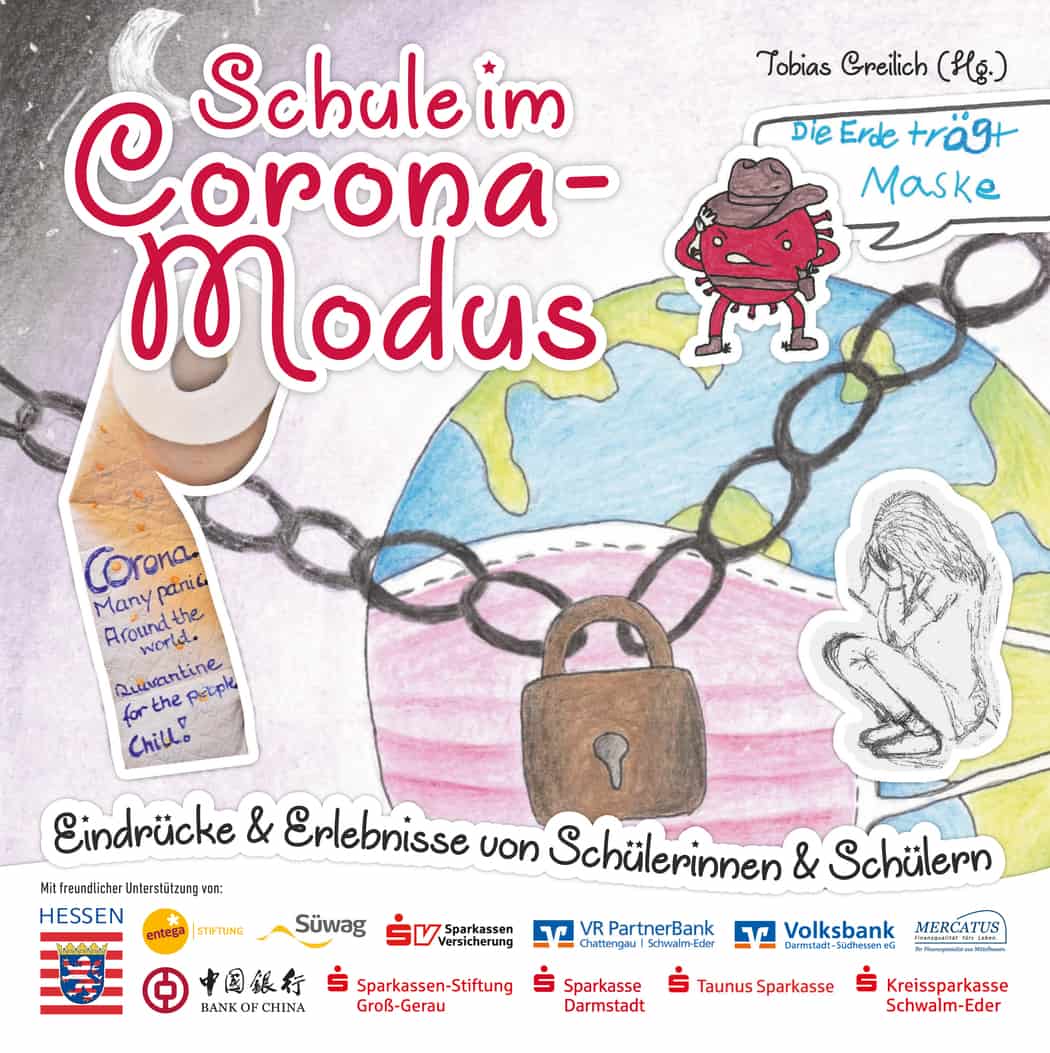
Concern for oneself, concern for others: The book "School in Corona Mode" brings together more than 400 texts and pictures from 44 Hessian schools, in which boys and girls have put their impressions and experiences in the Corona pandemic on paper.
Book cover “School in Corona mode”
The joy over extra days off school during lockdown was short-lived. The humor with which students commented on the panic buying of pasta and toilet paper quickly faded. With each passing day of this exceptional situation, they miss the structure that school and lessons provide in their lives more and more.
Above all, they miss the personal interaction with their classmates in person. They are painfully experiencing that online communication cannot replace this. Boredom sets in, then insecurity, fears of being alone, of loneliness, of an uncertain future. And anger: anger at the coronavirus, this invisible enemy.
In their diversity – the contributions come from all age groups and school types – the works represent a broad cross-section of the Hessian school landscape. To convey an "unvarnished picture of the general mood," the publisher , "Aktion Hessen hilft," refrained from editorial revision.
"School in Corona Mode" thus offers an authentic glimpse into the emotional world of young people in an extreme situation that has now lasted for more than a year. It is also a documentation of the creativity that children and teenagers develop to express their worries and needs: be it through a comic, a diary, a film script, a poem, or a prayer.
“School in Corona mode – Impressions and experiences of students”, published by Aktion Hessen hilft eV/Tobias Greilich, 464 pages.
The book, which includes a foreword by the Hessian Minister of Culture, Professor Dr. R. Alexander Lorz, is available in bookstores for €14.80.
ISBN: 978-3-942347-34-1. The non-profit organization requests donations to account DE81 5185 0079 0121 0076 65 to print another book. The organization can be contacted at contact@ahh-mail.de.
Deep insights into the concerns of students during the pandemic
Editor Tobias Greilich on the publication “School in Corona Mode” by the “Aktion Hessen hilft”
Editor Tobias Greilich with his new book “School in Corona Mode”
Since 1995, the "Aktion Hessen hilft" (Hesse Helps Action) has been providing humanitarian aid to people in need worldwide. Now it is publishing the book "School in Corona Mode – Impressions and Experiences of Students." Mr. Greilich, you have been chairman of the association since its founding. How did the idea for the book come about? How does it fit into the association's mission?
The "Hessen hilft" (Hesse Helps) campaign originated during my own school days as an initiative of students and young people because we were shaken by the suffering caused by the war in the former Yugoslavia and wanted to try to help. To this day, several hundred Hessian schools support the "Hessian School Campaign for People in Need".
Since having my own children, it has become increasingly important to me, as they have grown older, to broaden the social horizons of participating students through joint projects with schools and to help them understand the world a little better. During the pandemic, students themselves are "people in need"—this gave rise to the idea of putting them and their worries and needs at the center of attention.
The volume brings together contributions from boys and girls of all ages, from elementary school to high school graduation, from more than 40 schools. How did this wide range come about?
In fact, students of all ages and school types from all parts of Hesse contributed. We have been working with some of these schools for many years, while others were new partners who were drawn to the book idea and encouraged their students to participate.
What's special is that contributions from primary school students appear alongside those from vocational school students, from grammar school students alongside those from special needs students. Everyone expresses themselves in a different way, but together they provide a direct snapshot of the mood of the Hessian student body.
They deliberately chose not to evaluate or classify the contributions and also did not undertake any editorial revision. Why?
We are aware that the submissions vary in quality, but our aim was not an artistic or literary competition. Rather, we wanted to give children and young people a voice – sharing their impressions and experiences honestly and without embellishment, in self-chosen artistic forms, without restrictive formatting. We see this very diversity as an expression of authenticity – and this is reflected in the results.
What feelings did you personally experience while working on the book?
I was affected in many ways. Through my own children, their circles of friends, and the two schools where I chair the parent council, I was already close to the situation. But I hadn't expected to see and read in such a concentrated way how much the Corona crisis was weighing on the students.
This turned what started as a mere idea into a passion project for me; the students' contributions are very personal and moving, and I think they are absolutely worth publishing and preserving.
Besides two grown daughters, you have a nine-year-old son. Have you spoken to him about the book?
Naturally, the book was a frequent topic of conversation at our house. Our son is experiencing the "corona mode" from the perspective of a primary school student, and our middle daughter is taking her A-levels under these conditions. Even for our eldest daughter, a university student, nothing is the same as it was at the start of her studies, and we parents are also part of "school in corona mode.".
My wife and children accompanied and supported the book project, contributing ideas, and our son even designed several sections. It was also good for him to be able to express his feelings in this way.
And where would you like to see discussions about "school in Corona mode"?
Everyone at the schools is aware of the effects of the pandemic and its restrictions. However, I wish that politicians were more aware of the consequences of their decisions.
Those who started primary school this year have essentially never known a school without masks, without playing in the schoolyard, without a comforting hug from a teacher, or even without daily lessons at school. The medium- and long-term effects of this on our children are still completely unknown. Anyone who wants to understand this will gain profound insights from the students' contributions.
Photos by editor Tobias Greilich with participating students from the Maria-Sibylla-Merian-School Ortenberg and class teacher Tobias Hölzinger
About “Action Hesse Helps”
Founded in 1995, "Aktion Hessen hilft" e.V. originated as an initiative of schoolchildren and young people to help the victims of the civil war in Yugoslavia . Since then, the organization has provided humanitarian aid in crisis, disaster, and war zones in approximately 30 countries worldwide: for example, after the earthquake in Nepal (2015), the typhoon in the Philippines (2013), the tsunami in Sri Lanka and Indonesia (2004), the earthquake in Haiti (2010), the floods in Serbia and Bosnia-Herzegovina (2014), and the earthquake in Croatia (2020), but also within Hesse during the Elbe River floods (2002 and 2013).
The association cooperates with, among others, the United Nations Refugee Agency, non-governmental organizations, consulates general, and church congregations. Since 2013, Hesse's former Minister of Education, Dorothea Henzler, has been the patron of the "Hessian School Campaign for People in Need," initiated by "Aktion Hessen hilft" (Action Hesse Helps).
Since then, several hundred Hessian schools with well over 100,000 students have participated. The association is based in Ortenberg. Founding member Tobias Greilich is the chairman. The sales and marketing manager has himself traveled to crisis zones more than one hundred times.
He describes his experiences as a humanitarian aid worker in the former Yugoslavia in the book "The Night the Future Burned" (2016).
Owner and Managing Director of Kunstplaza . Publicist, editor, and passionate blogger in the fields of art, design, and creativity since 2011. Graduated with a degree in web design from university (2008). Further developed creative techniques through courses in freehand drawing, expressive painting, and theatre/acting. Profound knowledge of the art market gained through years of journalistic research and numerous collaborations with key players and institutions in the arts and culture sector.
We use technologies such as cookies to store and/or access device information. We do this to improve your browsing experience and to display (non-)personalized advertising. If you consent to these technologies, we can process data such as browsing behavior or unique IDs on this website. Refusal or withdrawal of consent may adversely affect certain features and functions.
Functional
Always Active
Technical storage or access is strictly necessary for the legitimate purpose of enabling the use of a specific service expressly requested by the subscriber or user, or for the sole purpose of carrying out the transmission of a message over an electronic communications network.
Preferences
The technical storage or access is necessary for the legitimate purpose of storing preferences that were not requested by the subscriber or user.
statistics
Technical storage or access that is solely for statistical purposes.Technical storage or access that is used solely for anonymous statistical purposes. Without a subpoena, the voluntary consent of your internet service provider, or additional recording by third parties, the information stored or retrieved for this purpose cannot generally be used to identify you.
marketing
Technical storage or access is required to create user profiles, to send advertising, or to track the user on one or more websites for similar marketing purposes.



 J-Line decorative cushion "Christmas tree" with fringes and pom-poms, cotton (white/gold)
42,90 €
J-Line decorative cushion "Christmas tree" with fringes and pom-poms, cotton (white/gold)
42,90 €


