I have read the books, turning their pages in quiet hours by lamplight, absorbing the theories that have long shaped academic discourse. Some of these theories, I confess, contain truth—like faint starlight reaching us from a distant past.
But year after year, I have also sat before the spontaneous and unadulterated theater of children creating art. I have watched their hands—at first tentative, then bold, irresistible—as they glided across paper, canvas, and walls. I have listened to their little voices as they invented, protested, and explained. And I have come to an understanding that only decades of profound experience can teach: not only how children learn to make art, but even more painfully, how they fail at it.
This failure, I have come to realize, does not stem from the child, but from the adult world: its blindness, its stale myths, its convenient refusal to see. Adults, with their ingrained prejudices and memories of their own artistic defeats, carry into the world a conception of art so impoverished that it shapes—even sabotages—the art education of the next generation. And most devastating of all is the conviction that art cannot truly be taught, that one must either be born with a flame already kindled or grope in the dark forever.
Like any other discipline, art also possesses a pedagogy. There is structure, logic, development—and there is wonder, but a wonder that grows with nourishment. I have seen the results in the work of children and young people. And I have seen just as often the opposite—those who wandered alone, repeating the same stylized images over and over again, until their hands grew weary, their eyes grew dim, and they finally believed the lie that they lacked talent.
Yes, most children can make marks on paper, create shapes that resemble faces, houses, or suns. But these are byproducts of perception and movement, of motor skills and imitation. Without guidance, without insight into seeing—into true seeing—the child isn't drawing the world, but rather a shorthand version of it. A sun in the corner. A triangle for a roof. A line with a circle on it. Symbols of a world they haven't yet learned to observe.
If a child doesn't learn through meaningful instruction and the careful development of their abilities, they stagnate. They remain stuck. They repeat the same visual formulas like a child who never learns new words. And the tragedy lies not only in this repetition, but also in the adult who praises it as "creative." For the adult, too, was once left behind and recognizes in the child's developmental stagnation a reflection of themselves.
I taught these children. I witnessed their transformation. Not because they were "gifted," but because they were taught. The so-called "gifted" child is not one born with a divine spark, but one who has learned—consciously or accidentally. And learning, in the truest sense, is never magic
"I taught these children. I witnessed their transformation."
A child crouches on the floor, surrounded by the sacred stillness of the morning light, a crayon in hand. Before him, a large sheet of paper—larger, it seems, than his own body. And on it, a first stroke: trembling, uncertain, yet filled with a secret life force. Then another stroke, and another—curves and loops, explosions of color like tiny fireworks of the hand.
The adult, moved by affection or curiosity, might pick up a pen and draw a line or two next to it, a barely perceptible impulse. The child responds—not merely through imitation, but by entering into the mysterious joy of creating form from nothing. The page becomes a field of possibilities. And in that moment, something begins.
From kinesthetic daydreams to the repetition of forms
In *Artful Scribbles* , Howard Gardner reminds us that the earliest gestures are not representations but rhythms—kinesthetic daydreams, physical acts. The child is not trying to depict the world; it inhabits it through movement. Pressure, speed, direction: these are the unconscious physical laws of its young imagination. Scribbles become spirals, spirals become circles, and the child—eager to repeat the magic—begins to recognize a connection between its inner energy and the trace it leaves behind.
These are not drawings of the world, but drawings into the world.
Then a transformation occurs: The child recognizes patterns. It begins to repeat shapes. It assigns meaning to them. A circle becomes a face, two lines a house, a jagged edge a mountain. And so arises what Gardner calls the "symbolic stage." Between the ages of four and seven, the child acquires a vocabulary—not of words, but of images. Its creations become evocations of meaning: This is Mommy, this is the sun, this is me.
But these are not portraits; they are emblems, heraldic symbols of identity and history.
A child does not draw to copy what is visible, but to express what it feels, remembers, and knows deep within its pre-verbal self.
And how rich these images are! They speak with the openness of dreams. A girl with shoes that float above the ground. A tree with hearts instead of leaves. A family without mouths, but with enormous eyes. Often the drawing is accompanied by a narrative—a story full of breathless joy or quiet perseverance—and the picture becomes a kind of theater, a stage for memory and invention.
But—and here lies the sadness—I have seen all too often how this symbolic richness disintegrates through repetition. A rainbow for the fifty-seventh time. A sun in the top corner of every page. A house with three square windows and no interior. These are not the products of creative freedom, but of its exhaustion. The child draws this way because no one has shown them anything else. They are stuck in a visual echo chamber, repeating a vocabulary that no longer expands.
And the adult sees this, smiles and says: "How creative!"
Beyond Gardner: Art should truly be taught
Here I diverge from Gardner. He is right when he describes the stages of development; they are real enough. But he never dares to fully express what I must say: that art can be taught. Not imposed, not drilled into lifelessness—but revealed, like a language that everyone can learn. Like reading, like music, like geometry. The child need not remain trapped in symbols. It can be gently and imaginatively guided into the world of observation.
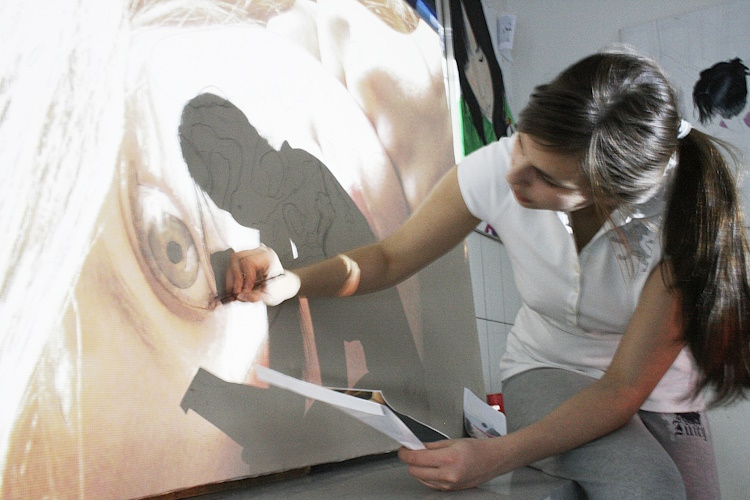
I taught children as young as seven to see—not just to look, but to truly see. To draw what was in front of them. To recognize that the beach isn't yellow, the tree isn't simply green. That a ball isn't a circle, but a sphere, with shadows and highlights. That light has texture. That space has depth. I placed a cardboard frame in front of the window and said, "Now look." And when they did—really did—the world changed.
The moment a child no longer perceives the world as a symbol, but as the present – as form, as light, as surface and shape – is like a second birth. And it is not a miracle. It is pedagogy.
From the beginning of order, through visual codes and rules of representation
Around the age of seven, something else creeps in—not with malice, not with noise, but with a quiet, mechanical persistence: order. The child begins to construct images the way language constructs sentences. A sun is always in the upper right corner, obedient like the punctuation mark at the end of a line. Trees grow symmetrically on either side of a house, which resembles an emblem more than an actual place. A blue stripe at the top of the page is the sky; a green stripe at the bottom is the grass; and in between, the world shrinks to a corridor of repetition.
This is what theorists rightly call the schematic stage. The child develops systems—visual codes, rules of representation. There is something endearing, even ingenious, in their consistency. They try to order the visual chaos of the world through symbols that are manageable. But mastery without guidance becomes imitation. And imitation, over time, becomes a form of boredom.
I saw it in my classroom: a weariness of inventiveness. A girl, bored with rainbows, draws them again nonetheless. A boy, weary of football players in profile, draws the same one over and over. The line becomes brittle; the page empties its mind. These children haven't lost their "creativity" —they've been abandoned by their education. No one has opened the door for them to pass through. The house of childhood has shrunk, and they have outgrown it. But no one has given them the key to the next house.
Here, the myth of innate talent returns like a plague. "He's gifted," someone says. "She's just got it." But what does that mean? Nothing more than this: that some children discover, by chance or instinct, what everyone should have been taught. A gifted child is a learned child. Learned through books, through parents, through sheer perseverance, or through chance. They have learned what others could have learned as well.
The failures of adults
And yet, the adult world clings to the romantic myth of the "natural." And in doing so, it excuses its own shortcomings. If art cannot be taught, why fund it? Why train teachers? Why design proper curricula? Any stick figure will do. Any untrained "creative" will suffice. And so schools appoint the unqualified, the indifferent, the unprepared—and then wonder why the subject fails to flourish.
I've seen it – year after year. The administrators who reduce art to glue sticks and glitter, who believe a child painting on the back of a canvas is innovation. The principals who ask, "Why not use the other side?", don't grasp the sanctity of surface and intention. These are people who themselves have never progressed beyond the schematic stage. Their eyes have never learned to see. Their minds have never learned to draw.
And when they encounter a true artist-teacher, they often don't recognize what they're dealing with. Or worse: they do recognize it. And they fear it. Because the presence of genuine knowledge casts a long shadow over their ignorance. And their response is almost always bureaucratic violence: exclusion, suppression, ridicule, removal. I have seen this. I have experienced it.
And the children pay the price.
The tragedy isn't that children can't draw well. The tragedy is that they aren't shown how. That their curiosity is mistaken for talent, and their weariness for a lack of it. That their rainbow drawings are still called "creative" long after they've grown tired of them. That no one says, "Come, look at the world. This is how you see it. This is how you start anew."
Youth as a land of doubt
With adolescence, the child – provided it still draws – enters a new land. It is the land of doubt
Here the lines are sharper, the eye more critical, and the mind less certain of itself. The adolescent no longer draws to tell a story, but to measure, to test the accuracy of what he sees against the persistent weight of what he wants to express. In earlier years, a figure could float joyfully without gravity; now there is a desire to anchor it in space and depict it realistically. The sky, once a blue strip, is now to gain depth; the tree, formerly a green lollipop, is now to possess branches, textures, and shadows.
But nobody showed them how.
So they give up. Or they apologize for their attempts even before the pencil touches the paper. "I can't draw," they say, looking away, as if confessing a fundamental flaw. What they really mean is: "I was never taught how to see." And so their untrained perception fades into silence.
What we call "realism" at this stage is often not a goal, but a battlefield. It's the place where the intuitive symbols of childhood collide with the perceived world—and lose. The drawing doesn't fail because the child lacks imagination, but because the hand hasn't learned to serve the eye. And so they give up. Or worse: they continue to draw what they drew at nine years old because they've never learned any other way.
But it's not too late.
It's never too late to develop your own artistic language
It's never too late to develop your own artistic voice.
With proper instruction—structured, conscious, and with an open heart—this moment can become transformative. I've witnessed it in my teaching: the wonder on a sixteen-year-old's face when they first see how a shadow falls around a form and understand how to trace it. The moment a student realizes that a face is not a symbol, but a field of light, tone, and texture. This revelation is not merely technical. It is emotional. It is the beginning of an expression with substance.
And when this happens, when the young artist begins to combine perception with skill, something remarkable occurs. He encounters the vision of his childhood again—not as a memory, but as raw material. The symbolic richness, the narratives, the visual poetry—all of this returns, now filtered through an awakened eye and a disciplined hand. This is the maturity of artistic language: not the abandonment of childhood, but its translation.
Gardner, for all his brilliance, falters at this point. He claims that the most gifted artists are those who preserve the child's vision, and he is right about that. But he fails to recognize that this preservation is not mystical—it is pedagogical. It is a process of learning.
The return to poetic vision is not a regression, but an ascent: the symbols of childhood, made visible again through skill. The dream, remembered and articulated
But without education there is no advancement. Only repetition. Only the desert of an undeveloped style, where talent is mistaken for fate and failure for truth.
I'll say it again: Art can be taught. Art must be taught.
Art can be taught. Art must be taught.
For it is not only the hand that learns, but also the mind, the eye, and the self. Art education is education in seeing —not just the surface of things, but their structure, their relationships, their essence. And from this arises not only the ability to create art, but also the ability to view the world with a more generous soul.
And what about the adult who never experienced this? He carries this silence within him. He looks at his children's drawings with pride, certainly, but also with a quiet panic. He doesn't know what to do with them. He encourages, he praises, but he doesn't guide. Because he, too, was never guided. He doesn't know that art doesn't begin with inspiration, but with attention—and that attention is something that is taught, cultivated, and refined.
And so the cycle continues. The adult who cannot draw becomes the administrator who cannot appreciate drawing. The teacher who was never taught becomes the one who teaches nothing. And when someone appears who can teach, who truly knows, the system recoils. It is easier to maintain the myth of the "gifted" than to acknowledge the extent of institutional failure.
And so it remains the prerogative of a select few—those who persist, those who believe, those who have seen with their own eyes what happens when a child is taught to see. We are often dismissed as idealists. But we are not. We are realists in the truest sense. We have experienced the reality of transformation.
Closing meditation: An explanation of commitment, criticism, and hope
Let's leave the metaphors aside for now.
Let us emerge from the dream of colored chalk dust and say clearly and unequivocally what needs to be said: The failure of art education is not a minor oversight—it is a catastrophe of the mind. And it is a silent catastrophe, the kind that doesn't happen in a single moment, but over decades. It happens when we allow a generation to grow up believing that seeing is not a skill, drawing is not a language, and art is the domain of a select minority. It happens in every classroom where no one teaches the child to observe, to create, to understand the visual world.
It happens when we call this neglect "freedom." It happens when we mistake neglect for respect.
In mathematics, we don't do this. We don't randomly hand a child a calculator and say, "Express your numerical self." We don't tell a child to discover grammar through inspiration alone. We teach. We guide. We give them the tools of the culture in which they live. So why do we abandon them, especially in art?
Because we ourselves were abandoned.
And herein lies the tragedy, repeated like a damaged loop in the filmstrip of public education. The administrators, the education policymakers, the school principals—they too were once children, with drawings that were never nurtured, with hands that reached for paint and were left to fail. They carry this shame silently within them. They consider it natural. They believe the lie that they have “no talent.” And so they create systems that reflect this inner silence.
Art becomes a decorative pursuit. A trivial matter. A decorative piece. A mere afterthought.
And yet – I've seen the opposite. I've witnessed what happens when children are taught to see, to draw, to develop a visual language. I've watched transformation unfold in real time: the slumped body straightens as self-confidence returns; the dull eyes awaken as the world regains its structure. Not all of them become artists. That's not the point. But they all become witnesses – to their own perception, their own stories, their own worth.
Because art is not a luxury. It is a human heritage.
Art is not a luxury. It is a human heritage.
And we, who teach them, bear an enormous responsibility. Not merely to hand out brushes, but to guide children toward a way of being in the world that is more perceptive, articulate, and empathetic. We don't just teach drawing—we teach seeing. We don't just teach color—we teach nuance. We teach presence. We teach reflection. We teach caring.
Therefore, I am now saying this as clearly as I possibly can:
Art must be taught.
Art can be taught.
And those who claim otherwise do not understand what teaching means.
To those who hold the keys to the curricula, to those who appoint and dismiss, to those who ridicule what they do not understand—to you I say: Your ignorance is not harmless. You destroy what you do not recognize. You raise generations of children to be silent.
And to those who have been silenced—students, teachers, parents—I say: Speak up.
Speak through the pencil, the brush, the line, the clay. Speak through your children's drawings. Speak against the systems that have degraded this deeply human birthright to a mere leftover item in the curriculum. Speak through your practice. Speak through your resistance. Speak through your art.
Because it's not too late.
It's never too late to learn to see.
And never too late to teach others to see.
And once we see the world clearly—its light, its complexity, its shadowy corners—we cannot help but reshape it with greater care.
That is what art teaches. And that is why we must teach art.
Consultation: Gardner, Howard – Artful Scribbles: The Significance of Children's Drawings. New York: Basic Books, 1980. English.
A fundamental text that examines the psychological and developmental dimensions of children's early drawings and the emergence of symbolic thinking in visual expression.
Brian Hawkeswood holds a Bachelor of Fine Arts degree and a teaching qualification, both from Sydney University, Australia. His journey as an artist and educator is a testament to art's enduring power to evolve while honoring its rich heritage.
Brian Hawkeswood holds a Bachelor's degree in Fine Art and a teaching qualification, both from Sydney University, Australia. His journey as an artist and educator is a testament to the enduring power of art to evolve while honoring its rich heritage.
We use technologies such as cookies to store and/or access device information. We do this to improve your browsing experience and to display (non-)personalized advertising. If you consent to these technologies, we can process data such as browsing behavior or unique IDs on this website. Refusal or withdrawal of consent may adversely affect certain features and functions.
Functional
Always Active
Technical storage or access is strictly necessary for the legitimate purpose of enabling the use of a specific service expressly requested by the subscriber or user, or for the sole purpose of carrying out the transmission of a message over an electronic communications network.
Preferences
The technical storage or access is necessary for the legitimate purpose of storing preferences that were not requested by the subscriber or user.
statistics
Technical storage or access that is solely for statistical purposes.Technical storage or access that is used solely for anonymous statistical purposes. Without a subpoena, the voluntary consent of your internet service provider, or additional recording by third parties, the information stored or retrieved for this purpose cannot generally be used to identify you.
marketing
Technical storage or access is required to create user profiles, to send advertising, or to track the user on one or more websites for similar marketing purposes.




 J-Line LED table lamp “Lustre II”, gold base, transparent glass lampshade
289,00 €
J-Line LED table lamp “Lustre II”, gold base, transparent glass lampshade
289,00 €


