In contemporary art, few artists have a visual signature as instantly recognizable as Romero Britto . He is more than a painter or sculptor; he is at the heart of a global aesthetic phenomenon that brilliantly blurs the lines between high culture, popular design, and commercial brilliance.
As the “King of Pop Art” of our time, Britto has built a huge empire, which is based on the core values of optimism, love and an almost childlike lightheartedness.
This detailed study examines the life, work, and extraordinary market success of a man who dedicated his life to changing the world with color
The beginnings of a global star: A rise story in biographical form
Romero Britto's life story embodies the archetypal rags-to- riches tale, only in the realm of visual arts. Born on October 6, 1963, in Recife, a vibrant but socially unequal city in northeastern Brazil, Britto experienced a childhood rich in culture despite material poverty. As one of nine children of a single mother, he realized early on that creativity was the most effective tool for escaping the limitations of poverty.
Romero Britto (2013) Image source: Dirk Vorderstraße, CC BY 2.0, via Wikimedia Commons
Formative years in Brazil
Without access to traditional painting materials, the young Romero used everything he could find as a canvas: newspaper margins, discarded cardboard boxes, and scraps of fabric became the supports for his first artistic attempts. This early phase of improvisation decisively shaped his later style. Painting on newspaper, a necessity in his childhood, later became a conscious aesthetic element in his professional work, revealing the dialogue between art and everyday life.
His exceptional talent was already evident at the age of eight. A pivotal moment came when his older brother brought home art books showcasing the works of masters such as Henri de Toulouse-Lautrec . By obsessively imitating these works, Britto developed an intuitive understanding of composition and line long before receiving any formal training. Despite his obvious gift, he initially pursued a career in law.
However, the call of art was stronger; after only one year, he ended his studies to follow his creative urge.
The European Enlightenment and the Leap to Miami
Britto traveled to Paris in 1983, which fundamentally broadened his artistic horizons. There, he encountered the works of Henri Matisse and Pablo Picasso . The discovery of Cubism and Fauvism in the Parisian museums acted as a catalyst. His understanding was that one must not depict reality, but rather recreate it. In his mind, Picasso's fragmented forms and Matisse's bold use of color merged with the vibrant colors of his Brazilian homeland.
After returning to Brazil, he quickly realized he needed a bigger stage. In 1988, he moved to Miami, Florida – a choice that changed not only his life but also the modern pop art scene. At that time, Miami was a city on the rise, a cultural melting pot that embraced the bold and dynamic.
In Coconut Grove, Britto began exhibiting his artwork. Fittingly, his first real studio was a former beauty salon in the Mayfair Shops. He displayed his vibrant canvases among hair dryers and barber chairs. This was an early indication of his desire to bring art to where people live and work, rather than isolating it in sterile galleries.
The decisive breakthrough: Absolut Britto
1989 was probably the most decisive turning point in Britto's career. He was chosen to work on Absolut Vodka's "Absolut Art"campaignAndy Warhol and Keith Haring. The campaign made him an overnight star of the international art scene. His iconic interpretation of the vodka bottle was reprinted in more than 60 prestigious magazines worldwide, bringing his name and style to international attention.
milestone
Year
Location
Meaning
birth
1963
Recife, Brazil
Cultural influences and early improvisation
First exhibition
1977
Brasilia
Early recognition of talent
Paris trip
1983
Paris, France
Encounter with Cubism (Picasso/Matisse)
Moving to the USA
1988
Miami, Florida
Establishment in the international art metropolis
Absolute Art Deal
1989
New York / Miami
Global breakthrough and brand building
Britto Foundation
2007
Miami, Florida
Institutionalization of philanthropic work
Soumaya Museum
2013
Mexico City
First living artist with a solo exhibition there
Britto Palace
2020
Miami, Florida
Opening of the world's largest art studio
The unmistakable style: An analysis of Neo-Pop Cubism
In unmistakable Romero Britto style: Brazilian President Dilma Rousseff receives a painting (Presidenta Dilma) by Romero Britto (2011) at the Palácio do Planalto. Photo: Roberto Stuckert Filho/PR. Image source: Dilma Rousseff, CC BY-SA 2.0, via Wikimedia Commons
Romero Britto's style is a visual language that needs no translation. He and experts often refer to his work as "Neo-Pop Cubism ." This term hits the nail on the head, as it encapsulates the three key currents that shape his influence: the mass appeal of Pop Art, the structural deconstruction of Cubism, and the direct, often raw energy of Street Art .
The anatomy of shape and color
A “true Britto” stands out through a number of codified characteristics that distinguish him from other contemporary artists. The main focus is on extremely saturated colors, often mixed directly from the tube or in radiant primary and secondary tones.
These colors are not merely decorative; they send emotional signals. Yellow symbolizes the sun and joie de vivre, red stands for love, while blue embodies the infinity of the sky and the sea
Thick, black contour lines separate these areas of color. The lines serve two functions: On the one hand, they create a graphic clarity for the works, reminiscent of comics or stained glass. On the other hand, they act as a structuring element, breaking the motifs down into segments—a legacy of Cubism. Unlike the analytical Cubists, who often deconstructed form beyond recognition, Britto uses segmentation to fill the motif with patterns.
The optimism patchwork
In Britto's universe, no surface is simply flat. He uses a repertoire of patterns to fill the spaces created by the black lines:
Polka dots : A wonderful classic pop art element that creates movement and playfulness.
Hatching and zigzag lines : They create a tactile texture and a visual vibration on the artworks.
Hearts and stars : These universal symbols immediately determine the emotional character of the image.
Often, the subjects are everyday motifs, but in an idealized version: children laughing, dogs playing, brightly colored fish swimming, couples dancing, or landscapes depicted in a stylized manner. At first glance, these motifs appear simple, but experts and close observers of his creative power emphasize that Britto captures the essence of a feeling with enormous precision in just a few lines. His works have been aptly described by the "New York Times" as art that "spreads warmth, optimism, and love .
Orange – Big Apple by Romero Britto Image source: Maria Eklind, CC BY-SA 2.0, via Wikimedia Commons
Materiality and Technology
Britto goes beyond the canvas. He uses a variety of media in his work:
Painting : Acrylic on canvas, often combined with glitter or diamond dust to create additional light effects.
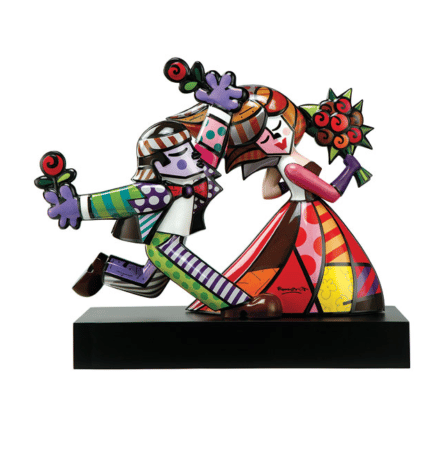
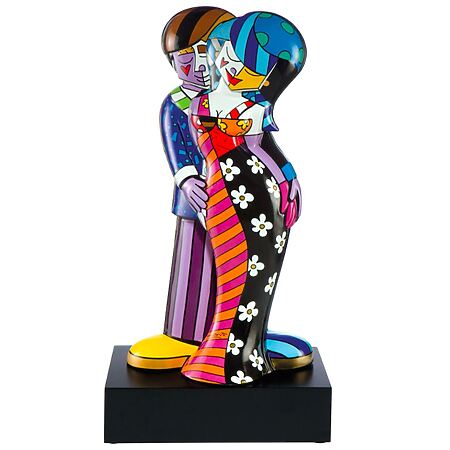
Sculpture : Masterpieces made of bronze, aluminum or resin, often featuring a high-gloss, lacquered surface to preserve color brilliance in three-dimensional space.
Serigraphy and prints : Affordable limited editions that make his art accessible to a wider audience.
Digital art : In recent years, he has increasingly used digital methods to prepare his designs for large-scale installations or new media.
What makes Romero Britto's artworks so popular? A market analysis
Romero Britto is an artist whose commercial success has garnered much attention. He is often credited with the title of "most licensed artist in history ." But what is the reason for this enormous demand, which has remained unbroken for over three decades?
The democratization of art
A major reason for Britto's popularity is his philosophy of accessibility . He often reflects on his childhood in poverty and wishes that art weren't reserved for a small elite. While his original paintings fetch up to $250,000 at auction, fans can purchase licensed products like Watches , umbrellas, or porcelain figurines for a fraction of that amount. This low-entry barrier has allowed him to cultivate a global fanbase spanning all social classes.
The power of cooperation
Britto has transcended the art world and is now a global brand. His list of collaborators reads like a "Who's Who" of the global brand landscape. Through these collaborations, his art reaches the everyday lives of millions of people who might never otherwise visit a museum.
Industry
Partners (selection)
Project type
Luxury goods
Hublot, Bentley, Movado
Watches design, special paint finishes
Consumer goods
Coca-Cola, Pepsi, Absolut Vodka
Packaging design, advertising campaigns
technology
Apple, IBM
Corporate art, design collaborations
automobile
Audi, Volvo, Mini Cooper
Vehicles as mobile works of art
Entertainment
Disney, Mattel, Hasbro
Editions of Mickey Mouse, Barbie, board games
Lifestyle
Royal Caribbean, Evian
Ship design, special edition bottles
Psychological effects and the “Happy Art Movement”
In a world often dominated by crises, bad news, and complex social problems, Britto's art is like a "visual antidepressant ." He founded the "Happy Art Movement" in 1992. Its mission: to use colors and shapes as messengers of happiness.
Scientific studies and visitor surveys demonstrate that viewing his works can measurably influence well-being. Observations show that anxiety decreases and empathy and optimism increase when people visit his "Happy Art" exhibitions. It is frequently reported that collectors acquire a work by Britto to create a positive atmosphere in their living or working spaces.
A major factor in the demand is the emotional functionality of art.”
Brazilian Culture Minister Ana de Hollanda accompanies President Dilma Rousseff at the reception of the artist Romero Britto at the Palácio do Planalto (2011). Image source: Ministério da Cultura, CC BY 2.0, via Wikimedia Commons
Britto in Germany: An impressive presence
For Romero Britto, Germany is one of the most important markets in Europe. Strategic partnerships with galleries, especially Galerie Mensing , are the reason why his works are so popular here.
Romero Britto & Katarina Witt at a press event of the Mensing Gallery, Hamm (2013) Image source: Dirk Vorderstraße, CC BY 2.0, via Wikimedia Commons
Exhibitions and public projects
Britto's art can be found in numerous prominent locations in Germany. In Berlin, his colorful "Friendship Bear" located in the Friedrichshain district. The Mensing Gallery regularly organizes large exhibitions with titles like "Summer Love" or "The Greatest Show Ever," which often attract thousands of visitors.
Front of the “Best Buddies Friendship” bear by Romeo Britto on Mühlenstraße in Berlin-Friedrichshain in front of the O2 World. Image source: Assenmacher, CC BY-SA 4.0, via Wikimedia Commons
A particular highlight was the unveiling of a Bentley designed by Britto at the Kö-Galerie in Düsseldorf. Such projects combine the German passion for engineering and automobiles with the Brazilian temperament of Pop Art. Cities like Nuremberg, Hanover, and Hamm are home to a loyal community of collectors who appreciate both his large-format unique pieces and his limited-edition 3D objects.
Price segments in the German market
In Germany, prices for Britto objects vary considerably depending on size and exclusivity. Non-limited series are available starting at €100 per piece, making them very accessible. Limited-edition prints or smaller-scale sculptures often range in price from €1,000 to €5,000, while large original paintings or monumental outdoor sculptures can fetch prices well over €100,000.
Gallery owners report that German collectors particularly appreciate the craftsmanship and the durability of the colors, which still shine brightly even after years of being displayed in the gallery.
Criticism and art historical classification: Art or commerce?
Every artist of Britto's caliber has their critics. He is often treated controversially in the academic art world. The crucial question revolves around this: Where does art end and where does pure commerce begin?
The discourse on kitsch
Britto is often seen by his critics as someone who "kitsch ." In academic literature, kitsch is frequently described as art that demands no intellectual engagement and appeals only to superficial emotions. Experts call his works "sanitary" —they are clean, non-threatening, and lack critical depth. They criticize him for using a "formula" that he now mechanically imitates.
Art enthusiasts on platforms like Reddit are engaged in lively discussions about whether Britto is more of an "art stylist" or a brand than a traditional artist. Comparisons to Andy Warhol are common, with critics arguing that Warhol offered subversive commentary on capitalism, while Britto simply embraces it.
Defending optimism as an important concern
Britto and his followers argue, however, that one of art's highest purposes is to make people around the world happy. Their position is that embodying beauty and hope today requires more courage than indulging in nihilistic abstraction . Britto emphasizes that his art is not naive; he is aware of the world's darkness but deliberately chooses light as his subject.
It is interesting to observe that museum circles are also increasingly showing recognition. Britto has proven, with exhibitions at the Louvre (Carrousel du Louvre) in Paris and as the first living artist at the Soumaya Museum in Mexico City, that his work can withstand the demands of institutional contexts.
Philanthropy: The Soul of Art
Romero Britto has a tremendous commitment to philanthropy, which forms a significant part of his identity. He uses his success to help the community.
Britto Foundation Global Projects
He founded the Britto Foundation in 2007 to consolidate his charitable efforts. Today, he supports more than 250 charities worldwide, including organizations such as the Red Cross , Best Buddies International , and numerous children's hospitals globally.
Britto doesn't just donate money; he makes his art available for fundraising purposes and designs entire wards in hospitals to make the stay more comfortable for young patients. He has a wide influence, from designing a series of postage stamps for the United Nations to participating in the World Economic Forum in Davos, where he speaks about the power of art as a bridge between cultures.
Art as a means of diplomacy
His ability to connect people has led to Britto often being called upon for diplomatic roles. He was appointed an arts ambassador for Florida and served as an official artist at major events such as the FIFA World Cup and the Olympic Games.
With these roles, he demonstrates that his art is a universal language capable of bridging political and cultural divides.”
The Britto Empire: A Look Behind the Scenes
In 2020, Britto moved into its new headquarters in Miami, the "Britto Palace."BRITTO® brand .
The company strategy for 2025 and 2026
An impressive goal lies ahead: Over 300 Britto retail stores are to be established worldwide within the next five years, with the aim of reaching up to 1,000 stores in the long term. Expansion into Asia and the Middle East is a particular focus.
Investment potential: Essential information for collectors
It is crucial for collectors and investors to distinguish between the different categories of his works. In 2026, the market will be structured as follows:
category
Features
Value development
Original painting
Unique pieces, hand-painted by the artist, often large-format
Highest potential, steadily increasing
Limited Editions (Fine Art)
Hand-signed, numbered, small editions
Good resale values, moderate increase
3D designs
Characteristic Park West editions
Popular with private collectors, high decorative value
Sculptures (bronze/resin)
Limited editions
Highly sought after for public and private spaces
Merchandising
Mass-produced goods, clothing, accessories
Low investment potential, high lifestyle value
FAQ – Everything you need to know about Romero Britto
Who is Romero Britto?
Brazilian artist Romero Britto, who lives in Miami, is internationally renowned. As the founder of the "Happy Art Movement," he is known for his unique style, which combines elements of Pop Art and Cubism. His artworks captivate viewers with their vibrant colors and optimistic themes.
What characterizes Britto's art style?
He often calls his style "Neo-Pop Cubism," characterized by thick black outlines, vibrant primary colors, and playful patterns like dots and hearts. Similar to Picasso, he breaks down motifs into geometric shapes, but he fills them with life-affirming symbolism.
What makes Romero Britto's art so expensive?
Although licensed products are relatively inexpensive, original artworks command high prices because the artist enjoys immense worldwide renown, boasts a prominent collector's list, and plays a significant role in contemporary pop art. An original is a unique piece with high prestige and resale value.
Where can one purchase art by Romero Britto in Germany?
In Germany, Galerie Mensing is the main partner for Britto's unique pieces and strictly limited editions. They have locations in many major cities, including Hamburg, Berlin, Düsseldorf, and Hanover. Their work can also be viewed and accessed through specialized online marketplaces such as Kunstplaza .
Is Romero Britto a worthwhile investment?
Rare and signed editions, as well as original works, are considered to hold their value. Provenance and condition are, as with any art investment, of crucial importance. As a global brand, Da Britto has a thriving secondary market for its works.
Which celebrities are Britto collectors?
His collectors include Arnold Schwarzenegger , Michael Jordan , Steffi Graf , Elton John , as well as members of the British royal family and the Kennedy family.
The legacy of a visionary
Romero Britto has achieved something that only a few artists in history have: he has created a visual iconography that everyone understands. He constantly invites us to see the world through the eyes of optimism. His influence on popular culture and modern design is undeniable, even if he divides art critics.
By bringing art from museums to Watches , airport suitcases, and the walls of children's hospitals, he democratized it. His message of "Love and Happiness" is more important than ever in these uncertain times. Romero Britto vividly embodies hope, and his colorful legacy will continue to inspire generations to come.
Owner and Managing Director of Kunstplaza . Publicist, editor, and passionate blogger in the fields of art, design, and creativity since 2011. Graduated with a degree in web design from university (2008). Further developed creative techniques through courses in freehand drawing, expressive painting, and theatre/acting. Profound knowledge of the art market gained through years of journalistic research and numerous collaborations with key players and institutions in the arts and culture sector.
We use technologies such as cookies to store and/or access device information. We do this to improve your browsing experience and to display (non-)personalized advertising. If you consent to these technologies, we can process data such as browsing behavior or unique IDs on this website. Refusal or withdrawal of consent may adversely affect certain features and functions.
Functional
Always Active
Technical storage or access is strictly necessary for the legitimate purpose of enabling the use of a specific service expressly requested by the subscriber or user, or for the sole purpose of carrying out the transmission of a message over an electronic communications network.
Preferences
The technical storage or access is necessary for the legitimate purpose of storing preferences that were not requested by the subscriber or user.
statistics
Technical storage or access that is solely for statistical purposes.Technical storage or access that is used solely for anonymous statistical purposes. Without a subpoena, the voluntary consent of your internet service provider, or additional recording by third parties, the information stored or retrieved for this purpose cannot generally be used to identify you.
marketing
Technical storage or access is required to create user profiles, to send advertising, or to track the user on one or more websites for similar marketing purposes.










 Square 3D wall relief "Graphic", metal object with matte finish and branch motif
189,00 €
Square 3D wall relief "Graphic", metal object with matte finish and branch motif
189,00 €


