Ahmet Ögüt lives and works in Amsterdam and Berlin. Ahmet Ögüt conceives and creates conceptual art , and he uses a wide range of media for this art: video , photography , installation , drawing/painting , and printed materials .
Ahmet Ögüt is a fairly well-known artist in the art world, currently ranked 356th on the international art world rankings. In 2000, Ögüt was still somewhere in the 5000+ range, but in 2005 his rise to the top began. While his ascent leveled off slightly around 400th place in 2010, it still shows such a clear upward trend that art speculators should certainly keep an eye on Ahmet Ögüt.
Those more interested in art than in money are already keeping an eye on Ahmet Ögüt because they consider his art important and/or because they have already seen enough of Ahmet Ögüt's art and know that they can expect an interesting work of art.
This video is embedded using YouTube's enhanced Privacy mode, which blocks YouTube cookies until you actively click to play the video. By clicking the play button, you consent to YouTube placing cookies on your device, which may also be used to analyze user behavior for market research and marketing purposes. For more information about YouTube's use of cookies, please see Google's Cookie Policy at https://policies.google.com/technologies/types?hl=de.
Ahmet Ögüt's art frightens and arouses curiosity, provides fodder for active brain cells and disturbs them, amuses and then slyly strikes the amused viewer with a sarcastic sledgehammer… art critics agree (almost, they never completely agree, that would be the downfall of the profession) that Ahmet Ögüt's art very often exhibits elements that are distinctly playful. And that's a good thing, because:
Conceptual art is art that develops its artworks from ideas, with the idea being the decisive artistic achievement. Ultimately, it is the idea that remains; often, the artwork can and should be created multiple times, not necessarily by the artist themselves, but by other people.
Conceptual art, therefore, has a playful element in its very logical approach: if art arises from ideas, then at the beginning of a work of art's development lies a vast, expansive, and diverse world of thought. As the artist moves within this world, it is an inevitable logical consequence that the artist's own world of thought expands… The more familiar they become with their world of ideas, the more expansive, larger, and more colorful this world will become, and the more exciting, imaginative, and "crazy" the art will be.
Conceptual art has adopted a concept that extends far beyond the realm of art: it also seeks to explore what motivates people to learn new things. More precisely, what motivates people to engage with their environment in a learning capacity in the first place.
Evolution has developed a method that is as intelligent as it is effective in getting rational mammals to engage with their environment in a learning capacity. It is called "play" and is practiced most intensely by those species whose individuals are the most intelligent.
Whether humans belong to the species whose individuals are the most intelligent is certainly questionable, at least with regard to the current practice of promoting cognitive and motor development and social competence through play: In the school setting, there is hardly any play, and certainly rarely in a way that fosters a sense of discovery, curiosity, and a slight fear of the unknown, overcoming which greatly promotes learning.
Neurologists have known for quite some time how humans (elephants, bears, dogs, hamsters, fleas) learn best: through surprising discoveries during play, which should ideally be physically active. More complex content requiring endurance and concentration is conveyed playfully in a quiet environment; light movement is beneficial, and support through continuous motivation and praise is essential for success.
In school, most of the time the exact opposite takes place: instead of surprise, there's a timetable; instead of movement, a fixed seat; instead of a quiet place, a full class; instead of continuous motivation, continuous admonishment; instead of praise, task completion according to the requirements of a grade of 1 as a prerequisite, thus a programmed failure for most students.
How fortunate that in free democratic states there are artists from whom all those (young) people who dare to use their minds without guidance can learn.
Ahmet Ögüt is among the leading artists whose work inspires us to think freely. Here are a few examples from his multifaceted, sometimes quite whimsical, often amusing, but never simply playful oeuvre:
The art of Ahmet Ögüt
"Across the Slope" features a specially prepared Fiat 131 "hanging quite high over the ridge" on a specially treated surface.
This video is embedded using YouTube's enhanced Privacy mode, which blocks YouTube cookies until you actively click to play the video. By clicking the play button, you consent to YouTube placing cookies on your device, which may also be used to analyze user behavior for market research and marketing purposes. For more information about YouTube's use of cookies, please see Google's Cookie Policy at https://policies.google.com/technologies/types?hl=de.
Also from 2008 are the “Perfect Lovers” (see ahmetogut.com ) – a two-euro coin and a Turkish lira side by side in familiar unity and uncanny resemblance. Meanwhile, Prime Minister Erdoğan is quietly forgetting all the legal reforms towards the rule of law that he promised in 2004 (immediately before the start of EU accession negotiations), contrary to his official announcement of an accelerated pace of reform in the course of his fight against the PKK (Kurdistan Workers' Party), and the Attorney General's request to ban Erdoğan's AKP is narrowly rejected…
Here is Ögüt's model for the perfect lovers by the Cuban conceptual artist Felix Gonzalez-Torres : “Untitled” (Perfect Lovers), 1990.
Felix Gonzalez-Torres: Untitled (Perfect Lovers) Photo by DMT Biscuit, via Wikimedia Commons
In 2009, Ögüt represented Turkey at the 53rd Venice Biennale . He presented the installation “Exploded City ,” a model city constructed from buildings damaged or destroyed by terrorist attacks. With this seemingly orderly, reliable, and safe model city, Ögüt adds his own utopia to the commemoration of the countless victims of the attacks: a model of peaceful coexistence among diverse people, both in one place and across the globe. A 360° view of “Exploded City” can be found on the artist's website.
In 2010, Ahmet Ögüt built the “River Crossing Puzzle” , an interactive installation featuring a bomb disposal expert, a suspicious bag, a soldier, two security dogs, a suicide bomber, his wife in a wheelchair, and his daughter.
This bizarre group needs to cross a river and has already spotted a small boat. According to the artwork's instructions, this boat poses even greater danger to the involuntary companions during the crossing than the last dilapidated tugboat
The small boat can carry no more than two people or one person with a dog/bag in one crossing. The suspicious bag cannot be left alone with anyone unless the bomb disposal expert is present (Why doesn't he just defuse the bomb? Ask the artist!).
The suicide bomber cannot be left alone with one of the security dogs when the soldier is not present (Why don't they just leave him on the shore to carry out the attack? Because his wife and daughter still want to change his mind!). The soldier cannot be left alone with the suicide bomber's wife or daughter when the suicide bomber is not present (Why? Because soldiers hold the wives and daughters of suicide bombers collectively responsible, just as our state holds people who want to marry a disabled person accountable?).
Only the soldier, the suicide bomber, and the bomb disposal expert know how to use the boat (Why? Purely in terms of strength, because the wife is in a wheelchair and the daughter is too small? It's certainly not misogynistic tendencies like "women can't do that" for an artist as globally active as Ahmet Ögüt). The question now is: How will this horrific society cross the river? And at booooooom.com/2010/10/20/river-crossing-puzzle-by-ahmet-ogut , you'll find not only an image of the installation but also a number of suggested solutions from creative art viewers.
in the Van Abbemuseum Eindhoven's "Het Oog" program with his installation "Black Diamond ." Het Oog (The Eye) is a courtyard in the museum's open-air area, which is made available to artists for six months at a time as part of an artist-in-residence program to carry out an art project. Het Oog is indeed shaped like an eye and is otherwise simply an enclosed space, visible from the sides through glass panels.
Ahmet Ögüt filled the entire space of the “eye” with 12 tons of coal and buried “a small part from the museum” in the coal he created. He had taken this “small part from the museum” from a wall of the inner exhibition rooms; instead of it, a valuable diamond now hangs there.
With this installation, Ahmet Ögüt wanted to delight an art viewer who, in this case as an active art seeker, was to find the "small piece" and hang it back in its place, receiving the diamond as a reward. In the following video, you can see how the coal piles are heaped up:
This video is embedded using YouTube's enhanced Privacy mode, which blocks YouTube cookies until you actively click to play the video. By clicking the play button, you consent to YouTube placing cookies on your device, which may also be used to analyze user behavior for market research and marketing purposes. For more information about YouTube's use of cookies, please see Google's Cookie Policy at https://policies.google.com/technologies/types?hl=de.
In 2011, Ahmet Ögüt conceived “Stones to throw,” an installation that integrates public space and art viewers into the processes associated with the artwork. Ögüt adorned 10 stones with a kind of comic drawing, the style of which quite obviously alludes to the graphic symbols on the fuselages of military aircraft (“graffiti of destruction”).
Nine stones were individually shipped via FedEx to the artist's Turkish hometown. The shipment was documented by the FedEx invoice and a screenshot. The last stone remained with the artist, representing all the stones that disappeared from the streets of his hometown during military conflicts.
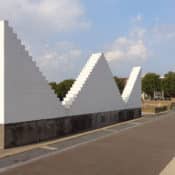
In 2012, Ögüt had “The Castle of Vooruit” suspended above the cultural center of the same name in Ghent, Belgium, which had emerged after lengthy discussions from the former community center of the Vooruit consumer cooperative.
In 2014, Ahmet Ögüt, with his “Anti-Debt Monolith,” drew attention to a future-threatening problem inspired by our all-time favorite film, “2001: A Space Odyssey”: For years, an increasingly absurd debt culture has been developing around higher education in the United States. As always, the most unscrupulous lenders profit the most, and there is a great risk that borrowers will first lose their livelihood and then (also due to the way society deals with the problem) their self-respect.
In this madness, it's not bank-swindled, "greedy homeowners" who perish this time (who only wanted to create a safe place to live for themselves and their children and need support from society, not ridicule), but students – who have to take out these loans to complete their vocational training. Not only is productive research stifled under this mountain of debt, but it also transforms students into compliant, immature subjects; it doesn't get any more socially inept than this.
Ögüt initiated “Day After Debt ,” a long-term art project intended to raise awareness of the increasing debt burden among students. The Broad MSU (Eli and Edythe Broad Art Museum at Michigan State University) and the Istanbul-based art organization Protocinema jointly presented the exhibition featuring the anti-debt monolith. Ahmet Ögüt persuaded some of the leading contemporary artists to participate: Natascha Sadr Haghighian, Dan Perjovschi, Martha Rosler, Superflex, and Krzysztof Wodiczko created sculptures that, in highly imaginative ways, illustrate the crisis and the pressure on students.
In each of the Broad Art Museum's spaces stood sculptures serving as collection points for public contributions to the Debt Collective. The Debt Collective is an initiative to abolish student debt, launched by the Strike Debt! movement and its offshoot Rolling Jubilee ( debtcollective.org , strikedebt.org , rollingjubilee.org ). The Day After Debt event continues; see createlondon.org/event/day-after-debt .
In 2015, Ögüt playfully satirized the motto of the 13th Lyon Biennale, “La vie moderne,”“Workers taking over the factory .” A typical Ögüt work: complex social problems are addressed with a subtle humor that highlights rather than masks the importance of the issue.
In the case of the Lyon Biennale, there is a double reference to local history: the invention of cinema by the Lumière brothers and the famous textile industry of Lyon, which, in addition to producing wonderful silk, had caused two major revolts in 1831 and 1834 by silk weavers toiling like slaves, each resulting in hundreds of deaths.
These two themes have already intersected in the history of contemporary art: “Workers Leaving the Lumière Factory in Lyon” was the first film in history and was shot in Lyon in 1895. See also the article “Harun Farocki: The Ultimately Triumphant Rise of the Keen Eye” , which deals (also) with Harun Farocki’s 1995 commentary on this first film in history: “Workers Leaving the Factory” .
This video is embedded using YouTube's enhanced Privacy mode, which blocks YouTube cookies until you actively click to play the video. By clicking the play button, you consent to YouTube placing cookies on your device, which may also be used to analyze user behavior for market research and marketing purposes. For more information about YouTube's use of cookies, please see Google's Cookie Policy at https://policies.google.com/technologies/types?hl=de.
The 120th anniversary of the first film shoot in history was celebrated at the very spot where the Lumière brothers' camera once stood; the Lumière Institute is located there today.
On March 19, 2015, three thousand citizens of the region played the role of factory workers leaving the factory at that time; Ahmet Ögüt approached some of them in the run-up to the event and equipped their costumes with logos of companies that had been driven into bankruptcy, several of them from the Rhône-Alpes region around Lyon.
Sculpture by Aaron Swartz entitled “Information Power to The People”, created by Ahmet Öğüt, photographed during an exhibition at the Skissernas Museum in Lund, Sweden. Image source: JezW, CC BY-SA 4.0, via Wikimedia Commons
Ahmet Ögüt's path to art
Ahmet Ögüt studied art:
From 1999 to 2003 he studied at the Painting Department of the Fine Art Faculty of Hacettepe University in Ankara, from which he graduated with a BA (Bachelor of Arts).
From 2003 to 2006 he studied at the Art and Design Faculty of the MA, Yildiz Teknik University in Istanbul, graduating with an MFA (Master of Fine Arts).
In 2007 and 2008, Ögüt worked at the Rijksakademie van Beeldende Kunsten in Amsterdam as a “guest artist”.
Ahmet Ögüt's current position: Shaping the world, not just with art
Ahmet Ögüt's official website can be found at ahmetogut.com .
The artist, whose name is arguably the most unsuitable for web publication, has stripped his name of all accents in his top-level domain. Presumably, this was done with global accessibility in mind; Öğüt is correctly spelled with a breve and two diacritics, diacritical marks that a large proportion of web browsers worldwide cannot interpret.
On the website, which features a pleasingly understated design, you can view over 50 images of Ahmet Ögüt's artworks, along with project descriptions and additional materials if needed to understand the artwork. Further information – biography, texts, interviews, links, contact details – can be quickly accessed via the simple structure, which is easily navigated from the main page, and is presented in a straightforward manner, making it very easy to read.
After reading excursions on the colorful yet excessively fragmented websites of online magazines or online sales platforms, which tremble uneasily under the weight of constant advertising attacks, Ahmet Ögüt's website is a true balm for the eyes.
True balm for the soul can also be found on Ahmet Ögüt's website; under "Links" you'll find his refugee project "Silent University , thesilentuniversity.org . Ahmet Ögüt has created a truly ingenious project:
The “Silent University” imparts knowledge from refugees with academic backgrounds. Ögüt conceived the idea for an autonomous platform for knowledge exchange by and for people in the migration process and those interested in their fate in London in 2012. During research, he became aware of the plight of refugees and asylum seekers with academic backgrounds who were unable to utilize their knowledge and skills in their host country and were also unable to exchange ideas with others.
Their university degrees are initially worthless; during the (lengthy) process of determining their legal status, their educational status will eventually be decided. Until then, the migrants live in a kind of enforced silence, which the "Silent University" aims to end, immediately activating the "silenced knowledge"—for the benefit of all involved.
Take a look, there's a lot on offer.
There are currently courses on
“Didactics for Learning New Languages” (in Arabic),
“Types of Networks; Local Area Network and Wide Area Network” (in Russian),
“Cash Book for good accounting” (in French),
“Consultation process before Surgery” (in French),
“Ten types of Arabic calligraphy” (In Arabic)
“What is health?” (in English)
“A comparison of Sharia laws and the Swedish political system” (in Arabic)
“Iraqi Stories from the Heart: A Historical Look at the Ethnic and Social Composition of Iraq” (in Arabic)”
“The history of food preparation through the visual arts” (in Portuguese)
“Sexually transmitted diseases & the history of HIV” (in Spanish)
“Grounds for Asylum According to the 1951 Convention” (in Kurdish)
“What children (in migrant families) need for their psychosocial development” (in German)
“How to set up your own business” (in French),
“The History of Kurdish Literature” (in Kurdish),
“Failures of Education System in Xinjiang Uyghur Autonomous Region” (in Uiguriska), at half a dozen different locations, by academics from over a dozen different countries – here, the dream of every true scientist (in the sense of someone who truly creates and seeks knowledge) is being realized: to gain free access to the knowledge of people all over the world… STILL on a tiny scale.
Furthermore, there are online resources such as the “Silent University Intro film” and articles written by experts on “Asylum Rights Activism” , “Migration & Neoliberalism” , “Access to Education for All” , “Performing Silence” , “Seeking Refuge: Two Friends in Conversation” , “Experiences of Immigration” , “Gaining Influence Through Local Organising” , “Is a world without borders utopian?” , “It's an evil World and we need strict rules!” .
And useful apps like “Bureaucrazy ,” an app conceived by Syrian refugees and mentors to help refugees in Germany cope with the “ubiquitous German paperwork.” The creators have ambitiously set themselves the goal of eventually helping Germans manage their regularly required bureaucratic tasks as well – and yes, we could certainly use perfectly simple tools for taming the German red tape, thanks to the clear outsider's perspective.
The Silent University provides several additional tools and ideas aimed at making a more meaningful use of this terrible period of enforced inactivity for knowledge-rich individuals. Anyone can participate (attending courses, reading articles, downloading apps, etc.) by entering into a "loan agreement for the exchange of time and skills" with the Silent University.
Ahmet Ögüt's art offers us some inspiration for the future, for example, regarding the meaning of art and the pursuit of peaceful coexistence: Those who create art from ideas can – to put it simply – really make a splash. Those who have been creating art from ideas for a long time and have built many connections with other creative people can make an even bigger splash.
Anyone who develops art from ideas over a long period of time and with great success will eventually have the necessary funds to make such a lasting impact that something is created which the world will not soon forget… the “Silent University” could develop in exactly this direction, and this is what is hoped for the artist and the participating knowledgeable and learning people.
We all hope that more artists and cultural workers, but also employees and entrepreneurs, children and senior citizens, poor and rich citizens will become as committed as Ahmet Ögüt; then perhaps the model of peaceful coexistence à la “Exploded City” will become a reality…
Ahmet Ögüt, brief biography
1981 Ahmet Ögüt is born in Silvan, Diyarbakir, TR
1999 – 2003 BA, Hacettepe University, Fine Art Faculty, Painting Department, Ankara, TR
2003 – 2006 MA, Yildiz Teknik University, Art and Design Faculty, Istanbul, TR
2005 Artist in Residence IAAB, Basel, CH
2005 First solo exhibition “Ahmet Ögüt”, Mala Galerija + The Museum of Modern Art of Ljubljana, SI
2007 – 2008 Artist in Residence Rijksakademie van beeldende kunsten, Amsterdam, NL
2008 Artist in Residence Future Arts Research at Arizona State University, US
Owner and Managing Director of Kunstplaza . Publicist, editor, and passionate blogger in the fields of art, design, and creativity since 2011. Graduated with a degree in web design from university (2008). Further developed creative techniques through courses in freehand drawing, expressive painting, and theatre/acting. Profound knowledge of the art market gained through years of journalistic research and numerous collaborations with key players and institutions in the arts and culture sector.
Conceptual art is an artistic style that was coined in the 1960s by the US artist Sol LeWitt (in English-speaking countries: Conceptual Art).
The origins of conceptual art lie in minimalism , and with it the theories and tendencies of abstract painting further developed.
What is special about this style is the fact that the execution of the artwork is of secondary importance and does not have to be carried out by the artist themselves. The focus is on the concept and the idea, which are considered equally important for the artistic work.
In this section of the art blog you will find numerous articles and content about this topic, as well as about artists, exhibitions and trends.
We use technologies such as cookies to store and/or access device information. We do this to improve your browsing experience and to display (non-)personalized advertising. If you consent to these technologies, we can process data such as browsing behavior or unique IDs on this website. Refusal or withdrawal of consent may adversely affect certain features and functions.
Functional
Always Active
Technical storage or access is strictly necessary for the legitimate purpose of enabling the use of a specific service expressly requested by the subscriber or user, or for the sole purpose of carrying out the transmission of a message over an electronic communications network.
Preferences
The technical storage or access is necessary for the legitimate purpose of storing preferences that were not requested by the subscriber or user.
statistics
Technical storage or access that is solely for statistical purposes.Technical storage or access that is used solely for anonymous statistical purposes. Without a subpoena, the voluntary consent of your internet service provider, or additional recording by third parties, the information stored or retrieved for this purpose cannot generally be used to identify you.
marketing
Technical storage or access is required to create user profiles, to send advertising, or to track the user on one or more websites for similar marketing purposes.






 Organic wall mirror "Bosa", curved wooden frame (white, 46 x 61 cm)
39,00 €
Organic wall mirror "Bosa", curved wooden frame (white, 46 x 61 cm)
39,00 €


