Harun Farocki, who died near Berlin in 2014, is considered one of the most important and internationally influential German filmmakers . He was an ethnographer of capitalist lifeworlds, which he scientifically investigated and studied. The exploration of the meaning of images, their creation, and especially the power structures encoded within them was central to his approach and his entire body of work.
Throughout his artistic career, Farocki has already achieved top positions on the world's best list of art, generated by attention and sales success, through his artistic work.
This rise in popularity reached its preliminary peak a year and a half after Farocki's death. A Van Gogh effect (a respected artist shortly after death, but only truly famous around 100 years later) cannot therefore be responsible. This is because appreciation for Farocki's work has increased dramatically in recent years.
Films (Farocki films, serious films, films with substance and food for thought) don't bring in Michelangelo-level money either, so that can't be the reason – it could be that the content of Farocki's films is more relevant than ever. Unfortunately; you'll find out why in the article.
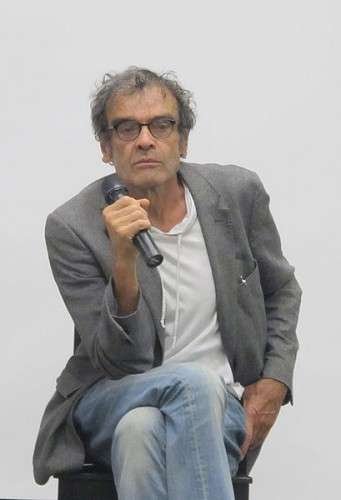
German filmmaker Harun Farocki in Moscow (1944) by Андрей Романенко [CC BY-SA 3.0], via Wikimedia Commons
Harun Farocki: Focus areas of his artistic work
It's quite clear that Harun Farocki was above all a dedicated and sustained filmmaker. Between 1968 and 2014, he produced over 120 films as a producer, writer, director, and editor (often all three roles combined). That's an average of roughly 2.5 films per year, including feature films, essay films, documentaries, and artistic and experimental video installations.
In his 1997 video Still Life (Nature morte),he examined the work of advertising photographers: objects were meticulously placed and staged, a dramaturgy was developed, and requirements were invented. Farocki compared this to 16th-century Dutch-Flemish art, which also aimed to create vivid images to evoke a specific mood, desire, or appreciation.
Just as images are meant to warn us of our transience and mortality, Farocki's camera exposed the dishonesty of the advertising industry.
In addition to his films, he was a successful speaker, media theorist, and video and installation artist. His works were recently exhibited at: Neuer Berliner Kunstverein (2017; 2009); Haus der Kunst, Munich (2017); Manifesta, Zurich (2016); Hamburger Bahnhof, Berlin (2016; 2014); Museum Ludwig, Cologne (2014); Deichtorhallen Hamburg (2012); Museum of Modern Art, New York (2011); and Kunsthaus Bregenz (2010).
Farocki's artistic expression was not limited to moving images:
In 1976, together with Hanns Zischler, he took over the direction of two sensational Heiner Müller productions at the Theater Basel with the plays "Die Schlacht" and "Traktor" , see "Harun Farocki and Heiner Müller and the relevance of the battle".
Farocki wrote for numerous newspapers and magazines; from 1974 to 1984 he was editor and author of the magazine Filmkritik (Munich).
From the turn of the millennium, Farocki created a series of artistic works that are shown in exhibitions and museums, installations such as “Eye/Machine I, II, III” (2000 – 2003), “Counter-Music” (2004), “Listening Stations” (2006) and “Eat or Fly” (2008).
In 2006, Farocki curated the exhibition “Cinema like never before” (together with his wife Antje Ehmann, first in Vienna, 2007 in Berlin).
in Documenta 12 (Kassel 2007) with the media installation “Deep Play” from 2007.
How did Harun Farocki get into art?
Harun Farocki studied his art; he attended the first class of the German Film and Television Academy Berlin (dffb).
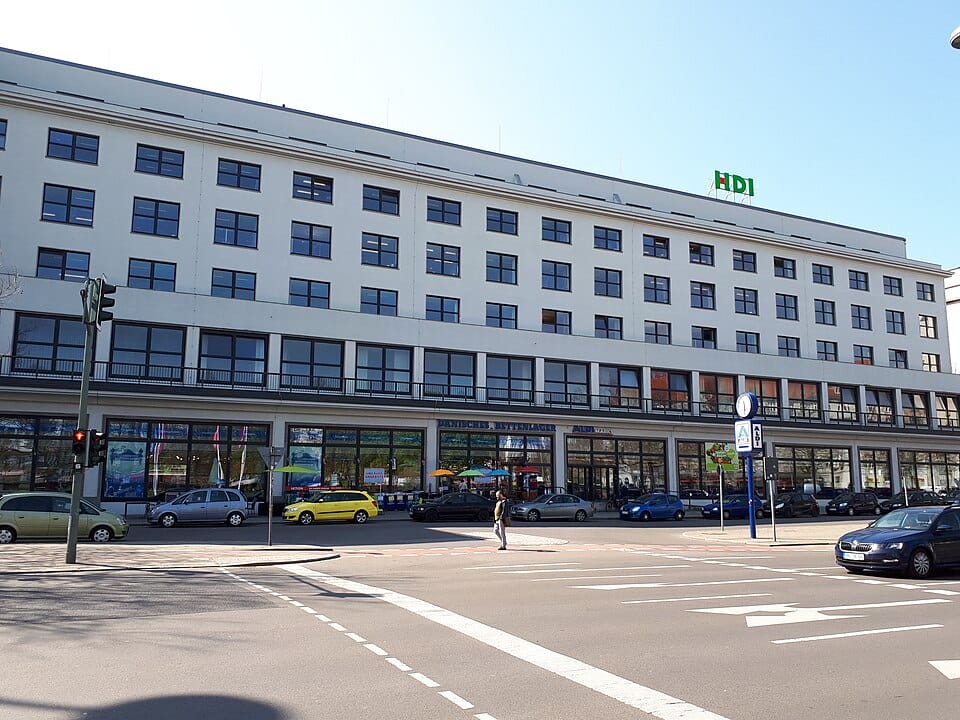
Opened on September 17, 1966 by the Governing Mayor Willy Brandt, the academy began its training activities in the premises of the SFB's Deutschlandhaus at Adolf-Hitler-Platz (today: Theodor-Heuss-Platz 7, the theater visible at the back is the cabaret theater "Die Wühlmäuse").
Berlin-Westend Deutschlandhaus Image source: Fridolin freudenfett, CC BY-SA 4.0, via Wikimedia Commons
The aim was to revitalize the struggling German post-war cinema by promoting young talent, but towards the end of the 1960s things became political, turbulent, and quite contentious at the dffb. Typical Berlin and 1968 generation: even in the year after its founding, the student body and the management were regularly clashing.
The desire for political activism drove the dffb students far. The German Film and Television Academy was even occupied by some students and renamed the Dziga Vertov Academy. It is likely that Harun Farocki was involved; he and his fellow students in this very first class of the film school are said to have participated in every uprising.
It ended as so often in 1968: the heated protest cooled down, 18 students had to leave the university for good, and the rest continued their rebellion within the institution in a somewhat more civilized manner. For example, Harun Farocki, at that time a Dadaist and Maoist, a didactician and Situationist, a deconstructionist and constructivist in his prime.
Farocki already shows us some ugly faces of politics in his early films and remains committed to this over the years – his work becomes ever more subtle, until his view of “Life – FRG” (1990) splits open even the last branching of power.
The dffb had become quite reasonable again by that time; Harun Farocki's fellow student Holger Meins (RAF) had already died as a result of a hunger strike, and fellow student Wolfgang Petersen was perhaps already on his way to Hollywood in spirit, when the dffb gained its first serious recognition around the middle of the 1970s, primarily through documentary films
To this day, the dffb offers a dozen study places in directing, six in cinematography, and eight in production, with multi-stage selection processes. The dffb's fundamental principle remains: "Film cannot be taught, film can only be learned."
Farocki did exactly that: He learned a lot about film in his life and achieved impressive mastery in it:
The art of Harun Farocki: Examples
A small selection of films in which Harun Farocki wrote the screenplay, directed or produced (and/or, often all three at the same time):
In 1969 "Inextinguishable Fire" published, a terrifying treatise on the use of napalm in the Vietnam War.
In 1978, Farocki's first feature-length film, produced over a period of six years, was released: "Between Two Wars" is a coolly abstracting, but also furiously intense treatise by the artist on the emergence of the blast furnace industry between 1917 and 1933.
In a meticulously clear and precise work, Farocki presents "black and white" ideas surrounding the development of this heavy industry, including its connections to National Socialism and the Second World War. Using the example of iron smelting with its release of highly toxic blast furnace gas, Farocki aims to demonstrate the self-destructive nature of capitalist production.
In 1983, the magazine "Ein Bild" explored the absurd amount of effort involved in creating a fashion photograph. An excerpt can be seen in the following video:
In 1987, "The War of Images", an "examination of the examination"of the methods of image acquisition developed during the 20th century and used by the military and police in their work. It includes a report on the development of ways to read and interpret such photographs.
In 1989, "Images of the World and Inscription of the War" followed . This documentary, based on previously unexamined aerial photographs taken by American bombers during World War II, questions strategic interests that ignored the suffering of millions.
In 1993 , "A Day in the Life of Consumers" depicts this life in hundreds of commercials, from brushing teeth in the morning to the nightly nightmare of being underinsured. This "probably most expensive documentary of all time" manages without any commentary and is an admirable testament to how sensitively Farocki perceived the signs of the times.
Years before the major trading companies devised their tax avoidance schemes and "I'm not stupid" slogans celebrated consumer deception, Farocki had already documented the final descent into consumer madness for posterity.
The originators of the idiotic slogan, "the undisputed number one in the electrical trade," fearlessly compare their successes on their website to the first moon landing – lovers of ironic film documentaries regret that Farocki had no time to make a statement.
In 1995, Farocki's "Workers Leaving the Factory" an extensive look at the ant-like colony of factory workers. They were the central motif in the first film in history. Accompanied only by music, the exploited streamed towards freedom. Farocki shows them in the first film and again 100 years later, with the same decisiveness of their movements, with the same anonymous demise in "mass society."
In 1997, the focus shifted again to visual representation in advertising: In the documentary "Still Life", Farocki compares today's advertising photography with the Dutch-Flemish "mainstream" painting of the 16th century, finding many similarities.
In 2000, Farocki collected images of "detainees" in "Prison Pictures": inmates of prisons and inmates of homes for the disabled, from 1920 to the recent past.
In 2001, in "The Creators of Shopping Worlds," he paints a self-narrated character portrait of the men behind the faceless shopping centers that are currently transforming our world into a homogenous mass.
From 2001 to 2003, Farocki created the installations "Eye/Machine I – III,"in which he explored military imaging technology in civilian life. The central focus was the 1991 Gulf War images that caused a worldwide sensation, showing the bomb and camera lens becoming one for the first time.
In a similar vein, Farocki documented in 2003 in "Recognizing and Tracking" the technologization and dehumanization of modern "clean" warfare, in which "human casualties would at most be accepted as a necessary evil" (quote Harun Farocki).
In 2004, "Not Without Risk" reported on banks and money, venture capital and the negotiation of financing long before the crisis.
In 2007 , "Deep Play" offers profound insights into the FIFA World Cup final between Italy and France from 12 different perspectives; excerpt here:
In 2007, "Postponement" presented documentary scenes from a Jewish transit camp, silent historical 16mm footage shot by a Jewish inmate for the commandant of the Dutch transit camp Westerbork. A reflection on the truthfulness of images, on propaganda, and on intention, it won an award in Locarno in 2007.
In 2009, “For Comparison” examined stone production throughout the ages:
In 2009/2010, "Serious Games I-IV" , a series of installations/videos about "computer war games", commented on by Farocki himself:
In his 2012 book "A New Product," Farocki gets up close to how a product is created under neoliberalism. With brainstorming, a team of consultants, and flip charts, with colorful words and colored markers, with the coldness of the market economy only barely disguised.
In 2013, Farocki profiled "Sauerbruch Hutton Architects ," optimistically showcasing the sustainability, ecological efficiency, and playful new design language of the Berlin-based architecture firm's buildings. Trailer here:
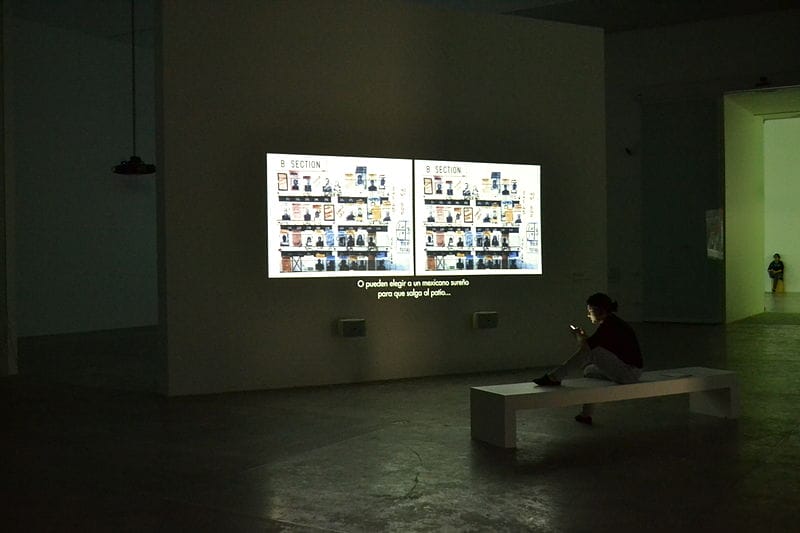
Temporary exhibition of the video artist Harun Farocki in the Museo de Arte Contemporáneo of the Ciudad Universitaria (Mexico City) Image source: Sama Hoz, CC BY-SA 3.0, via Wikimedia Commons
Buildings to admire:
Hamburg Authority for Urban Development and Housing
Federal Environment Agency Dessau
The Two New Ludgate, London
Art Cube Berlin
GSW Headquarters Berlin
University of Potsdam
In September 2014, a month after Farocki's death, "Phoenix" was released, a film by Farocki's student Christian Petzold, for which they both co-wrote the screenplay. This "post-war film" about a Jewish woman searching for her husband and betrayer after her imprisonment in Auschwitz received the International Film Critics' Prize at the 2014 San Sebastián Film Festival; trailer here:
Harun Farocki's work in the public sphere: exhibitions, art in public spaces and in public collections
After 30 years of creating film art, Harun Farocki developed around the turn of the millennium into a media artist whose installations populate museums and other exhibition venues.
Therefore, Harun Farocki's exhibition history only begins in 1997, but then immediately with a bang: the 2nd Gwangju Biennale and documenta X in Kassel exhibited his works.
To date, in just 20 years, his work has been featured in approximately 440 public exhibitions. Among the world's most sought-after artists are some who, in their entire long lives, never achieved such exhibition exposure. The majority of these exhibitions were in Germany (around a quarter), with nearly 50 in the USA and Austria, and about 30 in Spain and France. Farocki's exhibition venues often boast a particularly distinguished clientele.
Farocki was at Documenta 12 again in 2007, and also at a few other biennials:
2000 4th Werkleitz Biennale, Werkleitz Gesellschaft eV, Halle, Saale
2003 10th Biennale de l'Image en Mouvement, Center pour l'image contemporaine, Geneva
2005 11ème Biennale de l'Image en Mouvement, Center pour l'image contemporaine, Geneva
2007 Prague Biennale 3, Karlin Hall, Prague
2008 Mediation Biennale 08, Centrum Kultury Zamek, Poznan
2008 7th Shanghai Biennale, Shanghai
2008 16th Biennale of Sydney
2009 2nd Athens Biennial
2010 29° Bienal de São Paulo
2010 1st Ural Industrial Biennial of Contemporary Art Yekaterinburg
2010 8th Gwangju Biennale
2011 Sharjah Biennial 10
2012 Taipei Biennial 2012
2012 Biennale Regard Benin 2012, Cotonou
2013 La Otra Bienal De Arte 2013, Bogota
2013 6th Biennial of Moving Image Mechelen
2013 55th Venice Biennale
2014 Shanghai Biennale
2015 Vienna Biennale 2015
Harun Farocki's work has probably been featured in every museum in the world that has an abbreviation beginning with "M":
MACBA (Museu d´Art Contemporani de Barcelona)
MAC's (Musée des Arts Contemporains Hornu)
MAK (Austrian Museum of Applied Arts Vienna)
MARCO (Museo de Contemporary Art de Monterrey)
MARCO (Contemporary Art Museum of Vigo)
MART (Museo d'Arte Moderna e Contemporanea di Trento e Rovereto)
MASS MoCA (Massachusetts Museum of Contemporary Art North Adams)
MdM (Museum of Modern Art Mönchsberg)
MKG (Museum für Kunst und Gewerbe Hamburg)
MMOMA (Moscow museum of modern art)
MMSU (Museum of Modern and Contemporary Art Rijeka)
MNAC (National Museum of Contemporary Art Bucharest)
MOCA (Museum of Contemporary Art Jacksonville)
MOCA (Pacific Design Center West Hollywood)
MOCAK (Museum of Contemporary Art in Kraków)
MoMA (Museum of Modern Art New York City)
MuHKA (Museum for Hedendaagse Kunst Antwerp)
MUMOK (Museum of Modern Art Ludwig Foundation Vienna)
MUNTREF (Museo de la Universidad Nacional de Tres de Febrero Buenos Aires)
We use technologies such as cookies to store and/or access device information. We do this to improve your browsing experience and to display (non-)personalized advertising. If you consent to these technologies, we can process data such as browsing behavior or unique IDs on this website. Refusal or withdrawal of consent may adversely affect certain features and functions.
Functional
Always Active
Technical storage or access is strictly necessary for the legitimate purpose of enabling the use of a specific service expressly requested by the subscriber or user, or for the sole purpose of carrying out the transmission of a message over an electronic communications network.
Preferences
The technical storage or access is necessary for the legitimate purpose of storing preferences that were not requested by the subscriber or user.
statistics
Technical storage or access that is solely for statistical purposes.Technical storage or access that is used solely for anonymous statistical purposes. Without a subpoena, the voluntary consent of your internet service provider, or additional recording by third parties, the information stored or retrieved for this purpose cannot generally be used to identify you.
marketing
Technical storage or access is required to create user profiles, to send advertising, or to track the user on one or more websites for similar marketing purposes.



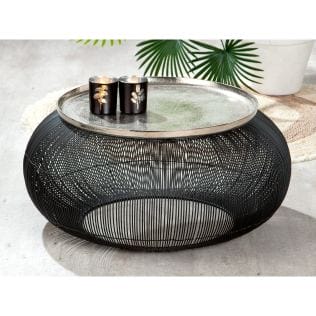
 Modern table "Puntual" in black grid design with aluminum tabletop
398,00 €
Modern table "Puntual" in black grid design with aluminum tabletop
398,00 €