3D printing has increasingly become the focus of artists in recent years. The ability to print objects in three dimensions opens up entirely new design possibilities.
But 3D printing offers entirely new possibilities not only for artists, but also for designers and architects. Previously, complex geometric shapes had to be painstakingly produced by hand or with the help of expensive CNC milling machines. Thanks to 3D printing, such shapes can now be manufactured much more easily and cheaply.
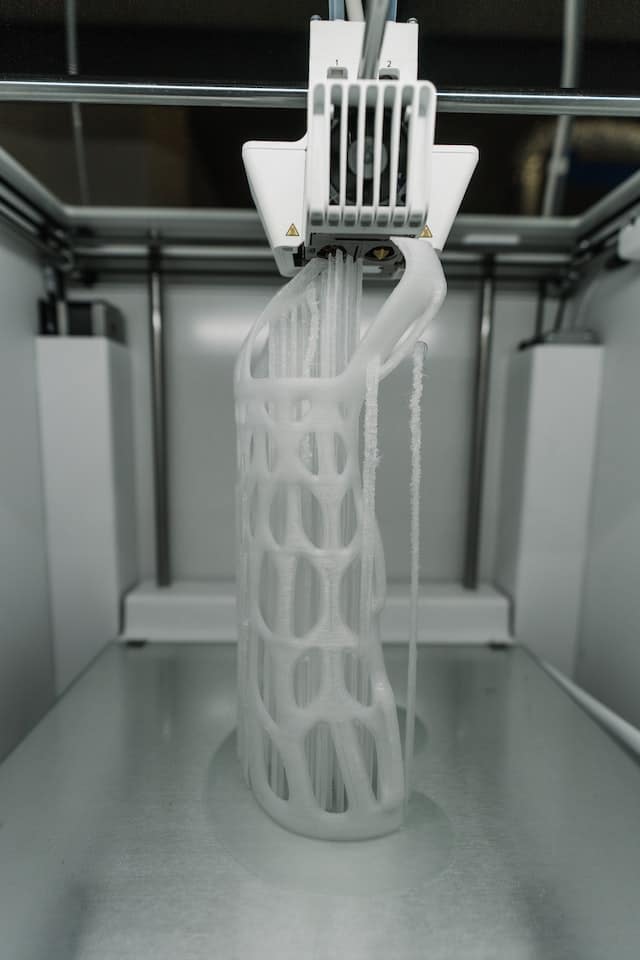
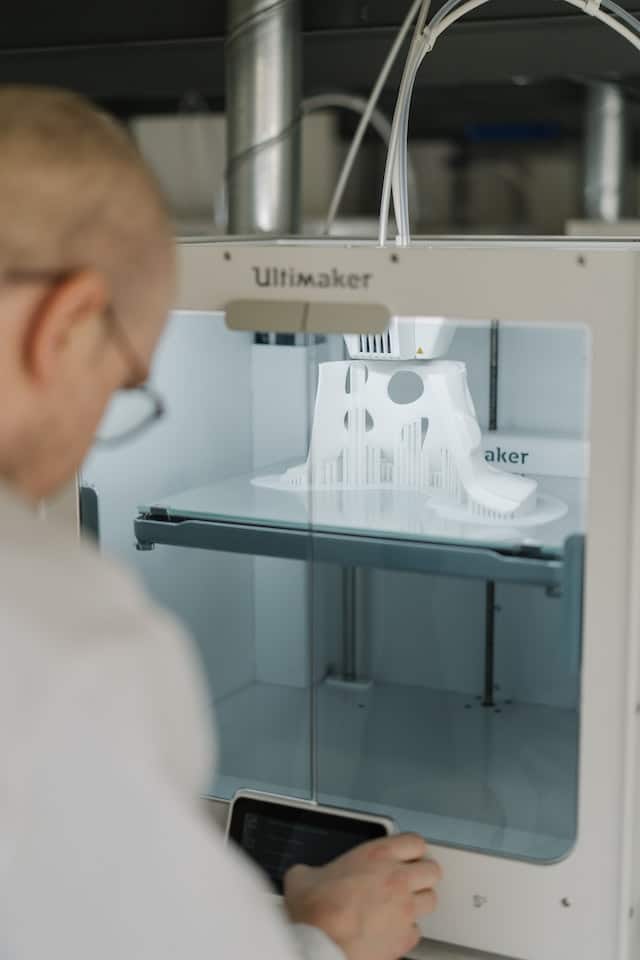
3D printing creates possibilities to print objects in three dimensions. Photo by Tom Claes @tomspentys, via Unsplash
The surface structure of objects can also be altered through 3D printing. For example, smooth surfaces can now be given textures that could otherwise only be created by hand. In the fashion industry , more and more clothing items and accessories made using 3D printing are also appearing.
Shoes, bags, and even dresses are already being successfully produced using 3D printers. There are no limits to the imagination, and it's only a matter of time before haute couture also benefits from this trend.
However, 3D printing is not only interesting for the production of objects; buildings can now also be constructed using this technology.
In China, the first house has already been built using 3D printing, and architects in other countries are also eagerly experimenting with this new method of construction.
3D printing will therefore increasingly find its way into our everyday lives and transform the world of art and design. Exactly what these changes will look like remains to be seen. However, it is certain that 3D printing will fundamentally change the way we live, design, and work in the future.
3D printing is a new technology that allows artists to realize their ideas and produce them on a large scale. This means that each piece is unique and not a duplicate of another.
3D printing also allows artists to produce their work in a shorter time and thus make it available to the market more quickly.
What technological advances has it brought?
3D printing technology has experienced rapid technological advancements in recent years and is now a ubiquitous phenomenon. Its unique feature is the ability to create highly customized designs that are difficult to produce using any other method. Until now, this technology has been primarily reserved for industrial applications.
For example, specialized companies offer 3D printing as a service for ordering custom components for prototypes, machines, or medical products. New materials are also constantly emerging that can be used in 3D printing. This new way of creating things has further stimulated human creativity.
The art world has greatly benefited from this development and has fundamentally changed in recent years. 3D printing technology has revolutionized art in many ways and will continue to play a significant role in the future.
A new perspective on art
3D printing technology has not only changed the way art is produced , but also the way art is seen .
The conventional notion that art is something abstract and intangible is now definitively a thing of the past. Most modern works are based on 3D printing technology and are therefore highly realistic and tangible. Viewers can now finally see what they have already seen hundreds of times in the cinema or on screen.
The themes of art are changing
However, the influence of 3D printing technology on art is not limited to manufacturing methods – it has also contributed to a radical change in the themes of art .
Previously, art often depicted abstract representations of feelings or ideas – today, however, it almost always involves figures or events from reality. This naturally also means that art today is much more realistic than before. 3D printing technology has therefore not only radically changed our understanding of art – it has also revolutionized our understanding of reality.
How has this affected the art world?
The spread of 3D printing has enabled artists to create three-dimensional objects that previously existed only in their imaginations. This technology allows artists to create unique, complex designs that can be produced quickly and efficiently.
3D Printing – Complex designs can be produced faster and more efficiently. Photo by Tom Claes @tomspentys, via Unsplash
Diverse application scenarios with different materials
3D printing technologies are used in a variety of ways in the art world to create everything from sculptures to clothing. The technology has also given artists access to a wider range of materials that can be used for different projects.
Some of these materials include metal , wood, plastic, and even glass . With each newly developed printing material, artists have even more possibilities at their disposal. The use of 3D printing technology also allows artists to achieve results faster and correct mistakes more easily.
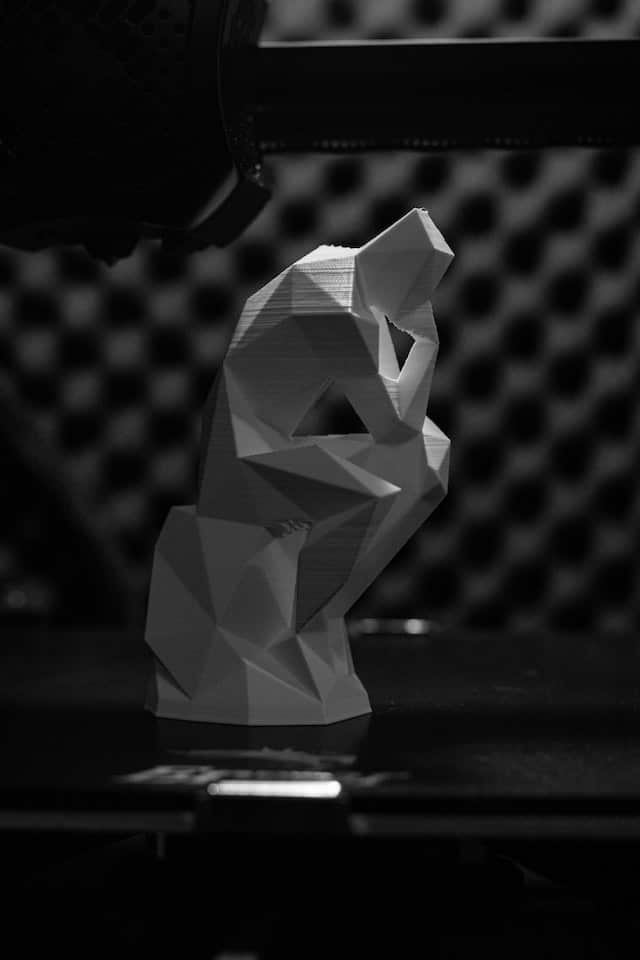
Sculptures can be produced using 3D printing with different materials. Photo by Karl Hörnfeldt @karlhornfeldt, via Unsplash
Digitization of design processes
Since most 3D printers come with software that allows users to modify or adapt designs, many artists have begun digitize the entire design process . This eliminates the need to wait for physical models or sketches before printing – instead, they can get started immediately.
More room for experimentation
Furthermore, 3D printing has also ample room for experimentation : artists have begun developing innovative ideas for their works; at the same time, they have also started experimenting with the most unusual materials and colors. 3D printing offers them limitless possibilities and makes it easier than ever before to produce artworks using various techniques and materials.
All these factors make it clear: 3D printing has helped to radically transform the world of art – it has enabled artists to enjoy more freedom in their work and to explore new avenues in the design process; at the same time, it has also enabled them to produce unique objects with significantly greater precision than ever before.
The impact of 3D printing is not only noticeable in the art scene – its revolutionary advances can already be observed in almost all industrial sectors today.
New opportunities and advantages for artists, collectors and art lovers
3D printing allows artists to create their works in a completely new dimension, giving free rein to their creativity.
One of the most important things 3D printing has brought to the art world is the reduction in costs compared to traditional manufacturing methods. With 3D printing, artists can produce their creations at a fraction of the cost.
The printing process can also accelerated to complete projects faster than usual. Furthermore, 3D printing allows artists to create three-dimensional objects without having to alter the design. This enables them to experiment with new ideas and achieve innovative results more quickly.
It also allows them to produce objects in a wide variety of sizes and shapes, making the creation process much more flexible .
The technology has also some unusual applications in the art world . For example, 3D printing can be used to recreate rare or antique objects, or even sculptures on the spot. In this way, art can be made accessible to everyone, regardless of their budget or location.
3D printing allows artists more interactive work and experiment with their art more deeply than ever before. Furthermore, it offers artists the opportunity to explore new techniques and fully realize their potential – whether they use traditional materials or digital media.
With the help of 3D printing, artists can do so much more than just painting or sculptural design – they can actually immerse themselves in a world.
But 3D printing doesn't just open up new possibilities for artists; it's also interesting for collectors and art lovers .
Until now, printed artworks were only two-dimensional and therefore had limited realism. With the use of 3D printing, it is now possible to create three-dimensional artworks that are much more lifelike.
Limited editions of artworks and replicas can be printed faster and just in time, giving every collector the chance to immortalize their favorite artworks in their collection. 3D printing is also interesting for unique pieces , as it can minimize losses due to theft or damage at exhibitions by producing a cost-effective, three-dimensionally printed exhibition copy.
In summary, it can be said that 3D printing has some interesting effects on the art world.
Creative application examples in the art world: installations, sculptures and street art from the international art scene
It seems there's little you can't create with 3D printing; we've recently seen lingerie, weapons, rocket engines, musical instruments, and even rooms and entire houses. In the art world, too, a number of artists have emerged from the crowd, whom we'd like to briefly introduce here.
The online magazine KulturPixel had already reported in 2020 in its article “Sculptures & Co.: 3D printing conquers the art world” on amazing and creative applications from the world of creative people.
01 Gilles Azzaro – The “Sculptor of the Voice”
French artist Gilles Azzaro uses the technology to capture something much more abstract.
His 3D-printed sculptures made from voice recordings resemble alien landscapes, with high and low tones represented as peaks and valleys. Instead of just hearing the rich tones of Barack Obama's State of the Union address, you can also see them in Azzaro's latest sculpture, titled "Next Industrial Revolution" .
Interestingly, in the 39-second clip of Obama's voice, the president expresses his views on how 3D printing could potentially revolutionize the way things are made.
To materialize a person's spoken words into a more permanent form, Azzaro developed programming software that could digitally reconstruct a person's voice in three dimensions, which he subsequently patented. His early attempts to create sculptures from these voiceprints suffered from a lack of access to the right tools, but all that changed when 3D printers became available.
This video is embedded using YouTube's enhanced Privacy mode, which blocks YouTube cookies until you actively click to play the video. By clicking the play button, you consent to YouTube placing cookies on your device, which may also be used to analyze user behavior for market research and marketing purposes. For more information about YouTube's use of cookies, please see Google's Cookie Policy at https://policies.google.com/technologies/types?hl=de.
This video is embedded using YouTube's enhanced Privacy mode, which blocks YouTube cookies until you actively click to play the video. By clicking the play button, you consent to YouTube placing cookies on your device, which may also be used to analyze user behavior for market research and marketing purposes. For more information about YouTube's use of cookies, please see Google's Cookie Policy at https://policies.google.com/technologies/types?hl=de.
02 “Regenerative Reliquary” by Amy Karle
The artist Amy Karle creates artworks that use the body to explore what it means to be human through a unique engagement with art, design, science and technology.
She harnessed the intelligence of human stem cells and created "Regenerative Reliquary" , a bioprinted scaffold in the shape of a human hand, 3D-printed in a biodegradable Pegda hydrogel that dissolves over time.
This video is embedded using YouTube's enhanced Privacy mode, which blocks YouTube cookies until you actively click to play the video. By clicking the play button, you consent to YouTube placing cookies on your device, which may also be used to analyze user behavior for market research and marketing purposes. For more information about YouTube's use of cookies, please see Google's Cookie Policy at https://policies.google.com/technologies/types?hl=de.
The sculpture will be installed in a bioreactor, with the intention that human mesenchymal stem cells (hMSCs from an adult donor) seeded onto this design will eventually grow into tissue and mineralize into bone along this scaffold.
“Regenerative Reliquary” utilized artistic, scientific, and technological advancements, inspiring new approaches to its creation. The use of cells and 3D-printed scaffolds represents a new medium for art and design.
Advances have been made in both software and hardware to process and digitally produce the extremely complex geometry that had to be 3D printed at a microscopic level in trabecular form to roughly represent the geometry of the number of cells in real human hand bones.
Amy Karle exhibited “Regenerative Reliquary” at the Ars Electronica Festival in Linz. Ars Electronica is one of the world's leading media art festivals. Founded in 1979, this festival for art, technology, and society aims to highlight the emerging digital revolution. Once a year, Ars Electronica invites artists, scientists, and researchers from around the world to Linz for a conclave to explore a specific, interdisciplinary theme through exhibitions, lectures, workshops, and symposia.
03 Digital Grotesque – Mind-expanding sculpture by Michael Hansmeyer
This sculpture, recently exhibited BMW Art Clubentirely from sand and resin . The design was the result of a collaborative effort between designer Michael Hansmeyer and a computer utilizing machine learning and artificial intelligence.
This video is embedded using YouTube's enhanced Privacy mode, which blocks YouTube cookies until you actively click to play the video. By clicking the play button, you consent to YouTube placing cookies on your device, which may also be used to analyze user behavior for market research and marketing purposes. For more information about YouTube's use of cookies, please see Google's Cookie Policy at https://policies.google.com/technologies/types?hl=de.
You might be fascinated, amazed, and even awestruck when you see it for the first time. The motivation behind this artwork is to evoke emotions in viewers and expand their vision of what future architecture could look like.
At first glance, this installation may simply look like a chaotic figure, but it harbors a different kind of beauty.
04 HORTUS XL
What do you get when a design studio collaborates with a research institute? A massive installation that provides insights into the microbiological world.
This video is embedded using YouTube's enhanced Privacy mode, which blocks YouTube cookies until you actively click to play the video. By clicking the play button, you consent to YouTube placing cookies on your device, which may also be used to analyze user behavior for market research and marketing purposes. For more information about YouTube's use of cookies, please see Google's Cookie Policy at https://policies.google.com/technologies/types?hl=de.
The sculpture HORTUS XL Astaxanthin.g simulates substrate growth , inspired by coral morphology. It is the result of a collaboration between ecoLogicStudio and the research institutes Synthetic Landscape Lab at the University of Innsbruck and Create Group at the University of Southern Denmark .
The artwork is the world's first 3D-printed bioreactor. Its experimental structures were algorithmically designed and then divided into 185 different construction units. The parts, weighing a total of 597 pounds, were printed entirely on WASP 3D printers.
The entire process took an incredible 1,780 hours.
05 Hypnerotomachia Naturae
The sculpture “hypnerotomachia naturae”, created Stefan Maier and Giacomo Pala under the direction of Bart Lootsma at the Institute for Architectural Theory
And this is quite deliberate: the modular structure is intended to remind us of the connections and contradictions in humanity's relationship with nature and technology. Hypnerotomachia was realized concr3de
The work features a multitude of individual pieces, which are combined to form a larger whole. The individual objects are intended to thematically remind the viewer of the diversity of utopias, myths, and cultures.
06 Mat Collishaw's Equinox at the Dubai Expo 2020
For the World Expo 2020 in Dubai, which was actually only able to start on October 1, 2021 due to the pandemic, the artist Mat Collishaw came up with something special with the work “Equinox”.
In an optical illusion, a gigantic lotus flower comes to life in the center of the Terra Pavilion. The blossoms rotate, insects circle and flutter around the flower, pollinating it. To make this ecological dance possible, the five-meter-high and three-meter-wide zoetrope hydraulically.
This video is embedded using YouTube's enhanced Privacy mode, which blocks YouTube cookies until you actively click to play the video. By clicking the play button, you consent to YouTube placing cookies on your device, which may also be used to analyze user behavior for market research and marketing purposes. For more information about YouTube's use of cookies, please see Google's Cookie Policy at https://policies.google.com/technologies/types?hl=de.
The petals were all 3D printed. It is not known which method the artist used, but we do know that Collishaw previously collaborated with the Spanish company Sicnova 3D to create a zoetrope for the Galleria Borghese in Rome.
What are the disadvantages and risks of this development?
Every new technology and every change also carries risks, dangers, and a number of disadvantages. We would also like to address these.
High costs for the purchase and maintenance of the required equipment.
Complex technology that requires regular training.
Risk that insecure Privacy practices could lead to Privacy breaches.
A lack of understanding and trust in the technology can cause uncertainty and doubt.
Rapidly evolving technologies make it difficult to always stay up-to-date.
Inflationary effect due to ever larger and faster output on the art market.
Conclusion
Ultimately, it's undeniable: 3D printing has revolutionized the way art is created, viewed, and reproduced today. It has enabled creatives to explore new avenues and offers unlimited possibilities for innovation and inspiration.
Owner and Managing Director of Kunstplaza . Publicist, editor, and passionate blogger in the fields of art, design, and creativity since 2011. Graduated with a degree in web design from university (2008). Further developed creative techniques through courses in freehand drawing, expressive painting, and theatre/acting. Profound knowledge of the art market gained through years of journalistic research and numerous collaborations with key players and institutions in the arts and culture sector.
We use technologies such as cookies to store and/or access device information. We do this to improve your browsing experience and to display (non-)personalized advertising. If you consent to these technologies, we can process data such as browsing behavior or unique IDs on this website. Refusal or withdrawal of consent may adversely affect certain features and functions.
Functional
Always Active
Technical storage or access is strictly necessary for the legitimate purpose of enabling the use of a specific service expressly requested by the subscriber or user, or for the sole purpose of carrying out the transmission of a message over an electronic communications network.
Preferences
The technical storage or access is necessary for the legitimate purpose of storing preferences that were not requested by the subscriber or user.
statistics
Technical storage or access that is solely for statistical purposes.Technical storage or access that is used solely for anonymous statistical purposes. Without a subpoena, the voluntary consent of your internet service provider, or additional recording by third parties, the information stored or retrieved for this purpose cannot generally be used to identify you.
marketing
Technical storage or access is required to create user profiles, to send advertising, or to track the user on one or more websites for similar marketing purposes.






 Mini stud earrings "Tree of Life", 925 sterling silver
33,90 €
Mini stud earrings "Tree of Life", 925 sterling silver
33,90 €