Taking the first step into the professional art world after graduation is both exciting and challenging. Many graduates find themselves asking questions like: "How can I best present my work?" "How can galleries or potential buyers become aware of me?" or "How can I gain visibility for grants and scholarships?"
The answer: a professional portfolio. This starter kit explains how to create a targeted portfolio without high costs.
Your portfolio provides an initial overview of your work. It reveals not only the direction of your art but also who you are and what you stand for. It's a combination of business card and self-portrait. A compelling portfolio often opens doors to internships at renowned studios or semesters abroad.
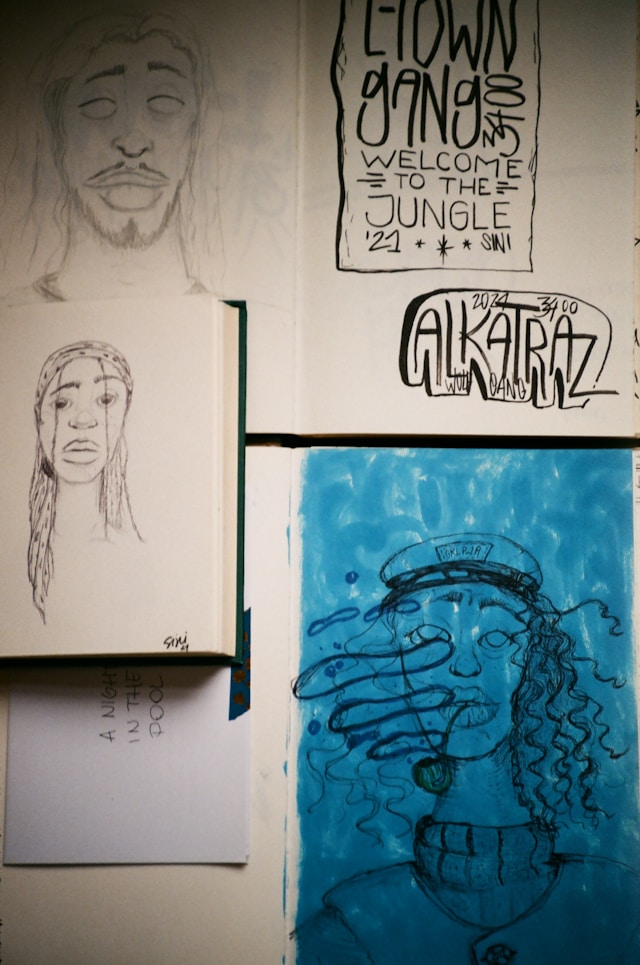
The artist's portfolio is a combination of business card and self-portrait. Photo by Sinitta Leunen @sinileunen, via Unsplash
How do I create a good portfolio?
Depending on the art form, various elements can be important. However, some elements should generally be included.
Choose your highlights: Don't show all your work, show your best projects. Quality clearly takes precedence over quantity here.
Variety: Show your diversity and different styles, while at the same time making sure not to lose your artistic individuality.
Brief descriptions: Briefly point out concepts and origins and concisely explain the techniques used.
Portrait: A statement about your artistic stance and a brief look at your biography are essential.
Online presence: Show how you can be found and contacted. List your social media accounts, such as Instagram or LinkedIn, and your website.
To maintain clarity, it's important to make a targeted selection and not present countless works. Structure and clarity are paramount. A portfolio thrives on clarity and structure.
Digital and analog HelloPrint works
Portfolios of digital works can be sent quickly, easily, and inexpensively. An analog portfolio, however, is the preferred option, especially for job interviews and exhibitions. The tactile experience of a high-quality portfolio reinforces your confident presentation and the necessary seriousness.
It's worth taking a close look and opting for professionalism. Many students use reliable providers like HelloPrintto brochures or presentation folders . This allows even emerging artists to design gallery-quality products in a cost-effective way.
With regard to the developments in our world today, a combination of analog and digital the recipe for success.
Step by step to a convincing portfolio
If you follow these steps, nothing will stand in the way of an attractive portfolio:
1. Select accents
Select a portfolio of works that represent you. A portfolio with your 10 most outstanding pieces often appears more convincing and meaningful than 30 or more.
2. Find clarity
Structure your portfolio. Include an introduction about your artistic style and approach, followed by your work. Start with your highlight.
3. Conscious design
Aim for a minimalist, recognizable design. Create a portfolio that allows your art to shine. Use unique layouts, white space, and clean typography.
4. Budget orientation
High-quality portfolios can be created without incurring significant costs. Professionalism isn't a matter of price. Those who plan ahead can find affordable printing options from providers like HelloPrint and thus present their work in high quality.
5. Request feedback
An outside perspective will help you identify your weaknesses and strengths. Ask colleagues and lecturers to review your portfolio.
The best video tutorials and expert tips
One of the most outstanding resources for young art students and emerging artists is and remains the Contemporary Art Issue (CAI). Julien Delagrange is an art historian, contemporary artist, and the founder and director of CAI. Delagrange studied art history at Ghent University, Belgium, and worked for the Centre for Fine Arts (BOZAR) in Brussels, the Jan Vercruysse Foundation, and the Ghent University Library . He has contributed to the international contemporary art scene as an art critic, lecturer, curator, gallery director, consultant, and artist.
As an artist, he is represented by the Sabine Bayasli Gallery in Paris, France, and the Space60 Gallery in Antwerp, Belgium.
The following video provides a perfect introduction to the topic:
How do you create an application portfolio? What should you pay attention to, and what should it actually contain? Lilaphie answers these questions in this video:
We also found two excellent video tutorials primarily aimed at aspiring (graphic) design students. However, art students should also be able to glean important insights from them:
How to avoid common mistakes
There are a few things to keep in mind. These are the following:
Less is more: Make a clear and conscious choice.
Print quality: The quality of the prints is of high professional importance.
Relevance to the recipient: When creating your portfolio, also consider the intended audience. Pay attention to personality and individuality, whether for exhibitions, funding programs, or other applications.
Your portfolio as a door opener
Your portfolio is your ticket into the world of professional art. It gives you the opportunity to showcase your story. Quality, structure, and clarity are the most important factors.
The goal is to find cost-effective and smart ways to showcase your impressive portfolio not only digitally, but also through hybrid formats. Especially for those just starting out in the professional art world, it's advisable to use providers like HelloPrint right from the beginning to create high-quality, budget-friendly prints. Your portfolio is your calling card. Use it actively to present yourself and your art in the best and most authentic way possible.
FAQ: Quick answers for students
How extensive can my portfolio be?
To get an impression of your work, 8 to 15 selected projects are perfectly sufficient.
How important is a printed portfolio?
For exhibitions and job interviews, a printed portfolio enhances your professional impression.
When should I update my portfolio?
Whenever a strong new project can be released, but at least once per semester.
Owner and Managing Director of Kunstplaza . Publicist, editor, and passionate blogger in the fields of art, design, and creativity since 2011. Graduated with a degree in web design from university (2008). Further developed creative techniques through courses in freehand drawing, expressive painting, and theatre/acting. Profound knowledge of the art market gained through years of journalistic research and numerous collaborations with key players and institutions in the arts and culture sector.
A fundamental need for every artistically creative person is likely to be the ability to live off their art.
To secure one's livelihood, earning money through art is essential . In fact, contrary to popular belief, many artists today can make a good living from their creative work. Nevertheless, the vast majority of freelance artists still rely on additional sources of income (e.g., teaching courses, commissions, side jobs, etc.).
Recognition as an artist often does not bring immediate financial security. Therefore, artists are often also life artists.
The opportunities to make a living from one's own art have, however, grown significantly due to the internet and social media. As an artist, however, you must be versatile and flexible to succeed. A certain degree of perseverance is also essential.
Customer relations and self-marketing are also important pillars for success as an artist.
In this section, we compile numerous articles, information, tips, and advice to help you make a living from your art.
We use technologies such as cookies to store and/or access device information. We do this to improve your browsing experience and to display (non-)personalized advertising. If you consent to these technologies, we can process data such as browsing behavior or unique IDs on this website. Refusal or withdrawal of consent may adversely affect certain features and functions.
Functional
Always Active
Technical storage or access is strictly necessary for the legitimate purpose of enabling the use of a specific service expressly requested by the subscriber or user, or for the sole purpose of carrying out the transmission of a message over an electronic communications network.
Preferences
The technical storage or access is necessary for the legitimate purpose of storing preferences that were not requested by the subscriber or user.
statistics
Technical storage or access that is solely for statistical purposes.Technical storage or access that is used solely for anonymous statistical purposes. Without a subpoena, the voluntary consent of your internet service provider, or additional recording by third parties, the information stored or retrieved for this purpose cannot generally be used to identify you.
marketing
Technical storage or access is required to create user profiles, to send advertising, or to track the user on one or more websites for similar marketing purposes.






 Ballerina sculpture "Ballet" (black/silver)
59,00 €
Ballerina sculpture "Ballet" (black/silver)
59,00 €