The federal cultural budget shows a surprising development in 2025. Despite persistently difficult economic conditions, the cultural budget grows by more than 50 million euros, reaching a total of just over 2.25 billion euros.
In fact, the current draft budget from the Minister of State for Culture shows a slight increase compared to the draft from the previous government. In this context, particular emphasis is placed on the urgent need to invest in and renovate cultural buildings. This ensures that the Federal Government remains a reliable partner for the cultural and media landscape in Germany.
What will change in the federal cultural budget in 2025?
Despite the tight financial situation, the second draft of the federal budget for 2025 reveals remarkable developments for the cultural sector. The federal cultural budget is rising to approximately €2.2 billion, a slight increase compared to the previous year's draft. Some sources even indicate an increase to €2.25 billion, representing growth of more than €50 million.
However, these funds are distributed unevenly across different cultural sectors. On the one hand, cultural film funding a significant increase of €11.3 million from 2025 onwards, with the formal increase actually exceeding €18 million. This figure also includes €7 million earmarked for cinema funding, which was previously allocated elsewhere in the budget.
The Prussian Cultural Heritage Foundation an additional €17 million beyond previous plans. This is intended to strengthen the foundation's operations, particularly during times of high cost increases. Deutsche Welle will receive an additional €25 million compared to the original financial plan.
On the other hand, there are also significant cuts: Funding from the Federal Cultural Fund is to be halved to comply with the debt brake."Alliance of International Production Houses" is hit even harder , with its funding of five million euros to be completely eliminated. This contradicts the coalition agreement, in which the Federal Cultural Fund was described as an "innovation driver" that was to be "expanded."
Chemnitz, the European Capital of Culture, with a total of 25 million euros, of which 10 million euros will be disbursed next year. Furthermore, the work of memorial sites is to be strengthened and the development of the German-Polish House is to be advanced with one million euros.
A particular focus of the draft budget is on investments in cultural buildings. More than 50 million euros in additional funding is earmarked for projects ready for construction.
Cultural and media policy priorities
The cultural policy priorities in the 2025 federal budget clearly indicate the direction for the future development of Germany's cultural landscape. The cultural buildings initiative , for which an increase of over 50 million euros is earmarked, is particularly noteworthy.Minister of State for Culture Wolfram Weimer emphasized in a press release from the German Cultural Council on July 9th that "cultural buildings are part of our identity as a cultural nation" and "contribute directly to the appeal and strengthening of Germany as a cultural location .
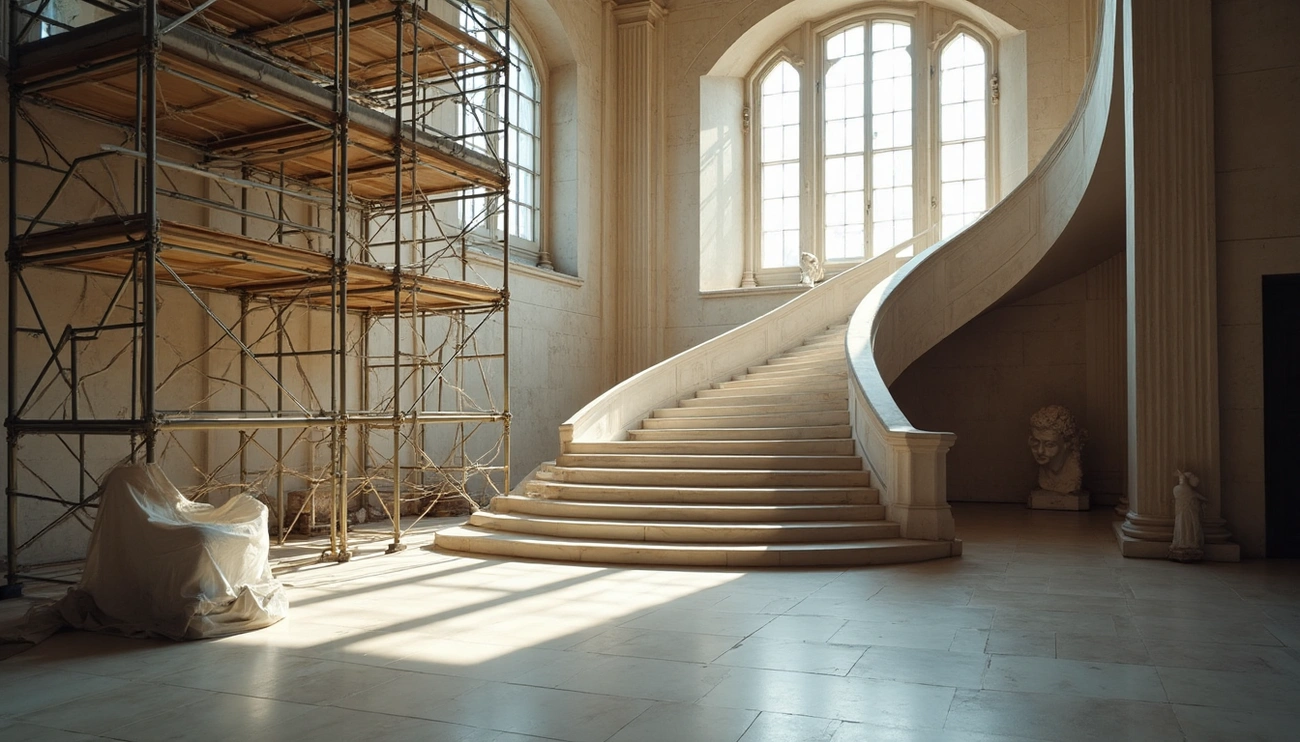
The cultural buildings initiative stands out in the 2025 federal cultural budget. This image is for illustrative purposes and was generated using image AI.
Specific projects include Museum Island in Berlin , the German-Polish House , and the redesign of Nazi memorial sites in Dachau , Ravensbrück, and Sachsenhausen. Furthermore, the renovation of St. Paul's Church , the Bayreuth Festival Theatre , and Friedenstein Castle in Gotha are being funded. The federal government is providing up to €55 million for the latter.
The budget for film funding has seen a considerable increase. Cultural film funding will be raised by €11.3 million. At the same time, the federal government is continuing the reform process for a modernized film funding system. The new Film Funding Act envisions fully automated production and distribution funding , which is expected to save €1.5 million in annual bureaucratic costs.
Deutsche Welle has been allocated an additional €25 million compared to the original budget. DW Akademie , as a center for international media development, will receive €37.75 million in project funding and operates in 60 developing and emerging countries.
Likewise, the culture of remembrance strengthened. Memorial site work will be supported in accordance with the coalition agreement, with the construction of the German-Polish House being funded with one million euros. This comes at a time when, according to studies, antisemitic and revisionist attitudes towards history have increased – 38.1% of those surveyed agree with the demand to draw a line under the Nazi era.
In addition, the Culture Pass 2025 will be continued and the European Capital of Culture Chemnitz will be supported with a total of 25 million euros, of which 10 million euros will be provided next year.
Criticism, debates and next steps
Despite the increase in the federal cultural budget to €2.25 billion, there are numerous critical voices regarding the current development. While the German Cultural Council welcomes the slight increase compared to the previous government's draft budget, it questions whether the funds for cultural buildings should come from the federal government's multi-billion-euro investment package or from the Minister of State for Culture's own budget.
A particularly controversial issue is the digital levy planned by Minister of State for Culture Wolfram Weimer for major internet companies like Google and Meta . Following the Austrian model, platform operators with billions in revenue would be required to pay a 10 percent levy. This levy, dubbed the "platform solidarity tax," is intended to apply to platforms that use media content. However, there is apparently still a considerable need for coordination within the federal government. The German Cultural Council emphasizes that such a levy should primarily benefit cultural content providers and not the state budget.
Concerns also exist regarding the social situation of artists. Although cultural spending has increased significantly, many artists still earn too little when receiving public funding. The German Cultural Council is therefore calling for swift negotiations with the federal states basic fees
Ahead of the start of budget negotiations in the Bundestag, an alliance of social organizations, environmental groups, and trade unions called on the coalition to invest in social and environmental sectors. They argued that the constant debates about cuts to essential areas such as inclusion, education, and social housing were disastrous.
The AfD sharply criticizes the black-red coalition's draft budget, describing the planned debt burden as "not without alternatives." At the same time, Saxony's Minister Klepsch warns against pitting institutions against each other and sees no room for further cuts without closing facilities.
The second draft of the 2025 federal budget is subject to the parliamentary budget approval process . A decision on the budget is expected in September, after the parliamentary summer recess.
Conclusion
In summary, the 2025 federal cultural budget shows remarkable development despite economic challenges. The increase to €2.25 billion underscores the importance of cultural funding for the federal government. The focus on cultural buildings, film funding, and support for Deutsche Welle is particularly significant. However, areas of tension persist between different cultural sectors.
The unequal distribution of funds raises questions. While some areas are experiencing significant increases, others are facing substantial cuts. This discrepancy is partly at odds with the coalition agreement and is therefore drawing criticism from the cultural sector. Furthermore, the social situation of many artists remains precarious.
The planned digital levy for large internet companies could represent a new source of funding in the future, but still requires further coordination within the government. At the same time, the strong support for cultural buildings should contribute to strengthening the cultural infrastructure in the long term.
Ultimately, it will only become clear after the parliamentary deliberations in September which aspects of the draft budget will actually be implemented. However, the debate makes it clear that culture remains a central component of German identity despite all the austerity measures. The coming months will be crucial in determining how Germany preserves and promotes its cultural diversity in economically challenging times.
Owner and Managing Director of Kunstplaza . Publicist, editor, and passionate blogger in the fields of art, design, and creativity since 2011. Graduated with a degree in web design from university (2008). Further developed creative techniques through courses in freehand drawing, expressive painting, and theatre/acting. Profound knowledge of the art market gained through years of journalistic research and numerous collaborations with key players and institutions in the arts and culture sector.
We use technologies such as cookies to store and/or access device information. We do this to improve your browsing experience and to display (non-)personalized advertising. If you consent to these technologies, we can process data such as browsing behavior or unique IDs on this website. Refusal or withdrawal of consent may adversely affect certain features and functions.
Functional
Always Active
Technical storage or access is strictly necessary for the legitimate purpose of enabling the use of a specific service expressly requested by the subscriber or user, or for the sole purpose of carrying out the transmission of a message over an electronic communications network.
Preferences
The technical storage or access is necessary for the legitimate purpose of storing preferences that were not requested by the subscriber or user.
statistics
Technical storage or access that is solely for statistical purposes.Technical storage or access that is used solely for anonymous statistical purposes. Without a subpoena, the voluntary consent of your internet service provider, or additional recording by third parties, the information stored or retrieved for this purpose cannot generally be used to identify you.
marketing
Technical storage or access is required to create user profiles, to send advertising, or to track the user on one or more websites for similar marketing purposes.








 Fluffy high-pile rug, grey (200 x 290 cm)
225,00 €
Fluffy high-pile rug, grey (200 x 290 cm)
225,00 €


