These days, Wi-Fi infrastructure in museums an essential component of modern exhibition concepts. According to an established industry standard, functioning Wi-Fi should be available for approximately 80% of the maximum expected number of visitors. For many cultural institutions, this presents serious challenges, as installing a complete Wi-Fi network can be difficult and expensive due to the technical requirements of historic buildings and heritage protection laws.
Proper planning and implementation of a WLAN infrastructure always begins with a thorough analysis of the requirements. During the setup of the WLAN infrastructure, strategically placed access points receive special attention, as they significantly influence the network's performance and security.
In fact, the cost of the necessary hardware accounts for approximately 50% of the total initial investment, according to an industry insider. A key performance criterion is the ability for up to five people in a room to simultaneously stream full HD videos on their smart devices. Media stations supported by robust Wi-Fi infrastructure hardware have become essential elements of modern museum education .
This guide provides a comprehensive overview of the design, setup, and maintenance of Wi-Fi networks in museums, developed with the expertise of museum professionals and infrastructure providers. Cultural organizations will find all the initial information they need for a future-proof Wi-Fi infrastructure in 2025 and beyond, covering everything from lighting and technical implementation to security considerations and digital applications.
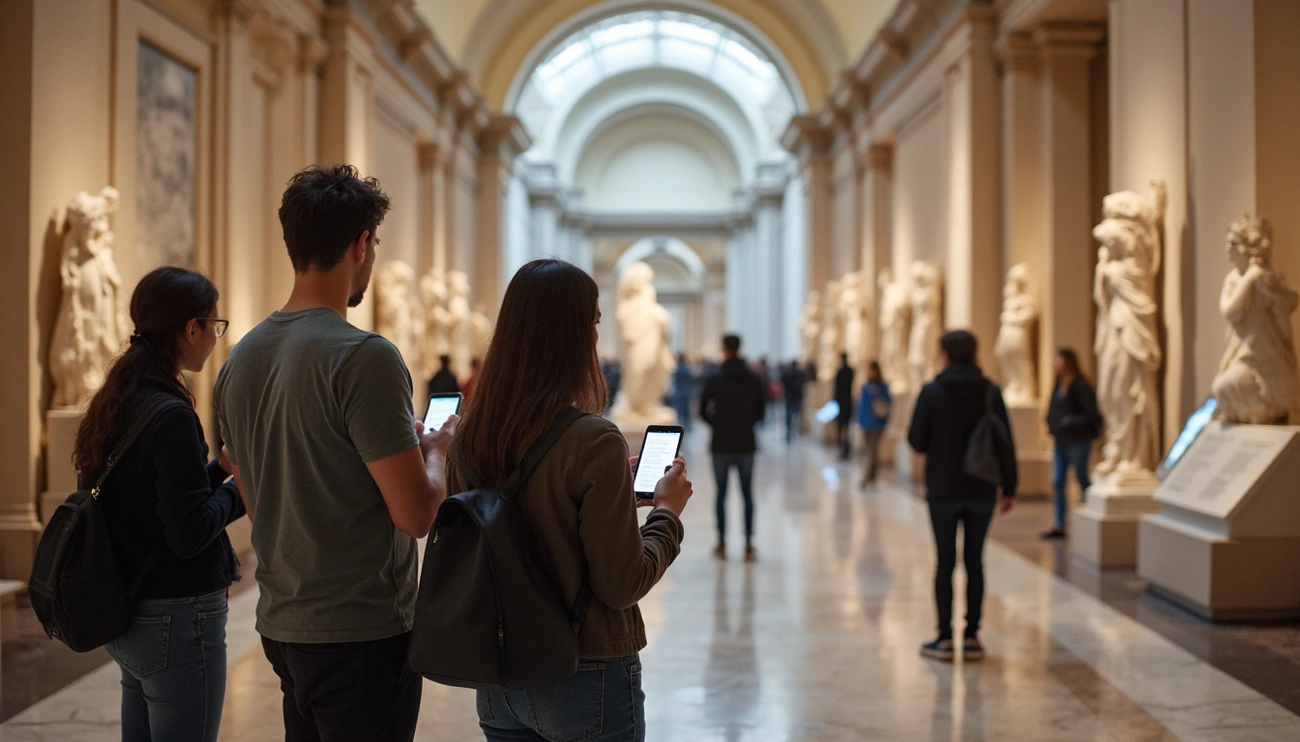
Comprehensive Wi-Fi infrastructure in museums and exhibition spaces: A guide for planners and decision-makers . Image for illustrative purposes, created using image AI.
Society's expectations and needs have changed significantly in the digital age. A Wi-Fi network in museums is now a basic requirement, not just a convenient amenity. Visitors now primarily access digital materials via their smartphones, a phenomenon that has a significant impact on museum operations.
Visitor needs in the digital age
The use of smartphones has fundamentally changed visitor behavior in cultural institutions. Visitors want to look up information online, share social media posts, and find their way around during their visit. This context-driven information and dissemination plays a particularly significant role in higher education and training.
It's interesting to observe that the digital target audience is growing in size and is not necessarily the same as the in-person audience. These online users have specific needs and desires that must be addressed. Analyzing digital usage patterns provides museums with valuable information about how many visitors use their services, how long they stay on specific pages, and what time of day the museum is busiest.
Digital mediation and mobile use
Because they offer visitors new ways to interact with exhibits and expand their knowledge, digital educational formats have become more important in museums. The use of educational programs that dynamically load multimedia material requires a functioning visitor Wi-Fi network.
Since the COVID-19 pandemic, another aspect has become clear: there is a growing need for purely digital access options – even far beyond periods of restricted access. Digital formats enable different ways of accessing exhibition content, background information, and contextual details. Furthermore, museums also benefit from engaging with their digital audiences through simple interaction methods such as chats , user-generated content uploads , and feedback tools .
A measurable criterion for a high-performance Wi-Fi infrastructure is its ability to allow up to five people in a room to simultaneously stream full HD videos to their smart devices without interruption. This supports modern mediation concepts such as augmented reality, virtual reality , and digital storytelling .
Expectations of modern cultural venues
“Mobile first!” – Cultural institutions must address this digital trend, as they increasingly expect not only a corresponding digital offering but also free on-site internet access. Digital transformation is one of the most significant challenges for museums, as evidenced by the growing demand for training and consulting on digitization-related topics.
Modern cultural venues must now connect the physical and digital worlds. Expertise and creativity in the development and application of digital technologies for documentation, education, and communication are hallmarks of a digitally competent museum. The core concept of the museum as an organization encompasses target group orientation, audience development, and community building.
Digitalization creates entirely new possibilities
Successful WLAN infrastructure planning is the first phase. This is followed by technical planning.
Analysis of WLAN coverage and requirements
Every effective network plan begins with a comprehensive Wi-Fi coverage survey. Identifying errors and developing the best solution is beneficial. In addition to improving network performance and quality, this systematic investigation ensures the necessary security.
The following factors must be taken into account in the needs analysis:
Required bandwidth and expected number of users
Special safety requirements
Support for specific devices or applications
The visitor Wi-Fi network should be sized to handle approximately 80% of the maximum number of visitors. Ticket sales figures from previous years provide a suitable data basis. Special events such as exhibition openings, with their peak usage, must also be taken into account for spaces like lecture halls or lobbies.
Goal definition: What should the WLAN achieve?
Clearly defining the objectives is crucial for the design of the Wi-Fi network. A visitor Wi-Fi network should primarily fulfill two functions: Firstly, it should allow guests to look up information online and post on social media. Secondly, it should provide the necessary foundation for mediation applications with dynamic multimedia data.
A measurable performance criterion is the ability to allow up to five people in a room to simultaneously stream full HD videos to their smart devices without interruption. Furthermore, the bandwidth must be expandable to accommodate increasing data traffic.
To avoid any impact on vital systems, the guest Wi-Fi must be completely isolated from the internal network for security reasons. The passive infrastructure consists of copper cables, fiber optics, and mounting hardware. It can be designed so that no further construction work will be required for the next 15 years, although the active infrastructure will need to be upgraded regularly.
Consideration of historic preservation and spatial structure
Historic buildings and listed museums are subject to special requirements. According to the Monument Protection Act (DSchG) , it must be verified whether the planned measure will affect the building's substance and structure. Structural alterations generally require a permit from the responsible monument protection authority.
The existing structure of historic buildings often presents a significant challenge. Without suitable solutions, internet access in locations with massive concrete ceilings, such as the Saar Historical Museum, which has exhibition spaces in the castle cellar, can be impossible. Access points must be positioned out of sight, concealed cable management systems implemented, and the existing lighting design taken into account to meet aesthetic standards.
Wireless technologies such as Wi-Fi repeaters and mesh networks offer good alternatives to cables when installation is difficult or prohibited. Furthermore, energy-efficient devices should be used to protect the existing architecture and the environment. Careful, future-proof planning is crucial; modular network solutions provide the necessary flexibility.
Technical implementation: from network integration to the access points
Building a robust Wi-Fi infrastructure in museums requires a thorough understanding of the technical elements and how they interact. The planning phase is followed by the actual implementation, which presents unique challenges.
Knowledge of the infrastructure mode of WLAN access points
In infrastructure mode, WLAN clients connect to the access point (AP), a central node. The AP establishes one or more wireless cells, manages access rights for WLAN clients to these cells, and organizes communication between clients as well as access to other networks. Particularly in larger WLAN applications, such as those found in multi-story or multi-building museums, several connected APs can provide shared access for WLAN clients.
The access point combines all WLAN clients into a wireless network and provides all network functions. It's important to note that in an infrastructure network, the access point sets the channel on which all WLAN clients send and receive data. This is crucial for the performance of the wireless LAN, as multiple WLANs may be operating on the same channel and potentially interfering with each other.
What hardware is needed for the WLAN infrastructure?
Required elements for creating a functional WLAN infrastructure:
As a key component of the infrastructure, access points must be carefully positioned . APs are placed under artificial ceilings or paneling using special brackets.
Control systems : With a single management interface, a FortiGate firewall act as a wireless controller to manage any connected access point.
Authentication systems : Systems such as a FortiAuthenticator , which manages visitor self-registration, SMS authentication and access logging, can be used for guest Wi-Fi.
Passive infrastructure: Mounting brackets, fiber optic and copper cables, and the necessary lightning protection can be used for approximately 15 years without further construction work if well planned.
However, active components such as access points and servers have an average lifecycle of five years. After this period, they need to be replaced, while the passive infrastructure remains in place.
Getic.de is a leading retailer of network equipment and accessories. The "UniFi Spare Parts" is particularly relevant for equipping showrooms with hardware, as it offers a wide range of access points and accessories.
Keep internal and visitor networks separate
For security reasons, the institution's network and the visitor Wi-Fi must be kept completely isolated to prevent any compromise of essential systems. Virtual local area networks, or VLANs, are frequently used to achieve this separation by logically dividing the network into multiple parts.
Multiple SSIDs are often set up for tourist Wi-Fi networks; for example, one SSID might be for public internet access and another for intermediary services such as interactive e-guides. SMS authentication makes sense for the latter to prevent misuse. Access may also be restricted to museum opening hours.
Power supply and cabling in historic buildings
A major problem in historic buildings is the wiring. Innovative solutions are needed when there are thick walls or significant attenuation due to metal or stone in the ceilings. Often, routing cables and lighting in museum rooms requires detours around several corners and through more permeable materials such as wood or glass.
Powerline adapters can be used to transmit the network signal over the electrical wiring when a wired installation is not possible due to structural limitations. An adapter that transmits the signal wirelessly can then be used to connect a Wi-Fi access point at the other end of the electrical circuit.
Another interesting approach is to move the network infrastructure outdoors. This involves mounting robust access points for outdoor use on masts and routing the Wi-Fi signal into the building through the windows. In fact, some projects have placed access points on the roof to provide coverage to the rooms below.
The angle at which the signal strikes an obstacle such as a wall can attenuate or reflect it. Therefore, the careful placement of special antennas (directional antennas, omnidirectional antennas) is crucial. To comply with the requirements of architects and historic preservation authorities, access points are sometimes painted in special RAL colors.
Future-proofing, maintenance and safety
Security is the foundation of any competent Wi-Fi system. In museums, where many visitors use the network daily, well-thought-out ideas for data security, maintenance, and sustainability are essential.
GDPR and Privacy in Museum Wi-Fi
In public Wi-Fi networks, the protection of personal information is of paramount importance. Museum operators are obligated to ensure that the information collected is used only for the contractually agreed-upon services. Wi-Fi providers are subject to additional regulations under the Telecommunications Act (TKG) and the PrivacyRegulation (GDPR) . In practice, this means that the guest Wi-Fi must be completely isolated from the internal network to prevent any impact on vital systems. A self-registration gateway with SMS authentication is recommended for the visitor Wi-Fi to prevent misuse.
Maintenance and remote maintenance concepts
Ideally, a functional support concept should consist of two levels: The institution itself provides the first, while a specialized service provider handles the second. Relatively little effort is required for effective monitoring and remote maintenance, thanks to well-established communication platforms such as TeamViewer or VPN. It is recommended to use a service level such as "Next Business Day Exchange" for hardware, which covers software updates, hardware replacement, and technical support for troubleshooting.
Planning the software and hardware lifecycle
The typical lifespan of active components, such as servers and access points, is about five years. They need to be replaced after this time, which will cost roughly half the original investment. However, with careful planning, the passive infrastructure—consisting of copper cables, fiber optics, and mounting structures—can be used for about 15 years without any additional construction work. Additionally, an asset recovery service with the disposal of outdated equipment in a Privacy friendly manner.
Expansion and scalability
If the museum expands or new departments are created, the Wi-Fi infrastructure should be designed for easy scalability using modular components. At the same time, the bandwidth must be expandable in case of increased traffic. Maintaining liquidity and avoiding significant upfront payments are two further advantages of flexible payment structures.
Options for visitors using digital technologies
The basis for state-of-the-art digital services to improve the museum experience is a modern Wi-Fi network.
Media companies, apps and BYOD
Visitors use their own smartphones to access digital content as part of the "Bring Your Own Device" (BYOD) concept . This approach saves museums money on distribution logistics, hardware, and maintenance. However, not every visitor has the right device. Consequently, a hybrid approach with additional features is being used.
There are several alternatives available when developing an app: Native apps typically work offline and are installed via app stores. In contrast, web apps don't need to be installed, but they require a strong Wi-Fi network that is available while viewing. In fact, 40–65% of people use digital guides when they are included in the admission price.
Local content and offline strategies
Digital products should also be accessible offline to ensure the best user experience. In this case, the museum's Wi-Fi can be used to provide local materials such as films, exhibition details, or interactive features. Furthermore, some museums include multimedia guides or dedicated media stations that allow access to dynamic content without a constant internet connection.
Multilingualism and accessibility
Excellent accessibility is made possible through digital services. Many museums offer materials in multiple languages, most commonly English, German, and others. While content for the hearing impaired can be presented in sign language, audio descriptions are helpful for blind people. Furthermore, products in plain language facilitate access for various target groups.
Usage analysis and statistics
Museums can obtain reliable information about visitor behavior, such as length of stay, preferred language, or most frequently used materials, by using individual codes. Digital offerings can therefore be tailored for optimal performance. Of course, Privacy must be respected in all evaluations.
Let's summarize
Finally, it should be mentioned that a well-designed Wi-Fi infrastructure is now a basic requirement and not an optional feature for contemporary museums.
However, a number of variables influence how well a museum's Wi-Fi works. A major obstacle in this regard is the structure of old buildings. To further reduce security concerns, the visitor network should always be kept separate from the internal network.
By investing in a future-proof Wi-Fi infrastructure, museums are now laying the foundation for a range of digital products, such as interactive media stations, multilingual audio guides, and accessible learning formats. They are also appealing to a broader audience that expects digital support during a museum visit.
Ultimately, there is no denying that the digital revolution in museums is progressing inexorably. Cultural organizations will remain relevant and find new ways to reach a broad audience if they actively shape this change and invest in a robust Wi-Fi infrastructure.
Sources, expert support and further information:
State Office for Non-State Museums in Bavaria:BYOD Operating Concept , https://museumsberatung-bayern.de/fileadmin/user_upload/Landesstelle/Beratungsthemen/fabulAPP/BYOD_Betriebskonzept_fabulAPP.pdf
Swiss National Museum, Landesmuseum Zürich / BeeLine Networks GmbH / Boll Engineering AG:Comprehensive Wi-Fi coverage in the Landesmuseum, https://www.boll.ch/datasheets/Fortinet_CaseStory_Boll_Landesmuseum.pdf
Computerworld : WLAN in historic buildings , https://www.computerworld.ch/business/firmenbeitraege/wlan-in-historischen-bauten-1345422.html
märz dv:Case study: Implementation of a modern WLAN infrastructure at Maxlrain Castle , https://www.maerz-dv.de/wp-content/uploads/2023/05/Fallstudie-WLAN-Maerz-Datenverarbeitung-GMBH.pdf
museum4punkt0 : A Wi-Fi infrastructure in exhibition areas , https://www.museum4punkt0.de/ergebnis/eine-wlan-infrastruktur-in-ausstellungsbereichen/
Social Solutions : What challenges and solutions exist when setting up Wi-Fi networks in historic buildings or listed buildings? , https://www.socialsolutions.group/welche-herausforderungen-und-loesungen-gibt-es-beim-aufbau-von-wlan-netzwerken-in-historischen-gebaeuden-oder-denkmalschutzgebiete/
State Office for Non-State Museums in Bavaria : The Expanded Museum – Media, Technologies and the Internet , https://www.berliner-museumsverband.de/wp-content/uploads/2021/07/das-erweiterte-museum-multimediale-elemente-als-vermittlungsbausteine-im-museum.pdf
Hessian State Museum Darmstadt (HLMD) : Terms of Use for Visitor Wi-Fi , https://www.hlmd.de/de/hlmd/wlan-nutzungsbedingungen/
Tobias Meyer Museum : IT infrastructure as the basis for digitization at the Tobias Meyer Museum , https://tobias-mayer-museum.de/?p=4915
DELL Technologies / Natural History Museum:Device management transformation for today's workplace , https://www.delltechnologies.com/asset/da-dk/services/support/customer-stories-case-studies/dell-technologies-natural-history-museum-customer-profile.pdf
museum4punkt0 : Ping! The museum app , https://www.museum4punkt0.de/aufnahme/ping-die-museumsapp/
German Federal Association for Museum Education (Bundesverband Museumspädagogik eV):Guidelines: A new media guide for museums , https://www.museumspaedagogik.org/fileadmin/Data/Fachgruppen/Digitale_Bildung/BVMP_Leitfaden_Entwicklung_Medienguide_2020_Juli.pdf
Deutsches Museum:The Deutsches Museum app , https://www.deutsches-museum.de/museumsinsel/besuch/app
Owner and Managing Director of Kunstplaza . Publicist, editor, and passionate blogger in the fields of art, design, and creativity since 2011. Graduated with a degree in web design from university (2008). Further developed creative techniques through courses in freehand drawing, expressive painting, and theatre/acting. Profound knowledge of the art market gained through years of journalistic research and numerous collaborations with key players and institutions in the arts and culture sector.
We use technologies such as cookies to store and/or access device information. We do this to improve your browsing experience and to display (non-)personalized advertising. If you consent to these technologies, we can process data such as browsing behavior or unique IDs on this website. Refusal or withdrawal of consent may adversely affect certain features and functions.
Functional
Always Active
Technical storage or access is strictly necessary for the legitimate purpose of enabling the use of a specific service expressly requested by the subscriber or user, or for the sole purpose of carrying out the transmission of a message over an electronic communications network.
Preferences
The technical storage or access is necessary for the legitimate purpose of storing preferences that were not requested by the subscriber or user.
statistics
Technical storage or access that is solely for statistical purposes.Technical storage or access that is used solely for anonymous statistical purposes. Without a subpoena, the voluntary consent of your internet service provider, or additional recording by third parties, the information stored or retrieved for this purpose cannot generally be used to identify you.
marketing
Technical storage or access is required to create user profiles, to send advertising, or to track the user on one or more websites for similar marketing purposes.



 Coastal Bohemian Interior wall mirror "La Principessa", abaca fibers, natural
219,95 €
Coastal Bohemian Interior wall mirror "La Principessa", abaca fibers, natural
219,95 €


