Basel is one of Europe's largest cultural centers . In the age of digitalization, the Kunstmuseum Basel, which is expanding its exhibition offerings with artificial intelligence, stands out in particular.
Kunstmuseum Basel, photo by Jean-Pierre Dalbéra
But what exactly is artificial intelligence , what can visitors expect at the Kunstmuseum Basel, and how is artificial intelligence changing the future of the art world?
Artificial intelligence, or AI for short, refers to the attempt to replicate the function of the human brain and mind using computers. The goal is to equip computers with the intelligence to find answers and solve problems independently.
Many people associate artificial intelligence with robots like the android "Data" from the sci-fi series "Star Trek," but in everyday life, we mostly encounter AI in connection with our laptops, smartphones, and tablets. We can talk to "Siri" on our phones, and Amazon's algorithm independently recommends new and relevant products. Such examples of artificial intelligence are referred to as "weak AI." They lack their own consciousness, empathy, or understanding and cannot independently find answers to specific questions.
Unlike a program where every step is pre-programmed and based on specific rules, AI uses an algorithm that can create individual steps itself. The AI itself doesn't write code, but rather modifies certain parameters within the code to recognize and utilize patterns in the input data.
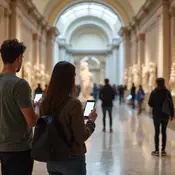
AI at the Kunstmuseum Basel. Photo by Possessed Photography, via Unsplash
AI at the Kunstmuseum Basel
A visit to Basel is worthwhile not only because of its numerous historical buildings , but also because of its vibrant art scene . You should allow plenty of time and ideally rent a holiday home near the city to explore Basel and its surroundings at your leisure.
A particular highlight is undoubtedly the Kunstmuseum Basel. As one of the first art institutions, the museum utilized artificial intelligence exhibition“The Incredible World of Photography”
Since 2020, the vast collection of images by Ruth and Peter Herzog, encompassing the entire era and subject matter of analog photography and comprising 20,000 images, has been accessible in a new way. Previously, only around 400 images could be viewed on site.
The centerpiece of the exhibition is located in the middle of the tour, on a gigantic wall projection . There, the full extent of the collection becomes apparent, as the entire screen is filled with overlapping photographs. When visitors scan their museum ticket at one of two scanning stations, a randomly selected photograph is enlarged. Using image recognition, the algorithm then selects similar images that complement it, constantly generating new clusters and connections.
When a second museum ticket is scanned, the algorithm merges the two randomly selected images, creating vanishing points between two motifs from different time periods. Visitors can thus playfully identify parallels and differences.
How AI is revolutionizing the art world
Artificial intelligence will play an increasingly important role in the future of the art world, as the collections of various museums and galleries grow and it becomes increasingly difficult to give interested people access to the multitude of diverse artworks.
Algorithms can address the individual needs of visitors and individual exhibitions, thus helping to create a low barrier to discovering and enjoying art
This video is embedded using YouTube's enhanced Privacy mode, which blocks YouTube cookies until you actively click to play the video. By clicking the play button, you consent to YouTube placing cookies on your device, which may also be used to analyze user behavior for market research and marketing purposes. For more information about YouTube's use of cookies, please see Google's Cookie Policy at https://policies.google.com/technologies/types?hl=de.
The potential applications of AI systems in the art world are diverse and largely untapped. Algorithms can extract information from vast amounts of data, the complexity of which humans could never grasp. This is particularly true for images, drawings, videos, and other formats that lack a uniform structure and therefore cannot be searched by programs. For example, AI could be used to verify the authenticity of artworks.
In the future, AI systems could also welcome visitors, provide them with information about individual artworks or entire collections, and answer their questions. Support for visually impaired people is particularly conceivable, as AI robots and computers can deliver detailed image descriptions and relevant facts, making exhibitions accessible to previously disadvantaged groups.
What opportunities does artificial intelligence offer museums and galleries? Photo by Jessica Pamp, via Unsplash
The future of artificial intelligence in art
For many artists and art lovers, artificial intelligence and “real” art seem like two opposites that simply don't fit together.
This video is embedded using YouTube's enhanced Privacy mode, which blocks YouTube cookies until you actively click to play the video. By clicking the play button, you consent to YouTube placing cookies on your device, which may also be used to analyze user behavior for market research and marketing purposes. For more information about YouTube's use of cookies, please see Google's Cookie Policy at https://policies.google.com/technologies/types?hl=de.
As in many other areas, digitalization is also causing uncertainty in the art world. People fear for their jobs, and quite a few harbor the irrational fear that machines will one day slip out of our control and develop a conscious life of their own.
But in art, too, humans and machines will be inextricably linked in the future, and not only because humans alone lack the skills and resources to collect, organize, and access all the artworks of a species. Like smartphones and laptops, AI systems should also be understood as tools that support us and simplify data-related tasks.
AI will by no means eliminate jobs in the art world, but rather transform them for the better. The sheer volume of data bombarding us today means that, in many professions within the art world, people are spending more time on analysis and processes than on the actual core of their work.
AI enables many professions to refocus on the essentials and address complex tasks that require human awareness, rather than simple routines that can also be taken over by AI systems.
For art museums and galleries, AI opens up entirely new ways to present artworks and present information about art. This creates an exciting new approach to art, attracting audiences who have previously shown less interest in art and its history. Interaction with artworks becomes more playful and contemporary.
Those interested in artificial intelligence in the context of art can now experience AI in various art venues in Switzerland and Germany.
These include, for example, the House of Electronic Arts in Basel with the exhibition “ENTANGLED REALITIES – LIVING WITH ARTIFICIAL INTELLIGENCE” , which examines how AI affects social life.
At the ZKM in Karlsruhe, the topic of AI and AI art critically examined from different perspectives as part of “The Intelligent Museum” using various approaches to AI-supported digital art
The German Museum Bonn become a place to experience artificial intelligence with its exhibition “Mission AI”
Owner and Managing Director of Kunstplaza . Publicist, editor, and passionate blogger in the fields of art, design, and creativity since 2011. Graduated with a degree in web design from university (2008). Further developed creative techniques through courses in freehand drawing, expressive painting, and theatre/acting. Profound knowledge of the art market gained through years of journalistic research and numerous collaborations with key players and institutions in the arts and culture sector.
We use technologies such as cookies to store and/or access device information. We do this to improve your browsing experience and to display (non-)personalized advertising. If you consent to these technologies, we can process data such as browsing behavior or unique IDs on this website. Refusal or withdrawal of consent may adversely affect certain features and functions.
Functional
Always Active
Technical storage or access is strictly necessary for the legitimate purpose of enabling the use of a specific service expressly requested by the subscriber or user, or for the sole purpose of carrying out the transmission of a message over an electronic communications network.
Preferences
The technical storage or access is necessary for the legitimate purpose of storing preferences that were not requested by the subscriber or user.
statistics
Technical storage or access that is solely for statistical purposes.Technical storage or access that is used solely for anonymous statistical purposes. Without a subpoena, the voluntary consent of your internet service provider, or additional recording by third parties, the information stored or retrieved for this purpose cannot generally be used to identify you.
marketing
Technical storage or access is required to create user profiles, to send advertising, or to track the user on one or more websites for similar marketing purposes.







 Fluffy high-pile rug, grey (200 x 290 cm)
225,00 €
Fluffy high-pile rug, grey (200 x 290 cm)
225,00 €


