Even a seemingly boring book can be quite exciting from the right perspective, and you can make these classics more exciting for yourself – a little background knowledge helps to generate genuine interest, as will now be demonstrated by an overview of Adalbert Stifter's life:
Adalbert Stifter – a rather tragic figure
Adalbert Stifter was born in 1805 in a small village in the Bohemian Forest, now Horní Planá in the Czech Republic, near the Austrian border. Horní Planá has just over 2,000 inhabitants and, apart from a few memorials to Adalbert Stifter, offers something of interest to some politicians, writers, artists, and interested contemporary witnesses with the "Oberplaner Gespräche" ("Hornoplánské rozpravy") every autumn. However, it probably offers just as few leisure activities for local youth as it did in Adalbert Stifter's time.
It wasn't that Adalbert had time or money for leisure activities: His father died in an accident when he was 12 years old, his mother Magdalena raised him alone with very little money, and the teenager had to work hard on his grandfather's farm. Only his other grandfather recognized that little Adalbert had a bright mind, and he ensured that Adalbert was allowed to attend secondary school (back then, these were called Latin schools).
The Latin school young Stifter attended must have been truly excellent, a Benedictine monastery in Kremsmünster in a beautiful landscape; Stifter later called his school days, which lasted until 1826, the best time of his life (although he too had to read the old and new poets there).
Although these poets had clearly inspired him, and he wrote his first works immediately after finishing secondary school, Adalbert was also expected to learn a proper trade first, and so he began studying lawFederal student aid (BAföG) didn't exist back then; Stifter financed his studies as a private tutor, which presupposes that he had his mind together.
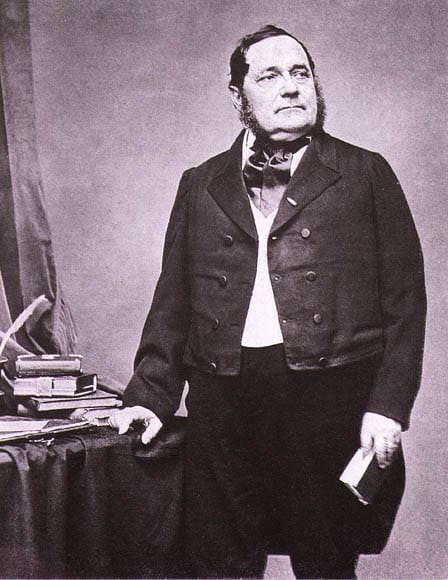
Photo portrait of Adalbert Stifter
But that wasn't the case; Stifter fell unhappily in love with Fanny Greipl, the daughter of a wealthy merchant. She was initially quite taken with him, but her mother found the poor student, who was unsure whether to finish his law degree or pursue art, completely unsuitable and spread rumors about the relationship. Stifter suffered greatly, with negative consequences for his work, and in 1830 he abandoned his studies without graduating.
Like many unhappily in love men, Stifter had the idea that other mothers also had beautiful daughters – he became involved with the milliner Amalia Mohaupt and married her in 1837. Not a good idea, Amalia proved not only to be quite simple-minded, but also quite spendthrift; she had given up her work as was common at the time, and in the year of their wedding the bailiff was at their door for the first time, and again in 1841.
In his desperation, Stifter even began to paint pictures, which brought in a little money, but things only started to improve somewhat when he published the story “The Condor” in a Viennese art and literature magazine , a modest success, which was followed in 1841 by the story “Wildflowers” .
The publisher of the art magazine then supported him until Stifter became famous with “Abdias” in 1842. This, in turn, earned him a lucrative position as a private tutor to the son of the famous Prince Metternich.
Stifter was now financially independent for the first time in his life, at the ripe old age of 37. In the following years, he wrote his major works: "Brigitta" and "Das alte Siegel" in 1844, "Der Hagestolz" and "Der Waldsteig" in 1845. Alongside these, he revised his early stories and presented them in the first volumes entitled "Studien," which were also well received.
However, the tide quickly turned; the last two volumes of the studies, published in 1850, were no longer successful, and the newcomer was sharply criticized by the already established poet Friedrich Hebbel : Stifter embodied a "descriptive nature that was broad and expansive" and "rhetorically reached as far as Poland".
When one reads a text by the eloquent Hebbel, who also published in the most prestigious newspapers of the time, in direct comparison to a text by Stifter, one tends to agree…
In the revolutionary year of 1848, the revolutionary supporter and progressive liberal Stifter moved to Linz, where he appointed school inspector and state conservator , but was also increasingly plagued by financial worries. His marriage, which was probably happy in itself, was strained by childlessness and the mysterious death of a foster daughter, and his cirrhosis of the liver caused increasing problems – on January 26, 1868, Stifter cut his carotid artery with a razor on his sickbed and died two days later.
Even the facts of this summary of Stifter's life, based on officially available data, move and touch empathetic people, but for a curious reader with a bit of a sense of drama, the questions are only just beginning:
If his beloved Fanny Greipl found Stifter quite attractive, how could her mother destroy the relationship? Was Stifter simply too "lukewarm," or too insecure, or was money involved? If he was now enjoying himself with Amalia Mohaupt as a substitute, why did he feel compelled to marry her if she was intellectually inferior to him and also wasted his money?
Is it related to Hebbel's sharp criticism that Stifter can only record initial successes? Was this criticism, despite all its justification, also a kind of negative campaign by the VIP, against which Stifter could not defend himself?
Why couldn't Stifter live on his salary as a school inspector and state conservator – a salary that was probably quite decent even back then? Was Amalia still spending his money excessively? If his marriage to Amalia was supposedly so happy, why did his adopted daughter Juliane run away from home several times, and why was her body eventually found in the Danube? Was it an unbearable atmosphere in the Stifter household, an accident, suicide, or a crime?
As you can see, with a little imagination Stifter's life really becomes quite adventurous and dramatic; a crime writer would actually be licking their fingers at this source material.
Owner and Managing Director of Kunstplaza . Publicist, editor, and passionate blogger in the fields of art, design, and creativity since 2011. Graduated with a degree in web design from university (2008). Further developed creative techniques through courses in freehand drawing, expressive painting, and theatre/acting. Profound knowledge of the art market gained through years of journalistic research and numerous collaborations with key players and institutions in the arts and culture sector.
We use technologies such as cookies to store and/or access device information. We do this to improve your browsing experience and to display (non-)personalized advertising. If you consent to these technologies, we can process data such as browsing behavior or unique IDs on this website. Refusal or withdrawal of consent may adversely affect certain features and functions.
Functional
Always Active
Technical storage or access is strictly necessary for the legitimate purpose of enabling the use of a specific service expressly requested by the subscriber or user, or for the sole purpose of carrying out the transmission of a message over an electronic communications network.
Preferences
The technical storage or access is necessary for the legitimate purpose of storing preferences that were not requested by the subscriber or user.
statistics
Technical storage or access that is solely for statistical purposes.Technical storage or access that is used solely for anonymous statistical purposes. Without a subpoena, the voluntary consent of your internet service provider, or additional recording by third parties, the information stored or retrieved for this purpose cannot generally be used to identify you.
marketing
Technical storage or access is required to create user profiles, to send advertising, or to track the user on one or more websites for similar marketing purposes.



 "Flower of Life" stud earrings, 925 sterling silver
32,90 €
"Flower of Life" stud earrings, 925 sterling silver
32,90 €