The art market is undergoing a noticeable transformation. Digital platforms, new buyer groups, and changing market conditions are shaping how artworks are bought and sold today. This article provides a current overview with helpful insights.
For a long time, the art market was considered an exclusive world with its own rules. Anyone wanting to acquire a work of art went to a gallery, visited a fair, or sat in the hall of an auction house.
These places still exist, but they no longer stand alone. A look at the key developments reveals what is actually changing for buyers and sellers.
Experts distinguish between the primary and secondary markets. On the primary market, artworks are offered for sale for the first time, usually through galleries that support and develop artists over the long term.
The secondary market encompasses all further sales. Here, works change hands again via auction houses, art dealers, or private contacts. For well-known artists, this is often where the publicly visible prices are achieved.
Trade fairs, museums, critics, and collections influence both areas. They help determine which positions receive attention. This very structure has been in flux in recent years.
What is changing buying and selling today
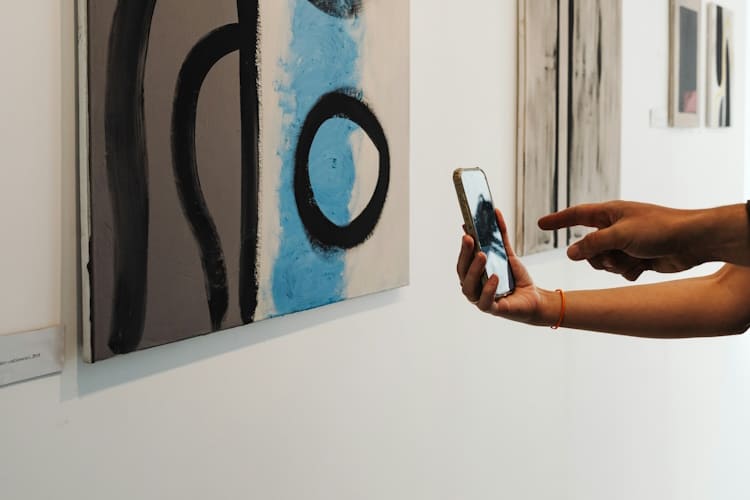
The art market is changing: How buying and selling are evolving. Photo by Karolina Grabowska @kaboompics, via Unsplash
Several developments are currently intertwined. Some concern technology, others buyer behavior or the role of dealers. Together, they are changing the ways in which art finds its audience.
The art market is shifting online
Galleries are increasingly presenting their collections online, often with images, dimensions, and prices. Online galleries and platforms connect artists directly with interested parties, eliminating the need for a physical exhibition space.
Auctions are also increasingly taking place with live bidding via the internet. Those who previously had to travel to the event can now bid from the comfort of their sofa.
However, a screen cannot replace the experience of encountering the original. Surface, material, and spatial effect can only be captured to a limited extent in a photograph.
Many buyers therefore primarily use the internet for research and then visit the factory in person. The digital presence thus serves mainly as a showcase for the showroom.
Galleries remain important points of contact
Despite all the digitalization, specialized auction houses retain their importance, especially for established names. Anyone to buy or sell art by Günther Uecker , can find advice there on authenticity, condition, and price.
Galleries today often combine both: initial contact is made online, but the decision is made in a personal conversation. Especially with larger sums of money, a relationship of trust with the dealer remains essential.
More transparency in pricing
Previously, prices in the art market were hardly comprehensible to outsiders. Today, it is possible to research the results of past auctions and compare offers from different sellers.
This creates a more solid basis for decisions. However, a single winning bid says little about the value of another work. Technique, format, condition, and provenance often make significant differences.
Furthermore, many sales continue to take place discreetly. Galleries and private dealers do not always publish their prices, so public data only reflects a fraction of what is happening.
New buyers with their own expectations
In addition to long-time collectors, younger people are entering the market, often first gathering information via social media. They expect transparent pricing, prompt communication, and excellent documentation.
Many people are looking for art that complements their living environment. Smaller formats, prints, and limited editions offer an accessible entry point. For artists, this opens up new opportunities to build their own audience.
Auction or gallery as a sales channel
Anyone wanting to sell a work of art is usually faced with a choice between two options. These differ in process, costs, and predictability:
Galleries offer individual consultations and strategically connect works with suitable collectors.
Auction houses reach a wide audience, but the final bid price remains undecided until the very end.
Both options involve commissions or surcharges, the amount of which should be clarified in advance.
An article about the first art auction explains exactly how an auction works and what forms it can take . This preparation is particularly worthwhile for beginners.
Regardless of the chosen path, realistic price expectations are helpful. This leads to some practical tips for anyone new to this world.
Tips for getting started in the art market
A first purchase doesn't have to be expensive or complicated. More important than a large budget are curiosity, patience, and a certain degree of diligence. The following principles have proven effective:
Visit exhibitions, fairs and open studios to hone your own taste
Compare prices from several providers and ask questions if anything is unclear
Pay attention to documents regarding origin, invoices, and proof of authenticity
Plan for costs for framing, insurance and transport from the beginning
Political decisions also affect the art market. Since 2025, a reduced tax rate, which is intended to strengthen galleries in international comparison.
Those who are familiar with these conditions can better assess offers and make more relaxed decisions.
Between tradition and new paths
The art market has become more open, digital, and diverse. Galleries, auction houses, and online platforms now complement each other and reach different target groups.
For buyers and sellers, this means more choice and information. However, expertise, careful due diligence, and reliable partners remain the optimal foundation for any sound decision.
Owner and Managing Director of Kunstplaza . Publicist, editor, and passionate blogger in the fields of art, design, and creativity since 2011. Graduated with a degree in web design from university (2008). Further developed creative techniques through courses in freehand drawing, expressive painting, and theatre/acting. Profound knowledge of the art market gained through years of journalistic research and numerous collaborations with key players and institutions in the arts and culture sector.
We use technologies such as cookies to store and/or access device information. We do this to improve your browsing experience and to display (non-)personalized advertising. If you consent to these technologies, we can process data such as browsing behavior or unique IDs on this website. Refusal or withdrawal of consent may adversely affect certain features and functions.
Functional
Always Active
Technical storage or access is strictly necessary for the legitimate purpose of enabling the use of a specific service expressly requested by the subscriber or user, or for the sole purpose of carrying out the transmission of a message over an electronic communications network.
Preferences
The technical storage or access is necessary for the legitimate purpose of storing preferences that were not requested by the subscriber or user.
statistics
Technical storage or access that is solely for statistical purposes.Technical storage or access that is used solely for anonymous statistical purposes. Without a subpoena, the voluntary consent of your internet service provider, or additional recording by third parties, the information stored or retrieved for this purpose cannot generally be used to identify you.
marketing
Technical storage or access is required to create user profiles, to send advertising, or to track the user on one or more websites for similar marketing purposes.








 Bar stool / Bar Chair "Cloud" with cream-colored upholstery