Jonathan Meese – Work and Legacy

Jonathan Meese is undoubtedly one of the most interesting German artists of our time. He is also almost certainly one of the most controversial artists of our time. Which makes an attempt at understanding his work all the more worthwhile.
Show table of contents
What kind of art does Jonathan Meese actually create?
Jonathan Meese paints and shapes sculptures , designs performances and installations , shoots video art , puts together collages and conceives stage designs or productions for theatre .
In German, he does a lot in all areas of art; a common element is rather the frequency with which he also makes dubious personalities of world history, unsympathetic heroic sagas and threatening ancient myths the subject of his works.
This choice of theme makes sense when one observes how frequently Meese attempts to reference “German delusion” and German mythologies in his work, sometimes in a quite aggressive manner. In a self-proclaimed tradition of the historical revisionist Anselm Kiefer, Meese engages in a similar kind of “exorcism” when his installations employ terms such as “blood hospital, archreligion, harvest and sowing, arch-mercenary Richard Wagner , private army and weapon.”
According to Meese
It's all just toys. That's all there is to it. Whether communism, National Socialism, ancient Egypt, or ancient Rome, nothing comes back. I can't hope for a revolution from the streets anymore; humanity can't do that. We should unleash something else, let the volcano of art erupt.

by Warburg [CC-BY-SA-3.0], via Wikimedia Commons
Despite dropping out of his studies in 1998, Meese quickly proved to be an exceptional talent, he was welcomed by artistic luminaries of the time such as Daniel Richter and Leander Haußmann, and above all, he set an incredible pace:
The exceptional talent Meese
Following initial exhibitions during his studies, Meese created the scenery and stage designs for the film “Sonnenallee” by Claus Boje, Leander Haußmann and Detlev Buck in the same year. This resulted in a production that grew into a comprehensive spectacle by the artist, who was by then also active as an author: “Mr. Deltoid's aka Urleandrusus' – Sonnenallee – AHOI DE ANGST – FAIR WELL Good Bye” was shown in 1999 at the Neuer Aachener Kunstverein.
With the role of the mad artist in “Sonnenallee,” Meese worked as an actor for the first time. In 1999, the following exhibitions took place: the window display and artist's book presentation “Frontbibliothek Meese” at the Walther König bookstore in Cologne; the exhibitions “Schnitt bringt Schnitte” at the Schnitt exhibition space (both in Cologne); “Sonnentanz/ Der Weidenmann/ Nahrung/ Erzisis” at the Kunsthalle St. Gallen; “Wunderkammern: Erzreligion Blutlazarett/ Erzsöldner Richard Wagner / Privatarmee Ernte und Saat/ Waffe: Erzblut der Isis/ Nahrung: Bluterz” at the Frankfurter Kunstverein; “Information – Erlösung – Wiederkehr/ Richard Wagners Privatarmee Lichterz” at the Kunsthalle Bielefeld; and “Gesinnung '99 – Der letzte Lichtstrahl des Jahrtausends,” with Erwin Kneihsl at Contemporary Fine Arts in Berlin.
During this time, Meese also became known abroad: In 1998, at the first Berlin Biennale, presented the installation "Ahoi der Angst" (Ahoy of Fear), a colorful collage dedicated to the Marquis de Sade, in which politicians, musicians and actors were included, and visitors could listen to music and read poems, but also watch the video Caligula.
This installation, adorned with numerous posters, was Meese's first work to receive extensive media coverage beyond Germany's borders. Here, one can read the first comments reflecting a total confusion that would later become typical of Meese: The artwork was described as a "labyrinth of sentimentality" (Art magazine), but also as a "chamber of horrors somewhere between porn, Charles Bronson, and Slayer" (Peter Richter) or as a "cluttered boy's room" (Berliner Zeitung).
In 1998, Meese could also be seen in Vienna, in the group exhibition “Junge Szene '98”, in Basel at the art fair “Liste 98”, in London as a participant in the exhibition “Site Construction” of the South London Gallery and in Marseille at the exhibition “Today Tomorrow” of the Galerie de l'Ecole Supérieure des Beaux-Arts de Marseille.
From 1999 onwards, his appearances increased, both nationally and internationally, in group exhibitions and as solo presentations. There are interesting spatial installations and performances to see; one thing is certain: Meese himself will also be present.
Whether in disguise or as part of a collage, in a painting or drawing, or simply in action, the artist always makes his body available when he imbues his works with themes of coming to terms with history and with allusions to German philosophy and literary history. Meese does not shy away from also evoking Adolf Hitler in his performances and actions; on several occasions, he has provocatively displayed the forbidden Hitler salute.
In 2004, Meese returned to the theater, designing the set for Frank Castorf's production of "Cocaine" at the Volksbühne in Berlin. He also worked for the Avignon Theatre Festival and the Salzburg Festival. In 2005, he created the set for "Magic Afternoon," directed by Angela Richter, which was performed in Hamburg, Berlin, and Düsseldorf.
In 2006, he directed the play “Zarathustra. The Figures Are on the Move” with Martin Wuttke in the Neuhardenberg Palace Park and created the set design for Frank Castorf’s “Die Meistersinger” at the Volksbühne in Berlin. That same year, he also conceived the work cycle “The Whip of Memory” with Daniel Richter, which resulted in works by both artists exploring their engagement with history.
The impetus for the work idea was the medieval grave of the Archbishop of Stade, Gottfried von Arnsberg; the exhibition will first be shown in the Kunsthaus Stade, and the group of works, which Meese supplemented in the meantime, will travel on to Berlin and Hamburg, Rosenheim and Freiburg, Grenoble and Biel until 2011.
In 2007, he directed his first own play at the Volksbühne Berlin, which, with its cumbersome title “De Frau – Dr. Pounddaddylein – Dr. Ezodysseuszeusuzur”, had to fight for attention and also found little applause in terms of content.
Among other things, it was criticized that the colorful mix of penises and dolls, swastikas and skeletons and banners was already familiar; “He may bring something fresh to the Volksbühne, but in his own art he goes around in circles,” was the comment from the magazine “Die Zeit”.
In any case, the stage design for Castorf's "Fuck Off America" at the Berlin Volksbühne in 2008 marked the end of his theatre work until Meese took over the stage design for "Dionysus" at the Salzburg Festival in 2010.
Meese all over the world
Meanwhile, Meese's first comprehensive overview of his work, “Mama Johnny,” at the Deichtorhallen in Hamburg is already providing several months of typical Meese entertainment, with over 150 sculptures and paintings, photographic works and installations, for example with an oversized “Black Box” as an exhibition space for one of his stage designs and with two equally huge, walk-in sculptures.
With this retrospective, Meese had succeeded: Immediately after its end in September 2006, Meese was ranked among the hundred most important artists in Germany in the artist ranking of Capital magazine in October (a place he has essentially maintained to this day), and since 2008 he has been allowed to design the medal for the Roland Berger Prize for Human Dignity.
Since then, many more exhibitions by Jonathan Meese have been shown, some with new themes: “Erzstaat Atlantisis” (Dictatorship of Art) at the Arp Museum Bahnhof Rolandseck in Remagen in 2009 dealt with Joseph Beuys’ works on the theme of Atlantis in around 170 sculptures, over a dozen paintings and artist’s books, ten films, 4 sound sources and a large collage .
Meese's self-promotion was more skillful than ever; at the opening, Meese, in uniform and in a military jeep standing on a ferry, crossed the Rhine several times, and then, accompanied by the press and shouting slogans about the "dictatorship of art", took over the Arp Museum Rolandseck.
Also in 2009, Meese in Italy took on the writer Gabriele D'Annunzio, whom he exposed as one of Mussolini's mentors and a leading figure of the Italian fascists in an installation with the beautiful title "AHAB says: MOBY DICK is NOT DEMOCRACY, ALL DEMOCRATS will soon NO LONGER be sitting in one BOAT (Battleship of ART will never sink)" and an equally beautifully titled radio performance ("DON LOLLYTADZIOZ Metabolismys doesn't stink (POOPS)").
There it is again, the coming to terms with history, and it is also evident in the exhibition entitled "Meat is harder than steel - MEERPFERD FÖTUSMANN UND BEAUSATAN KÄSE AN DER OZBAR (Die geilblökenden THINGER)", in which Meese and Herbert Volkmann presented works in the Goslar Mönchehaus Museum in autumn 2009 that deal with Goslar's history as a residential city and National Socialist Reich Farmers' City.
In the Goslar Hall Manifesto, published concurrently, Meese prophesies that the “dictatorship of art will soon encompass everything” and explains that “art is not a religion, but every religion is art.” One of these hall manifestos also delights us with such important insights as the following: “All Japanese schoolgirl panties are total art, since they are, incidentally, the metabolic processes of the human animal.”.
At the same time, his “Gören” were included in the Cologne Sculpture Park in 2009, which of course cannot do with such a short title, but call themselves in full “We, Archchildren learn power (Sweet Village of the Damned) = Gören”.
In any case, they are quite figurative and quite beautiful, and thus works of art that can appeal even to the average person with a general cultural background. They might not find the Humpty Dumpty machine of the total future, which was installed in front of the Alte Nationalgalerie in Berlin in 2010, particularly appealing, but all tech-savvy tinkerers have a great deal of fun with it.
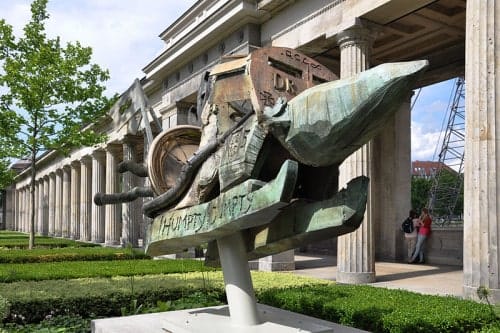
by Photo: Andreas Praefcke (Own work) [CC-BY-3.0], via Wikimedia Commons
Meese's artistic drive – contentious and controversial
If you're fed up with the disregard for humanity and the environment shown by those in power, you might at first glance like the artist's idea of the "dictatorship of art," which, according to Meese, is "about the most loving rule of a thing, such as love, humility, and respect, summarized and culminating in the rule of art." However, Meese's dictatorship of art reveals a rather elitist claim; he even very decisively distinguishes art from all works with utility and pleasing beauty.
As Meese put it in an art discussion on the occasion of documenta in 2012: “I suffer from the fact that I am sold sculptures as art, but in reality they are design. I suffer from the fact that I am shown shitty paintings that are actually hyped-up illustrations.”
If you are fed up with unlimited self-power, you will probably not be able to warm to such a dictatorial claim, according to which only “the thing rules, like light, breathing, jelly (ore), love or total beauty, like Scarlett Johansson.”
In this case, however, you might appreciate Meese's recurring tendency towards the grotesque, with which he not only parodies Nazi figures or uses National Socialist trash vocabulary to "turn against the beautiful, the true, and the good" (Harald Falckenberg, head of the Phoenix Art cultural foundation in Hamburg, according to whom "fools have a purifying power in society because they question what is right").
When Meese provocatively displays the Hitler salute in many actions, it is probably still appropriate as a cautionary reminder, and it seems that “a generation” is not “so free from this shadow”, as Georg Diez noted in his article “Playing Führer – Why German artists should keep their hands off Hitler” in Die Zeit in July 2007, as the outdated mindset can still be felt in many corners of Germany.
The following short video offers a glimpse into the staging art of Meese (his complete sculptural work is on display for the first time at the Arp Museum Rolandseck under the title "Erzstaat Atlantisis"). KULTUR.21 discusses the artist and his world of myths:

Featured Art

Design and Decor Highlights
-
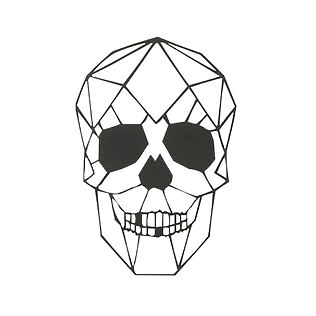
 J-Line wall decoration "GeoSkull" - Geometric metal art, black
59,90 €
J-Line wall decoration "GeoSkull" - Geometric metal art, black
59,90 €
VAT included.
Delivery time: 2-4 working days
-
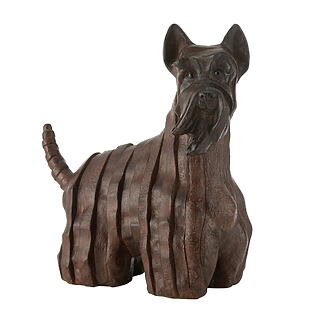
J-Line Decorative Dog Sculpture "Scottish Terrier" made of dark brown resin (large)
119,00 €
VAT included.
Delivery time: 1-3 working days
-
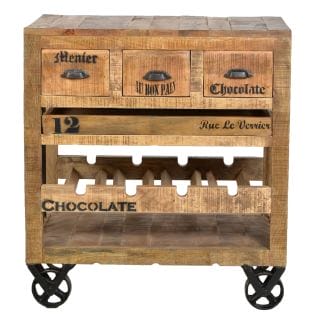
Wine cabinet made from recycled mango wood, antique black metal fittings
1.065,00 €
VAT included.
Delivery time: 6-11 working days
-
Sculptural table lamp "Contour" made of papier-mâché (white)
145,00 €
VAT included.
Delivery time: 2-4 working days
-
J-Line TV cabinet with 1 drawer, wood / metal
The original price was: €899.00449,00 €The current price is: €449.00.
VAT included.
Delivery time: 5-8 working days
-
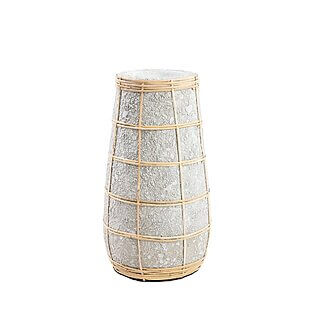
"Cutie" terracotta vase with raffia details (grey) - M
38,00 €
VAT included.
Delivery time: 3-5 working days
-
J-Line 7-piece nativity scene figure set, resin (brown)
125,00 €
VAT included.
Delivery time: 3-5 working days