Emilia and Ilya Kabakov or “The Russian Soul of New York” – Part 1

Emilia and Ilya Kabakov are among the most important painters and conceptual artists in the world because they have been surprising the world with original Russian art from New York .
New York isn't exactly in the heartland of Russia; the fact that genuine Russian art is created here is both surprising and should be. But that's not the only surprising thing about the Kabakovs and their story – a glimpse into the lives of these two artists reveals one wondrous art narrative after another, garnished with subtle wit and a defiance that is as positive as it is persistent.
What is certain is that the Kabakovs are among the world's most celebrated artists, known wherever people can freely create and appreciate art (on the most neutral available list of the world's best artists, Emilia and Ilya Kabakov have long been ranked just outside the top 100). A little of the remaining, more open to interpretation, is revealed below to truly pique your curiosity about art and artists:
Ilya and Emilia Kabakov's path to art as a professional home
Ilya Kabakov was born on September 30, 1933, in Dnipro, which was called Dnepropetrovsk until 1991 as part of the USSR and Dnipropetrovsk again until 2016 as part of Ukraine. Theoretically, life in this large city on the Dnieper River (today Ukraine's fourth-largest city with nearly 1 million inhabitants) would be wonderful, with a mild Mediterranean climate and the Sea of Azov, a giant bathtub within easy reach, whose water temperature often reaches 30°C in summer. But it wasn't meant to be; today, Eastern European squabbles disturb the peaceful life there; certainly not at the time of Ilya Kabakov's birth
World War II was imminent; Kabakov's father was drafted (and later died at the front), and Kabakov and his mother were evacuated to Samarkand (now Uzbekistan). There, from 1943 onwards, Ilya Kabakov is said to have attended the art school of the Leningrad Academy of Fine Arts, which had also been evacuated to Samarkand.
However it came about (Kabakov's mother actually had some more important things to do than arrange for her son's free art education), it was a brilliant move in the middle of the war to let a 10-year-old live.
Brain research has established and confirmed that creative activities create neurons and neural connections that contribute to a positive mood. In fact, they are so effective in positively reshaping the brain (and thus the rest of the body) that creative activities now have a firm place in trauma therapy.
Art brings joy, perhaps initially (in the duress, after the tragic event) only in tiny parts/for a short time – in the worst case, it is only about preserving a certain positive, human potential (this is the reason why soldiers at the front pursue all sorts of cheerful activities, which is often perceived as heartless from the outside or in retrospect).
But a neuron is a neuron, in war and in peace; blissful experiences/emotions always lead to the release of certain substances; these substances always promote the formation of brain connections that are good for the brain and the person.
Furthermore, since the age of seven or eight, young Kabakov had lived in an environment with a foreign language (in Samarkand, Tajik is spoken, not Russian or Ukrainian as in Dnipropetrovsk), so attending art school was also a refuge in familiar childhood surroundings.
The seed of "art" had certainly been sown, and after the war, Ilya Kabakov went to Moscow to further his training in this field. From 1945 to 1951, he attended an art school in Moscow, and from 1951 to 1957, he studied graphic design and book illustration at the Surikov Moscow Art Institute (a branch of the venerable Moscow School of Painting, Sculpture and Architecture, which, after its division into art and architecture, devoted itself to artistic training), graduating with a diploma.
Kabakov is therefore a qualified graphic designer and book illustrator , who studied at the two major art schools in his home country.
He was trained in the then-prevailing or mandated style of “socialist realism” , but is said to have studied Cézanne and all other international art he could get his hands on, and even to have made free drawing studies from nature (an outrageous deviation for a worker in matters of state-mandated art).
Whether this was because young Kabakov had absorbed too much ancient Islamic culture and primal Islamic freedom of thought in the Uzbek highlands to be able to tolerate the ideological stench of socialist realism , or whether he simply felt no desire “optimistically forward-looking workers of a collective farm on a tractor” , is irrelevant; his yearning for freedom would later break through unstoppably.
Initially, after graduating, Kabakov worked dutifully as a children's book illustrator for a while. But simply having seen Cézanne was such a good argument against the attempt to spoil children's books by illustrating the socialist realities of the working world that this didn't last very long: in 1965 he did become a member of the USSR Artists' Union, which was actually an ideological branch of the Communist Party.
Membership gave Kabakov the right to exhibit his works, but by no means the actual opportunity. Therefore, since 1967, Kabakov's attic apartment in the center of Moscow increasingly became a hub for the unconventional, dissenting Moscow artists who, in dictatorships and totalitarian states, are called dissidents.
A term that is unknown in democracies, because in those countries everyone has a fundamental right to express their opinion freely and without hindrance (not to be confused with unconstitutional incitement to hatred or criminally relevant insults that follow the phrase "one should still be allowed to say").
Ilya Kabakov himself developed into a Moscow conceptual artist whose works initially reflected the Russian mentality and addressed the social limitations and daily problems of his fellow citizens in the USSR. Soon, his first utopian architectural designs emerged, until Kabakov finally arrived at social utopias and began to explore them in depth. He did so mostly with humor and irony, always with a (bitter) connection to reality.
From 1978 onwards, Kabakov created his first murals in which he parodied the “official art” of the Soviet system , embellishing them in a collage-like manner with corresponding texts. Subsequently, the collage technique was further expanded in his installations, culminating in 1981 in the story of the man who never threw anything away (an installation with various boxes full of papers and sheet music, surrounded by all the other trash that belongs to this man's identity).
Kabakov was still involved when a group of rebellious Moscow artists launched "Moscow Conceptualism" Soz Art (Soz Art being what Pop Art elements, scattered to Russia, made of Socialist Realism), and they did so outside the official Soviet art scene. However, Kabakov was already preparing to leave; soon, works that he was not allowed to exhibit in the USSR mysteriously found their way to the West.
In 1985, Kabakov was invited to his first solo exhibitions in France (June 11 to July 13, 1985, “Ilya Kabakov”, Galerie Dina Vierny, Paris) and Switzerland (August 31 to November 18, 1985, “Ilya Kabakov: On the Edge”, Kunsthalle Bern) – 25 paintings and 490 drawings made their way there, but unfortunately the artist was not allowed to travel.
Even without him, Kabakov's artworks continued to travel to Marseille and Düsseldorf in 1986; the first installations made their way to Switzerland in 1986 via adventurous routes for the exhibition “Rauminstallationen und Bildwerke aus dem 80er Jahren” (15.08. – 03.09.1986, Neue Galerie, Schlössli Götzental, Dierikon), and the “Ilya Kabakov” exhibition was on display at the Centre National des Arts Plastiques in Paris from 19.11.1986 to 11.01.1987.
For an episode of TateShots, reporters visited the artist couple Kabakov at their Long Island home in New York, where they have lived for over thirty years, while preparing for their first major museum exhibition in the UK at Tate Modern (2018):
In early 1986, Mikhail Gorbachev initiated the process of restructuring and modernizing the Soviet Union, which we know as Perestroika; this was accompanied by Glasnost, literally openness, freedom of information, freedom of speech, one could also simply speak of freedom of opinion and of the press or democratization of the state.
With the works for the exhibition “Contemporary Art from the Soviet Union: Ilya Kabakov and Ivan Tchuikov” (February 20 – April 20, 1987, Museum of Contemporary Art, Basel, Switzerland), the artist was finally allowed to leave the country, initially remaining in the West on a scholarship from the Graz Art Association, and would not return home as long as his homeland was still called the USSR.
From March 20, 1988 to April 8, 1988, “rescued” and new Kabakov works were on display in the exhibition “Before Dinner” (organized by the Graz Art Association) in the foyer of the Graz Opera House; also in April 1988, art and artists made the leap from Austria across the Atlantic: April 30, 1988 to June 4, 1988, exhibition “Ten Characters”, Ronald Feldman Fine Arts, New York, USA.
This is where Emilia comes in , then still Emilia Lekach; a Russian emigrant who had been working as a curator and art dealer in New York since 1975.
Emilia Lekach was born in the USSR in 1945. From 1952 to 1959, she studied at the Moscow Music School, from 1962 to 1966 at the Irkutsk Conservatory, and from 1969 to 1972 at Moscow State University, where she studied Spanish language and literature. In 1973, Emilia emigrated to Israel with her entire family. In 1975, she moved from Israel to New York, where she soon began working as a curator and art dealer, a position she still holds today. And here's the best part—it's almost unbelievable: Emilia Kabakov Lekach was also born in Dnipropetrovsk.

Photography by Valerij Ledenev [CC BY-SA 2.0], via Wikimedia Commons
Emilia Lekach and Ilja Kabakov, two people from one of dozens of large cities in a country whose area, even in its smaller current form, is exactly 47.84 times the size of Germany, meet 7,904 km away from that city in New York, and they both work in the field of contemporary art.
A man and a woman, 54 and 42 years old, with similar educations and passions, and similar terrible experiences under governments that disregard human rights, had even met in their youth in Moscow – wouldn't it be rather strange if they didn't marry?
The fact that this story has not yet been turned into a Disney fairy tale is probably due to the age of the protagonists.
This isn't a story of a blonde princess "still dreaming" and her seemingly carefree, future-promising hero, but rather of two established contemporary artists who, for many good reasons, decide to live and work together. Even without Disney, their story unfolds like a fairy tale, and with their combined strength, the two are destined to achieve worldwide fame in a short time
Free world, free mind, good work
Ilja Kabakov remained in New York and began working with Emilia Lekach in 1989. The artistic couple developed a collaborative working style in which each of them gave, and still gives, their best – to varying degrees depending on the project.
In 1992, Ilja Kabakov and Emilia Lekach became an artist couple and, at the latest with this step, became parts of an artistic working partnership in which woman or man are each “half of the artist” (if anyone thinks they can express this constellation in correct gender language: Please, gladly!).
This working partnership, so often touted as something very special, doesn't have much that's spectacular about it upon closer inspection: Two people work together (as equals, of course) and take care to make the best possible use of each other's talents and to cushion each other's weaknesses as best as possible.
A sensible basic model for any project that people undertake together and that should function in the long term without suppressing the partner(s).
You might also be interested in:

Featured Art
Design and Decor Highlights
-
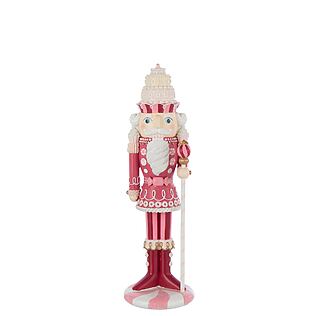
 J-Line nutcracker in a playful candy lollipop design (pink/white)
119,00 €
J-Line nutcracker in a playful candy lollipop design (pink/white)
119,00 €
VAT included.
Delivery time: 2-3 working days
-
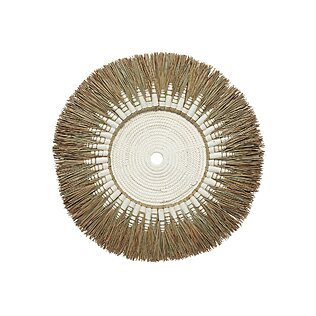
The Raffia Macrame Wall Decor (white-natural)
124,95 €
VAT included.
Delivery time: 2-4 working days
-
Hypoallergenic lambskin rug in classic black (50 x 85 cm)
67,00 €
VAT included.
Delivery time: 3-5 working days
-
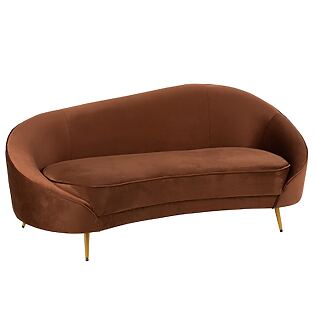
J-Line 2-seater sofa "Elisabeth" in sculptural design, brown
799,00 €
VAT included.
Delivery time: 4-8 working days
-
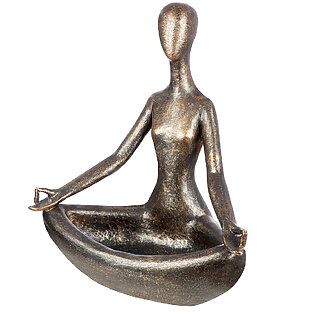
Semi-abstract sculpture "Relaxing" with antique finish, for indoor and outdoor use
Original price was: €145.00125,00 €The current price is €125.00.
VAT included.
Delivery time: 2-4 working days
-
J-Line Abstract Aluminum Figure "Two Faces" on Black Base
149,00 €
VAT included.
Delivery time: 2-3 working days
-
J-Line Christmas tree "PAMPA" with white artificial snow look and 400 LED lights
685,00 €
VAT included.
Delivery time: 3-5 working days