Artists and other creative professionals have a unique set of criteria when renting a home: In many cases, the property should be able to serve as both a living space and a professional studio, or at least a small office.
For process-oriented work, visual artists often desire high ceilings, stable lighting, and ventilation. Performing artists, on the other hand, require strong soundproofing of the structure to prevent noise from disrupting their work. Digital and media artists, however, need commercial-grade internet connections with high redundancy, and upload speeds are often more critical than download speeds.
From the landlord's perspective, a well-known adage applies: a reliable tenant is worth their weight in gold to property owners. They pay on time, treat the property with care, and plan for long-term use. Attracting precisely these kinds of tenants requires not only experience but also a professional approach. The real estate team in Lahr supports owners in finding suitable tenants and renting out their properties profitably – securely, efficiently, and transparently.
What tenants should generally pay attention to when choosing a property
Location and infrastructure
Location is one of the most important factors for renters. Apartments in neighborhoods with good infrastructure, short commutes, and quick access to public transportation are particularly sought after. Proximity to shops, restaurants, schools, kindergartens, and green spaces significantly increases the value of a property. Families also place great importance on a quiet and safe environment.
Apartments in central or popular urban areas usually achieve higher rental income and attract responsible tenants who want to stay long-term.
Safety and environment
Security is a crucial factor for many tenants when choosing an apartment. Properties located in quiet residential areas or equipped with access control, video surveillance, and modern locking systems are highly sought after. A well-maintained neighborhood and bright outdoor areas further enhance trust and a sense of security.
Parking
A parking space or underground garage is a must for many tenants. Nobody wants to search for a parking space every evening. A secure, nearby parking option therefore significantly increases the attractiveness of your property and often justifies a higher rent.
Apartment furnishings and condition
What artist tenants look for when choosing a property. Photo by Melrose By The Lake @melrosebythelake, via Unsplash
To attract high-quality and reliable tenants, your property should be in impeccable condition.
Key points:
Technical equipment : All devices and installations should be fully functional.
Cleanliness : A freshly cleaned and well-maintained apartment conveys a sense of value.
Renovation : Small modernizations or a new coat of paint create a positive first impression.
Amenities : A kitchen with modern appliances, a washing machine or dishwasher are clear advantages.
A well-maintained bathroom, a bright living area and a well-thought-out room layout also contribute to tenants feeling comfortable in the long term.
Building condition and additional areas
The condition of the building plays a significant role. Intact heating, water, and electrical systems are crucial to avoid future repairs. Additional space—such as a balcony, terrace, or storage room—is equally valuable. These details enhance quality of life and make your property stand out from the competition.
Key space requirements for artist tenants
Whether a unit can function well as an art studio often depends directly on the decision to rent it. Creative workers look for spaces that can be designed in a specific way, are the right size, and offer the right kind of logistical support.
Living/working configuration and space requirements
For artists, an open floor plan ideal, as it offers them the greatest freedom in using the space and makes it easier for them to switch between creating art, storing it, and exhibiting it. This flexibility is essential for artists who work from home as their primary source of income.
For many artists, an open floor plan is ideal. Photo by Alex Tyson @alextyson195, via Unsplash
The size of the studio must meet the needs of the media. For example, a photographer needs at least 5 meters by 3 meters of space to handle standard paper rolls (2.72 meters wide) and maintain the correct distances between the camera, the model, and the background. A minimum size of approximately 6 meters by 4 meters is usually necessary to accommodate storage, tools, and technical equipment.
Furthermore, artists typically seek out spaces with high ceilings for very practical reasons, such as accommodating tall easels or allowing sufficient light to filter through. There can also be a psychological benefit to ceiling height. Spaces with higher ceilings (like 3 meters) can encourage people to think more broadly and creatively. Meanwhile, spaces with lower ceilings encourage people to focus on details. High ceilings give you a sense of "creative freedom ," and in real life, they help clear away any toxins that build up during the creative process.
Infrastructure for warehousing and logistics
In a space that serves both as a living and working area, storage is essential. To save valuable floor space, artists need to smart, vertical storage solutions . Pegboards, floating shelves, and wall-mounted grids are just a few ways to keep tools within easy reach. Trolleys and mobile containers can be used for storage on the go and for easy organization when guests arrive. Labeled drawers and clear containers ensure everything runs more smoothly by making items easy to find.
In addition to integrated solutions, artists require external sources for finished works, specialized tools, or large quantities of materials. The optimal way to store finished artworks is in a museum-like off-site storage facility with enhanced climate control, security systems, and fire protection. These solutions are highly specialized and expensive, but they are essential for long-term preservation.
Self-storage units and other lower-cost options present significant problems regarding their functionality. Most facilities prohibit operating a business, selling art, or using the space as a business address. Importantly, most self-storage units lack basic utilities such as heating, running water, or adequate ventilation. Because they lack sufficient air circulation and artificial lighting, they are often unsafe or unsuitable for working with vapor-producing materials. This means the artist must use the unit almost exclusively as a studio.
Specific needs depending on the field of activity
When choosing a rental apartment, it is often the small details that the average tenant overlooks, but which can be crucial for the professional practice of artists. These details vary depending on the artistic field.
Visual artists
Lighting and light control
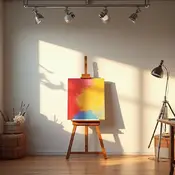
Artists working with images need light that is stable and color-accurate. In the past, they sought light coming from the north because it is even, soft, and diffused, without the harsh shadows and dramatic shifts that come with direct sunlight. This even light is crucial for accurately seeing colors and values, giving you greater control over your work.
For visual artists, direct daylight is the best option. Photo by Pablo Merchán Montes @pablomerchanm, via Unsplash
If there is insufficient daylight, additional artificial lighting must meet strict quality standards to resemble natural light. The following requirements should be met:
Color temperature : Light bulbs must be in the range of 5000 K–5500 K, which is very close to the color of natural daylight. Cooler lights above 5500 K impart an undesirable blue tint, and lights below this range impart a yellow or red tint. This makes it difficult to mix colors correctly.
Color Rendering Index (CRI) : A CRI of 90 or higher is required to ensure true color reproduction, which is important for artists who use dyes or colors that easily change their hue.
Light intensity , measured in lux, can range between 250 and 450 lux for detailed work such as classical art. It depends on the style and the distance.
Ventilation and safety
Many fine art techniques, such as screen printing, acid etching, and spray painting, use materials that emit hazardous fumes or dust; therefore, these techniques require adequate ventilation to ensure safety. To effectively remove contaminants, artists should local exhaust ventilation (LEV) systems . These systems have specialized components, such as slotted hoods or flexible ducting systems, that are positioned near the source. Most technical standards require an exhaust airflow rate of approximately 0.7 CFM per square foot.
Process artists working in standard rental apartments face challenges because they require specialized air, often of very high volume. For LEV (Light Air Ventilation) to function, either permanent structural modifications (such as installing ventilation ducts) or the use of specialized tools are necessary, which contradicts the terms of most rental agreements.
Furthermore, most leases contain clauses regarding hazardous materials, obligating the tenant to pay for their removal and any damages resulting from a breach. The artist cannot perform processes safely or ethically without professional ventilation, and cannot legally install the necessary system without violating the lease. This conflict between professional necessity and the lease agreement makes it very difficult for artists working with process-intensive media to find a space that meets their needs.
Performing artists (dealing with sound and noise)
For bands and artists, acoustic requirements are paramount, as they must satisfy their neighbors and comply with local laws. Basically, there are two different sets of requirements:
Soundproofing , also "sound insulation ," is an important aspect of construction. Soundproofing prevents mechanical sound energy from entering or leaving a room through floors, walls, and ceilings by using specialized tools and materials.
Sound control , also sound absorption , is the process of eliminating unwanted frequencies in a room. This is usually done with acoustic panels or foam to improve the sound quality for recordings or rehearsals. Sound control improves the acoustics within the room, but it doesn't prevent sound from traveling to adjacent units.
Landlords face significant structural and financial challenges due to the need for high-quality soundproofing. Effectively blocking noise requires expensive, invasive, and potentially permanent construction methods such as specialized insulation, double-glazed windows, and soundproof walls. These modifications increase construction costs, materials may deteriorate over time, and future repairs will be more difficult. As a result, musicians who need to practice loudly (such as drummers or musicians in an amplified band) cannot realistically utilize standard multi-family rental apartments because they are too expensive and difficult to implement.
If soundproofing is not carried out properly, it can directly lead to legal disputes. Legally, tenants have the right to the "quiet use" of their apartment. If a musician's noise exceeds local laws or the building's quiet hours, it could infringe on a neighbor's rights. This could lead to the landlord intervening and imposing fines. In the worst-case scenario, the lease could even be terminated.
Digital and media artists
For people who work as animators, software artists, or designers of interactive installations, high-speed internet is a fixed cost they cannot do without. It is needed to synchronize digital art, perform real-time updates, and operate large displays.
The broadband needs of these artists differ from those of most remote workers and are often higher. A speed of 50–100 Mbps is fine for most remote work, but creative digital artists often send huge files (such as submissions and finished animations) that require more bandwidth and, more importantly, fast upload speeds.
Digital artists require symmetrical, commercial connectivity with high upload capacity and reliability to remain productive and meet the minimum studio requirements. This differs from regular users, whose needs primarily revolve around downloading. If landlords want to attract this group, they should focus on improving their infrastructure to ensure that multiple users and devices can connect to the internet reliably.
Location, accessibility and the creative cluster ecosystem
For artists, the choice of rental location is based not only on convenient accessibility and a practical location for logistics, but also on the desire to be part of a creative community that supports each other.
Neighborhood that inspires creativity
Creative professionals often prefer living in diverse, unconventional, and mixed neighborhoods that bring together various subcultures. They frequently visit these areas for inspiration and to be perceived as living in a true cultural hub, which is also beneficial for business.
Being located near a vibrant arts scene provides artists with important motivation and support, aligning with their expressed desire to engage and collaborate within the community. Often, building complexes that include multi-purpose community facilities, ground-floor gallery spaces, and residential units facilitate artists' integration into the community.
Accessibility from a logistical perspective is also essential. If the artist wants to attract clients or participants for courses and workshops, the studio must be easily accessible. This means there must be sufficient parking or excellent public transport connections. It is also crucial that the location facilitates the transport of large or unwieldy artworks and materials.
Creating creative meeting spaces and addressing the problem of gentrification
Creative urban development utilizes art, culture, and design activities to strengthen communities and support economic, physical, and social change in many urban planning and economic development schemes. People understand that art can boost economic growth by bringing new energy, highlighting specific neighborhoods, and inspiring people to find new uses for a place.
Gentrification, on the other hand, is a profound social and economic problem that accompanies this lifestyle. The study shows that artists seeking affordable and attractive housing are often the first to help a neighborhood improve. Their presence, typically in commercial arts districts, is associated with the area's upgrading and significant increases in the number of highly educated people living there.
As property values rise, so do rents, leading to the displacement of long-term residents, as well as small businesses and artists who helped make the area popular in the first place. While the influx of new people is good for the economy, it also displaces what initially attracted creative people – affordability.
Therefore, cities must not forget the importance of combining efforts to revitalize areas with measures to prevent artists from leaving. Strategies focused on long-term affordability, such as supporting non-profit rental models, are necessary to ensure that the fine arts remain a stabilizing force and do not simply cause rapid, damaging demographic change.
About Immokanzlei24
Immokanzlei24 assists property owners with all aspects of selling and renting real estate. With experience, local market knowledge, and personal commitment, the team ensures professional handling and lasting results. Transparency, discretion, and expertise are always paramount.
Lahr – Living and Life in the Ortenau region
Lahr lies in the heart of the Ortenau region, nestled between the Black Forest and the Rhine Plain – a region that perfectly combines nature, business, and quality of life. The city boasts a charming historic old town, green parks, and excellent infrastructure. Thanks to its proximity to Offenburg, Freiburg, and Strasbourg, Lahr is an attractive place to live not only for families but also for commuters.
Find the ideal tenant with the help of experts
If you want to successfully rent out your property in Lahr or the surrounding area, rely on experience and trust. The real estate team in Lahr supports you from assessing the rental price and creating the property listing to selecting suitable tenants.
Contact us now – and benefit from a comprehensive service that puts your property in the best possible hands.
Owner and Managing Director of Kunstplaza. Journalist, editor, and passionate blogger in the field of art, design, and creativity since 2011. Successful completion of a degree in web design as part of a university study (2008). Further development of creativity techniques through courses in free drawing, expressive painting, and theatre/acting. Profound knowledge of the art market through years of journalistic research and numerous collaborations with actors/institutions from art and culture.
Category for interior design,residential design, object furnishings, product and material innovation.
Here you will find everything that makes an interior designer's heart race. We present to you the latesttrendsand developments in the world of home design, as well as innovative products and materials for unique space design.
Our goal is to provide our readers with inspiration and help them creatively redesign or completely transform their living spaces.
We place great importance on ensuring that our articles are not only esthetically pleasing but also include practical tips.
We also introduce you to successful interior designers – from newcomers to the most well-known names in the industry – so you can be inspired by their projects and get to know their working methods.
Whether it's about making the most of a small space or furnishing your home with new furniture in the trendy industrial style: With us, you will find all the information you need on the topic of interior design!
We use technologies like cookies to store and/or access device information. We do this to improve the browsing experience and to show (non-)personalized ads. If you agree to these technologies, we can process data such as browsing behavior or unique IDs on this website. The refusal or withdrawal of consent may adversely affect certain features and functions.
The technical storage or access is necessary for the legitimate purpose of storing preferences that are not requested by the subscriber or user.
Always active
Die technische Speicherung oder der Zugang ist unbedingt erforderlich für den rechtmäßigen Zweck, die Nutzung eines bestimmten Dienstes zu ermöglichen, der vom Teilnehmer oder Nutzer ausdrücklich gewünscht wird, oder für den alleinigen Zweck, die Übertragung einer Nachricht über ein elektronisches Kommunikationsnetz durchzuführen.
Vorlieben
Technical storage or access is required for the lawful purpose of storing preferences that have not been requested by the subscriber or user.
Statistiken
The technical storage or access that is used exclusively for statistical purposes. The technical storage or access that is used exclusively for anonymous statistical purposes. Without a subpoena, voluntary compliance by your internet service provider, or additional records from third parties, information stored or retrieved for this purpose alone cannot usually be used to identify you.
Marketing
Die technische Speicherung oder der Zugriff ist erforderlich, um Nutzerprofile zu erstellen, um Werbung zu versenden oder um den Nutzer auf einer Website oder über mehrere Websites hinweg zu ähnlichen Marketingzwecken zu verfolgen.





 Minimalist earrings "Shiva Eye" made of 925 sterling silver and shell, maritime jewelry
19,90 €
Minimalist earrings "Shiva Eye" made of 925 sterling silver and shell, maritime jewelry
19,90 €


