With LED profiles, light becomes an integral part of the decor. A line of light at the front, under the shelf, highlights objects. A profile at the top of a niche transforms it into a small stage. A picture looks best when the light hits it at an angle of approximately 30 degrees. Warm white light with high color rendering displays colors accurately, while a subdued brightness protects delicate artwork.
That a line of light can itself become a form was demonstrated early on in art. The American artist Dan Flavin specialized in commercially available fluorescent tubes and, from 1963 onward, exhibited only light art. He achieved his breakthrough with the "Diagonale of May 25th." His works are exhibited, among other places, at the Hamburger Bahnhof in Berlin and the Kunstsammlung Nordrhein-Westfalen in Düsseldorf. What transforms a gallery wall there can be transferred on a smaller scale to a shelf or a wall niche.
In living spaces, the aluminum profile takes on this role. It holds the LED strip, dissipates its heat, and its cover determines the appearance of the light. An overview of the available designs, from surface-mounted to flush-mounted profiles, can be found at sk-led.com.
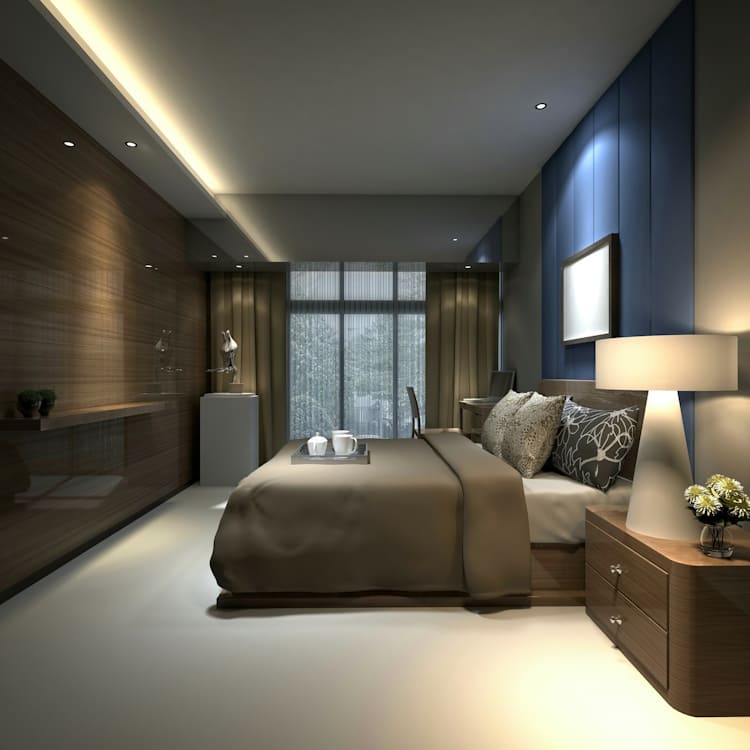
Light as a design element – the experts from SK-LED revealed to us how to effectively illuminate shelves, niches, and pictures with LED profiles. Photo by Getty Images @gettyimages, via Unsplash
inserted into plasterboard and filled with joint compound
Light gap in wall or ceiling, niche
shadow gap profile
In drywall construction, light exits from the side
wall that is evenly striped from above
The cover determines the character of the light. Clear covers let in the most light, but show every single LED. Opal and satin covers diffuse the light and create a smooth line, but reduce brightness slightly. Black covers are barely noticeable when switched off.
LED lighting design – installation examples. This image is for illustrative purposes and was created by us using image AI.
Shelves and display cases: Light facing forward
The best position for a light strip on a bookshelf is at the front, under the shelf, shining diagonally backwards. If the strip hangs on the back wall, the books in front of it will cast shadows on their own spines. A corner profile on the front edge directs the light by 45 degrees and is less glaring than a strip that is simply glued flat.
For collections and ceramics displayed in a showcase, it's worth considering the contrast. According to the museum brochure from licht.de, an object only truly stands out when it's at least five times brighter than its surroundings. At a ratio of 1:20, distinct accents emerge, while at 1:100, a display becomes dramatic, which is only achievable in a very dark environment. Therefore, an illuminated shelf in a brightly lit room will be lost. In the evening, when the other lights are dimmed, it becomes truly prominent.
Niche markets: plan early, stock late
A wall niche creates a striking effect when light falls from above onto the back wall and objects, while the light source itself remains hidden. Drywall and recessed profiles disappear completely into the wall. The catch is timing: they must be installed during the interior finishing phase. They cannot be retrofitted into a surface that has already been plastered and painted; in that case, a surface-mounted profile remains.
Define the cable exit point before filling the gaps, for example using an end cap with a cable hole.
Insert the strip only after filling, sanding, and painting. Otherwise, dust and paint overspray will end up on the illuminated surface.
Provide an accessible location for the power supply, for example in a cavity wall box next to it or in the suspended ceiling.
The profile and strips on the 24-volt side are assembly work, as long as the power supply is disconnected from the mains. However, if the power supply is permanently connected to the building's electrical system, Section 13 of the Low-Voltage Connection Ordinance: Apart from the network operator, only an installation company registered in an installer directory is permitted to do this.
Highlighting pictures and picture walls
Museums use the so-called 30-degree museum angle. This is the angle at which the light hits the painting. If the angle is steeper, long shadows are cast under the frame. If the light source is too far from the painting, the viewer quickly finds themselves in the light and casts their own shadow on the artwork. For living spaces, licht.de suggests as a rule of thumb to direct the light diagonally from the ceiling at a distance of about 0.5 to 1.5 meters.
The beam angle depends on the image size. For sculptures and small formats, licht.de recommends narrow angles of 10 to 30 degrees, and for large images, 30 to 60 degrees. For images behind glass, shielded lights and narrow beams are essential; otherwise, the light source will be reflected in the glass.
A gallery wall with many frames, on the other hand, doesn't need individual spotlights. A wallwasher is a better fit here: a shadow gap profile on the ceiling evenly distributes light across the entire wall. The pictures can then be rearranged without anyone having to readjust a light fixture.
Protect delicate artworks from excessive light
LED light is virtually free of UV and infrared radiation. This protects original artworks, but not completely, as visible light also alters pigments and paper. According to licht.de, light damage is cumulative and irreversible. The decisive factor is the dose, i.e., illuminance multiplied by time. The technical brochure on museum lighting, based on the technical specification CEN/TS 16163, the following guidelines:
A calculation example illustrates what this means at home. A watercolor painting illuminated for eight hours a day at 50 lux accumulates 400 lux hours per day, or around 146,000 per year. This is just below the recommended level. At 200 lux, the annual dose would be reached in just over three months. A timer or dimmer switch helps, and direct sunlight should be avoided on paper paintings anyway.
Light color and color rendering
For living spaces, warm white light between 2,700 and 3,000 Kelvin is the usual choice, as it makes wood and paper appear more inviting. For artwork, color rendering is more important than the light color. The initiative licht.de recommends a minimum CRI of 80 for picture lighting, and many LED strips specify a CRI of 90 or higher in their datasheets. Anyone displaying original artwork should check this value in the datasheet.
The powerful influence of light on spaces can be experienced in winter even outside one's own home. a list of light-related events in Franconia, ranging from museums to mountain bonfires.
Before screwing the profiles in place, a test run is worthwhile: Temporarily attach a strip to the planned location with painter's tape and observe the effect from the sofa in the evening. Only drill when the angle, brightness, and light color are correct.
Planning & practical tips from a professional
Plan niches early: Drywall and recessed profiles must before interior finishing. Determine cable exit points beforehand!
Keep it clean: LED strips only after filling, sanding and painting.
Power supply position: Provide an easily accessible location (e.g., a cavity wall box). Caution: Permanent connection to the mains power supply must only be carried out by a qualified electrician!
Color rendering index (CRI): For images, look for a minimum Ra 80, ideally CRI > 90 (for true-to-life colors). Light color in living spaces: Warm white (2,700 – 3,000 Kelvin).
The sofa test: Before drilling, temporarily attach the LED strip with painter's tape and test the effect from the sofa in the evening!
Owner and Managing Director of Kunstplaza . Publicist, editor, and passionate blogger in the fields of art, design, and creativity since 2011. Graduated with a degree in web design from university (2008). Further developed creative techniques through courses in freehand drawing, expressive painting, and theatre/acting. Profound knowledge of the art market gained through years of journalistic research and numerous collaborations with key players and institutions in the arts and culture sector.
Category for interior architecture, interior design, room design, home design, commercial furnishing, product and material innovation.
Here you'll find everything an interior designer's heart desires. We present the latest trends and developments in the world of home design, as well as innovative products and materials for creating unique spaces.
Our goal is to provide our readers with inspiration and help them creatively redesign or completely transform their living spaces.
We place great importance on ensuring that our articles are not only esthetically pleasing but also include practical tips.
We also introduce you to successful interior designers – from newcomers to the most well-known names in the industry – so you can be inspired by their projects and get to know their working methods.
Whether it's about making the most of a small space or furnishing your home with new furniture in the trendy industrial style: With us, you will find all the information you need on the topic of interior design!
We use technologies such as cookies to store and/or access device information. We do this to improve your browsing experience and to display (non-)personalized advertising. If you consent to these technologies, we can process data such as browsing behavior or unique IDs on this website. Refusal or withdrawal of consent may adversely affect certain features and functions.
Functional
Always Active
Technical storage or access is strictly necessary for the legitimate purpose of enabling the use of a specific service expressly requested by the subscriber or user, or for the sole purpose of carrying out the transmission of a message over an electronic communications network.
Preferences
The technical storage or access is necessary for the legitimate purpose of storing preferences that were not requested by the subscriber or user.
statistics
Technical storage or access that is solely for statistical purposes.Technical storage or access that is used solely for anonymous statistical purposes. Without a subpoena, the voluntary consent of your internet service provider, or additional recording by third parties, the information stored or retrieved for this purpose cannot generally be used to identify you.
marketing
Technical storage or access is required to create user profiles, to send advertising, or to track the user on one or more websites for similar marketing purposes.



 Small rattan hanging lamp "Fini" (natural)
44,95 €