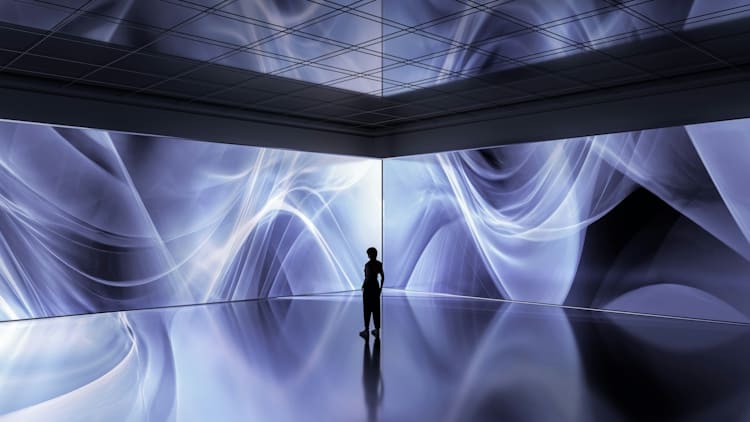
The exhibition space is black until a foot crosses the threshold. Suddenly, small points of light detach themselves from the wall, follow the movement, condense into abstract sculptures in the silence, only to rush back into nothingness. Such moments are no longer the exclusive domain of luxury hotels. In interactive installations, the audience is elevated from mere spectator to critical co-creator of the performance.
The unique aspect: The aesthetic form is directly influenced by the actual presence and decisions of the people in the space. This invisible, continuous cycle is at the heart of these works: An action is performed, a system processes the input, and the installation reacts.
What was once the exclusive realm of expensive specialized laboratories can now often be designed directly at one's own desk in a studio using miniature electronics. However, the path from the initial fleeting idea to weeks of continuous gallery presentation is fraught with technical challenges that are rarely addressed at traditional art academies. If one wants to use cameras, radars, and sensors as artistic materials, one must first understand the logic of the machines.
Most reactive work runs on a single-board computer, roughly the size of a credit card. However, the performance of these small boards has changed dramatically in recent years. Today, we'll be discussing true edge computing in practice. This means that sensor data is processed locally—at the "edge" of the network—rather than being sent with significant delay to cloud servers on the internet.
Many of these devices have their own camera port. A MIPI-CSI-2 camera transmits image data via a short board-level connection to a nearby processor or single-board computer, which then handles further image processing. This relieves the computer of the burden and allows for smooth responses as long as the camera and board are located close together, for example, in the base of a sculpture or within the frame of a picture. However, if the camera needs to be several meters away from the computer, suspended from the ceiling, other connection types such as USB are often more practical.
The latest generation of these devices, such as the Raspberry Pi 5, offers powerful PCIe interfaces (Gen 3) and data transfer speeds previously only achievable on larger, bulkier desktop PCs. This enables the direct hardware connection of specialized AI accelerators, such as a Hailo 8L module on an AI HAT. This allows such a small computer to effortlessly handle extremely computationally intensive tasks like skeletal tracking or real-time object recognition in space.
Why is local computing power so important for art? The answer lies in latency. If a visitor to an exhibition raises their arm and the acoustic feedback arrives half a second later, the illusion is instantly shattered. The human brain is highly sensitive to asynchronous delays. To be perceived as natural by the audience, a reaction must be immediate. Even a millisecond delay can destroy the delicate impression of a living, breathing piece.
Sensor beyond the eye: perception of space
The software needs eyes or ears to perform any calculations at all. For simple effects, such as turning on the lights, a simple motion sensor that detects whether someone is in the room is often sufficient. The easiest way to start creating sound art is to use microphones to record clapping or voices. Ultrasonic or time-of-flight sensors, which simply monitor a person's proximity to an object, can also allow for fine, incremental control.
Interactive (light) installations require a lot of modern technology. Photo by Mohamed Nohassi @coopery, via Unsplash
But when artists wanted precise spatial information, cameras. They provide specific information such as position, direction of movement, and skin tone. If the camera is very close to the computer, for example, in the base of a plastic housing, direct MIPI-CSI-2 connections are fine and reduce the load on the computer. Due to cable length, USB connections are often the more practical option when sensors need to be installed several meters away on the ceiling.
However, cameras have a significant negative impact on the exhibition space. Furthermore, they are highly dependent on light. The camera image constantly changes with varying light conditions, from daylight to museum spotlights, which poses a challenge for many algorithms. As soon as the tiny lenses capture human faces, the European Privacy Regulation (GDPR) applies, even in the art world. Although this can be formalized through signage and a strict policy against image storage, the public still feels monitored.
Therefore, an alternative technology is now emerging in the field of modern media art: mmWave radar (millimeter wave radar).
The design studio rootoftwoshowcased the beautiful and extensive use of these sensors in their elaborate installation "Anyspace? Whatever." at the Museum of Contemporary Art Detroit (MOCAD) . Instead of standard camera equipment, the artists opted for an interactive pavilion. They used eight Apollo R PRO-1multisensors integrated into the ceiling frame. These sensors employ sophisticated radar chips (LD2450 and LD2412) to detect the silent presence of a person as well as movement throughout the space.
This approach offers significant aesthetic and privacy advantages, as radar technology does not produce optical images. Visitor privacy is protected from the outset, and there are no faces that could be recorded or misused. Furthermore, high-frequency radio waves can penetrate thin materials, allowing the studio to completely conceal the circuit boards within black 3D-printed nylon (PA-11). The art remains art and is not altered by visible lenses.
Data interpretation: nodes instead of lines of text
No camera or radar alone can provide interactive content. The software is the only connection. It decides what happens next, based on the incoming input.
There are still useful tools like software libraries (available for free) such as OpenCVfor tracking contours and analyzing motion flows. Programming environments like Processing are designed for designers and make it easier to get started with programming. But as spatial layouts become more complex, so too does the structuring of visual programming environments. Tools like TouchDesigner and HeavyM offer artists a way to organize data streams visually, rather than as text. Tracking data can be easily sent via network protocols like OSC (Open Sound Control) or MIDI , allowing a spatial position to directly control the physics of a video projection.
But building these networks requires a lot of discipline. In 2025, Florian Rouzaud Cornabas, a leading expert in interactive media systems, stated at the TouchDesigner event in Paris that it was important to have a clean, modular architecture for art installations.
In the following recording of the TouchDesigner conference in Paris, we take an in-depth, technical look at the design of complex, reactive media systems for permanent installation in galleries:
The clarity of the software structure, given the communication between multiple sensors and output devices, determines whether the installation will organically adapt to the unpredictable behavior of the audience or collapse into an endless cycle.
Physical reality: the heat, the cables, the everyday life of the museum
The worst thing that can happen is a crash during the exhibition. What works in the protected environment of a studio can tragically fail in the harsh reality of a museum.
Local AI integration brings with it real, physical challenges. The Raspberry Pi 5 and similar processors generate a lot of heat under stress and require active cooling. The electronics are encased in an airtight concrete substrate, which causes the system to overheat. Another important aspect is the storage medium: since standard microSD cards wear out with continuous operation and write access, professionals prefer to use robust NVMe SSDs for server and installation projects.
Then there's the pesky problem of power supply. All that cable clutter ruins the illusion of multiple room operations.PoE (Power over Ethernet) has become the lifeline standard. The radar modules used at rootoftwo are powered and receive data via a single Ethernet cable. This solves the problem of unreliable Wi-Fi networks and the unstable wall sockets in the gallery, which frequently fail when hundreds of visitors are present at once. This level of planning not only guarantees that the artworks automatically restart after a power outage, but also saves the supervisory team a significant amount of time.
Technology as a means to an end
The focus must remain on the work itself. All technical specifications must be in place. Technology should not be the goal, but rather a means to an end, a conceptual goal. Let's say, the observation of stagnation. A fundamental principle, when executed regularly and perfectly, usually has a greater aesthetic impact than an overly complicated and error-prone system.
Kim Asendorf, a generative and digital artist, succinctly summarizes the importance of spatial experience through code.
The best way to learn is to put your art in a room and observe how people react. Did they even notice it? Or did they simply ignore it?
Instead of hiding in a laboratory, he recommends testing his works in the real world and learning how people react to them.
Today, cameras, sensors, and powerful boards enable forms of expression we couldn't have imagined just a few years ago. Single-board computers and accessories are affordable, and makerspaces and free workshops make getting started significantly easier. The works are not merely present in the space; they are created by those who understand the basics of the hardware, anticipate temperature and light fluctuations, and constantly address data security concerns. They are beginning to actively interact with the public.
Further sources for a more in-depth introduction to the topic (external resources)
Derivative (TouchDesigner): Complete lessons and forums for the best node-based program for interactive installations and video mapping, https://derivative.ca
Rooftop Immersive Studio: A knowledge base and conceptual essays on how technology is changing audiences from passive observers to contributors, https://rooftopimmersive.com
Raspberry Pi documentation: Detailed technical specifications for edge computing, including AI kits and NVMe storage, https://www.raspberrypi.com/documentation/
Owner and Managing Director of Kunstplaza . Publicist, editor, and passionate blogger in the fields of art, design, and creativity since 2011. Graduated with a degree in web design from university (2008). Further developed creative techniques through courses in freehand drawing, expressive painting, and theatre/acting. Profound knowledge of the art market gained through years of journalistic research and numerous collaborations with key players and institutions in the arts and culture sector.
We use technologies such as cookies to store and/or access device information. We do this to improve your browsing experience and to display (non-)personalized advertising. If you consent to these technologies, we can process data such as browsing behavior or unique IDs on this website. Refusal or withdrawal of consent may adversely affect certain features and functions.
Functional
Always Active
Technical storage or access is strictly necessary for the legitimate purpose of enabling the use of a specific service expressly requested by the subscriber or user, or for the sole purpose of carrying out the transmission of a message over an electronic communications network.
Preferences
The technical storage or access is necessary for the legitimate purpose of storing preferences that were not requested by the subscriber or user.
statistics
Technical storage or access that is solely for statistical purposes.Technical storage or access that is used solely for anonymous statistical purposes. Without a subpoena, the voluntary consent of your internet service provider, or additional recording by third parties, the information stored or retrieved for this purpose cannot generally be used to identify you.
marketing
Technical storage or access is required to create user profiles, to send advertising, or to track the user on one or more websites for similar marketing purposes.







 J-Line Minimalist Floor Lamp "Black Strings", delicate metal with paper lampshade
215,00 €