One of the main reasons that can prevent the "average" person from engaging with art is uncertainty. Uncertainty arises when one lacks a basis for judgment to decide what is art and what is not, as well as which artwork possesses high artistic value and which does not.
How is uncertainty combated? By acquiring knowledge; knowledge provides security. Security in assessing whether something art , and thus at least a little more certainty about what price this art might be worth.
The question of what art is has been and continues to be answered in a variety of ways by artists and art critics. The spectrum ranges from the veneration of creative craftsmanship to the notion that whatever an artist considers art is, in fact, art. Which immediately leads to the question of what an artist actually is.
What is art? – A journey of discovery with Ralph Caspers from Quarks
In the study of Ralph Caspers, popular presenter of the WDR program Quarks, one picture immediately catches the eye: an elephant balancing on a car – it almost looks like a child's drawing. And it is precisely at this point that the captivating question begins: What does art actually mean?
The term "art" is linguistically derived from the word "can" – an abstract expression that describes something intangible. According to the Duden dictionary, art encompasses "creative shaping with a wide variety of materials or the means of language and sound – in engagement with nature and the world.
However, depending on the perspective, art can take on manifold meanings. A famous example from 1917 illustrates just how flexible the concept of art is: Marcel Duchamp caused a sensation when he presented an ordinary urinal at an exhibition in New York. What was initially rejected at the time is now considered an important museum piece.
Duchamp's provocative action fundamentally expanded the concept of art—no longer just technical skill, but also the conscious selection and classification of an object can transform it into art. However, the history of art stretches back much further. The "Makapansgat Stone," a naturally formed, face-like object collected by early humans around three million years ago, could, according to Duchamp's definition, already be considered a kind of "primordial art .
Undisputedly recognized as a work of art, however, is the "Lion Man" —a 40,000-year-old mammoth ivory carving from Baden-Württemberg, which impresses with its remarkable craftsmanship and creative imagination. But art is not limited to human creations. The animal kingdom also offers phenomena that suggest artistic expression—from complex courtship rituals to intricately designed nesting cavities, as Ralph Caspers demonstrates in an engaging, entertaining, and charming way in the Quarks Dimension video
The ubiquitous forms of artistic expression in all known societies point to the central importance of art for social cohesion. Especially communal arts such as music, dance, or funeral rites create connections between people and foster identity.
What could be more fascinating than the question of why we humans have been creative since the beginning of our existence? Perhaps the answer lies in the nature of art itself: it is simultaneously an expression, a communication, and a reflection of our humanity
Joseph Beuys, alongside Duchamp, is another well-known representative of the creative profession who "expanded the concept of art ." His idea of art as a force shaping society detached art from the material work. Acquiring more knowledge about his work is therefore a good approach to exploring the questions: "What is art?" and "How can art be understood as an idea?"
Art as an idea
The interested layperson can probably best grasp this idea of art with the help of people who have already considered the possible definitions of the concept of art. There are numerous resources available for this purpose. These might include a city walk themed "Art as an Idea," or acquiring an insightful book that explores these very questions.
There are also experts who “explain art”, and as a rule, they do not try, freely paraphrasing Beuys's action, “to explain the pictures to the dead hare”, but rather to people.
One could also book a course at a distance learning academy or explore whether the city's adult education center or the local museum offers a course focusing on the topic of "understanding art"
From the experts, the logical next step leads to the artists themselves, who are willing to explain their art or to elaborate in great detail on why they choose not to. This perspective is also valid – an artist deliberately chooses a specific form of expression to address the issue that concerns them. Often, they are less able to describe their concern in words; otherwise, they would have chosen paper and pen from the outset, rather than brush and canvas, for example.
But it's definitely worth discussing all these questions: The world of artist talks is still far too little explored. Such events take place regularly in galleries, museums, or artists' studios in Germany.
Constant engagement with various works of art is naturally part of it: seeing a lot of art eventually helps to understand art – just as there is a tacit conviction among gourmets that the true connoisseur can only be a person who has already emptied at least one large wine cellar.
Many exhibition organizers have already adopted the practice of having interested and knowledgeable laypeople explain the art on display. If you visit Documenta this year, with a bit of luck you might be given an expert tour of the exhibition by former Federal Finance Minister Hans Eichel. And you might even discover how charming a serious finance minister can become through frequent exposure to art.
Follow his example: on Kunstplaza you have the opportunity to search for insightful works about art or to post your own. You can also look for a knowledgeable exhibition guide, offer your services as one, or find/offer courses that deal with engaging with art.
Like any subject area, art a wealth of subject-specific terminology, expressions, abbreviations and foreign words.
In this section, we would like to introduce you to some of the most important and common terms from time to time.
Here you will learn and deepen your understanding of a range of information, definitions, liturgical terms, notes, common technical terms and their abbreviations, as well as concepts from art theory, art history and art philosophy
We use technologies such as cookies to store and/or access device information. We do this to improve your browsing experience and to display (non-)personalized advertising. If you consent to these technologies, we can process data such as browsing behavior or unique IDs on this website. Refusal or withdrawal of consent may adversely affect certain features and functions.
Functional
Always Active
Technical storage or access is strictly necessary for the legitimate purpose of enabling the use of a specific service expressly requested by the subscriber or user, or for the sole purpose of carrying out the transmission of a message over an electronic communications network.
Preferences
The technical storage or access is necessary for the legitimate purpose of storing preferences that were not requested by the subscriber or user.
statistics
Technical storage or access that is solely for statistical purposes.Technical storage or access that is used solely for anonymous statistical purposes. Without a subpoena, the voluntary consent of your internet service provider, or additional recording by third parties, the information stored or retrieved for this purpose cannot generally be used to identify you.
marketing
Technical storage or access is required to create user profiles, to send advertising, or to track the user on one or more websites for similar marketing purposes.



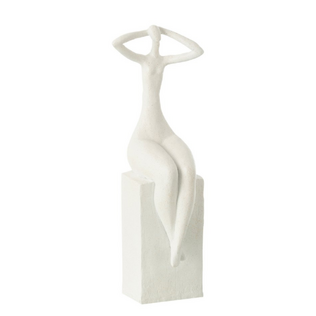
 J-Line Abstract female figure sitting on rectangular block, matte white
77,90 €
J-Line Abstract female figure sitting on rectangular block, matte white
77,90 €