Free VPN services offer digital artists crucial security advantages when traveling. With a VPN, online connections are secure, and thanks to 256-bit encryption, the interception of sensitive data is prevented. While premium providers rely on a business model entirely focused on user security, free VPN providers often finance themselves by collecting and selling user data.
What are the benefits of a VPN for traveling creative professionals?
A free VPN can improve online Privacy by masking your IP address and encrypting your internet connection. This is especially important on public Wi-Fi networks, which pose a higher security risk. Additionally, VPNs allow access to geographically restricted content, although effectiveness can vary among free services.
Why use a VPN?
Some users were even able to save considerable money – in their own tests, flights were booked for around €484 less and rental cars for as much as €580 less. However, a no-logs policy an important aspect that not all free providers can guarantee, while some premium services have their promises verified through independent audits.
Why digital artists prefer free VPN services when traveling. This image is for illustrative purposes and was created using image AI.
Digital artists face numerous technical challenges when working abroad, which can significantly impact their creative work. Using a VPN is becoming increasingly necessary to overcome these obstacles.
Insecure networks in cafes and hotels
The greatest danger in public Wi-Fi networks is so-called evil twin attacks , in which criminals set up a network with a similar or identical name. All data traffic then passes through the attacker's device. Digital artists who upload large files or access their online portfolios are particularly at risk.
In a man-in-the-middle attack, hackers can view or manipulate all transmitted information. This often happens in hotels, cafes, or airports, where unencrypted connections are common. The situation becomes particularly critical when two-factor authentication is not used.
To protect themselves, digital artists should always use encrypted websites when browsing public networks, recognizable by the “https://” in the address bar. It is also recommended to disable automatic connection to known Wi-Fi networks.
Limited access to cloud services
Cloud services are indispensable for digital artists, however, accessing About us secure networks poses a significant risk. If data is transmitted unencrypted, it is theoretically accessible to unauthorized individuals. Even a "completely free VPN" can provide the necessary encryption in this case.
Access via smartphones is particularly risky. If login credentials are stored in the app, malware may also have easy access to the cloud data. A "no-log VPN" offers additional protection by not storing any connection data.
Censored content in certain countries
Internet access is severely restricted in numerous countries. The internet is particularly heavily censored in North Korea, Somalia, Iran, China, Eritrea, Syria, Equatorial Guinea, Uzbekistan, Vietnam, Saudi Arabia, and Russia. This poses a significant problem for digital artists who rely on international platforms.
But restrictions also exist in popular holiday destinations like Cuba, Thailand, Egypt, Turkey, and Greece. The blocks in China usually prohibit all content critical of the government and completely block services like Netflix, Google, and Facebook. A digital artist who relies on Google services or social media for their work faces serious problems here.
While VPN services offer a solution, many countries with internet censorship prohibit VPNs and block the providers' websites. Therefore, it's advisable to install and test a reliable VPN service before traveling to see if the of "why use a VPN" is no longer relevant in such cases.
How free VPNs can solve these problems
For many digital creatives, free VPN services are the perfect solution for security and access problems on the go. A virtual private network offers far more than just anonymity while browsing.
IP masking for greater anonymity
A significant advantage of free VPNs is the effective masking of your IP address. Once the connection is established, your original IP address is replaced by that of the VPN server. This conceals your actual location and online identity from third parties. This measure makes it considerably more difficult for internet service providers, websites, or potential attackers to track your online activity. It also reduces the risk of becoming a victim of a targeted hacking attack.
Access to blocked creative platforms
The best and most reliable method for bypassing geo-blocking is a VPN service. Digital artists can circumvent country restrictions and access otherwise inaccessible content by choosing a server in their desired country. Changing your virtual location is as simple as a few clicks, granting access to numerous server locations worldwide. This is especially useful for artists who want to access tools or websites that are blocked in their current country of residence.
Protecting sensitive data during uploads
For digital artists who regularly send designs, presentations, or complete projects to clients or galleries, a VPN offers crucial security advantages. End-to-end encryption protects data and communication across various devices and operating systems. All internet traffic is routed through a secure, private tunnel that shields sensitive content from third parties. This is especially important when using public Wi-Fi networks in cafes or at exhibitions.
A free VPN encrypts all data transmitted over the internet, thus preventing potential eavesdropping attempts by other users on public Wi-Fi. However, digital artists should bear in mind that completely free VPN services often have limitations – for example, limited data allowances or slower connections compared to paid services.
Limitations and risks of free VPN services
Despite their many advantages, free VPN services raise serious security concerns. The truth behind the "free" offer is often more complicated than it initially appears.
Is there really a safe, free VPN?
The reality is sobering: Of 150 free VPNs examined, experts could only recommend seven, including the VPNLY app , which offers a free VPN service . A shocking 88% of the tested free applications reveal identifiable data, Top10VPN*
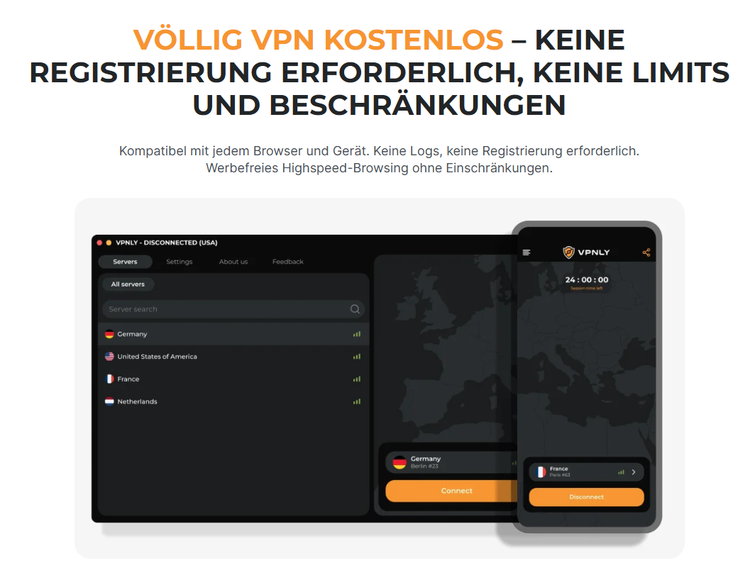
VPNLY is compatible with any browser, does not record logs and requires no registration.
A free VPN service incurs significant costs for its operators – the server infrastructure alone can amount to over $100,000 per month. These costs must be covered somehow, if not through user fees, then in some other way.
Data sales and tracking by disreputable providers
The business model of many free VPNs relies on the sale of user data. Popular services like Hotspot Shield sell names, network data, and device IDs to advertising partners. The Australian government organization CSIRO has also accused the service Betternet of misusing user data for advertising purposes (source: Computerbild*) .
Particularly concerning: Approximately 38% of all free Android VPN apps were demonstrably infected with malware or malvertising.
Missing no-logs VPN policies
A true no-logs VPN doesn't store any data about user activity, thus reducing the risk of a data leak. However, there are virtually no free no-logs VPNs. Even if some free providers claim to keep no logs, caution is advised – they need to make money, after all, which often comes at the expense of privacy. Several VPNs have been proven to log user data despite claiming otherwise.
Slow connections and server overload
VPN providers tend to limit the number of servers accessible to non-paying users. This increases traffic on these servers and leads to congestion. As a result, free VPN users often experience increased latency and slower internet connections. Additionally, many providers deliberately impose speed limits – for example, Hotspot Shield bandwidth to 2 Mbps, as reported Netzwelt*
Most free services also limit the amount of data – bandwidth limits of less than 10 GB per month are the norm. This is often insufficient for digital artists who need to upload large files. The limited server selection, lack of advanced features, and advertisements also often make free VPNs unsuitable for professional applications.
Recommendations for secure VPN use on the go
When choosing a VPN service for use on the go, digital artists should consider some essential security aspects. Selecting the right provider is fundamentally a matter of trust, as all data traffic passes through their servers and could theoretically be monitored there, according to the German Federal Office for Information Security (BSI ).
Combination of free VPN and trial version
A smart strategy for traveling artists is to use a mix of free services and premium trials. While truly free trials don't require any payment information, money-back guarantees require an initial payment with a guaranteed refund within a specific timeframe. Some providers, for example, offer a 24-hour trial without requiring payment details. Alternatively, providers offer a 30-day trial period with full premium functionality.
Freemium services do not impose data or speed limits, while some providers offer at least 10 GB of monthly data. However, users of free services should expect limited functionality and slower connections.
Prefer VPNs with ad-free browsing
Digital artists should pay particular attention to VPN providers with an integrated ad blocker. Such a feature blocks ads and malware in browsers and mobile apps. This not only ensures a more pleasant user experience but also reduces potential security risks.
"kill switch" is also particularly important for connection security . This function immediately disconnects the internet connection if the VPN connection unexpectedly drops or fails, thus preventing the real IP address from being revealed.
Regular review of the Privacy policy
A VPN provider's no-logs policy should be reviewed regularly. Reputable providers undergo external security audits by independent third parties.
Transparency reports, such as those published by major providers in their trust centers, also provide information on how many requests the provider has received from governments and law enforcement agencies and how they responded. VPN providers with servers in the EU are particularly secure, as these are often subject to stricter Privacy regulations than, for example, those in the USA.
Before traveling to countries with internet censorship, such as China, it is essential to check whether VPN services are legal there by consulting the current travel advice from the Foreign Office.
Let's summarize:
Although free VPN services offer numerous advantages, our analysis clearly highlights the associated trade-offs. Digital artists must therefore weigh convenience against security. Encrypting data traffic and protecting sensitive information are undoubtedly crucial factors, especially when working on insecure public networks.
VPNs do indeed solve many of the typical problems faced by traveling creatives. Access to blocked platforms, bypassing geo-restrictions, and protection during file uploads enable uninterrupted work. At the same time, however, artists should not underestimate the significant risks of free VPN services. Data sales, a lack of no-logs policies, and slow connections can severely disrupt creative workflows.
A practical solution therefore consists of combining free offers with premium trial versions. This strategy ensures maximum security without a permanent financial burden. Artists should also prefer VPNs with ad blockers and regularly check the Privacy policies.
For digital artists traveling, a VPN service remains an indispensable tool. The right choice between free and paid options depends on individual needs. Those who process sensitive customer data or work in countries with internet censorship should opt for premium services. For occasional use and less critical applications, the recommended free services may suffice. However, the most important factor is always the conscious balancing act between cost savings and the protection of one's digital identity.
Sources, expert support and further information:
Top10VPN:The best free VPNs of 2025, https://www.top10vpn.com/de/beste-vpn/kostenlos/
Computerbild : VPN services: Trading in user data , https://www.computerbild.de/artikel/cb-News-Sicherheit-Kostenlose-VPN-Dienste-Verkauf-sensible-Daten-21781145.html
Netzwelt:The best free VPNs of 2025: These 5 free providers impress, https://www.netzwelt.de/vpn/beste-kostenlose-vpn-dienst-fuenf-anbieter-2025-vpn-vergleich.html
Süddeutsche Zeitung : Surfing with a VPN: How travelers can protect themselves , https://www.sueddeutsche.de/wissen/sichere-verbindung-mit-vpn-surfen-so-koennen-reisende-sich-absichern-dpa.urn-newsml-dpa-com-20090101-240516-99-49295
Owner and Managing Director of Kunstplaza . Publicist, editor, and passionate blogger in the fields of art, design, and creativity since 2011. Graduated with a degree in web design from university (2008). Further developed creative techniques through courses in freehand drawing, expressive painting, and theatre/acting. Profound knowledge of the art market gained through years of journalistic research and numerous collaborations with key players and institutions in the arts and culture sector.
Regardless of your field of activity as a web designer, graphic designer, game developer, photographer, programmer, product designer, journalist, content creator or influencer , as a self-employed person you have a wide range of tasks to manage.
From customer acquisition and successful project implementation to time management and financial administration – including the often unpopular tax matters.
Good information and the right online tools are crucial for a successful career as a freelancer or content creator.
In this section you will find helpful articles and valuable advice with tips specifically for freelancers.
We use technologies such as cookies to store and/or access device information. We do this to improve your browsing experience and to display (non-)personalized advertising. If you consent to these technologies, we can process data such as browsing behavior or unique IDs on this website. Refusal or withdrawal of consent may adversely affect certain features and functions.
Functional
Always Active
Technical storage or access is strictly necessary for the legitimate purpose of enabling the use of a specific service expressly requested by the subscriber or user, or for the sole purpose of carrying out the transmission of a message over an electronic communications network.
Preferences
The technical storage or access is necessary for the legitimate purpose of storing preferences that were not requested by the subscriber or user.
statistics
Technical storage or access that is solely for statistical purposes.Technical storage or access that is used solely for anonymous statistical purposes. Without a subpoena, the voluntary consent of your internet service provider, or additional recording by third parties, the information stored or retrieved for this purpose cannot generally be used to identify you.
marketing
Technical storage or access is required to create user profiles, to send advertising, or to track the user on one or more websites for similar marketing purposes.



 Street art canvas print "Urban Beauty", hand-painted on a stretcher frame
295,00 €
Street art canvas print "Urban Beauty", hand-painted on a stretcher frame
295,00 €