In January 2024, Japanese author Rie Kudan the prestigious Akutagawa Prize for her novel "Tokyo-to Dojo-to." In her acceptance speech, she explained that approximately five percent of the text was directly generated by a generative AI. These passages were not an oversight but rather part of the concept, as the novel itself deals with the soft, smoothing language of such systems.
This case illustrates how blurred the line has become. Anyone discussing creative writing today must clarify what a tool is allowed to do and when a text ceases to be one's own.
Language models have long since become part of the everyday lives of authors. They suggest synonyms, smooth out awkward transitions, or even provide an entire scene on request. This raises a practical question for literary competitions, publishers, and writing schools: how can a predominantly generated text be distinguished from one written independently?.
Some juries therefore run submitted manuscripts through Getsolved's AI detector beforehand to mark passages with strikingly machine-like patterns and ask specific questions. However, such a notification does not replace a conversation with the person who submitted the text.
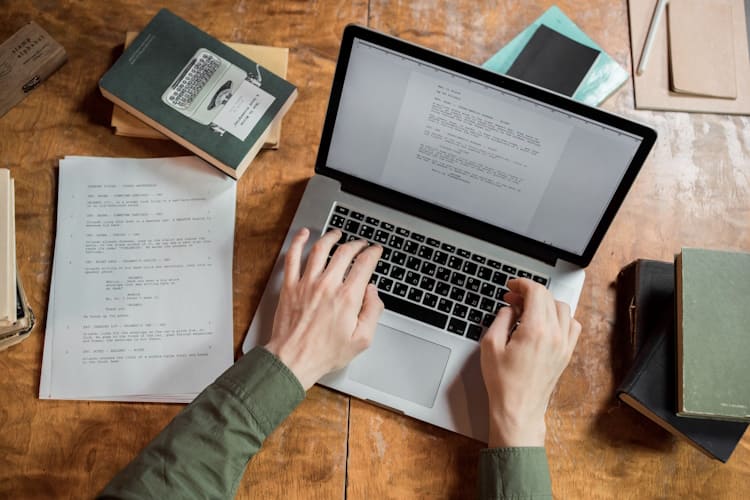
AI and creative writing: Where does the tool end and authorship begin? Image by Vitaly Gariev, via Pexels
This is precisely where the limitations of such checks lie. A detector calculates probabilities; it doesn't judge originality. A very consistent, correct style can be just as noticeable as a genuinely generated paragraph, and someone writing in a foreign language is more likely to be suspected. Therefore, the result is useful as a reason for further inquiry, not as proof.
A spectrum instead of a line
The debate often suffers from the fact that "written with AI" can mean anything and nothing. A more helpful approach is to look at the individual work steps, as the machine's contribution increases from stage to stage.
Level
Role of AI
Who is the author?
research
Gather facts, find sources
Clearly, humans
brainstorming
Suggest variations for characters or plot twists
Man, as long as he chooses and discards
Editing
Check spelling, rhythm, and repetitions
Humans and AI act as correctors
Co-writing
Draft entire paragraphs that will be revised
Divided, depending on the scope of the revision
Full generation
Generate text based on a prompt
Questionable, legally usually no one
The table shows that the real limitation lies not in the application of the technology, but in the control over the outcome. As long as a human decides what stays, what gets deleted, and why, AI remains a tool like a dictionary or a typewriter.
Literature has always played with rules and chance
The idea of a writing apparatus is not new. Tristan Tzara suggested pulling newspaper words out of a hat and constructing a Dadaist poem from them. William S. Burroughs and Brion Gysin cut up texts and reassembled them in the late 1950s, while the Oulipo group wrote according to strict formal constraints.
In all cases, the process only provided material. The selection process created the text, and this same principle applies to language models.
What copyright law says about it
Legally, the situation is clearer than in the artistic debate. In both Germany and the USA, protection requires a human creation.
The situation in Germany
According to Section 2, Paragraph 2, copyright law only protects intellectual creations". A text generated by a machine without significant human input does not meet this requirement. "personal
However, those who select generated building blocks, modify them, and combine them into something of their own can certainly create a protected work. The crucial factor is how much personal expression is present in the final product.
The US position
the US Copyright Office published a comprehensive report following more than 10,000 public comments. The report states that prompts alone do not provide sufficient human oversight to make users the authors of the result. A distinction is made between AI as a tool that does not diminish copyright protection and AI as a replacement for human creativity.
Whether the control is sufficient will be examined on a case-by-case basis. Back in 2023, the agency had already protected the text and page layout of the graphic novel "Zarya of the Dawn," but not the images created with Midjourney .
What authorship actually entails
What actually constitutes authorship? Photo by Ron Lach, via Pexels
Beyond the legal paragraphs, an older question arises. Authorship isn't just about putting words on paper. It means making decisions and standing by them. A character dies because the author wants it that way. A sentence remains awkward because the author needs the friction. A model can simulate this intention, but it cannot take responsibility for it. Then there's the voice. It develops from experiences, readings, and idiosyncrasies that accumulate over years. A model trained on vast amounts of text, on the other hand, tends toward the middle, toward the most probable next word.
Those who write with AI can test themselves with a few questions.
Could I justify every decision in the text, including stylistic ones?
Did I modify the AI's suggestions or simply accept them?
Would the text still work without the generated passages?
Would I be willing to openly explain how the text came about?
Does the result sound like my vote or like an average of all votes?
The more often the answer is an honest "yes", the more clearly the authorship lies with the human.
Transparency as the new norm
Rie Kudan publicly disclosed the amount of AI used in her work, and this has brought objectivity to the discussion. Many publishers and competitions now demand an explanation of whether and how AI was involved. This openness removes the suspicion of fraud and makes visible what would otherwise remain hidden.
This is beneficial for readers, as they can decide for themselves what value they place on a text. A brief mention in the afterword or acknowledgments is often sufficient, similar to how editing or translation are mentioned there.
Final thoughts
AI is changing creative writing, but it isn't eliminating authorship. It's simply shifting the focus of the actual work. Research, editing, and brainstorming can confidently be delegated. The selection, the approach, and the responsibility for what ultimately appears on the page remain human.
Where these three things are missing, the tool ends, it replaces the author, and then it is no longer creative writing, but production.
Owner and Managing Director of Kunstplaza . Publicist, editor, and passionate blogger in the fields of art, design, and creativity since 2011. Graduated with a degree in web design from university (2008). Further developed creative techniques through courses in freehand drawing, expressive painting, and theatre/acting. Profound knowledge of the art market gained through years of journalistic research and numerous collaborations with key players and institutions in the arts and culture sector.
In this magazine section you will find numerous reports and articles about the use of artificial intelligence (AI) in art, design and architecture.
It's not just about the question of how AI can be used in these areas, but also about the impact this has on creative creation.
While some experts believe that the use of AI will lead to a revolution in art and design, there are also voices within the industry itself who are skeptical of AI art and AI-powered image generators .
An early example from 2016 of the use of AI in art is the project "The Next Rembrandt". Here, software was developed that created a new painting in the style of the Dutch painter based on data analysis – without human intervention.
The result was surprisingly realistic and clearly demonstrated the potential of this technology even back then.
What does this development mean for traditional crafts? Will they become obsolete, or can new opportunities be created?
These questions occupy many people both within and outside the industry alike.
In any case, the connection between art and artificial intelligence offers us exciting insights into possible future scenarios.
We warmly invite you to embark on an adventure of discovery with us!
We use technologies such as cookies to store and/or access device information. We do this to improve your browsing experience and to display (non-)personalized advertising. If you consent to these technologies, we can process data such as browsing behavior or unique IDs on this website. Refusal or withdrawal of consent may adversely affect certain features and functions.
Functional
Always Active
Technical storage or access is strictly necessary for the legitimate purpose of enabling the use of a specific service expressly requested by the subscriber or user, or for the sole purpose of carrying out the transmission of a message over an electronic communications network.
Preferences
The technical storage or access is necessary for the legitimate purpose of storing preferences that were not requested by the subscriber or user.
statistics
Technical storage or access that is solely for statistical purposes.Technical storage or access that is used solely for anonymous statistical purposes. Without a subpoena, the voluntary consent of your internet service provider, or additional recording by third parties, the information stored or retrieved for this purpose cannot generally be used to identify you.
marketing
Technical storage or access is required to create user profiles, to send advertising, or to track the user on one or more websites for similar marketing purposes.







 Luxurious "Lucky Bunny" table lamp with black satin shade
88,00 €