A narrow alleyway in the evening light, an abandoned antique shop, or a greenhouse full of plants: sometimes a space of just a few centimeters is enough to suggest an entire story. Miniature worlds show how closely spatial design, light, and our imagination are intertwined.
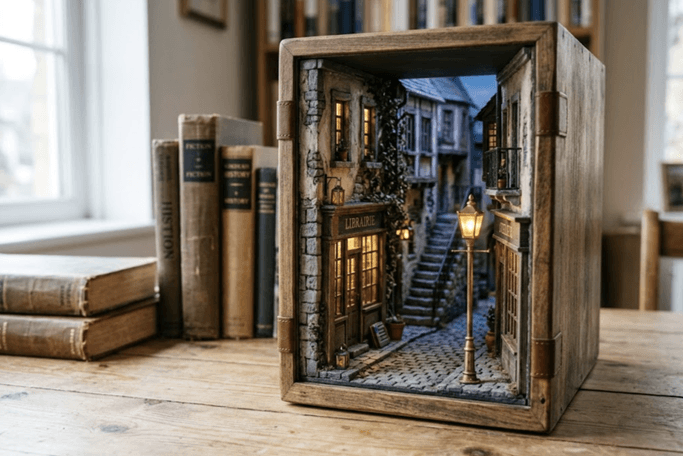
A small street opens up between two books. Lights are on behind the windows, tiny flowerpots stand on the cobblestones, and at the end of the alley, a staircase disappears into the semi-darkness. No one is visible. Yet the place seems inhabited. Perhaps a shop has just closed, perhaps someone is expecting visitors. The real story isn't created solely by what is visible, but also by what the observers add.
This unique effect makes so-called "book nooks" interesting. These narrow miniature scenes are placed among books, combining elements of model making with spatial staging. Anyone wanting to experiment with such design ideas can a miniature project for their bookshelf as a starting point. The crucial factor is less the size of the scene than how its individual elements interact.
Miniature worlds have a longer tradition than the current trend of Book Nooks might suggest. Dioramas have long been a part of museum and exhibition design. They vividly illustrate historical events, landscapes, and technical concepts by recreating spatial situations on a reduced scale.
A well-known example is the Deutsches Museum in Munich, whose exhibitions feature numerous dioramas created in its own workshops. The scenes range from historical workshops to polar expeditions. Their purpose is not merely to depict objects with the greatest possible accuracy. They are intended to make connections visible and to give viewers the feeling of having a specific place or moment right in front of them.
The theater stage works in a similar way. Scenery, props, and lighting are combined to create a believable setting from a limited space. A door can suggest an entire room, a lit window the presence of an unseen person.
Book Nooks take up these principles on a different scale. Unlike a scientific diorama, they don't have to document historical reality. They can condense everyday places, evoke memories, or depict entirely invented worlds. The limited space is not merely a restriction, but a design choice that forces a focus on the essentials.
Miniature worlds demonstrate how closely spatial design, light, and our imagination are intertwined. Image source: diy-booknookkit.com
Light, color, and visual guidance: the language of small spaces
No matter how meticulously a miniature scene is crafted, without a discernible visual order, the eye quickly gets lost in the details. Therefore, the impact depends crucially on where the gaze first falls and which elements are subsequently discovered.
A light-colored door frame against a dark facade immediately draws the eye. A narrow staircase conveys a sense of depth. Different surfaces, such as rough brickwork next to smooth glass, make materials distinguishable even on a small scale.
Light plays a similar role here as it does in film and theater design. Warm light behind small windows can convey a sense of security. A single streetlamp, on the other hand, creates a completely different atmosphere, especially if the rest of the room is in shadow. Even an unchanged scene can take on a new meaning through different lighting.
Our article on light as a design element also demonstrates how strongly lighting influences the perception of objects . What is described there for wall niches, shelves, and works of art can be observed on a smaller scale: light highlights forms, creates focal points, and alters the spatial atmosphere.
However, more light doesn't automatically mean a better effect. If every window and every corner appears equally bright, the composition loses its tension. Depth is created only through the interplay of visible and deliberately understated areas. An unlit passageway can pique curiosity more than a fully illuminated room.
Three locations, three different stories
How much the effect of a miniature changes through its design can be observed in three conceivable scenes.
The antiquarian bookshop: High shelves, narrow aisles, and a small reading lamp create a space that seems to have grown organically over the years. Irregularly arranged books, yellowed paper, and slightly worn furniture speak of use and history. The scene needs no figure to suggest a human story. A half-open drawer or an open book is enough.
The rain-soaked alley: Here, surfaces and lighting take center stage. Dark pavement reflects the light of a lantern, while the facades in the background blur. An abandoned bicycle or a closed shutter can reinforce the impression of a particular moment. Unlike in an antique shop, the atmosphere arises less from the quantity of objects than from contrasts and empty spaces.
The greenhouse: Transparent surfaces, delicate plants, and light green tones convey a sense of openness. Different leaf sizes create spatial gradations, while a narrow path guides the eye through the scene. The effect is calmer and less mysterious. Nevertheless, a narrative emerges: Someone has arranged and cared for the plants and designed this small space.
All three examples follow the same basic principle. It is not the number of miniature objects that determines the quality of the scene, but their relationship to one another. A deliberately placed object can express more than a completely filled backdrop.
Between kit and custom design
How much personal creativity is there in a miniature whose parts are already prefabricated? More than it initially seems. Photographers also work with found motifs, while collages made from existing materials create new connections.
Similarly, a Book Nook kit offers room for personal choices: A differently painted wall, a repositioned piece of furniture, or a strategically placed light source can completely change the atmosphere. Small signs of wear and tear make rooms appear lived-in, while open spaces create a sense of calm.
That DIY goes far beyond simply assembling things is Kunstplaza also creative breaks within your own four walls. The crucial point is not to make every single detail yourself, but to develop an independent design from existing elements.
Owner and Managing Director of Kunstplaza . Publicist, editor, and passionate blogger in the fields of art, design, and creativity since 2011. Graduated with a degree in web design from university (2008). Further developed creative techniques through courses in freehand drawing, expressive painting, and theatre/acting. Profound knowledge of the art market gained through years of journalistic research and numerous collaborations with key players and institutions in the arts and culture sector.
We use technologies such as cookies to store and/or access device information. We do this to improve your browsing experience and to display (non-)personalized advertising. If you consent to these technologies, we can process data such as browsing behavior or unique IDs on this website. Refusal or withdrawal of consent may adversely affect certain features and functions.
Functional
Always Active
Technical storage or access is strictly necessary for the legitimate purpose of enabling the use of a specific service expressly requested by the subscriber or user, or for the sole purpose of carrying out the transmission of a message over an electronic communications network.
Preferences
The technical storage or access is necessary for the legitimate purpose of storing preferences that were not requested by the subscriber or user.
statistics
Technical storage or access that is solely for statistical purposes.Technical storage or access that is used solely for anonymous statistical purposes. Without a subpoena, the voluntary consent of your internet service provider, or additional recording by third parties, the information stored or retrieved for this purpose cannot generally be used to identify you.
marketing
Technical storage or access is required to create user profiles, to send advertising, or to track the user on one or more websites for similar marketing purposes.






 Eye of the Galaxy - Abstract Metal Wall Decor