A ring, a necklace, a pendant: jewelry is one of humanity's oldest forms of cultural expression – and a craft that demands patience, knowledge of materials, and precision. But what actually happens between the raw material and the finished piece?
Anyone wanting to understand how gold, platinum, and precious stones are transformed into jewelry of lasting value will find the most vivid answers where this knowledge is applied daily: in a traditional goldsmith's workshop. A look behind the scenes reveals why this centuries-old craft has lost none of its significance to this day.
Goldsmithing as a living craft: Studio in Stuttgart in focus. Image by Antoni Shkraba, via Pexels
Jewelry is far more than mere decoration. Archaeological finds prove that people adorned themselves with beads, pendants, and rings tens of thousands of years ago – long before they began working with metals. Jewelry marked belonging and status, served as a talisman, and accompanied life's transitions: birth, marriage, inheritance. In many cultures, jewelry was also considered aTerms & Conditions. The desire to adorn oneself is considered a fundamental human need.
This function has changed remarkably little to this day. An engagement ring, a necklace for a milestone birthday, or an inherited choker always tells a personal story. Jewelry expresses feelings and gives shape to memories. It's no coincidence that jewelry is among the things people most like to pass on. Precisely because such pieces are often worn for generations, their craftsmanship determines whether they survive this time unscathed – and this is where the goldsmith's work begins.
From raw material to finished piece of jewelry – craftsmanship with tradition
Goldsmith works on a piece of jewelry by hand in his workshop. Image by COPPERTIST WU, via Pexels
The journey from precious metal to Terms & Conditions piece of jewelry involves classic techniques such as sawing, filing, forging, soldering, and polishing. Added to this is the setting of stones, a skill in itself: every stone behaves differently, and every setting demands different precision and experience. Goldsmithing is therefore traditionally considered one of the most demanding apprenticeships – the path to mastery extends over many years. Unlike industrial production, each piece in the workshop is individually crafted – with visible and tangible differences in surface finish, setting, and durability.
The length of this journey is illustrated by Marion Schäfer. She completed her goldsmith apprenticeship from 1982 to 1986. Simultaneously, she attended vocational school in Schwäbisch Gmünd, graduating as a journeyman goldsmith. This was followed by two years of travel and work experience in three different workshops – a stage still highly valued in the goldsmithing trade because it sharpens one's eye for diverse working methods and styles.
At the goldsmithing school in Pforzheim – a city with a long tradition of jewelry making – she passed her state-certified designer examination in 1991; in 1994, she completed her master craftsman training there, becoming a master goldsmith. After ten years as an employed master goldsmith and designer at a Stuttgart jeweler, she opened her own studio at Olgastraße 35 in 2005, which she expanded in 2010 to include the adjacent retail space. Anyone the Stuttgart goldsmith's studio today experiences the fruits of this long training in her daily work – both at the workbench and in her consultations.
Repair, restoration and custom manufacturing
A goldsmith's workshop differs from industrial jewelry production primarily in its close connection to each individual piece – and in services that extend far beyond simply creating new pieces. The daily work of the Stuttgart workshop includes repairing and restoring existing jewelry: rings are resized, necklaces lengthened or shortened, and pearl and gemstone necklaces restrung. Lost stones are replaced, and loose stones are reset. The care and cleaning of customers' jewelry is also part of the service – an often underestimated task, as settings wear down with everyday use, and timely inspection can prevent the loss of a stone.
That such work is a matter of trust is obvious: often, it involves heirlooms or gifts with high emotional value that far exceeds any material cost. Master craftsman certification, design training, and decades of experience form the basis in the workshop for the expert preservation of these pieces. According to the workshop, they implement everything that is technically possible in goldsmithing – from the virtually invisible repair of old settings to the creation of custom-made pieces according to customer specifications.
Gemstones, precious metals and the language of materials
The range of materials goldsmiths work with is manageable, yet demanding: gold, platinum, and silver form the foundation, while diamonds and brilliants, colored gemstones, pearls, and coral add accents. Each material presents its own challenges in terms of processing. Platinum is tough and requires very high temperatures for forging and soldering; silver tends to tarnish and needs care; organic materials like pearls and coral cannot tolerate heat or harsh cleaning agents. Even within a single metal, there are differences: gold is processed in various shades and degrees of hardness depending on its purity and alloy – from warm yellow gold to cool white gold.
The choice of material is far more than just a question of price. It determines the feel, durability, and effect of a piece – and it has a cultural dimension: For centuries, certain stones have been attributed meanings that extend beyond their visible luster. The Kunstplazaarticle on precious, semi-precious, and healing stones, which categorizes the most important stones from a mineralogical and cultural perspective,
In the goldsmith's workshop, this knowledge of materials is directly applied: When advising on a new piece, the hardness, color, origin and fracture behavior of the stones are taken into account, as well as the question of which alloy suits the everyday life of the wearer.
Delicate gold ring with diamond on a textured stone surface, blurred white flowers in the background. Image by Rene Terp, via Pexels
Wedding rings as a special example of individual goldsmithing
Few pieces of jewelry combine craftsmanship and meaning as closely as the wedding ring. It is typically worn daily for decades – and should remain as magnificent as ever. The closed circular shape has been a symbol of eternity since antiquity – a symbolism that has lost none of its power. It's no wonder that many couples don't want to buy their rings off the rack, but consciously seek out individually crafted pieces. This is precisely what can be experienced in a goldsmith's workshop: couples choose the alloy, width, profile, and finish, decide on the stone setting and engraving, and receive a pair of rings that are truly one of a kind.
Wedding rings and bridal jewelry are among the core competencies of Marion Schäfer's Stuttgart studio. This is a deliberate specialization, as it brings together all the strengths of the craft: material consultation, design expertise, precise manufacturing, and an understanding of the emotional significance of each commission. Even after the wedding, the studio remains a point of contact, for example, if a ring needs resizing or refurbishment years later.
Goldsmithing is anything but a relic of the past. It is a living tradition where centuries-old techniques meet modern design – and where every piece is both a work of craftsmanship and a personal statement. Next time you hold a piece of jewelry in your hands, take a closer look: behind the luster lies a craft that deserves to be seen. Many an heirloom is just waiting to be brought back to life by experienced hands.
Owner and Managing Director of Kunstplaza . Publicist, editor, and passionate blogger in the fields of art, design, and creativity since 2011. Graduated with a degree in web design from university (2008). Further developed creative techniques through courses in freehand drawing, expressive painting, and theatre/acting. Profound knowledge of the art market gained through years of journalistic research and numerous collaborations with key players and institutions in the arts and culture sector.
We use technologies such as cookies to store and/or access device information. We do this to improve your browsing experience and to display (non-)personalized advertising. If you consent to these technologies, we can process data such as browsing behavior or unique IDs on this website. Refusal or withdrawal of consent may adversely affect certain features and functions.
Functional
Always Active
Technical storage or access is strictly necessary for the legitimate purpose of enabling the use of a specific service expressly requested by the subscriber or user, or for the sole purpose of carrying out the transmission of a message over an electronic communications network.
Preferences
The technical storage or access is necessary for the legitimate purpose of storing preferences that were not requested by the subscriber or user.
statistics
Technical storage or access that is solely for statistical purposes.Technical storage or access that is used solely for anonymous statistical purposes. Without a subpoena, the voluntary consent of your internet service provider, or additional recording by third parties, the information stored or retrieved for this purpose cannot generally be used to identify you.
marketing
Technical storage or access is required to create user profiles, to send advertising, or to track the user on one or more websites for similar marketing purposes.









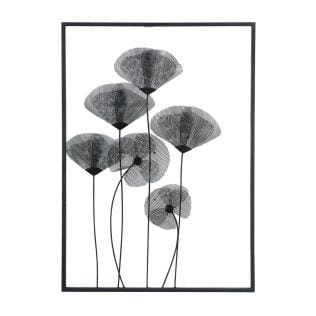
 Metal wall relief "Poppy" with floral motif and black frame
85,00 €
Metal wall relief "Poppy" with floral motif and black frame
85,00 €