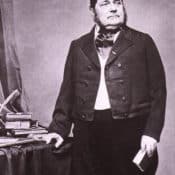
This either tragic or simply mediocre figure, Adalbert Stifter, "Rock Crystal", a recognized work of German literature, which has a reputation among friends of suspenseful literature for being a real bore.
Anyone who starts this work will quickly find it quite challenging, wondering, for example, why the author prefaces it with an introduction in which he explains Christmas in a whopping 735 words… and it continues in a similar vein. Stifter uses another 16,671 words to tell us his story of the siblings who got lost in the mountains. Even the author of this article finds her sentences getting longer and longer; Stifter's writing style is probably rubbing off on her.
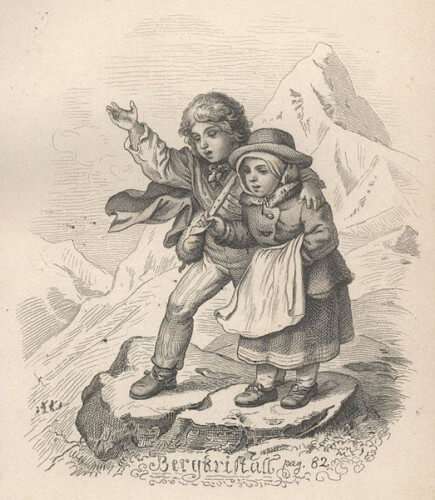
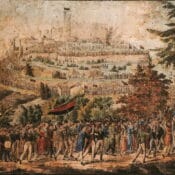
Illustration by Ludwig Richter for Adalbert Stifter's story "Rock Crystal" Source: by Adrian Ludwig Richter [Public domain], via Wikimedia Commons
The story could actually be told very briefly:
Siblings Konrad and Sanna get lost in the mountains on Christmas Eve and have to spend the night in a cave. Konrad and Sanna are the children of parents from two villages separated by a high mountain – moving to the other village and then having children together is unheard of, and the villagers regard each other with deep suspicion.
Xenophobia aside, the children must not be left to die on the mountain, and so the inhabitants of both villages overcome their prejudices for a joint rescue operation, the children are saved, the villagers reconcile, even the children's mother, who had moved in with the father, is finally accepted in the new village, all is well…
Stifter sets all of this up around Christmas, providing plenty of symbolic material for a "happy ending." Then there's also a great deal of untamed nature to which the weak humans are helplessly exposed; films like "The Core" and "2012" can hardly compete in terms of drama (ironic? Yes!).
Have you ever experienced long, aimless car journeys where the (male) driver, stranded in the middle of a field at the end of a rough track, still insisted he knew exactly where to go? Then Stifter's story introduces you to the Alm-Öhi version of this typical male behavior: Konrad, in utter ignorance but with great verbal fanfare, leads his little sister deep into the ultimately hopeless snowdrift.
Stifter calls it the bravado of ignorance, an expression that astute observers of current events could gladly adopt and apply to many a speech by an executive body or media representative…
The girl Sanna certainly seems to be familiar with the choleric outbursts that can follow sensible suggestions; she doesn't have much more to say in the entire play than: "Yes, Konrad." She says that 17 times, though, and "My eyes hurt" and "I can't see any trees anymore" twice each; apparently, that's all she can think of.
Depending on one's temperament, and at the latest by "Yes, Konrad" No. 17, this gets on the reader's nerves considerably, and in this context, it also becomes apparent that among the 17,406 words that Stifter has strung together for his story, quite a few words are rather superfluous.
However, the content has completely different references to the present day than the typical misguided behavior of the male sex outlined above, and anyone who does not see current references behind this story probably also thoroughly lacks imagination.
Peoples living side by side, making life unnecessarily difficult for each other with infantile mistrust?
Israel and Palestine, China and Japan, Türkiye and Greece, Russia and Ukraine – all today, in the year 2010 onwards.
Anyone who enjoys the German language will also find a few nice phrases in the otherwise boring Stifter: The aforementioned “strongheart of ignorance,” truly great; “finely jagged forests”; “mountains that sweep with smooth edges against the shining sky”; “stars that shone, sparkled, and trembled and are traversed by only shooting stars”; “the sun that stands most crookedly against our climes”; “magical gifts”; and “milky blue of the distant snow” are also not bad.
Perhaps we're completely wrong about all this, and Stifter is simply pulling our leg with this lengthy account. One could certainly entertain this audacious idea when reading that the linguistically gifted Friedrich Nietzsche, the eloquent writers Theodor Storm, Theodor Fontane, and Hermann Hesse, and even the sharp-tongued satirist Karl Kraus held Adalbert Stifter's work in extremely high esteem.
Against the background of this debate, it is worthwhile to take a closer look at Stifter's linguistic expression, which can be read in the article "German Literature, the greatest works: A critical examination of the language in Adalbert Stifter's Bergkristall".
We use technologies such as cookies to store and/or access device information. We do this to improve your browsing experience and to display (non-)personalized advertising. If you consent to these technologies, we can process data such as browsing behavior or unique IDs on this website. Refusal or withdrawal of consent may adversely affect certain features and functions.
Functional
Always Active
Technical storage or access is strictly necessary for the legitimate purpose of enabling the use of a specific service expressly requested by the subscriber or user, or for the sole purpose of carrying out the transmission of a message over an electronic communications network.
Preferences
The technical storage or access is necessary for the legitimate purpose of storing preferences that were not requested by the subscriber or user.
statistics
Technical storage or access that is solely for statistical purposes.Technical storage or access that is used solely for anonymous statistical purposes. Without a subpoena, the voluntary consent of your internet service provider, or additional recording by third parties, the information stored or retrieved for this purpose cannot generally be used to identify you.
marketing
Technical storage or access is required to create user profiles, to send advertising, or to track the user on one or more websites for similar marketing purposes.






 J-Line table lamp with natural rattan shade, black metal base
119,00 €
J-Line table lamp with natural rattan shade, black metal base
119,00 €