Wood is a material with a fascinating history, used since prehistoric times for the construction of buildings, tools, and objects. Even in the Stone Age, people recognized the versatile properties of wood and valued its robustness and flexibility.
Nevertheless, the fear of fire led to a decline in the use of wood as a building material in past centuries. But now an era of wood rediscovery is dawning, in which its sustainable properties and aesthetic advantages are once again being increasingly appreciated. Not only in construction, interior design, and architecture, but also among sculptors and product designers, this renewable resource is being used more frequently.
The renaissance of wood design is here to stay – as a symbol of environmental awareness, innovation and timeless beauty.
Wood has always played an essential role as a material in art production and design . In fields such as sculpture, carving, and even the finishing of living spaces, wood occupies a central position. Its versatility and natural beauty make it an indispensable resource in the art world.
Artists can use wood to create innovative and unique designs that are both visually appealing and functional. Furthermore, wood offers practical advantages due to its natural properties: as an insulating material , it surpasses many other materials, contributing to a pleasant indoor climate . Skillful processing and design of wood not only result in impressive works of art, but also in practical objects that enrich and beautify our everyday lives.
A key advantage of wood as an artistic medium is its versatility and sustainability. It can be shaped, carved, burned, stained, and polished to achieve a wide variety of textures and effects. Furthermore, wood is a renewable resource, making it particularly attractive in an era of growing environmental awareness.
The design possibilities of wood are almost unlimited, allowing designers to give rooms, buildings, sculptures and products of all kinds a special charm and a soft character.
The significance of wood in art history
Wood has always played a central role in art history, captivating us with its versatility and natural beauty. Since the dawn of humanity, wood has been used as a material for creative expression, from primitive carvings to complex sculptures and architectural masterpieces.
Wood offers a unique combination of malleability and durability, enabling artists to create both functional and aesthetic objects.
Early cultures and wood art
Even in the earliest cultures, the importance of wood as an artistic medium is evident. In prehistoric times , wood not only served practical purposes but also played a spiritual or magical role.
Archaeological finds prove that wood carvings were widespread as ritual objects, images of deities, or simple jewelry. These early works laid the foundation for the multifaceted development of wood art over the centuries.
Medieval Championship
Woodcraft experienced a golden age in the Middle Agesecclesiastical art . Wood was the primary material for altars, pulpits, and statues of saints. Elaborate carvings adorned the interiors of churches and cathedrals, depicting biblical stories in rich detail.
A remarkable example is the altar by Veit Stoß in St. Mary's Church in Krakow , a masterpiece of late Gothic art that impresses with its size and wealth of detail.
Krakow High Altar by Veit Stoss (built between 1477 and 1489), on the Feast of the Assumption. Image source: Veit Stoss, CC BY-SA 4.0, via Wikimedia Commons
Tilman Riemenschneider , another outstanding artist of this era, created numerous sculptures and reliefs that impress above all with their fine workmanship and emotional expression.
Renaissance and Baroque
During the Renaissance and Baroque periods , wood continued to be used extensively, often in combination with other materials such as marble and bronze. New techniques and styles developed during this time, elevating woodcraft to a new level.
Intarsia work , in which different types of wood were joined together to form complex patterns, reached its zenith. These works of art were expressions of luxury and craftsmanship, adorning palaces and aristocratic homes. An outstanding example is the intarsia in the studiolo of the Duke of Urbino , created by Federico da Montefeltro , which creates illusions of shelves, books, and musical instruments.
Inlays in the Studiolo of the Duke of Urbino' by Francesco di Giorgio Martini Image source: Enric, CC BY-SA 4.0, via Wikimedia Commons
Modern and contemporary wood art
In the 20th and 21st centuries, wood has found a firm place in modern and contemporary art. Artists such as Constantin Brâncuși and Georg Baselitz used wood to create abstract forms that emphasize the material's natural properties.
Brâncuși's work "Endless Column" is an iconic example that represents the idea of infinity and uses wood in its pure, unadorned form.
Wooden monument “Endless Column” by Constantin Brancusi at sunset. Image source: Vlad Tamnos, CC BY-SA 4.0, via Wikimedia Commons
The German artist Georg Baselitz repeatedly causes a stir and surprises with his provocative and controversial artworks. Born in 1938, he not only shaped the Neo-Expressionist movement but is also a talented sculptor who also worked with wood as a building material.
His very first exhibition caused a scandal and he was charged with disturbing the peace – yet he has maintained this provocative style to this day. His carvings are as controversial as they are radical; for example, he created a wooden sculpture using a chainsaw. His sculpture “Model for a Sculpture,” which he presented at the Venice Biennale, was a constant topic of conversation, and one observer remarked that it resembled a man giving the Hitler salute.
Wooden sculpture by Georg Baselitz at the Hamburger Bahnhof Museum for Contemporary Art (Moabit, Berlin). Image source: Fred Romero from Paris, France, CC BY 2.0, via Wikimedia Commons
Today, many contemporary artists work with recycled wood to draw attention to the importance of sustainability in art. Ai Weiwei, for example, used antique wood from tea houses and temples to create monumental installations that both honor cultural traditions and address current social issues.
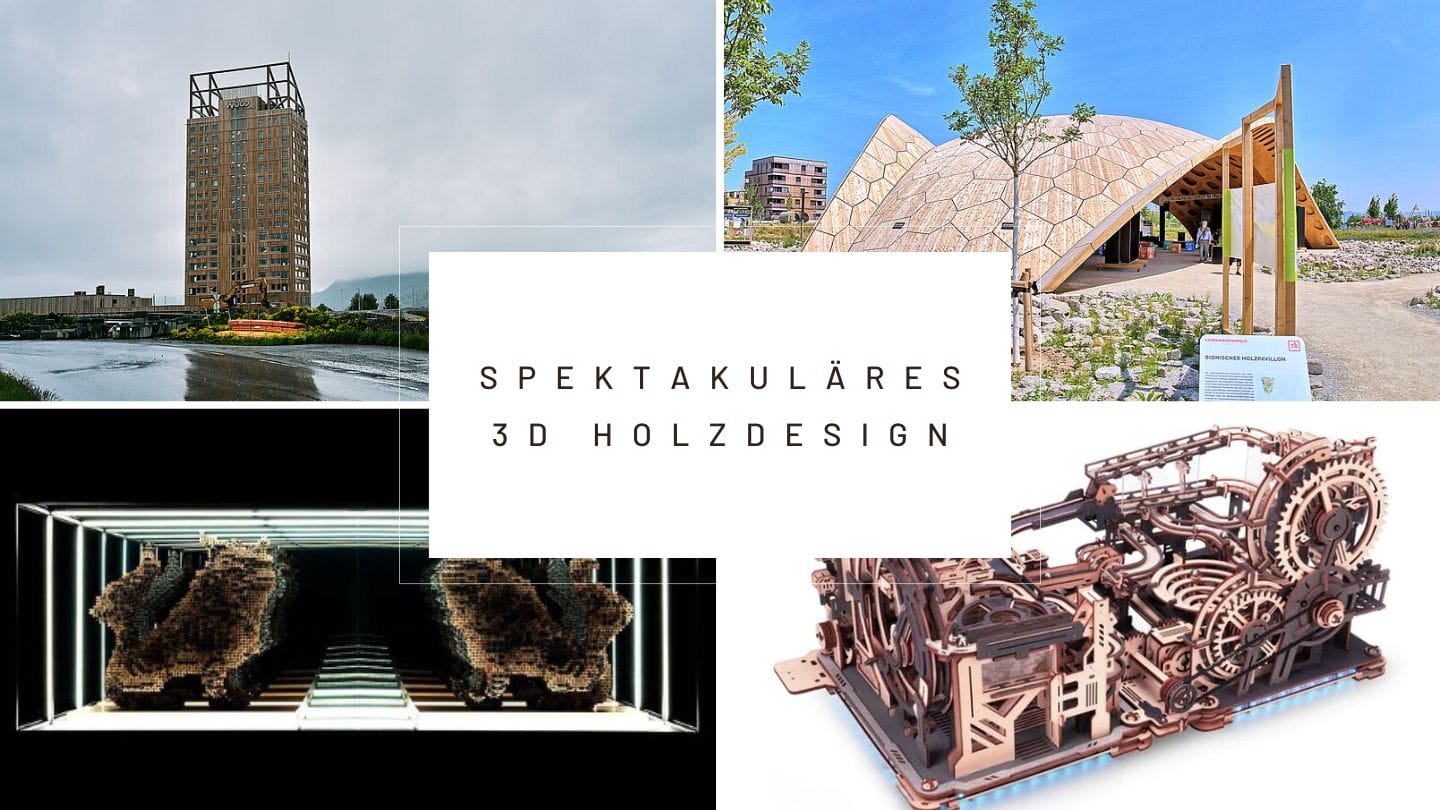
4 impressive examples of 3D wood design and wood art from the 21st century
Pavilion, puzzle, sculpture & skyscraper – 4 spectacular examples of 3D wood design
Having taken a brief detour into past centuries, we now return to the present. Here we would like to present four spectacular applications and outstanding examples of state-of-the-art wood design. The diversity of these examples stems from the fact that they all come from different fields.
01 Bionic wooden pavilion in Spinelli Park, Mannheim
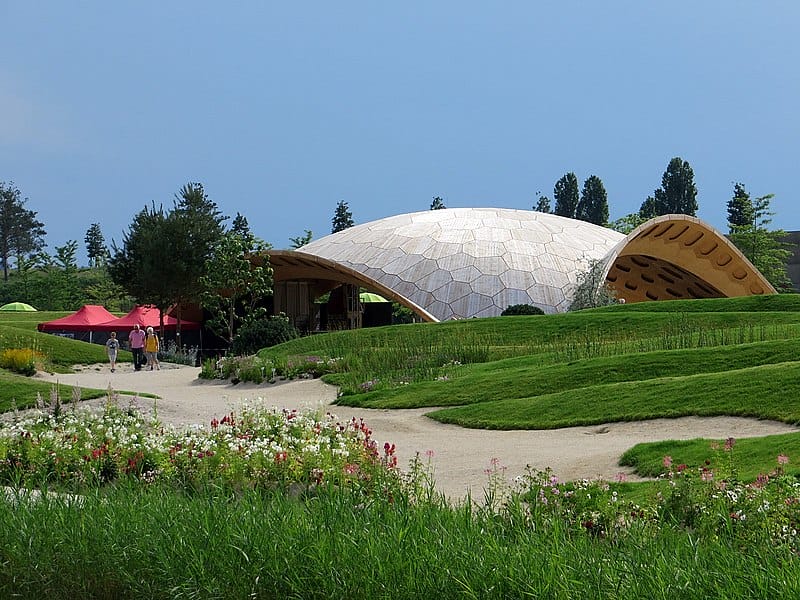
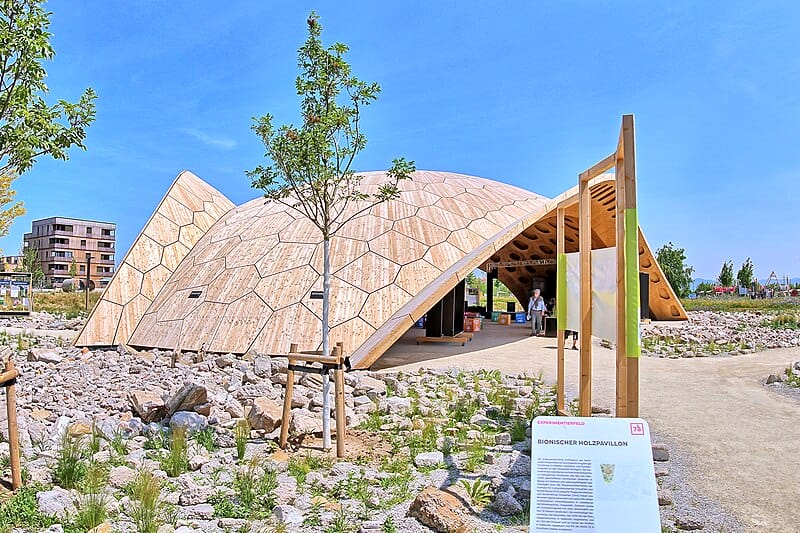
Bionic wooden pavilion – Wood & Innovation: Mother Nature helps build – Responsible architect Prof. Achim Menges (who received the Leibniz Prize in 2023) – Partners: University of Stuttgart and the State of Baden-Württemberg – Planners and builders: University of Stuttgart, ICD and ITKE / Müller Blaustein Holzbau / BIB Kutz GmbH & Co KG – The pavilion consists of larch wood panels and a total of 411 individual parts. Image source: Joachim Köhler, CC BY-SA 4.0, via Wikimedia Commons
This iconic wooden pavilion consists of precisely assembled segments that interlock like a sophisticated 3D puzzle. This temporary structure serves as a pioneering architectural attraction. Designed by the renowned Institute for Computational Design and Construction (ICD) in collaboration with the Institute for Structural Engineering and Design (ITKE) at the University of Stuttgart, the “BUGA Wooden Pavilion” explores new standards in digital timber construction .
The building envelope was designed using biological principles from the plate skeleton of sea urchins, which had been researched for almost a decade at the ICD and ITKE of the University of Stuttgart. As part of the project, a robotic assembly platform was developed to automatically assemble and mill the pavilion's 376 custom-made hollow timber segments – a process that ensures all segments fit together like a three-dimensional puzzle.
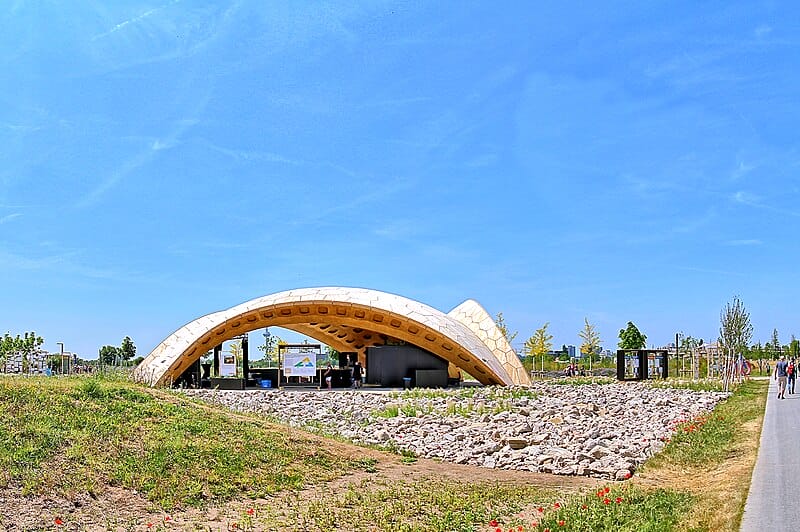
Mannheim BUGA 2023 Spinelli Park – The bionic wooden pavilion consists of larch wood panels and a total of 411 individual parts. The pavilion was designed based on the model of a sea urchin. Image source: Joachim Köhler, CC BY-SA 4.0, via Wikimedia Commons
The wooden roof extends over a total length of 30 meters (98 feet), thus providing ample space for events and concerts.
To efficiently reduce material consumption and weight, the wooden segments were manufactured using an innovative construction consisting of two thin panels, framed at the top and bottom by edge beams. This results in large-format hollow wooden boxes with a polygonal shape.
When assembled, the structure assumes a significant design function due to its striking, double-curved geometry. Image source: Joachim Köhler, CC BY-SA 4.0, via Wikimedia Commons
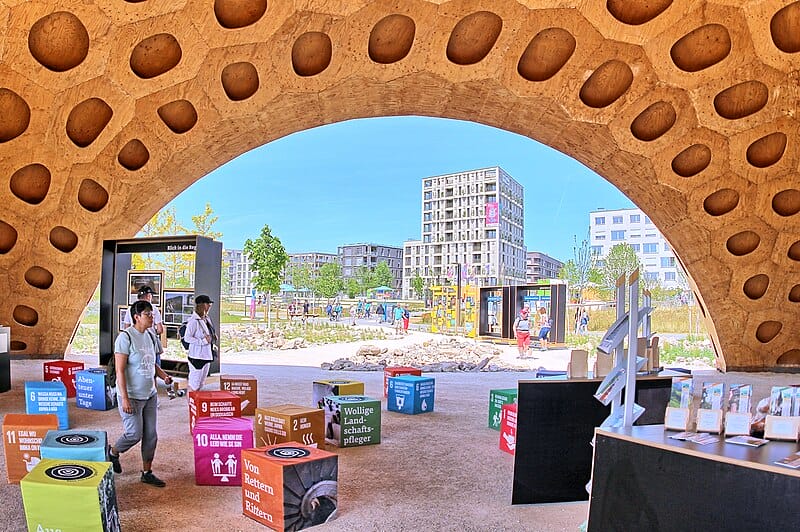
A striking architectural feature is the generous opening in the base plate, which not only offers an attractive visual appearance but also provides access to the concealed connections during assembly. Once assembled, the structure assumes a significant design function due to its distinctive, double-curved geometry.
Each individually manufactured shell segment was precisely assembled by robots. This involved the exact positioning of prefabricated wooden panels and beams, their temporary fixing with beechwood nails, and the precise application of structural adhesive between the panel and beam. The complex finger joints and openings were then incorporated into the segments.
View from the bionic wooden pavilion in Spinelli Park towards the Spinelli Quarter residential area. Image source: Joachim Köhler, CC BY-SA 4.0, via Wikimedia Commons
The entire process is fully automated, controlled by 2 million individual lines of robot code. The assembly time per segment averages 8 minutes, with the high-precision milling taking an additional 20-40 minutes.
02 From CAD modeling & laser cutting to intricate 3D wooden puzzles
You probably didn't expect to find something as "mundane" as a jigsaw puzzle in this list. But then you've certainly never seen a complex 3D wooden puzzle with its many small components in action. Here, you can observe mechanical principles working together, gear by gear, in a precise functional symbiosis.
If an electric motor is added for operation, then one can certainly speak of a delicate work of art that instantly brings back to mind our very own fascination with construction and technology from our childhood.
Take a look at Robotime 's Marble Spaceport (LGC01) , a kind of futuristic marble run made from hundreds of laser-cut and assembled wooden elements, and you'll know what I mean:
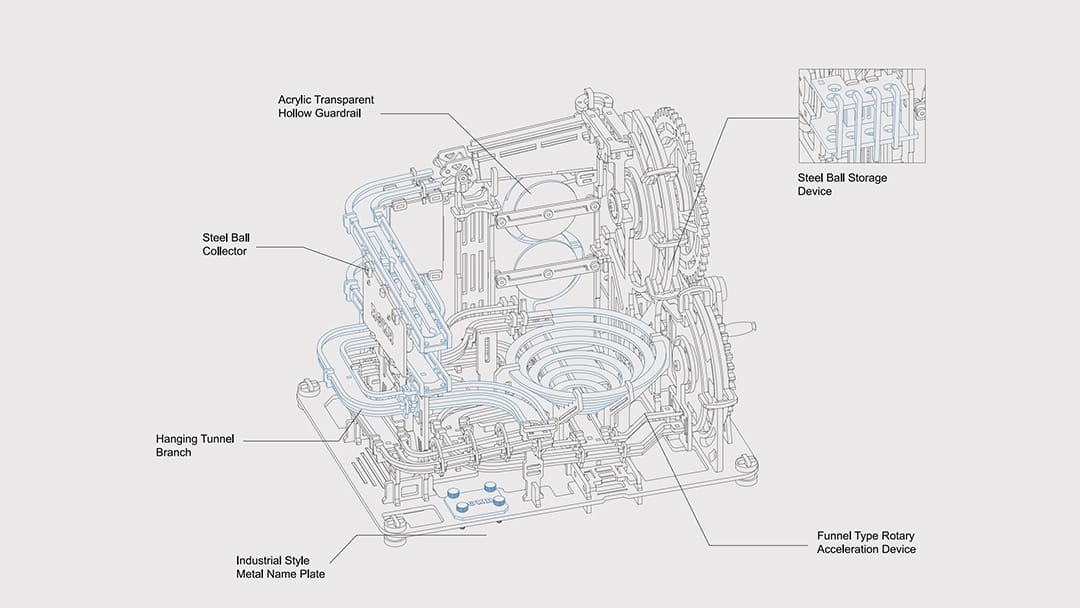
This captivating visual experience is a model of a marble run , finished in dark gray and decorated with silver dots. Part of the ROKR Track Maze City series, this product was designed with a future space technology theme in mind.
The unique feature of this marble run lies in its complex mechanical structure, consisting of 6 diversion mechanisms and 5 tracks. By turning the handle, you can watch steel balls roll along different paths. Thanks to the highly transparent PC and PS materials, it's possible to track the movement of each ball. The Marble Spaceport also features two drive modes: manual and electric.
While the finished puzzle is a visual and aesthetic delight in itself, we would like to delve a little into the exciting creation process from product design to laser cutting.
Concept phase
The product design team begins by developing the puzzle concept , determining the size and difficulty level, deciding on features such as lighting and sound effects, as well as the purpose and special features of the puzzle.
Design phase
After developing the concept, the designers create detailed sketches that reflect the theme, the concept, and the defined functions. They then use CAD (Computer-Aided Design) software to design each individual puzzle piece and its connections. This software allows them to enter precise measurements and calculations and to view the model from different perspectives.
The designers place particular emphasis on ensuring that each puzzle piece is unique in size and shape to guarantee clear differentiation. The stability and aesthetics of the finished puzzle are also taken into consideration. Once the 3D model is complete, detailed assembly instructions are created, including images, diagrams, and written explanations to guide the user through every step of the assembly process.
Prototype construction and testing
Once completed, the design goes to the production team to create a prototype. Are the parts manufactured precisely? Does the design fit the theme and is it aesthetically pleasing? Do the additional features function flawlessly?
Is the puzzle stable enough? If the test product passes the test, production can begin; otherwise, it will be returned to the designer for revision.
production
Once the design of a 3D wooden puzzle is ready for production, suitable hardwood such as maple, birch, mahogany, or oak is selected. The wood is kiln-dried to prevent warping.
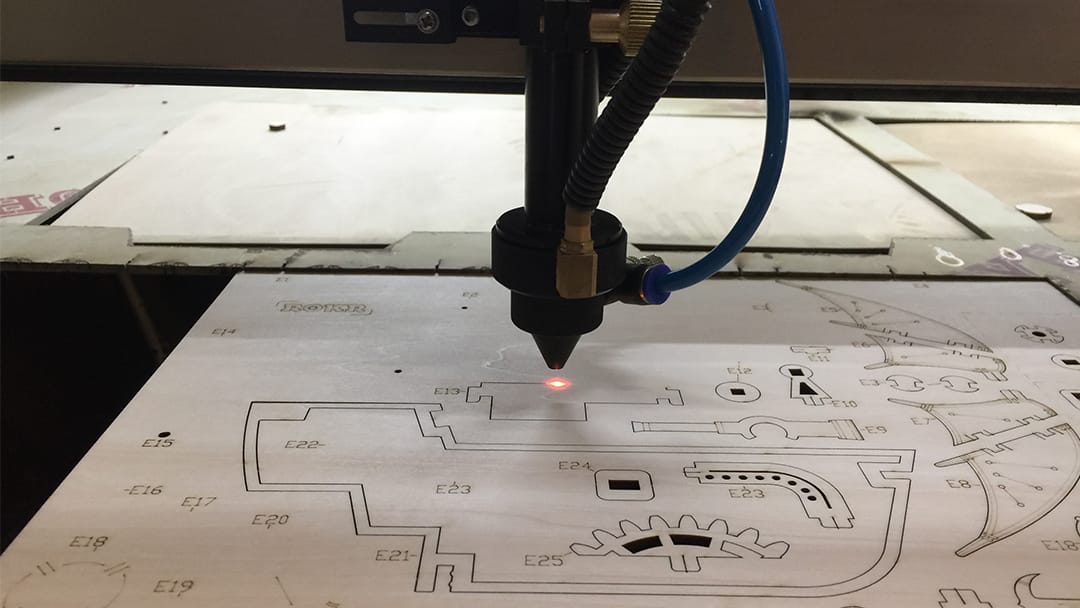
The puzzle pieces are precisely cut using laser cutting, scroll saws, or CNC milling machines. The wooden pieces are then finely sanded and, if necessary, stained, varnished, or protected.
The most common method for cutting wooden puzzle pieces is using a laser cutter. The design is programmed into the laser cutter. A powerful laser beam then burns the wood, precisely cutting it into the shapes and sizes specified in the design.
Finally, the puzzle is complete and can be purchased by customers via Robotime's online shop.
Other complex puzzle designs include a working pinball machine…
…and a fully functional printing press with interchangeable printing plates:
The Japanese artist and designer group Secca combines the puzzle theme with design and craftsmanship in a visually stunning way. Their impressive wooden sculpture 'A↔︎UN' is a silent testament to this symbiosis.
The Japanese creative group Secca assembled 15,000 artificial wood pieces into a complex sculpture reminiscent of a three-dimensional puzzle. Titled “A↔︎UN”, the work depicts a pair of a-un Komainu (guardian lion dogs) created by connecting each individual pixel-like piece.
This project explored how digital technology affects our relationship with nature by combining traditional Japanese techniques and concepts with state-of-the-art technology.
The couple is situated within a sequence of frames reminiscent of a digital device, representing a parallel world. This world exists countless times in a virtual space projected through front and rearview mirrors.
Humans have admired and envied what nature is capable of, and while we desperately try to imitate and artificially reproduce these creations, we have made progress in technology
What began as figurative painting, the act of recreating a scene observed by the viewer, now makes it possible to replicate the structural colors of morpho-butterflies, organs, genes, and even an individual's personality traits. Wood, too, can be artificially produced. While this was originally done two-dimensionally by printing simple wood patterns onto flat surfaces, state-of-the-art 3D printing technology has advanced to the point where it can reproduce the finest bumps of a vascular bundle, making it difficult to distinguish from real wood with the human eye. We like to have trees nearby, but we are never satisfied with what we have, instead creating artificial trees that are more convenient for us. What we ultimately enjoy is a space surrounded by artificial trees that look real
The three-dimensional object was created by combining parts that resemble pixels, similar to a virtual image materialized through digital data. Depending on the viewer's perspective, the back of the artificial wood structure becomes visible, revealing all the imperfections of the digital world.
The frame enclosing the two Komainu sculptures resembles a digital device, inviting visitors into a virtual space projected by the front and rear mirrors. According to Secca, this demonstrates how much people in today's society value diversity and extend the themes in which they seek solace into the digital world .
“A↔︎UN” was part of the exhibition “Kiinseido: Hirakushi Denchu and works that combine tradition with the future” at the Meiji Jingu Forest Art Festival 2021 in Tokyo.
04 Mjøstårnet – The tallest wooden skyscraper, Norway
Wood is currently enjoying great popularity due to its numerous advantages. Some construction developers even consider it the ideal building material for skyscrapers in technologically advanced countries. It is therefore hardly surprising that Norway, a country with large timber resources and at the forefront of social development, is a pioneer of this trend.
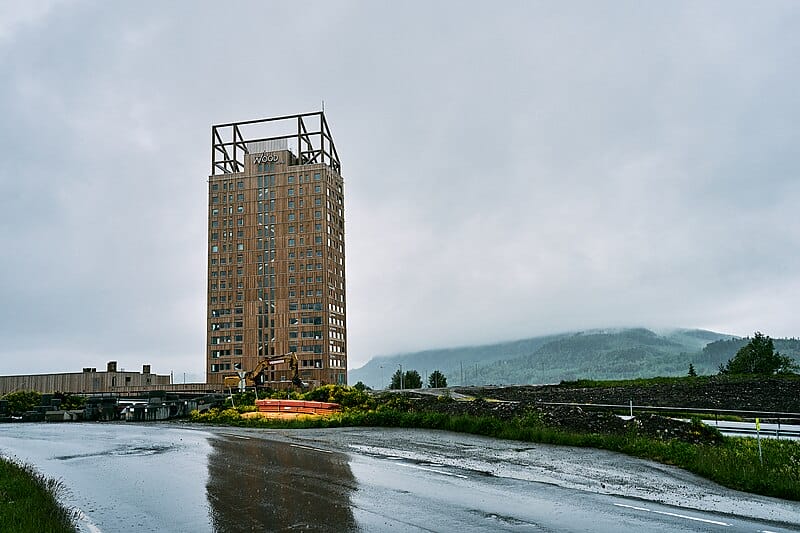
The world's tallest wooden skyscraper ( a plyscraperMjøstårnet , was built here in 2019.
Mjøstårnet (Lake Mjøsa Tower) in Brumunddal, Norway Image source: Øyvind Holmstad, CC BY-SA 4.0, via Wikimedia Commons
An imposing structure, 85.4 meters high, with 18 floors and a usable area of 10,500 square meters, constructed entirely from a sustainable, locally sourced raw material, impresses with its sheer statistics. An innovative assembly method was employed, in which the wooden beams were transported and positioned on-site with millimeter precision.
This required the utmost precision, as Rune Abrahamsen, CEO of the Scandinavian industrial group Moelven Limtre, which supplied the building products and systems for the project, emphasized in an interview after the successful completion of construction. There could be no room for error during assembly, as it was essentially like a Lego set for adults.
Thanks to the modular approach, the several hundred glulam beams could be assembled within just ten months. As a result, Mjøstårnet quickly took shape in the small town of Brumunddal. Assembly manager Lars Ivar Lindberg proudly stated at the opening ceremony:
It's an impressive feeling to lift almost 20 meters of the building's height into place all at once. Both the building and our pride grew together.”
The building is now occupied. Part of the tower serves as residential space, while another part houses offices. In addition, there is a hotel , restaurants, and even a large swimming pool covering 4,700 square meters.
As is already becoming apparent, the Mjøstårnet not remain the record holder for very long. A whole series of even more ambitious vertical timber construction projects have already been launched, reaching for the stars. The race to build the world's tallest wooden skyscraper is already in full swing.
What we consider impressive achievements today is overshadowed by another project in Tokyo: There, work is currently underway on the construction of a so-called "Plyscraper" called W350 .
To mark the 350th anniversary of the building materials giant Sumitomo Forestry , the company plans to erect a 350-meter-high wooden building as a monument to the company's history.
Owner and Managing Director of Kunstplaza . Publicist, editor, and passionate blogger in the fields of art, design, and creativity since 2011. Graduated with a degree in web design from university (2008). Further developed creative techniques through courses in freehand drawing, expressive painting, and theatre/acting. Profound knowledge of the art market gained through years of journalistic research and numerous collaborations with key players and institutions in the arts and culture sector.
We use technologies such as cookies to store and/or access device information. We do this to improve your browsing experience and to display (non-)personalized advertising. If you consent to these technologies, we can process data such as browsing behavior or unique IDs on this website. Refusal or withdrawal of consent may adversely affect certain features and functions.
Functional
Always Active
Technical storage or access is strictly necessary for the legitimate purpose of enabling the use of a specific service expressly requested by the subscriber or user, or for the sole purpose of carrying out the transmission of a message over an electronic communications network.
Preferences
The technical storage or access is necessary for the legitimate purpose of storing preferences that were not requested by the subscriber or user.
statistics
Technical storage or access that is solely for statistical purposes.Technical storage or access that is used solely for anonymous statistical purposes. Without a subpoena, the voluntary consent of your internet service provider, or additional recording by third parties, the information stored or retrieved for this purpose cannot generally be used to identify you.
marketing
Technical storage or access is required to create user profiles, to send advertising, or to track the user on one or more websites for similar marketing purposes.


















 Gobelin tapestry "Geisha" by Alison Wright, photorealistic art print, sound-absorbing
544,00 €
Gobelin tapestry "Geisha" by Alison Wright, photorealistic art print, sound-absorbing
544,00 €