• Art magazine
    • Art Magazine > Homepage
    • Architecture
    • Sculpture
    • Design
    • Digital Art
    • Fashion design
    • Photography
    • Freelancing
    • Garden design
    • Graphic design
    • Handmade
    • Interior Design
    • AI Art
    • Creativity
    • Art marketing
    • Art Periods And Movements
    • Art history
    • Art Trade
    • Artists
    • Knowing the art market
    • Art scene
    • Artworks
    • Painting
    • Music
    • News
    • Product Design
    • Street Art / Urban Art
    • Tips for Artists
    • Trends
    • Living from art
  • Online Gallery
    • Online Gallery > Home
    • Categories
      • Abstract Art Pictures
      • Acrylic painting
      • Oil painting
      • Sculptures & Statues
        • Garden Sculptures
      • Street-Art, Graffiti & Urban Art, Urban Art
      • Nude Art / Erotic Art
    • Post new artwork
    • Browse art
    • Search for artwork
  • Design & Decor Shop
    • Shop> Home
    • Wall Decors
    • Canvas art
    • Metal art
    • Sculptures
    • Furniture
    • Lighting
    • Textile Wall Pictures
    • Mirrors
    • Home textiles
    • Home accessories
    • Watches
    • Jewelry
    • Outlet / Sale
  • My Account
    • Customer area
    • For artists
      • Login
      • Register
Product added to your cart.

Abstract art – an overview of the non-representational art movement

Joachim Rodriguez y Romero
Thursday, July 3, 2025, 12:12 CEST

Read new posts immediately? Follow the Kunstplaza Magazine on Google News.

Have you ever stood before a work of art and been both impressed by its visual intensity and completely perplexed by its message? What is it actually supposed to represent? Is it art , or can it be thrown away? What is the artist trying to convey to me?

If you have ever had such thoughts while looking at a work of art and yet you couldn't let go, then it was most likely an abstract work of art.

Show table of contents
1 What is Abstract Art? – Characteristics and Definition
2 What idea lies behind this art movement?
3 The history of abstract art – from its beginnings to the present day
3.1 Precursors in the Stone Age
3.2 Origins and beginnings in the 19th century
3.3 Early 20th century
3.4 World Wars and Post-War Period
4 7 Forms of Non-Representational Art in Detail
4.1 01 Curvilinear Art
4.2 02 Art with a strong reference to color and light
4.3 03 Geometric Abstraction
4.4 04 Op Art
4.5 05 Emotional or intuitive abstract art
4.6 06 Gestural Abstraction
4.7 07 Minimalism
5 Why does abstract art fascinate us so much?
6 Understanding Abstract Art – A Short Guide
7 What is abstract photography?
8 In which museums and exhibitions can I find significant abstract artworks?
8.1 Buying abstract art – what you should pay attention to
8.2 Abstract art in our online gallery
8.3 Abstract paintings at our partner galleries
8.4 Further tips and guides
9 Contemporary art of German and Austrian expressive abstraction
9.1 You might also be interested in: :

What is Abstract Art? – Characteristics and Definition

Abstract art – also referred to as “non-representational art” or “non-objective art” – is, by definition, a collective term for art movements of the 20th century that emerged after 1900. It uses artistic means of expression that are partially or completely abstract from the object and thus has an overlap with Cubism.

Abstract artists create works completely detached from nature and real objects. They fundamentally reject any form of representation. Their consciousness and creative drive are based on aesthetics for its own sake.

Abstract art explained simply and succinctly:

Abstract art is art that does not attempt to create an accurate representation of a visual reality, but uses surfaces, lines, colors, shapes, textures, and gestural signs to achieve its effect

"Concrete Art" also frequently arises in this context, and a clear distinction from Abstract Art is only possible to a limited extent. The term was introduced by Theo van Doesburg Art Concret group in 1930 .

The art of abstraction is inextricably linked to the concept of concrete art - strictly speaking, this represents a direction of art that ideally is based on mathematical-geometric principles.
The art of abstraction is inextricably linked to the concept of concrete art – the latter, strictly speaking, represents a branch of art that ideally rests on mathematical and geometric principles.
Image source: Freepik

Strictly speaking, it represents a specific art form that ideally is based on mathematical and geometric principles.

Abstract art, alongside music, is arguably one of the purest forms of artistic expression . It gives artists complete freedom to communicate feelings and emotions unhindered by figurative elements within objective reality.

Abstract art also often carries a moral dimension, representing virtues such as order, purity, simplicity, and spirituality, and propagating these in pictorial form. It has constituted a central movement in modern art .

Abstract paintings can be created using many different media, with many artists using acrylic paints. Abstract oil paintings and watercolors are also very popular among contemporary artists. Their Canvas art is in high demand by collectors, dealers, and art lovers worldwide.

What idea lies behind this art movement?

Abstract art - abstract painting and example of non -related art
Abstract Art – Abstract painting and example of non-representational art.
Image source: rawpixel.com, via Freepik

As mentioned at the beginning, the key theme is aesthetics as such and the liberation of forms of expression from a representational constraint.

The conceptual roots likely extend back to ancient Greece. The philosophical framework for classifying and appreciating the formal qualities of a work of art thus derives from a statement by Plato :

Straight lines and circles are not just beautiful... but eternally and absolutely beautiful.”

Basically, Plato wanted to express that non-representational images (e.g., simple geometric shapes) possess an absolute, unchanging beauty.

Accordingly, a work can be appreciated and valued solely on the basis of its lines and colors – it is not obliged to depict a natural object or a representational scene.

Non-representational art - Abstract artwork from the Museum of Fine Arts, Boston, USA
Non-representational art – Abstract artwork from the Museum of Fine Arts, Boston, USA.
Image by lucia @luciadong, Unsplash.com

The French painter, lithographer and art theorist Maurice Denis (1870-1943) was evidently very aware of this idea of ​​Plato's when he wrote:

Remember that a picture – before it becomes a warhorse or a naked woman… is essentially a flat surface covered with colors in a specific order.”

Some abstract artists describe their ambitions as creating the visual equivalent of a piece of music, one that can be viewed and appreciated on its own merits. They don't want viewers to have to ask, "What is this painting actually about? "

The history of abstract art – from its beginnings to the present day

Precursors in the Stone Age

If we go back a bit, abstract art already had significance around 70,000 years ago with prehistoric engravings. For example, two boulders engraved with abstract geometric patterns from this period were found in Blombos Cave in South Africa.

Then there were archaeological finds of abstract red-ochre dots and hand stencils used in the paintings of the El Castillo cave from the period 39,000–34,000 BC).

After that, abstract symbols apparently became the predominant form of Paleolithic cave art for a long time and were found about twice as often as figurative images.

Origins and beginnings in the 19th century

Independent, unbiased and free thanks to your click

Links marked with a symbol or an asterisk are affiliate links. We only recommend products we use (or would use) ourselves. If you visit affiliate links in our content, we may receive a commission on your purchase (at no extra cost to you). This helps fund the free editorial content we provide to you ( more details here ).

Abstract art forms, as we know them today, are much more recent. Their origin lies in the departure from classical academic painting in late 19th and early 20th century Europe.

Before that, paintings and sculptures traditional principles of classical realism, as taught at major European academies . These principles established the paramount duty of art as the depiction of a recognizable scene or a concrete object.

The era of the late 19th and early 20th centuries, characterized by such a comprehensive abundance of artistic creation, produced a whole series of painters who investigated in detail the connections and inherent mechanisms of light and visual perception.

Many renowned artists before this time painted using the methods of classical realism , employing realistic perspectives, shading, and other techniques to create historical scenes and objects.

The Romantic era was characterized by an attitude towards art that rejected the imitation and idealization of Classicism. Instead, the role of imagination and the unconscious was emphasized as essential creative factors .

Gradually, many painters of this period came to appreciate the newly gained creative freedom and the new demands that accompanied the convergence of these attitudes. Impressionism as Art Movement (c. 1870–1880) already revealed the first signs of a departure from strictly figurative painting .

In particular, the variants Neo-Impressionist Pointillism and Post-Impressionism drew attention to the special effect of color as a stylistic device.

In "The Vulture in the Rocks" by Karl Mediz (Post-Impressionism), a clear departure from realism can already be seen
In Karl Mediz's "The Vulture in the Rocks" (Post-Impressionism), a clear departure from realism can already be seen.
Check artwork

German Expressionism ultimately established the free use of forms and colors as a cornerstone of painting. The subsequent Art Nouveau movement (c. 1890-1914) also influenced the development of abstract art.

Strong symbolist tendencies can already be seen in "The Girls" by the Art Nouveau representative Gustav Klimt
Strong symbolist tendencies can already be seen in “The Girls” by the Art Nouveau representative Gustav Klimt
Check artwork

Maurice Denis's quote from 1890 (see above) perfectly encapsulates this shift. It skillfully summarizes the prevailing sentiment among the Symbolist and Post-Impressionist artists of his time.

Early 20th century

All the major movements of the first two decades of the 20th century, including Fauvism, Expressionism , Cubism and Futurism, emphasized in some way the gap between art and the natural appearance of its subjects.

However, there is a significant difference between simply abstracting the actual appearance of a subject and creating works of art from shapes, lines, and structures that have no equivalent in our natural environment.

In the years before the First World War, artists such as Robert Delaunay, Wassily Kandinsky, Kasimir Malevich and Vladimir Tatlin to fundamentally abstract art.

"On the Spiritual in Art," published in 1911, became a founding manifesto.

Wassily Kandinsky: Abstract painting "Yellow - Red - Blue" (1925)
Wassily Kandinsky: Abstract painting “Yellow – Red – Blue” (1925)
Check artwork
Abstract painting "Composition VIII" (1923) by Wassily Kandinsky, limited reproduction, Giclée on canvas
Abstract painting “Composition VIII” (1923) by Wassily Kandinsky, limited edition reproduction, giclée print on canvas
Check artwork
Abstract picture "Heavy Red" (1924) by Wassily Kandinsky, Giclée on canvas

Abstract painting “Heavy Red” (1924) by Wassily Kandinsky, giclée print on canvas
Check artwork

However, it is now believed that the Swedish artist Hilma af Klint created the first abstract painting in Stockholm five years before Kandinsky. Her futuristic works, featuring biomorphic and geometric forms against a striking background, were revolutionary for their time.

While Vassily Kandinsky established a reputation as a successful painter, Klint's works remained largely unnoticed for a long time due to their quiet nature. She kept most of her work to herself and rarely exhibited it.

She asked her family to postpone the publication of her works until twenty years after her death, believing the world was not yet ready for her vision. Her artwork remained hidden until 1986, when it attracted widespread interest.

The Ten Greatest, No. 7, Adulthood, Group IV, 1907 by Hilma af Klint
Artwork as a reproduction
Buddha's Standpoint in Earthly Life, No. 3a by Hilma af Klint
Artwork as a reproduction
Group IV, No. 2. The Ten Greatest, Childhood, 1907 by Hilma af Klint
Artwork as a reproduction

This new style of painting was considered "pure art" because the motifs originated solely in the artists' minds and were not copied or referenced in the real world. The formal qualities of a work of art were emphasized over its representational subject matter.

This complete abandonment of any form of representation was viewed rather critically by the majority of even progressive artists of that time. During the First World War, the emergence of the De Stijl group in the Netherlands and the Dada group in Zurich further broadened the spectrum of abstract art.

Abstract artwork in the style of Action Painting and dripping technique by Jackson Pollock
, by Paul Blenkhorn of Sensory Art House Abstract Art Studio @SensoryArtHouse, via Unsplash.com

Paul Klee is often omitted from the list of names regularly mentioned in discussions about abstraction in early 20th-century art – and this is indeed unjustified. His extensive body of work, encompassing both early and late periods, offers a wealth of impressive examples of the development of abstract visual worlds and effective processes of painterly abstraction.

While his contemporary artists often dealt with the subject matter radically, practically shocking the public with their non-representational compositions, Paul Klee strove for connections and continuities in his abstract paintings. He integrated representational elements into many of his works and, through carefully chosen titles, opened up new possibilities for interpretation. This may even have been a decisive reason for the remarkable success of this artist.

Abstraction. The cool romanticism of this style, devoid of pathos, is unprecedented.”

Klee noted this in 1915. Another observation about the degree of abstraction in art from the same year seems more relevant today than ever and can be universally applied to modern existence:

The more terrifying this world, the more abstract the art, while a happy world produces an earthly art

These insights not only demonstrate Klee's profound engagement with art, but also invite us to rediscover his work and reflect on its relevance in our present time.

Klee's abstract work "Fire at Full Moon" is a shining example of the use of abstract forms to depict a multifaceted idea. Fire and moon are symbolized by repeating geometric shapes surrounded by darker areas that emphasize the dancing flames and the moon's gravitational pull. The intense colors further enhance the sense of pulsating movement, while the dark and gray areas provide a calming contrast.

Abstract painting "Fire at Full Moon" (1933) by Paul Klee, Limited Reproduction
Abstract painting “Fire at Full Moon” (1933) by Paul Klee, Limited Reproduction
Check artwork
Abstract picture "View from Red" (1937) by Paul Klee, Giclée, reproduction on canvas
Abstract painting “View from Red” (1937) by Paul Klee, Giclée print, reproduction on canvas
Check artwork
"Urban Composition with Yellow Windows" (1919) by Paul Klee, reproduction on wove paper
“Urban Composition with Yellow Windows” (1919) by Paul Klee, reproduction on handmade paper
Check artwork

Paul Klee's abstract works are deeply rooted in the themes of nature, architecture, music, and writing. These elements enabled him to distill the essence of painting. His art displays a rich use of line and color, revealing a diversity of possibilities. For example, the colorful abstraction of his watercolor garden views of Hammamet (1914) varies considerably from the explosive compositions he created during the First World War.

During the Bauhaus period, Klee's color field paintings, which depicted blossoming trees, transformed into minimalist forms of architectural associations. His late works are particularly striking, featuring dark shapes reminiscent of plants or written characters. An enthusiastic musician, Klee also found rhythmic structures in his abstract compositions, from which musical tones and melodies can be clearly discerned.

World Wars and Post-War Period

The advance of this art movement was halted by the World Wars. In light of totalitarian politics and art movements that increasingly focused on Surrealist and socially critical Realist , abstract works received little attention during this period.

Only after the end of the Second World War did an energetic American school of abstract painting emerge – this was called “Abstract Expressionism” and was to have a great, lasting influence on the art world.

Since the 1950s, abstract art has been a recognized and widespread approach in European and American painting and sculpture. This art movement has undoubtedly confused many people and probably still elicits head-shaking from some viewers.

For those art lovers who accept and appreciate its non-referential language, however, there is no doubt about its value and the achievements of its artists.

7 Forms of Non-Representational Art in Detail

Abstract artworks in the Art Gallery, Wilson y Avenida Amazonas
David Adam Kess [CC BY-SA]
More abstract paintings and sculptures from the Art Gallery, Wilson y Avenida Amazonas
David Adam Kess [CC BY-SA]

In order to make a logical classification within this collective term, the following six basic types can, in principle, be distinguished from one another stylistically based on certain characteristics:

01 Curvilinear Art

This type of curvilinear abstraction is closely related to Celtic art, which employed a variety of abstract motifs and patterns. These included knots, braided patterns, and spirals (including the triskele).

Surprisingly, the Celts were not the originators. Older cultures had already used these Celtic designs centuries before. However, it cannot be denied that the Celts breathed new life into this art form, further developed its level of detail and finesse, and significantly contributed to its dissemination.

Later, curvilinear motifs returned during the Celtic Revival Movement of the 19th century and the influential Art Nouveau movement of the 20th century, particularly in book covers, textiles, wallpapers and chintz designs by William Morris (1834-96) and Arthur Mackmurdo (1851-1942).

William Morris

William Morris was born in 1834 near London, more precisely in Walthamstow. His family belonged to the wealthier class of society, as his father worked on the stock exchange and thus left him a considerable inheritance.

Morris' interests and abilities were diverse, ranging from painting and poetry to decorative arts and architecture.

Morris was a passionate nature lover, a fact reflected in his elaborate decorations adorned with delicate flowers and birds. His colorful works masked his occasionally fiery temper.

Under his leadership, the company expanded considerably and now also produced carpets, wall hangings and wallpapers.

Although Morris remained busy working on his business until his death, he still found time to indulge his passion for carpet weaving and writing poems and legends.

Acanthus leaves, wild rose on a purple background, 19th century (wallpaper), by William Morris
Check artwork
The Woodpecker Tapestry, detail of the woodpeckers, 1885 tapestry, by William Morris
Check artwork
Wallpaper pattern Bird and Pomegranate, printed by John Henry Dearle (1860-1932), 1926 (wallpaper), by William Morris
Check artwork

Arthur Heygate Mackmurdo

Arthur Heygate Mackmurdo was a visionary architect and designer from England whose ideas significantly influenced the Arts and Crafts movement . In particular, through the founding of the Century Guild of Artists in 1882 in collaboration with Herbert Horne, he provided important impetus for the development of abstract art.

As a pioneer of the Modern Style , he is considered a driving force of the worldwide Art Nouveau movement.

Title page of Wren's City Churches, design by Arthur Heygate Mackmurdo, engraved by G. Allen
Regarding the design

Curvilinear abstraction also influenced Islamic art .

02 Art with a strong reference to color and light

Exemplary of this type are works by William Turner (1775-1851) and Claude Monet (1840-1926). They employ color or light so skillfully that they detach the artwork from representational reality, while the object dissolves in a swirl of pigments.

William Turner

William Turner , one of the most important English artists, was admitted to the Royal Academy in 1789. Alongside his studies, he also apprenticed with the watercolorist Thomas Malton. He first exhibited his watercolors at a Royal Academy exhibition in 1790 and submitted his first oil painting there six years later.

After a period of travel that took him to Scotland, Switzerland, and France, Turner opened his own gallery in 1804. In 1807, he was appointed professor at the Royal Academy and began "Liber Studiorum ," a catalogue in which he categorized painting according to specific criteria.

A trip to Italy in 1819/20, during which he spent an extended period in Rome, led to a change in Turner's style. His paintings increasingly distanced themselves from realism, which drew sharp criticism. Some of his later works were no longer exhibited at the Royal Academy due to the dissolution of representational elements.

Turner later traveled repeatedly to southern Europe, particularly to Venice, which fascinated him with its transfigured colors and inspired several paintings. With his bright and pure colors, he is considered one of the most remarkable landscape painters of the Romantic era .

William Turner “Sunset over a Lake” (1840), framed giclée print
Check artwork
"Moonlight over Lake Lucerne" (1841-44) by William Turner, Romantic painting, limited reproduction
Check artwork
"The last trip of the Temeraire" (1839) by William Turner, painting of romance, limited reproduction
“The Last Voyage of the Temeraire” (1839) by William Turner, Romantic painting, limited reproduction
Check artwork

Fauvism

Similarly, several Fauvist works by Henri Matisse (1869-1954) can be classified as belonging to this type. The same applies to a number of Kandinsky's Expressionist paintings and to works by his colleague Franz Marc (1880-1916).

Franz Marc: Lying Dog in the Snow (1911)
Check artwork

Furthermore, the Czech painter Frank Kupka (1871-1957) created some of the first color-intensive abstract paintings, which later Robert Delaunay (1885-1941). Delaunay, in his Orphist , which was also inspired by Cubism, likewise relied on color.

Color field painting & lyrical abstraction

In the late 1940s and 1950s, color-related abstraction reappeared in the form of color field painting Mark Rothko (1903-70) and Barnett Newman (1905-70)

Color field painting, which utilizes large areas of bright and intense colors, was also championed by Clyfford Still . Color field painting is characterized by its focus on the interplay of colors rather than specific ideas or forms. Large-format canvases were used to give the works a striking expressiveness.

By abandoning conventional pictorial arrangements and figurative representations, the immediate impact of pure color fields was given free rein. Mark Rothko is one of the most important representatives of this movement. Abstract compositions with numerous rectangular fields in different shades of the same or similar character define his oeuvre. Although strong primary colors are also used, warm earth tones predominate.

Similarly, Clyfford experimented with even greater abstraction in his works. In doing so, he created large-format paintings with powerful, contrasting colors. In this way, the artist evoked a strong emotional response.

Color field painting, through its revolutionary approach, created new spaces for personal feelings and provoked emotions in the viewer by avoiding conventional representational methods. Lyrical abstraction , as a competing form of this style, first appeared in France in the 1950s.

03 Geometric Abstraction

This form of more intellectual art, employing geometric forms, emerged towards the end of the first decade of the 20th century. An early, still underdeveloped form was Cubism, specifically Analytical Cubism.

He completely rejected linear perspective and the illusion of spatial depth in painting, breaking with many previously prevalent standards in the art world. This radical reorientation led artists to focus entirely on the two-dimensional aspects of a picture.

Geometric abstraction is also known as concrete art and non-objective art – with a strong focus on non-naturalistic images, using simple geometric forms such as circles, squares, triangles, rectangles, etc.

The complete lack of any reference to, or indeed any connection with, the natural world makes it virtually the purest form of abstraction.

Examples of Concrete Art include:

  • Black Circle (1913) by Kasimir Malevich (1878-1935) – exhibited at the State Russian Museum in St. Petersburg
  • Broadway Boogie-Woogie (1942) by Piet Mondrian (1872-1944) – exhibited at MoMA in New York
  • Composition VIII (The Cow) (1918) by Theo van Doesburg (1883-1931) – also exhibited at MoMA in New York
  • A tribute to the square by Josef Albers (1888-1976)

04 Op Art

Optical art , sometimes also known as Op Art , first emerged in the 1960s. The Hungarian artist Victor Vasarely (1906–1997), who intensively studied optical phenomena, significantly shaped this movement.

To create visual illusions, Op Art artists – including renowned artists such as Julio Le Parc , François Morellet , and Yaacov Agam – played with colors, shapes, and light. It was like a reversal of the Abstract Expressionist movement of the previous decades.

While Op Art focused on deceiving the viewer's gaze and inducing a state of visual obsession, Abstract Expressionist artists communicated their feelings and emotions through dynamic brushstrokes. Geometric patterns and illusionary effects characterized this art movement.

The resulting images, created through a skillful interplay of color and form contrasts, made it impossible for the viewer to distinguish foreground from background or realistic representation from pure design. The creators of Op Art were not only concerned with an aesthetic experience, but also with the active involvement of the audience.

They practically invited the viewer to see through the visual illusions and solve the mystery behind the artwork by testing their senses. Because of this interactive component, Op Art was a remarkable artistic trend.

Optical art also had an enormous influence on other fields such as design and architecture. Its principles were applied to the design of everyday objects, building facades, and even fashion.

05 Emotional or intuitive abstract art

This is a type of art . It is fundamentally characterized by a mix of styles. A common theme can be identified, which is marked by a naturalistic tendency.

This inclination towards naturalism is revealed in the manner of using forms and colors. In contrast to geometric abstraction, which manages almost entirely without references to representational nature, this art form takes a somewhat different direction.

Intuitive abstraction seeks to bring nature to life in its works, but in a less representational way.

Two important sources for this type of art are organic abstraction (also biomorphic abstraction ) and Surrealism .

Perhaps the most famous representative of this form of painting was the Russian-born Mark Rothko .

Reproduction of the "Green Red on Orange" painting by Mark Rothko in the frame
Reproduction of the painting “Green Red on Orange” by Mark Rothko in a frame
Check artwork
Abstract Painting "Untitled" (1968) by Mark Rothko, Giclée on Paper
Abstract painting “Untitled” (1968) by Mark Rothko, giclée print on paper
Check artwork
Abstract color field painting "Untitled (Violet, Black, Orange, Yellow on White and Red)" (1949) by Mark Rothko
Abstract color field painting “Untitled (Violet, Black, Orange, Yellow on White and Red)” (1949) by Mark Rothko
Check artwork

Exemplary works of intuitive abstraction include, besides Mark Rothko's paintings:

  • Composition No. 4 (1911) and Composition VII (1913) by Wassily Kandinsky – exhibited in the Kunstsammlung Nordrhein-Westfalen and Tretjakow Gallery
  • The typical plate, fork and navel (1923) by Jean Arp (1887-1966) – in a private collection
  • Woman (1934) by Joàn Miró (1893-1983) – also in a private collection
  • Inscape: Psychological Morphology no. 104 (1939) by Matta (1911-2002) – also in a private collection
  • Infinite Divisibility (1942) by Yves Tanguy (1900-55) – exhibited at the Allbright-Knox Art Gallery in Buffalo (USA)

Examples in sculpture and carving:

  • The Kiss (1907) by Constantin Brancusi (1876-1957) – Kunsthalle, Hamburg
  • Mother and Child (1934) by Barbara Hepworth (1903–1975) – exhibited at the Tate Gallery
  • Giant Pip (1937) by Jean Arp – exhibited at the National Art Museum, Centre Georges Pompidou, France
  • Three Standing Figures (1953) by Henry Moore (1898-1986) – Guggenheim Museum, Venice

06 Gestural Abstraction

Gestural abstraction is a variation or sub-form of abstract expressionism. In this style, more importance is attached to the process of creating the painting than was usually the case before.

For example, paint can be applied in unusual ways here. Brushwork is also usually very loose, spontaneous, and quick.

Famous American representatives of gestural painting include Jackson Pollock (1912-56), the inventor of Action Painting and the dripping technique , and his wife Lee Krasner (1908-84), who inspired him with her own form of drip painting.

Jackson Pollock described abstract art as a “revealed energy and movement” to create art without self-censorship and intuitively, “from the gut.”

“Number IIA” (1948) by Jackson Pollock, Editions Pierre D'Harville (licensed by J. Pollock/SOFAM Belgique)
Check artwork
Jackson Pollock "Beyond the Edge, The Studio Set 1", limited Giclée print
Jackson Pollock “Beyond the Edge, the Studio Set 1”, limited edition giclee print
Check artwork

Other important figures include Willem de Kooning (1904-97), famous for his series "Woman", and Robert Motherwell (1912-56), who achieved worldwide fame for his series "Elegy to the Spanish Republic" .

illustrated by Tachism as well as by the CoBrA group – especially Karel Appel

07 Minimalism

As a counter-movement to the gestural painting of Abstract Expressionism, Minimalism as an avant-garde art movement in the USA. A kind of postmodernism , so to speak.

It was also freed from all external references and associations. It is reduced to what you actually see – nothing else.

Minimalism often takes on a geometric form or is structured according to geometric principles. This art movement is dominated by sculptors and has been particularly prevalent in architecture and modern design since the 1980s.

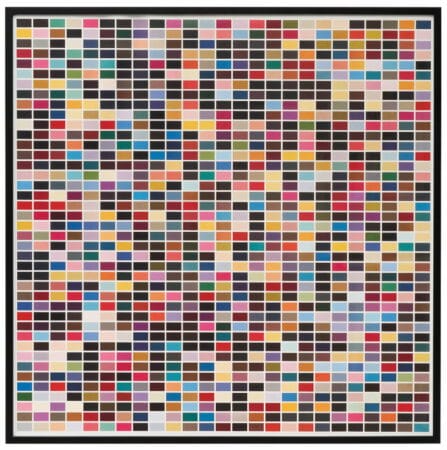
the Museum Barberini in Potsdam presented an impressive exhibition of over ninety artworks by the painter Gerhard Richter . The focus was on abstract art. This show placed Richter's works from more than fifty years into a broader context. The Berlin-av had the opportunity to meet Gerhard Richter at the exhibition's opening. In the video, he discusses various aspects of his artistic work during a press conference.

Gerhard Richter, often called the “Picasso of the 21st century ,” is celebrated for his diverse body of work. An exhibition at the Haus der Kunst in 2009 presented, for the first time, a comprehensive selection of his abstract paintings created since the 1970s. These large-format works, mostly created in series, reflect Richter's intensive exploration of the principles and limits of painting.

His creative process is characterized by a “planned spontaneity ,” in which he works without a preconceived motif and incorporates chance. Using brushes, squeegees, and spatulas, he creates layer upon layer of changing color elements, often resulting in spatial structures, yet never in clearly recognizable objects. Many of these paintings go through more than thirty stages, with the remnants of the process remaining captivatingly present.

The more than fifty works in the exhibition were characterized by their breathtaking color intensity and are a visual experience of “cascades of intoxicatingly psychedelic colors” .

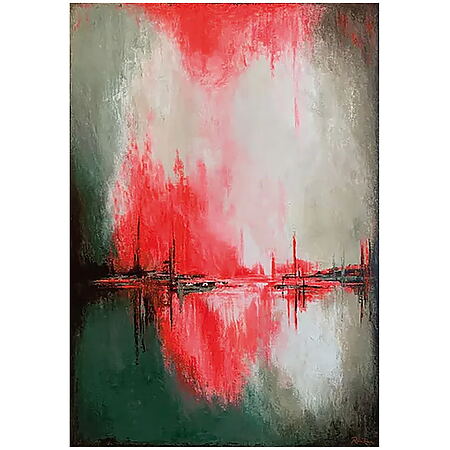
"1025 Colors" (1974) by Gerhard Richter, Reproduction on Paper
“1025 Colors” (1974) by Gerhard Richter, reproduction on paper
Check artwork
“Abstract Painting” (2004) by Gerhard Richter, limited edition reproduction on prestige paper
Check artwork
“Abstract Painting” (1992) by Gerhard Richter, limited edition reproduction on handmade paper
Check artwork

Why does abstract art fascinate us so much?

Perhaps you too have experienced this: you found yourself lingering on a particular abstract work of art, gazing at it for a long time and feeling a certain pull – without being able to fully grasp why.

It's not easy to explain, but it can't be denied. Non-representational art can evoke a unique fascination that captivates our minds. It can trigger diverse associations and thought processes in viewers, sending our imagination on a journey.

Understanding abstract art is not particularly difficult in itself – all you basically need is an open mind and a good dose of imagination.

The first step is to let go of familiar ideas and entrenched beliefs. Understanding abstract art is primarily about looking beyond how we know and perceive things. Only then does the true power of these works unfold.

The Armenian-born draftsman and painter Arshile Gorky sums it up as follows:

Abstraction allows humans to see with their minds what they cannot physically perceive with their eyes. Abstract art allows the artist to perceive the infinite beyond the tangible and to bring it out of the finite. It is the emancipation of the mind. It is an exploration of unknown territories

(rough translation from English)

Abstraction is rooted in the "intuition" and in "freedom" (for both the artist and the viewer). It is the artist's ability to use their imagination to see beyond the physically visible and to translate immaterial emotions onto the canvas.

It is also the audience's ability to connect with the artist's intention in abstract art and to free their own mind from visual limitations.

The most important thing to understand about this art form is that it does not have to have a specific meaning, history, or even a clear explanation.

Its main purpose is rather to foster imagination and an intuitive approach. This art form is primarily about offering viewers an intangible and emotional experience – and this experience is usually completely different for each person, depending on their individual personality and state of mind at the time of viewing.

All of this makes abstract art so incredibly exciting and enriching.

Understanding Abstract Art – A Short Guide

We have learned that it is not about recognizing and finding familiar figures or patterns in abstract works.

If the explanations in the last section are too general for you and you are still unsure how to proceed, then perhaps the following tips will help:

  • When trying to understand abstraction, it is important to recognize that there different ways to approach and classify art.
  • To appreciate modern art, the focus should not be on how realistically the artist has painted something or someone and how many sophisticated details are present, but rather on how successful a work is in evoking emotions and creating a deep connection with the artist.
  • Abstract paintings can also be appreciated in terms of their individual elements : color, form, line, texture, space, intensity, etc. The skill of an abstract artist lies in their ability to utilize colors and textures as effectively as possible and to create a complete (harmonious) composition from these elements.
  • Don't look at the clock! There's no need to stand in front of an abstract work for hours. But do take as much time as you are intuitively moved by it. Time shouldn't play a role. Under no circumstances should you set a time limit beforehand.
  • We all know that art is subjective , and sometimes there are works we simply can't connect with, especially when it comes to abstract art. Accept this fact or try again another time.
  • Don't belittle the artist's imagination or its value! If you don't like a work or can't connect with it, simply reflect on what specifically makes you feel that way. Perhaps this will open you up to a new perspective. And that, after all, is the secret of this kind of art.
  • Ignore the title! In most cases, abstract paintings have extremely vague titles (e.g., "Number 4" or "Black and Red"). Don't let this mislead you. Most abstract artists deliberately avoid using meaningful or even promotional titles. They emphasize that you interact with their art and ultimately find your own personal meaning in it. Only in some cases can a title be helpful in guiding your imagination in a certain direction.
  • Read the wall text or the explanations in accompanying art guides or brochures. This content can provide you with important information about the artist's background or artistic intention. Tip: Try viewing the artwork without any context first – this will allow for a more intense and unconstrained experience.
  • Let the painting speak to you! Clear your mind of all other thoughts. Give the artwork some time and allow its emotions to resonate with you. Observe the colors and textures. What do you feel? What thoughts race through your mind? Jackson Pollock once said, "Let the painting ask the questions, rather than the other way around."
  • Don't put pressure on yourself! Don't worry if you don't immediately feel something with every picture. An abstract painting doesn't need to evoke a contextual connection; that is, you don't have to be able to feel every emotion it might convey. If it doesn't do anything for you, that's perfectly acceptable. Negative emotions are also possible and should be acknowledged.
  • Don't forget that abstraction doesn't have to have meaning! While understanding a work of art can evoke a momentary feeling of victory, immersing oneself in its mystery brings lasting pleasure.

What is abstract photography?

In the world of abstract photography, photographers draw on the aesthetics and techniques of abstract art and reproduce them in photography. This is done through a combination of ordinary objects, scenes, and photographic techniques to create images that correspond to other forms of abstract art.

Barbara Crane was a photographer who used extreme close-ups, exaggerated shadows and overexposure to create experimental optics that distorted traditional cityscapes.

In her Loop series, she transformed skyscrapers and apartment blocks into high-contrast, geometrically abstract images. The artist described her approach as follows:

Even though I use past experiences as a foundation, I try to let go of old habits of seeing and thinking. I am constantly searching for something that is visually new to me. At the same time, I hope that form and content will merge.”

Kimberly Poppe also uses her camera to explore new perspectives. Her landscape photographs are more influenced by Rothko's paintings than by the ocean panoramas he photographs. The American abstract expressionist is one of her most important influences.

Sven Pfrommer, a contemporary photographer and visual artist living in Berlin, also dedicates himself impressively to abstract photography and works with great success worldwide.

In which museums and exhibitions can I find significant abstract artworks?

While non-representational art can be seen in most of the world's major art museums, there are a number of remarkable collections in prestigious museums that house important and special works of this art form.

A visit to the following important museums is particularly worthwhile:

  • Museum of Modern Art (MoMA), New York
  • Samuel R Guggenheim Museum, New York
  • Albright-Knox Art Gallery, Buffalo, NY
  • Tate Modern Gallery, London
  • Georges Pompidou Centre, Paris
  • Guggenheim Bilbao
  • Guggenheim Venice
  • Art Museum, Basel
  • Stedelijk Museum, Amsterdam
  • Musée National d'Art Moderne, Paris
  • MOMAT, The National Museum of Modern Art, Tokyo
  • Art Institute of Chicago
  • Museum of Contemporary Art, Sydney

Buying abstract art – what you should pay attention to

Through exchanges and discussions with other galleries, and also in the Art Trade Reports of recent years, we have observed a trend towards a new generation of young art collectors who can be classified as digital natives and who buy art almost exclusively online.

Besides urban art and street art , abstract art is particularly popular for online purchases. An upper price limit of around €25,000 has emerged, representing a significant increase in the value of works traded online over the past few years.

According to The Art Basel and UBS Global Art Market Report 2024, confidence in global online sales increased again in 2023, reaching an estimated 11.8 billion US dollars globally, representing a 7% increase over the previous year (2022) and accounting for 18% of the market's total sales.

Abstract art in our online gallery

In our virtual art gallery, of course, you also have the opportunity to acquire unique and colorful abstract works of art - directly from the artist or gallery partner.

Each of these paintings was created with the passion and exceptional skill of a talented artist. Explore the diversity of the most artistic forms in their most abstract expression and be inspired by images that tell your personal story.

Immerse yourself in a world full of creative inspiration with our extensive range of exquisite abstract masterpieces.

Abstract acrylic painting "The wave of life!" (2020) by Maria Kammerer

Abstract acrylic painting “The Wave of Life!” (2020) by Maria Kammerer

Abstract painting "Composition No. II, with Red and Blue" by Piet Mondrian, limited edition reproduction

Abstract painting “Composition No. II, with Red and Blue” by Piet Mondrian, limited edition reproduction

Abstract ink painting "Erythrite" (2010) by Muriel Napoli

Abstract ink painting “Erythrite” (2010) by Muriel Napoli

Acrylic painting "Sleeping Muse" (2014) by Stefan Szczesny (original painting / unique piece)

Acrylic painting “Sleeping Muse” (2014) by Stefan Szczesny (original painting / unique piece)

Far -intensive oil painting "A Golden Kiss" (2025) by Dini Christoforou

Color-intensive oil painting “A Golden Kiss” (2025) by Dini Christoforou

Semi-abstract nude photography "Metamorphosis" (2016) by Hugh Arnold

Semi-abstract nude photography “METAMORPHOSIS” (2016) by Hugh Arnold

Friedensreich Hundertwasser: The Big Way. The Big Way. Le grand Chemin, artwork as a limited reproduction

Friedensreich Hundertwasser: “The Great Way”, artwork as a reproduction

Semi-abstract nude photography “CONQUISTADORA Y CONQUISTADA” (2016) by Hugh Arnold

Semi-abstract nude photography “CONQUISTADORA Y CONQUISTADA” (2016) by Hugh Arnold

Rotating sculpture "Wogendes Quadrat" (2015) by Nikolaus Weiler, unique piece made of stainless steel and ash

Rotating sculpture “Waving Square” (2015) by Nikolaus Weiler, unique piece made of stainless steel and ash

Abstract mixed media painting “Born to be an artist II” by Xiaoyang Galas

Abstract mixed media painting “Born to be an artist II” by Xiaoyang Galas

Abstract acrylic painting "Ease of Flows" (2021) by Alexandra Dobreikin

Abstract acrylic painting "Ease of Flows" (2021) by Alexandra Dobreikin

Erotic acrylic painting "Body Worlds 01" (2019) by Ares Yannakopoulos

Erotic acrylic painting “Body Worlds 01” (2019) by Ares Yannakopoulos

"Disque (Le premier disque)" (1913) by Robert Delaunay, limited Giclée reproduction

“Disque (Le premier disque)” (1913) by Robert Delaunay, limited giclee reproduction

Constance Renken: "Touched by Heather" (2022) (original / unique), abstract painting on a stretcher frame

Constance Renken: “Touched by Heather” (2022) (Original / Unique piece), Abstract painting on stretcher frame

Abstract painting "Terrarosso" by Brigitta Maria Kaiser

Abstract painting “Terrarosso” by Brigitta Maria Kaiser

Abstract mixed media painting “Born to be happy” (2024) by Xiaoyang Galas

Abstract mixed media painting “Born to be happy” (2024) by Xiaoyang Galas

Abstract acrylic painting "Paysage Vibrant" (2023) from Cécile Windeck

Abstract acrylic painting “Paysage vibrant” (2023) by Cécile Windeck

Acrylic painting "New origin" (2022) (original / unique) by Robert Hettich

Acrylic painting “New Origin” (2022) (Original / Unique piece) by Robert Hettich

Abstract acrylic painting “ENJOY THE SILENCE” (2025) by Inez Froehlich, textured on canvas

Abstract acrylic painting “ENJOY THE SILENCE” (2025) by Inez Froehlich, textured on canvas

Large-format abstract painting "Mother Lode", gold-colored oil and acrylic paintings

Large-format abstract painting “Mother Lode”, gold-colored oil and acrylic painting

Abstract painting "Potential" by Brigitta Maria Kaiser

Abstract painting “Potential” by Brigitta Maria Kaiser

  • 1
  • 2
  • 3
  • …
  • 8
  • ›
Is loading …

The works in this collection are available for purchase, either directly from the artist or through their gallery. Simply click on the pieces of your choice to learn more.

Abstract paintings at our partner galleries

Our partner galleries Singulart  and Artfinder  offer a diverse collection of modern artworks. These online galleries are known for their carefully curated collections, showcasing both established and emerging international artists.

You will find works of exceptional expressiveness and creative diversity at ars mundi .

These partner galleries offer a wide selection of abstract artworks to suit every conceivable interior design style, whether you prefer vibrant colors, energetic shapes, or soft textures.

Further tips and guides

For more information, tips and recommendations on buying abstract artworks, please see our related articles:

  • How do I buy abstract art online?
  • Buying artwork online – 10 essential tips for your online art purchase

Contemporary art of German and Austrian expressive abstraction

Anyone looking for contemporary artists with a clear tendency towards non-representational forms of expression will find what they're looking for in the heart of the art and culture city of Dresden .

Here, Thomas Stephan Inspire Art, a hub for artists focusing on expressive abstraction, which has since grown steadily and flourished thanks in no small part to a talented, authentic and dedicated team of artists, becoming a center for art enthusiasts, artists and art dealers.

The established core group of Inspire Art includes Etienne Donnay, Florian Maiorescu, Marcin Marz, Mila Plaickner and Elena Drobychevskaja.

informal painting can be confusing, bizarre, and overwhelming. The Inspire Art team aims to counteract this with its approach of presenting modern artworks in a way that is primarily understandable and authentic. Engaging and creative discussions are expressly encouraged in the light-filled rooms of the Dresden art gallery.

You can stay up-to-date on new releases from German and international artists at www.inspire-art.de .

On the gallery's website you will also find an overview of its extensive portfolio of modern art as well as its fascinating and diverse collection of contemporary art positions from different art movements – with a strong focus on abstract art.

Affiliate Links Disclaimer : The links marked with a symbol are so-called affiliate links. As a general rule and without exception, we only recommend or link to products that we use (or would use) ourselves and all opinions expressed here are our own. Our product reviews and recommendations are independent and based on research, expert opinions and/or product testing. When you visit affiliate links in our content, we may receive commissions for your purchases (at no extra cost to you), but we never receive any compensation or remuneration for the content of our recommendations. This is how we finance the editorial work and the magazine articles we provide to you free of charge (details in our Editorial Standards ). Read the full Privacy policy .

Owner and Managing Director of Kunstplaza. Publisher, editor and passionate blogger in the field of art, design and creativity since 2011.
Joachim Rodriguez y Romero

Owner and Managing Director of Kunstplaza. Journalist, editor, and passionate blogger in the field of art, design, and creativity since 2011. Successful completion of a degree in web design as part of a university study (2008). Further development of creativity techniques through courses in free drawing, expressive painting, and theatre/acting. Profound knowledge of the art market through years of journalistic research and numerous collaborations with actors/institutions from art and culture.

www. kunstplaza .de/

You might also be interested in: :

  • The sculpture "Apollo and Daphne" by Bernini in the Galleria Borghese.
    Art Periods and Movements – Introduction to the Art History of Styles and Their Characteristics
  • Forms, colors, textures, perspective, movement and light form the tool for abstract photographers
    Abstract photography - motifs beyond reality
  • Buying art as a value system - how do you find the right work of art for yourself?
    Buy art - but how? 10 golden rules for clever investments in the art market
  • Forming currents of abstract art and its most important artists
    Forming currents of abstract art and its most important artists
  • Art selection for interior architecture: Instead of a large-format picture, a diptych can also be a great choice above the bed
    Art selection for interior architecture: A guide for interior designers

Search

Art Dictionary and Glossary

Like any subject area, art also has a wealth of specialised terminology, expressions, abbreviations, and foreign words.

In this section, we would like to introduce you to some of the most important and common terms from time to time.

You will be able to learn and deepen your understanding of a range of information, definitions, liturgical terms, notes, common technical terms and their abbreviations, as well as concepts from art theory, art history, and art philosophy.

In our continuously expanding category "Art Dictionary," we provide answers to questions such as "What is meant by Art Brut , Tape Art , Macramé , Performance Art or Conceptual Art ?"

Art Periods And Movements

In art, the classification of artists and artworks into stylistic periods occurs. These are based on common characteristic features of the artworks and cultural products of an era.

The division into epochs serves as a tool for structuring and classification of works and artists into a temporal framework and a cultural history.

Among the most important Art Periods And Movements are, for example Antiquity, Romanticism, Gothic, Renaissance , Baroque, Biedermeier, Impressionism, Expressionism , Art Nouveau and Pop Art ...

The knowledge of Art Periods And Movements plays a major role, especially in art trade as well as in art theory and classic image analysis.

In this section of the art magazine, we would like to help you gain a better understanding of these epochs, styles and movements.

Art styles and movements

The art style or also the direction in artworks refers to the uniform expression of the artworks and cultural products of an era, an artist or an artist group, an art movement, or an art school.

This is a tool for categorising and systematising the diversity of art. It denotes similarities that distinguish it from others.

The term is thematically related to the Art Movement, but it should not be viewed solely within a temporal framework and is therefore much broader.

In this section, we would like to help you gain a better understanding of styles and movements in art.

Similar posts:

  • Art Periods and Movements – Introduction to the Art History of Styles and Their Characteristics
  • Abstract photography - motifs beyond reality
  • Buy art - but how? 10 golden rules for clever investments in the art market
  • Forming currents of abstract art and its most important artists
  • Art selection for interior architecture: A guide for interior designers

Popular categories

  • Sculpture
  • Design
  • Digital Art
  • Photography
  • Freelancing
  • Garden design
  • Interior Design
  • Creative gifts
  • Creativity
  • Art Periods And Movements
  • Art history
  • Art Trade
  • Artists
  • Art marketing
  • Knowing the art market
  • Painting
  • Music
  • News
  • Street Art / Urban Art
  • Tips for art dealers
  • Tips for Artists
  • Trends
  • Living from art
All categories

Highlighted artwork

  • "The promise of the Sun" (2025) – Abstraktes Ölgemälde von Beata Belanszky Demko
    "The promise of the Sun" (2025) – Abstraktes Ölgemälde von Beata Belanszky Demko
  • "1025 Colors" (1974) by Gerhard Richter, Reproduction on Paper
    "1025 Colors" (1974) by Gerhard Richter, Reproduction on Paper
  • "Sense of Beauty" (2023) - color -intensive portrait paintings by Trayko Popov, acrylic on canvas
    "Sense of Beauty" (2023) - color -intensive portrait paintings by Trayko Popov, acrylic on canvas
  • Abstract sculpture "The Lovers" (2024) by Wiebke Bader, limited edition
    Abstract sculpture "The Lovers" (2024) by Wiebke Bader, limited edition
  • Abstract acrylic painting “Karma” (2021) by Michelle Kranz
    Abstract acrylic painting “Karma” (2021) by Michelle Kranz

Design and Decor Highlights

  • Pair sculpture "Moon" made of polyresin with bronze fine Pair sculpture "Moon" made of polyresin with bronze fine 49,95 €

    incl. VAT

    Delivery time: 3-4 working days

  • Pop art portrait of a woman, "Femme fatale", art print on canvas (framed) Urban art portrait of a woman, "Femme fatale", art print on canvas (framed) 195,00 €

    incl. VAT

    Delivery time: 3-5 working days

  • Rectangular rug "Miami", dark green, 160 x 230 cm Rectangular rug "Miami", dark green, 160 x 230 cm 145,00 €

    incl. VAT

    Delivery time: 3-5 working days

  • Coastal Bohemian Interior wall mirror "La Principessa", abaca fibers, natural Coastal Bohemian Interior wall mirror "La Principessa", abaca fibers, natural 219,95 €

    incl. VAT

    Delivery time: 1-4 working days

  • Luxurious 3D wall art "Tree of Life" made of MDF + resin behind glass, handcrafted Luxurious 3D wall art "Tree of Life" made of MDF + resin behind glass, handcrafted 185,00 €

    incl. VAT

    Delivery time: 4-8 working days

  • Dolphin tail necklace made of 925 sterling silver chain Dolphin tail necklace made of 925 sterling silver 34,90 €

    incl. VAT

    Delivery time: 4-8 working days

  • Designer chair "Rainbow" in Beige (2 Set) Designer chair "Rainbow" in Beige (2 Set) Designer chair "Rainbow" in beige (2-piece set)399,95 €Designer chair "Rainbow" in beige (2-piece set) 319,96 €

    incl. VAT

    Delivery time: 5-10 working days

Kunstplaza

  • About us
  • Legal notice
  • Accessibility
  • Press Area / Mediakit
  • Advertising on Kunstplaza
  • FAQ – Frequently Asked Questions
  • Get in touch

Languages

Art Magazine

  • About our magazine
  • Editorial Policy / Editorial Standards
  • Guest contributions / Guest author
  • RSS feeds / Subscribe to news

Online Gallery

  • About our gallery
  • Guidelines & principles
  • Buy Art in 3 Steps

Online Shop

  • About our shop
  • Newsletter & deals
  • Quality Promise
  • Shipping & Payment
  • Return Policy
  • Affiliate Program
Carossastr. 8d, 94036 Passau, Germany
+49(0)851-96684600
info@kunstplaza.de
LinkedIn
X
Instagram
Pinterest
RSS

Proven Expert Label - Joachim Rodriguez

© 2025 Kunstplaza

Imprint Terms & Conditions Privacy

Prices incl. VAT plus shipping costs

Manage Privacy

We use technologies like cookies to store and/or access device information. We do this to improve the browsing experience and to show (non-)personalized ads. If you agree to these technologies, we can process data such as browsing behavior or unique IDs on this website. The refusal or withdrawal of consent may adversely affect certain features and functions.

The technical storage or access is necessary for the legitimate purpose of storing preferences that are not requested by the subscriber or user. Always active
Die technische Speicherung oder der Zugang ist unbedingt erforderlich für den rechtmäßigen Zweck, die Nutzung eines bestimmten Dienstes zu ermöglichen, der vom Teilnehmer oder Nutzer ausdrücklich gewünscht wird, oder für den alleinigen Zweck, die Übertragung einer Nachricht über ein elektronisches Kommunikationsnetz durchzuführen.
Vorlieben
Technical storage or access is required for the lawful purpose of storing preferences that have not been requested by the subscriber or user.
Statistiken
The technical storage or access that is used exclusively for statistical purposes. The technical storage or access that is used exclusively for anonymous statistical purposes. Without a subpoena, voluntary compliance by your internet service provider, or additional records from third parties, information stored or retrieved for this purpose alone cannot usually be used to identify you.
Marketing
Die technische Speicherung oder der Zugriff ist erforderlich, um Nutzerprofile zu erstellen, um Werbung zu versenden oder um den Nutzer auf einer Website oder über mehrere Websites hinweg zu ähnlichen Marketingzwecken zu verfolgen.
  • Optionen verwalten
  • Manage services
  • Deny
  • Read more about these purposes
Manage options
  • {Title}
  • {Title}
  • {Title}