The American artist Mel Ramos passed away in October 2018 at the age of 83, leaving behind a vast body of work brimming with female sexuality. Critics at the time labeled his works vulgar and sexist, and the popular Pop Art figure was likely highly controversial throughout his life for his explicit depictions.
How could one describe his style as objectively as possible, without immediately agreeing with the formulations of either his admirers or his critics?
Cheeky – Provocative – Vibrant – Popular – Sexy – Critical of consumerism – Effective in advertising – Superficial – Garish – Cheerful – Humorous? Perhaps a mixture of all these attributes and much more.”
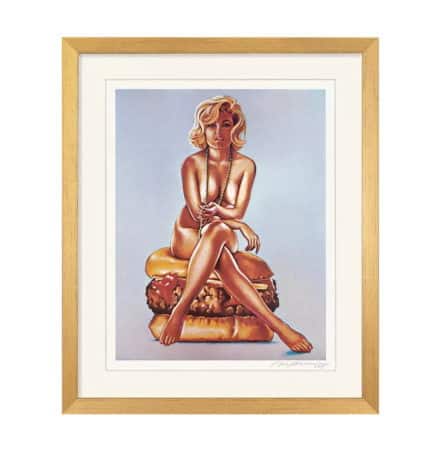
Objectively speaking, his paintings can be described as female nudes combined with popular, oversized branded goods – as pin-up girls in typical arrangements from 1950s and 1960s advertising. Such branded products included, for example, cigars, cigarette packs, soft drinks, chewing gum, chocolate, and automobiles.
Pop Art artist Mel Ramos (2007) Photo by Vernissagefan [CC BY-SA 3.0]
Behind this exaggerated portrayal of female sexuality, one can assume a parody or satire of the then-widespread advertising tactic with its clear "sex sells" approach . It was common practice at the time to stimulate the consumerist population's desire to buy with sexual stimuli.
The so-called “commercial pin-ups” became Mel Ramos’s unmistakable trademark for decades. This gave him an unusual, but no less significant, place in the history of Pop Art .
But let's start from the beginning and take it one step at a time.
“I make sure my pictures aren’t too erotic and always contain a touch of humor. I ensure they’re tasteful. You either get it or you don’t.”
Mel Ramos in brief
Mel Ramos is an outstanding American artist whose work has secured a firm place in the history of Pop Art. Born in 1935 in the United States, he had the privilege of experiencing firsthand the significant cultural upheavals of the 1960s and 1970s. This era was characterized by revolutionary changes in the art world and a move towards new forms of creative expression, to which Ramos fully dedicated himself with his artistic vision.
After graduating from Sacramento State College, where he studied under the renowned artist and teacher Wayne Thiebaud, Ramos embarked on a remarkable career as an artist and educator. His teaching positions at various American universities, including California State University, demonstrate his commitment to passing on his knowledge and passion for art to the next generation.
Mel Ramos's works are vivid testaments to his engagement with Pop Art. They often integrate elements from advertising, pin-up style nude painting, and mass culture, thus creating a provocative connection between everyday objects, provocative female nudity , and artistic reflection.
His paintings exude a unique aesthetic that is both visually powerful and thought-provoking. This has allowed him to present his work in numerous exhibitions in both the United States and Europe – particularly in countries like Germany and Austria, where his work has been met with great acclaim.
Mel Ramos – Installation view. Exhibition at the Crocker Art Museum, Sacramento. 2012. Image source: FlickreviewR, via Wikimedia Commons
Biography – His early years
Mel Ramos was born on July 24, 1935, in Sacramento, California, to Portuguese immigrants. He studied art at Sacramento Junior College (graduating with a bachelor's degree in 1957) and later at Sacramento State College (graduating in 1958). In fact, he remained a faculty member there until 1997, when he finally retired as a professor emeritus.
During his studies at Sacramento State, he was significantly influenced by the renowned pop artist Wayne Thiebaud, under whose guidance he earned his master's degree. This also brought him into contact with the Bay Area Figurative School , with which he remained closely associated for several years.
Gradually, however, he turned away from the Abstract Expressionism of the 1950s, which also included the art movements of Action Painting and Color Field Painting. In the early 1960s, Mel Ramos began—very much in keeping with the spirit of the times—to draw and paint comic book characters. Among his early works were primarily the first superheroes: Superman, Batman, The Spectre, and Wonder Woman.
Pop Art era and pin-up girls
In the early 1960s, the Western world changed dramatically, and a profound social transformation took place. These were times of upheaval that could be felt in almost every aspect of daily life, from childhood and adolescence to family, school, fashion, technology, and, of course, art.
It was an incredibly exciting time, filled with many major social and political events and upheavals. After several years of gloom following the two world wars, life suddenly became more colorful and vibrant again. Everything suddenly seemed possible.
Amidst these times, a new, flamboyant and popular art movement emerged: Pop Art was born.
While Mel Ramos never achieved the same fame as his two contemporaries Andy Warhol and Roy Lichtenstein, he nevertheless played an important role for the first generation of US Pop Art artists and can certainly be counted among the pioneers of this style.
He was one of 12 artists who, together with Andy Warhol and Roy Lichtenstein, launched the new art movement at the Los Angeles County Museum of Art in 1963, sowing the seeds for the true triumph of Pop Art inspired by the works of his contemporaries Roy Lichtenstein, Andy Warhol, and Robert Rauschenberg
Ramos enthusiastically embraced the depiction of pin-ups watches enormous popularity during those years . His early works in this genre were characterized by the sexually explicit portrayal of female comic book characters and superheroines like Wonder Woman. Pin-up girls would remain the core of his entire subsequent creative process.
The image of the femme fatale was shaped by sex symbols like Marilyn Monroe and Jane Mansfield, who perfectly embodied the glamour and fame of Hollywood, making millions of men swoon and millions of women dream. They reflected the longings of an entire generation.
Ramos took up this staging of the perfect female body full of grace, beauty and seductiveness in his Commercial Pinup Girls and, through their arrangement with consumer goods and products from well-known advertising formats, created a satirical examination of this staging of beauty ideals on the one hand and a subtle critique of the mechanisms of the advertising machine on the other.
Through his work, he also addressed the role of the female body in the emerging materialism of the social life of a developing affluent society, which was prospering for the first time after World War II.
In an interview with artnet News,gallerist, Louis K. Meisel, recalled his first encounter with the artist. Although the explicit depiction of nude female bodies in provocative poses was highly radical at the time, Meisel didn't hesitate and immediately signed him to a contract at his renowned New York gallery—perhaps also due to his unconventional demeanor and his personality as an artist. This partnership lasted from 1971 until the end and was crowned with extraordinary success.
He lived and worked throughout his life in the Californian city of Oakland and in the municipality of Horta de Sant Joan in Spain.
First solo exhibitions and collections
In 1963, Mel Ramos exhibited his works together with Warhol and Lichtenstein at the Los Angeles County Museum of Art.
solo Pop Art in 1964 at the Bianchini Gallery in New York. Contemporary art critic Elisabeth Stevens wrote about this exhibition for ARTNEWS at the time:
Mel Ramos brings a touch of carnival spirit from California… His works are striking, the colors vibrant, and the motifs highly attention-grabbing. As a painter, Ramos is no playboy, and like his mentor Wayne Thibaud, his realism is uncompromising, bold, and never academic
Two years later, he even ended up in Germany, and his works were exhibited in the Ricke Gallery in Kassel in 1966.
The following year, he was honored again in his native California – more precisely in San Francisco – with another solo exhibition. According to reports, the American feminist Judy Chicago ran screaming through the rooms and also hurled insults at the museum director.
In 1967, he organized another exhibition in Germany, this time in Cologne. It resulted in a major scandal. A large portion of the exhibited works were covered up by the police.
The reason for this action was his "Animal Paintings" series , whose motifs were considered far too sexist by the authorities at the time. They depicted women in explicit sexual poses with animals. This went far too far for many officials in the law enforcement agencies, and they decided to cover the works. The subsequent media reaction is easy to imagine.
In 1972, Ramos began publishing his works in the series “Unfinished Paintings” – these paintings were a parody of classical nudes by the old masters. The simple and often innocent eroticism of the masterpieces by Manet , Ingres, and Modigliani was replaced by provocative pin-ups and taken to absurd extremes.
This was followed by important exhibitions in renowned galleries worldwide, including the Kunsthalle Tübingen (2010), the Villa Stuck in Munich (2011) and the Albertina in Vienna (2012).
A selection of other important exhibitions in chronological order:
1963: Participation in Pop Art exhibitions at the Oakland Museum of California and the Contemporary Art Museum in Houston
1965: Participation in the group exhibition Pop Art, Nouveau Réalisme, etc. at the Palais des Beaux-Arts, Brussels
1966: Participation in the traveling exhibition "11 Pop Artists" through the USA
1969: Solo exhibition in Germany at Gegenverkehr, Center for Contemporary Art, in Aachen
1972: Solo exhibition at the Utah Museum of Fine Arts, Salt Lake City
1974: Participation in a Pop Art exhibition at the Whitney Museum of American Art in New York
1975: Solo exhibition at the Museum Haus Lange, Krefeld
1977: First retrospective at the Oakland Museum of California
1991: Participation in the major international traveling exhibition »Pop Art« (Royal Academy of Arts, London; Museum Ludwig, Cologne; Museo Nacional Centro de Arte Reina Sofia, Madrid; The Montreal Museum of Fine Arts)
1999: Participation in the printmaking group exhibition »Pop Impressions« at the Museum of Modern Art, New York
2007: Participation in the exhibition Pop Art Portraits at the National Portrait Gallery in London and at the Staatsgalerie in Stuttgart
2012: Mel Ramos: 50 Years of Superheroes, Nudes, and Other Pop Delights, Crocker Art Museum, Sacramento, USA (solo exhibition); Museum Ritter, Waldenbuch, Germany
2013: Pin Up Girls GALLERY FRANK FLUEGEL, Nuernberg; Pinups & Portraits – IKON Ltd, Santa Monica, USA
2014: Beauty and the Beast, Museum of Fine Arts, Leipzig, Germany; Everybody Needs a Hero, Scott Richards Contemporary Art, San Francisco, CA, USA
2015: Mel Ramos. My Age of Pop. Ludwig Museum Koblenz
2017: Mel Ramos: Editions and Drawings, GALERIE FRANK FLUEGEL, Nuremberg, Germany
Especially in Europe, Ramos's works have experienced a veritable revival in recent years. In 2010-2011, a large-scale retrospective of the artist toured the country as part of the 50th anniversary of Pop Art, making stops at the Villa Stuck in Munich, the Kunsthalle Tübingen, and the Albertina in Vienna.
honored the artist with an exhibition entitled “Mel Ramos: 50 Years of Superheroes, Nudes, and Other Pop Delights”
As recently as early September of last year – shortly before his death – Mel Ramos opened an exhibition of his works in Hamburg. At that time, no one expected the artist's imminent passing.
A month later, the exhibition “Mel Ramos – Superheroes of 1963” in his “home gallery” – the Louis K. Meisel Gallery – featuring six of his first 18 paintings, which can be classified as Pop Art. The artist did not live to see the end of this exhibition on November 10, 2018.
Collections and permanent exhibitions
The works of the painter and graphic artist have been included in numerous renowned collections and permanent exhibitions over the years and decades, including:
USA
Museum of Modern Art, NYC
Solomon R. Guggenheim Museum
Norton Simon Museum, Pasadena
Hirshhorn Museum, Washington, DC
Whitney Museum of American Art, New York
San Francisco Museum of Modern Art
Museum of Contemporary Art, Los Angeles + Chicago
Seattle Art Museum
Crocker Art Museum, Sacramento
Germany
State Gallery, Stuttgart
Hamburger Kunsthalle
Kunsthalle Darmstadt
Ludwig Forum for International Art, Aachen
Austria
Albertina, Vienna
Museum of Modern Art, Vienna
Even Playboy magazine featured his work and published a book with a collection of his sexy pin-up girls. Currently, you can images by Mel Ramos (e.g., as limited edition lithographs or linocuts) both through our online gallery and through the Zimmermann & Heitmann Gallery .
Prints and lithographs are at the heart of the artistic work
Since the 1950s, the Pop Art artist Mel Ramos focused his work primarily on printmaking, especially lithographs and screen prints. Together with printers, he developed innovative printing methods, which he combined with hand-painted accents and photographic reproductions.
In our extensive selection of Mel Ramos lithographs, his characteristic depictions of mostly unclothed pin-up models stand out, posing against vibrant, monochrome backgrounds with oversized consumer goods. Particularly noteworthy are works such as "Reese's Rose , "Lola Cola," and the "Hav-a-Havanna" series, in which the models are lasciviously arranged on giant cigars.
Other lithographs by Mel Ramos provocatively combine female nudes with animals, as in "Giant Panda ," which is reminiscent of his earlier "Animal Paintings" series. Ramos also references art historical works, for example with the depiction of a naked woman in the lithograph "Nude descending a staircase ," which alludes to Duchamp's famous painting.
Drawing Lesson” explores the creative process of life drawing, while other works such as “Lola Cola #4” show similarities to prominent figures like Michelle Pfeiffer.
Strong opposition from conservative and feminist circles
His early works, which mostly depicted superheroes, historical documents , and palm trees, were sometimes dismissed by critics as lacking in merit or even kitsch. This perception changed, however, when he turned to his central work and dedicated favorite subject – pin-up girls.
Due to the explicitness and manner in which he displayed naked female bodies, Ramos faced fierce criticism as early as the 1960s. This criticism came primarily from conservative and reactionary circles, but also from many women and feminists. They labeled his works vulgar, backward, degrading, and humiliating. Ramos likely encountered considerable opposition, particularly towards the end of the 1960s and into the 1970s, as feminism gained momentum.
In 1972, critic Linda Nochlin an exemplary essay in ARTNEWS “Women as Sex Object” about the supposedly fetishistic and degrading nature of his paintings. In later years, female Pop artists such as Marisol and Marjorie Strider are said to have similarly condemned his paintings as backward.
This wall of criticism seems paradoxical when one realizes that these very images contain a satirical intention and a critical edge against the portrayal of women as mere sex symbols for the marketing of mundane commodities. Was anti-sexism, then, being accused of sexism?
In a 2010 interview conducted by publisher Hatje Cantz with Ramos regarding these allegations, the artist vehemently denied any sexist content in his work:
I've also painted male portraits, but one thing is true: I'm interested in the female body. Why? What can I say? I love women, I'm a healthy, male American. And certainly, women are desirable to me
Although the naked female body appears to be the dominant element in his paintings, Ramos repeatedly asserted that he considered the face to be the most important part of a woman's body. He believed it to be the foundation for every new work. At the same time, he consistently advocated for greater public nudity. For him, the unclothed state was not erotically connoted, but rather an expression of naturalness. One could almost go so far as to say that he was a supporter of the nudist movement and a self-proclaimed naturist.
When he visited an exhibition at the Louvre in 2012 and encountered dozens of nudes there – including wonderful works by Titian, Veronese, and Tintoretto – he felt affirmed in his work. He decided to no longer be defensive about his art.
It is also interesting to note in this context that provocation and the instigation of controversy were probably never the artist's intention. He emphasized that he did not try to paint provocative and deliberately offensive pictures in order to intentionally anger or antagonize people. This is quite unlike, for example, Pablo Picasso with his pornographic works.
Ramos did not see himself as a critic of his time, but rather as an observer who did not want to start gender debates and did not consider art an instrument to bring (political, socio-critical) messages to the people.
Successes and auction prices
The criticism apparently did not harm him – at least not in terms of the development of his popularity and artistic career.
His works were extremely sought after on the art market, garnering widespread and sustained attention and achieving record prices at galleries and auctions. For example, a Marilyn Monroe nude was auctioned in Vienna in 2016 for €173,000. Even limited-edition art prints are rarely available for less than a four-figure sum.
This is likely also due to the fact that Pop Art simply never seems to go out of style. It possesses a unique charm and a special appeal. The ambivalence between its apparent superficiality on the one hand and its inherent profundity on the other exerts a powerful fascination. Pop Art combines playful lightness with serious critique so skillfully that we cannot escape its pull.
Despite his very successful career as an artist, some observers wonder why, compared to his colleagues Andy Warhol and Roy Lichtenstein, he has remained rather in the shadows in terms of attention, fame and economic success.
According to the artnet database, the auction record for one of his works was £1.07 million at Sotheby's (2012). This is only a fraction of what Warhol and Lichtenstein fetched at auction.
His gallerist Meisel offered a plausible explanation in an interview with ARTNEWS . According to him, it was simply due to Ramos's prolific output compared to Tom Wesselmann, Lichtenstein, and Andy Warhol.
Comparing the raw numbers, Warhol created approximately 36,000 works over the course of his artistic career, while Wesselmann produced between 8,000 and 10,000. Since Ramos painstakingly crafted a large portion of his work with meticulous attention to detail, and his full-time position as a professor at California State University (1966-1997) kept him quite busy, Ramos likely produced fewer than 1,000 works during his lifetime. Consequently, his work could not be collected to the same extent by art enthusiasts, gallery owners, museums, and patrons.
Buy artwork by Mel Ramos
Original works by Mel Ramos are expensive and difficult to acquire (see the auction record at Sotheby's above).
However, you can find limited edition color lithographs by Mel Ramos at affordable prices in the Kunstplaza
Mel Ramos died in his hometown of Oakland in October 2018 at the age of 83. According to his daughter and studio manager Rochelle Leininger, the cause of death was heart failure.
Besides his daughter, his wife Leta, and his son Skot, he leaves behind nearly 1,000 paintings and drawings as his legacy for posterity. His cheeky, colorful, and sometimes absurd works will continue to amuse, entertain, and provoke thought.
As one of the pioneers, he played a crucial role in making Pop Art so fascinating and inspiring for us for many decades. At the same time, his teaching at California State University for over 30 years undoubtedly had a significant influence on and shaped countless young artists in their development and creative process.
His legacy to the world of art cannot be overestimated.
The following statement by his former gallery owner Martin Muller to the San Francisco Chronicle is suitable as an obituary from the ranks of his contemporaries:
Ramos was a remarkable person, artist, and teacher. Throughout numerous political and social trends and changes in the art world, he always remained focused on the creative act of painting, with passion, dedication, and discipline
Owner and Managing Director of Kunstplaza. Journalist, editor, and passionate blogger in the field of art, design, and creativity since 2011. Successful completion of a degree in web design as part of a university study (2008). Further development of creativity techniques through courses in free drawing, expressive painting, and theatre/acting. Profound knowledge of the art market through years of journalistic research and numerous collaborations with actors/institutions from art and culture.
We use technologies like cookies to store and/or access device information. We do this to improve the browsing experience and to show (non-)personalized ads. If you agree to these technologies, we can process data such as browsing behavior or unique IDs on this website. The refusal or withdrawal of consent may adversely affect certain features and functions.
The technical storage or access is necessary for the legitimate purpose of storing preferences that are not requested by the subscriber or user.
Always active
Die technische Speicherung oder der Zugang ist unbedingt erforderlich für den rechtmäßigen Zweck, die Nutzung eines bestimmten Dienstes zu ermöglichen, der vom Teilnehmer oder Nutzer ausdrücklich gewünscht wird, oder für den alleinigen Zweck, die Übertragung einer Nachricht über ein elektronisches Kommunikationsnetz durchzuführen.
Vorlieben
Technical storage or access is required for the lawful purpose of storing preferences that have not been requested by the subscriber or user.
Statistiken
The technical storage or access that is used exclusively for statistical purposes. The technical storage or access that is used exclusively for anonymous statistical purposes. Without a subpoena, voluntary compliance by your internet service provider, or additional records from third parties, information stored or retrieved for this purpose alone cannot usually be used to identify you.
Marketing
Die technische Speicherung oder der Zugriff ist erforderlich, um Nutzerprofile zu erstellen, um Werbung zu versenden oder um den Nutzer auf einer Website oder über mehrere Websites hinweg zu ähnlichen Marketingzwecken zu verfolgen.









 Pair sculpture "Moon" made of polyresin with bronze fine
49,95 €
Pair sculpture "Moon" made of polyresin with bronze fine
49,95 €


