Robert Milton Ernest Rauschenberg is an American artist who ranks among the top dozen in contemporary art. Actually, he's only almost an American artist, because this "street dog mix" (hilariously self-described) has Native American and German roots: his grandmother was Cherokee, and his grandfather was from Berlin.
Rauschenberg's artistic output is as multifaceted as his background; he worked as a painter and photographer, graphic artist and object artist. Although he has been hailed as a pioneer of 20th-century Pop Art , his works cannot be categorized into a single style. Quite the contrary: hardly any other artist in the last century so readily transcended the boundaries between genres and styles as he did.
Rauschenberg was born on October 22, 1925, in Port Arthur, South Texas. Little is known about his childhood, except that he was raised by strict Puritans in rather impoverished conditions. His upbringing certainly led him to plan to become a preacher after high school, but in the early 1940s he began studying pharmacy at the University of Texas at Austin. He quickly abandoned his studies because he opposed animal testing.
In 1943, Rauschenberg was drafted into the military . Because he refused military service, he was assigned as an orderly to the psychiatric ward of the US Navy Hospital Corps. It was reportedly during a leave period in the army that Rauschenberg was able to see original artwork for the first time in his life at the Huntington Art Gallery in California—paintings by Thomas Gainsborough and Thomas Lawrence, which he had previously only known from reproductions on the backs of playing cards.
Rauschenberg was extremely fascinated; he later recalled that it was precisely in front of these pictures and at that moment that he had the realization that he could lead his life as an artist, however trite that may sound.
Robert Rauschenberg in 1999; By Fvlcrvm [CC-BY-SA-3.0], via Wikimedia CommonsSo, after the war, Rauschenberg studied art, first at the Kansas City Art Institute in 1946 and 1947. In between, he had to work as a window dresser and in a factory to support himself. In 1947, he changed his first name from Milton to that of his grandfather; the newly minted Robert then went to Paris and sets his artistic training for half a year at the prestigious, privately run Académie Julian.
Return to the USA
In 1948, Rauschenberg returned to the USA and studied at Black Mountain College in North Carolina until 1949. At that time, the college was the most important institution for interdisciplinary, primarily artistic training.
For example, many Bauhaus artists were invited to work at Black Mountain after emigrating from Germany. Rauschenberg, for instance, met John Cage through the German painter and designer Josef Albers, who had fled to America after the Bauhaus closed, and through Cage met Merce Cunningham ; he subsequently collaborated with both of them on performances and happenings.
In 1949, he moved from North Carolina to New York, to the Art Students League, where he met Cy Twombly . During this time, Rauschenberg had important abstract expressionists among his teachers : Jack Tworkov, Franz Kline, Willem de Kooning, and Robert Motherwell, who represented abstract expressionism and surrealism.
These influences bore fruit: Rauschenberg's first known painting (from 1949), following Albers' example, shows numbers arranged in an orderly structure on a white background. But neither Albers' color field paintings nor de Kooning's wildly abstract works satisfied Rauschenberg in the long run; he searched for an "art-life equation" into which the real world could be integrated and shaped. He continued his search, also consulting Joseph Beuys and Kurt Schwitters, and by 1951 he was ready for a self-determined artistic breakthrough.
White, Black, Red, Combine..
Only now did the "White Paintings", seven uniformly white panels which, according to Rauschenberg, were intended to "erase painting" by simply depicting stillness. Rauschenberg had his first solo exhibition with these White Paintings at the Betty Parsons Gallery in New York. Then he erased a drawing by Willem de Kooning , a radical gesture undertaken with de Kooning's consent, intended to settle accounts with the American Abstract Expressionists and their dominance.
These were followed by the "Black Paintings," a self-imposed limitation to "nothing" or even to not knowing about his own development, which was intended to serve Rauschenberg in his further search for himself. This development led to object boxes with bones, stones, and wood (1952) and to the "Red Paintings," in which Rauschenberg overpainted scraps of material with red tones; these became "Combine Paintings".
By incorporating everyday objects to help unite reality and art, Rauschenberg became perhaps the most important pioneer of Pop Art. To this day, his series of paintings in white, black, and red are considered Rauschenberg's most radical works, even though Pop Art has declared his later works "Pink Door" (1954) and "Bed" (1955) from the Combine series to be among his early works.
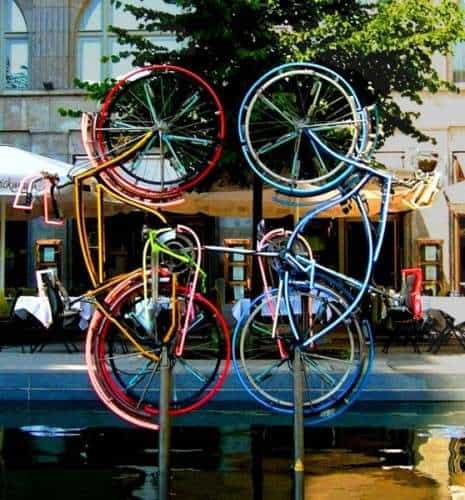
Riding Bikes, object art by Robert Rauschenberg, 1998 in Berlin; Hans Bug on the German Wikipedia [CC-BY-SA-3.0], via Wikimedia CommonsIn the following years, Rauschenberg traveled extensively, frequently to Europe, to Paris and Italy, but also to North Africa. He worked with Merce Cunningham on Decorations and choreography for its dance company, collaborates with Niki de Saint Phalle and Jean Tinguely participated in performances in Paris, discovered at the same time as Andy Warhol the screen printing (but uses it for more complex statements) and produces his first lithographs.
In 1966 he made his first film (“Canoe”) and founded the EAT, the project “Experiments in Art and Technology”, which was intended to explore the interactions of technology or electronics, industry and art (with the engineers Billy Klüver and Fred Waldhauer and the artist Robert Whitman).
In 1967, Rauschenberg combined screen printing and lithography techniques in several sensational works exploring the relationship between humans and technology (e.g., “Booster”). In 1971, he founded a printmaking workshop , and from 1974 to 1976, he collaborated with Alain Robbe-Grillet on a book. At the end of the 1970s, Rauschenberg created his response to Cambodia and Vietnam: “The 1/4 Mile or 2 Furlong Piece,” a work over 400 meters long composed of paintings, collages, and objects.
In 1984, Rauschenberg embarked on perhaps his most exciting project, the “Rauschenberg Overseas Culture Interchange” (ROCI), a traveling exhibition of approximately 200 artworks. Until 1991, the project toured 10 countries, with the works created in collaboration with the artists at each exhibition venue.
The ROCI was in Berlin, Chile and Japan, Mexico and the Soviet Union, Venezuela and Tibet. One immediately believes that Rauschenberg never regretted his decision "to do something about the global crisis instead of giving in to a midlife crisis.".
Building on these experiences, the artist founded the Robert Rauschenberg Foundation, a non-profit organization supporting political and social education and scientific research projects. The highly decorated artist died on May 12, 2008, at the age of 82 on Captiva Island in Florida.
We use technologies such as cookies to store and/or access device information. We do this to improve your browsing experience and to display (non-)personalized advertising. If you consent to these technologies, we can process data such as browsing behavior or unique IDs on this website. Refusal or withdrawal of consent may adversely affect certain features and functions.
Functional
Always Active
Technical storage or access is strictly necessary for the legitimate purpose of enabling the use of a specific service expressly requested by the subscriber or user, or for the sole purpose of carrying out the transmission of a message over an electronic communications network.
Preferences
The technical storage or access is necessary for the legitimate purpose of storing preferences that were not requested by the subscriber or user.
statistics
Technical storage or access that is solely for statistical purposes.Technical storage or access that is used solely for anonymous statistical purposes. Without a subpoena, the voluntary consent of your internet service provider, or additional recording by third parties, the information stored or retrieved for this purpose cannot generally be used to identify you.
marketing
Technical storage or access is required to create user profiles, to send advertising, or to track the user on one or more websites for similar marketing purposes.





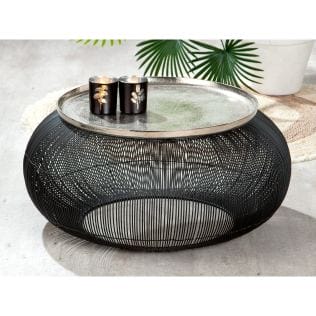
 Modern table "Puntual" in black grid design with aluminum tabletop
398,00 €
Modern table "Puntual" in black grid design with aluminum tabletop
398,00 €