Every few years, investors' investment priorities change. These intervals seem to be getting shorter and shorter, a trend significantly influenced by the numerous crises of recent times.
Following the collapse of cryptocurrencies and, above all, the bursting of the NFT bubble, there is a renewed search for alternative investment opportunities in times of inflation and economic crisis. The stock markets are also not very promising at the moment.
And the alternative to the alternative, to put it bluntly, is a return to tried and tested methods. Art objects of all kinds are proving themselves these days to be reliable stores of value and are demonstrating their potential with positive increases in value.
We have already discussed art as an investment in detail “Investing Successfully in Art – Art as an Investment”current developments and investment opportunities . Furthermore, we provide you with a short list of important dos and don'ts for maximum success on your investment journey.
The value of art tends not to move in line with the stock market and can therefore serve to diversify an investor's portfolio and offer real growth opportunities, especially during periods of market weakness in the DAX, Dow Jones, etc.
Investing in art can offer various benefits to a portfolio, but it also comes with certain inherent risks that you should be aware of before getting involved.
In the past, art could only be acquired at physical auctions or directly from the artist or owner. Now, there are countless ways to invest. There's the classic way to invest, where a physical artwork, such as a painting or sculpture, is purchased or acquired at auction – at one of the many auction houses . Beyond that, there are now numerous ways to own a fraction of a complete artwork, whether in digital or physical form.
Before beginning, investors should decide which path, if any, is best for them. Physical art naturally takes up space and may require more commitment than digital versions, but with the right choices, it can also generate higher returns. Art is considered an alternative investment , and investing in this type of asset can often require different methods than investing in stocks and bonds.
Why should you invest in art?
Before we examine the different options in more detail and highlight their individual opportunities and risks, we should address the most important questions right at the beginning: Why should you invest in art? and “Is art a suitable form of investment for you?”.
Let's first take a look at past performance :
Art market 1985 – 2018
A report published by Citibank showed that from 1985 to 2018, the returns of the art market were roughly equivalent to those of high-yield bonds and outperformed both developed and emerging market equities.
In short, art has outperformed other asset classes , but also experienced significant periods of volatility . Citi also highlights that contemporary art fell by a staggering 56.8 percent during the recession of the early 1990s and by about 28.5 percent during the Great Recession of 2008. During the COVID-19 pandemic, the market proved somewhat more resilient, likely because the market turmoil was short-lived and followed by a stock market boom.
The Sotheby'sMei Moses Index is widely regarded by the industry as an indicator of changing demand in the global art market. Over the past fifty years, this index has shown an upward trend, giving investors confidence in the resilience and progress of the sector as a whole.
Since art is inherently subjective, its value depends not only on objective appreciation but also on how it is viewed. Whether one sees art solely as a sound investment opportunity and a pure financial asset , or whether it also represents personal, emotional value for the owner.
For rare, unique pieces, the return on investment can only be realized after a buyer has been successfully found. However, since there is a relatively small number of interested parties, especially for expensive items, the achievable value depends almost entirely on the personal opinions of those individuals.
More traditional investments, such as stocks, have teams of analysts at various companies on the open market who examine the value of a company and assign a value to that particular asset, meaning that the value of a stock is (usually) more objective.
Investors have access to a range of analytical tools for stocks and other investments, allowing them to make data-driven investment decisions. The same level of information is (still) not available art
However, there have been recent developments such as the aforementioned All Art Index , which was created to track the sales of high-profile artists around the world, but it is not yet the same objective process as the research-based analysis for publicly traded stocks.
In social media, the American art curator and art market expert Moriah Alise made a name for herself in particular.
In the following video, she delivers razor-sharp analyses and provides insider knowledge on the following topics:
Understanding art market indices : What are art market indices and how do they work?
Measuring market momentum : Learn to read the "ECG" of the art market and find out what these highs and lows really mean.
Reading market trends: How to navigate trends and understand what increases an artist's "value" in this competitive field.
Art as diversification: Discover how art can be more than just an aesthetic pleasure – it is a strategic asset class that adds balance to your investment portfolio.
Predictive Insights : Take a look into the future as we discuss how big data and machine learning are changing the way we approach art collections.
For collectors and artists alike, this video is a goldmine of insights.
The range of data-based analysis tools and consulting services for the art market continues to increase rapidly.
Promising developments until 2021
2021 was a turbulent year in the investment world, with the effects of the global pandemic impacting every market. However, the contemporary art market proved exceptionally resilient, delivering continued success and record results despite challenges observed elsewhere.
The market for art as an investment continued its growth trajectory. Investor interest in sustainable investments and new technologies further increased. These are key findings of the 7th Art & Finance Report 2021 by Deloitte and ArtTactic .
high-net-worth individuals (HNWIs), who are particularly relevant to the art market, more than quadrupled between 2000 and 2020, reaching approximately US$191.6 trillion. Of this, US$1.481 trillion was invested in art in 2020.
Global UHNWI art & collectible wealth 2020 estimates Source: 7th Deloitte Art & Finance Report 2021
According to forecasts by Deloitte consultants, this figure could grow further to 1.882 trillion US dollars by 2025.
2022 – 2024: Status Quo & Current Trends
The most recent figures available to us on the global art market come, in part, from the 2024 Contemporary Art Market Report by artprice.com .
The 18th edition of the annual market report provides us with key insights for interpreting the challenges, perspectives, and current developments. This is based on an in-depth analysis of art auction sales of over 33,000 artists worldwide, which took place between July 2023 and June 2024.
Driven by a record number of transactions and the goal of making auction sales more accessible, the contemporary art market has developed a broader base below the $10,000 mark. This leads to greater stability and more resilient structures against crises and market fluctuations.
The increased purchasing interest is increasingly focused on the diversity of artistic creation and is reflected in the growing appreciation for female artists as well as new media such as digital creations.
, online sales make the art market by offering numerous opportunities to new participants. This development promotes shorter holding periods for artworks, which are subject to faster circulation.
In particular, works by young, ultra-contemporary artists such as Jadé Fadojutimi, Lucy Bull and Louis Sister are already enjoying success on the secondary market.”
The Art Basel and UBS Survey of Global Collecting 2024, published on October 24, 2024 .
The report represents the most comprehensive study of its kind to date and provides valuable insights into the purchasing behavior and wealth transfer between generations of wealthy individuals, particularly against the backdrop of challenging economic conditions.
This edition incorporates the opinions of over 3,500 such collectors from 14 international markets, including new participants from Switzerland, Mexico and Indonesia.
The report's author, cultural economist Dr. Clare McAndrew , is supported by Paul Donovan , chief economist at UBS Global Wealth Management , and Noah Horowitz , CEO of Art Basel .
Fittingly, there was a panel discussion with the authors:
Here is a summary of the 6 most important findings of the survey:
High Net Worth Individuals (HNWIs) are optimistic in a challenging market: Spending in the first half of 2024 indicates a stabilization, and 91% of HNWIs surveyed expressed a positive outlook for the global art market in the coming six months, compared to 77% at the end of 2023.
Signs of stable spending: The average spending of the surveyed HNWIs on art and antiques in the first half of 2024 (at USD 25,555) could, if used as an indicator for the second half of the year, reflect a consistent annual level of spending.
Purchases from new galleries: In 2023 and 2024, HNWIs showed a strong willingness to purchase from new galleries, with 88% of buyers making at least one purchase from a new gallery.
Support for new and emerging artists: HNWIs invested 52% of their spending in works by new and emerging artists, of which 21% went to artists in the middle of their careers and 26% to works by established artists (the majority of whom were living artists).
The strong post-lockdown spending recovery in mainland China continues: The 300 high-net-worth individuals (HNWIs) surveyed in mainland China reported average spending of US$97,000 on art and antiques in 2023 and the first half of 2024, the highest among all respondents. This figure was more than double that of any other region surveyed in the first half of the year, followed by France (US$38,000), Italy (US$32,000), the UK (US$31,000), and Hong Kong (US$28,000).
A decline in impulsive purchases and an increase in the collection of works by female artists: Impulse purchases decreased from 10% in 2023 to just 1%, while respondents increasingly conducted background research before making purchases. The proportion of works by female artists in the surveyed high-net-worth individuals' (HNWI) collections reached its highest level in seven years, at 44% compared to works by male artists.
The art market is as large as it is attractive: with an average annual return of 14 percent, it has consistently outperformed the US stock index S&P 500 since 1995.
Global art market: Annual performance 1995-2020
Source: 7th Deloitte Art & Finance Report 2021
Art has become an integral part of wealth management over the last decade.
What began ten years ago with an initial study by Deloitte on the role of art as an investment in wealth management has gained considerable momentum over the years.
Today, most asset managers have long recognized the importance of art and collectibles as strategic components of their holistic asset management offering.
According to the results of the current report, 85% of wealth managers, 76% of collectors and 96% of the art market experts surveyed believe that art should be an integral part of wealth management services.
10-year perspective from art experts and art collectors. Source: 7th Deloitte Art & Finance Report 2021
Thierry Ehrmann , CEO and founder of Artmarket.com, commented as follows:
We are very proud to have played a leading role in the democratization of the art market for 25 years with Artprice. Reserved for an elite circle of connoisseurs until the end of the 20th century, the art market is now accessible to a much wider range of people. Our services offer affordable information that can be accessed anywhere, without limits, and is updated hourly. With our value-added data, art professionals and art enthusiasts alike can buy and sell exceptional and accessible works with complete peace of mind
Assessing inherent risks: The approach of Artmarket.com
The art world is constantly rocked by sensational stories. From the discovery of a Turner among the junk at a flea market to the sudden surge in value of a self-destructing Banksy at the end of its sale… there seem to be many different ways to make a substantial profit in the art market.
But in reality, these sensational stories remain exceptions, and for each of them, tens of thousands of works change hands every year in a much more discreet and quieter way.
How can uncertainty be reduced?
Financial risk is an integral part of any investment, and art is no exception; quite the contrary. Fortunately, this risk can be partially controlled in various ways , particularly by knowing how to recognize the value of a work and by buying at the best price.
The buyer who dared Christopher Wool's "Untitled" (1990) in 2000 for $35,250 completed an extraordinary transaction by reselling it fifteen years later for $2,405,000.
Nevertheless, this investment involved considerable financial risks and a high degree of uncertainty. The appreciation in value of Christopher Wool's works essentially began after the 2008 financial crisis, as demonstrated by the price index for original works by this artist calculated by Artprice.
In fact, a collector who bought a painting (or drawing) by Christopher Wool shortly after he joined the Gagosian and Simon Lee have benefited almost as much from Wool's success, but without taking the same risks as the buyer who acquired it in 2000.
Christopher Wool Price Index – Base value 100 in January 2000. Source: artprice.com
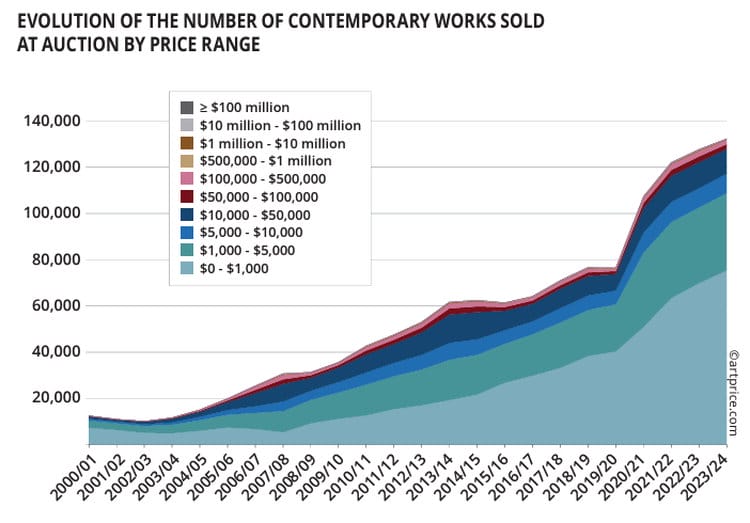
Another proven investment strategy lies in diversification , which sounds all the more promising the stronger the performance of works priced below USD 50,000 is on the market.
Trends in the number of contemporary artworks sold at auction by price category. Source: 2024 Contemporary Art Market Report, Artprice.com
While the affordable art sector is experiencing a boom, the $5,000 to $10,000 price segment stands out for its consistency and accounts for 6% of all transactions.
At the same time, the results in the $10,000 to $50,000 range showed remarkable dynamism, offering collectors and investors the chance to acquire some of the most dynamic works of contemporary art.
How to invest in art
There are various ways an investor can take to invest in art, whether physical or digital.
Physical: The classic approach is to invest in physical art. This can be done through galleries and auction houses (think Christie’s or Sotheby’s , two traditional auction houses), both in person and online.
Here you find a work of art that you consider a worthwhile investment, and you buy the whole thing directly.
Digital/NFTs: Non-fungible tokens or NFTs are a way to invest digitally in a work of art and obtain ownership documentation via a secure blockchain.
By purchasing an NFT you can own a digital work of art, but an NFT can really be anything – from a piece of art to a song to a written work.
Art isn't necessarily a painting or picture, and NFTs allow investors to own a wide range of digital art collections without ever physically handling them. They can then be traded and sold on the open market.
Marketplace sites : Specialized online platforms such as Masterworks , arttrade , or the Maddox Gallery in London allow the purchase of fractional shares of artworks.
Alternative ways to buy art directly – Fractional Art Investing – Source: MasterWorks
arttrade – Art for your portfolio
Invest in art – with Maddox Art Advisory
This is perfect for investors who want to get their feet wet but aren't quite ready to commit to buying an entire piece. The company acquires the artwork, securitizes it (so virtually anyone can invest), and then sells it when the time is right.
Investors can realize a return once the unit is sold.
Masterworks also offers a secondary market platform to provide liquidity for buying and selling artwork, similar to how NFTs are bought and sold (minus the blockchain). Investors can also buy and trade shares as they would other tradable assets.
Stocks, ETFs and investment funds : There are no classic stocks or ETFs and investment funds for art, but there are funds focused on art stocks, such as that of a company called Yieldstreet .
Through their Art Equity Fund II, investors can, for example, invest in a portfolio of 10-20 artworks. This particular fund focuses on artists influenced by the art scene in Harlem, New York.
Art equity funds function similarly to regular equity funds, as they have a fund manager and charge a management fee, but investors have to wait until (and if) the pieces are sold to earn a return.
While it's important to focus your resources on investing in well-known and widely accepted works, you might also want to consider the work of emerging artists. India's rising top artists .
While the risk is higher, the potential returns are far greater if your chosen artist achieves great success. It's a bit like gambling, so consider it a highly speculative investment (similar to warrants).
It is advisable not to invest all your resources in up-and-coming artists and instead aim for a good mix .
2. Focus on one category
Choose an art category or painting style that appeals to you most. Focus on studying that one category instead of randomly buying pieces that catch your eye.
The more you focus on one category (nature, still life, abstraction, mythology, etc.), the greater your chances of making the right decisions in the long run.
3. Start small
Don't rush your investment. Divide your budget according to how much you want to spend each year. Stick to these guidelines. This strategy also gives you enough time to assess market reactions.
4. Stay up-to-date with the latest trends
Stay informed about international trends. Most information is available online. As soon as demand for a particular art form gains momentum, offer your investment for sale.
5. Be steadfast and negotiate
Make a fair offer when buying and wait. If the artwork is available at your stated price, you'll get it. If it becomes more expensive, it might no longer be worth buying at that price. It's better to keep looking.
Be rigorous with your pricing, even when selling.
DOS
Remember – investing in art is a long-term investment option. Be patient and it will pay off.
Do your research. Make sure you verify the provenance of the painting/artwork. Don't just assume what the dealer or auction house has to say about it. Contact the artists directly if you can.
Ask the dealer/auction house as many questions as you like about the painting/artwork. Only proceed once all your doubts and questions have been answered.
Don'ts
Don't be swayed by the price. If the price is significantly lower than your estimate, verify its authenticity. Check if it was purchased legally, stolen, or illegally imported.
Do NOT jeopardize your credibility at any cost. If the work is international, ask about export licenses before purchasing.
Don't forget your insurance documents. Find out about the insurance options offered.
Don't neglect artworks after purchasing them. Take good care of and protect your acquired art.
Owner and Managing Director of Kunstplaza . Publicist, editor, and passionate blogger in the fields of art, design, and creativity since 2011. Graduated with a degree in web design from university (2008). Further developed creative techniques through courses in freehand drawing, expressive painting, and theatre/acting. Profound knowledge of the art market gained through years of journalistic research and numerous collaborations with key players and institutions in the arts and culture sector.
We use technologies such as cookies to store and/or access device information. We do this to improve your browsing experience and to display (non-)personalized advertising. If you consent to these technologies, we can process data such as browsing behavior or unique IDs on this website. Refusal or withdrawal of consent may adversely affect certain features and functions.
Functional
Always Active
Technical storage or access is strictly necessary for the legitimate purpose of enabling the use of a specific service expressly requested by the subscriber or user, or for the sole purpose of carrying out the transmission of a message over an electronic communications network.
Preferences
The technical storage or access is necessary for the legitimate purpose of storing preferences that were not requested by the subscriber or user.
statistics
Technical storage or access that is solely for statistical purposes.Technical storage or access that is used solely for anonymous statistical purposes. Without a subpoena, the voluntary consent of your internet service provider, or additional recording by third parties, the information stored or retrieved for this purpose cannot generally be used to identify you.
marketing
Technical storage or access is required to create user profiles, to send advertising, or to track the user on one or more websites for similar marketing purposes.





 Street art canvas print "Urban Beauty", hand-painted on a stretcher frame
295,00 €
Street art canvas print "Urban Beauty", hand-painted on a stretcher frame
295,00 €