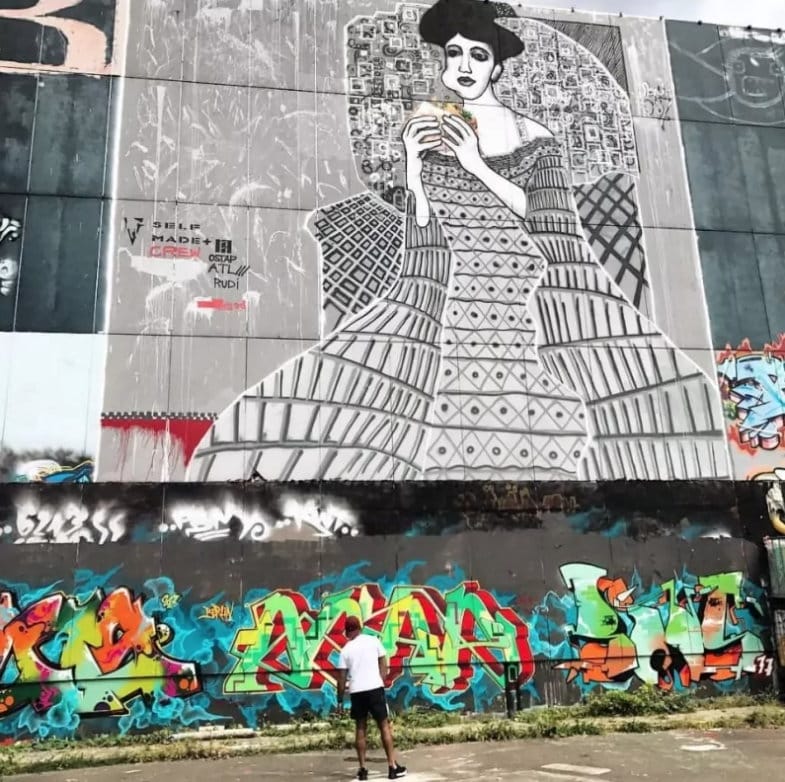
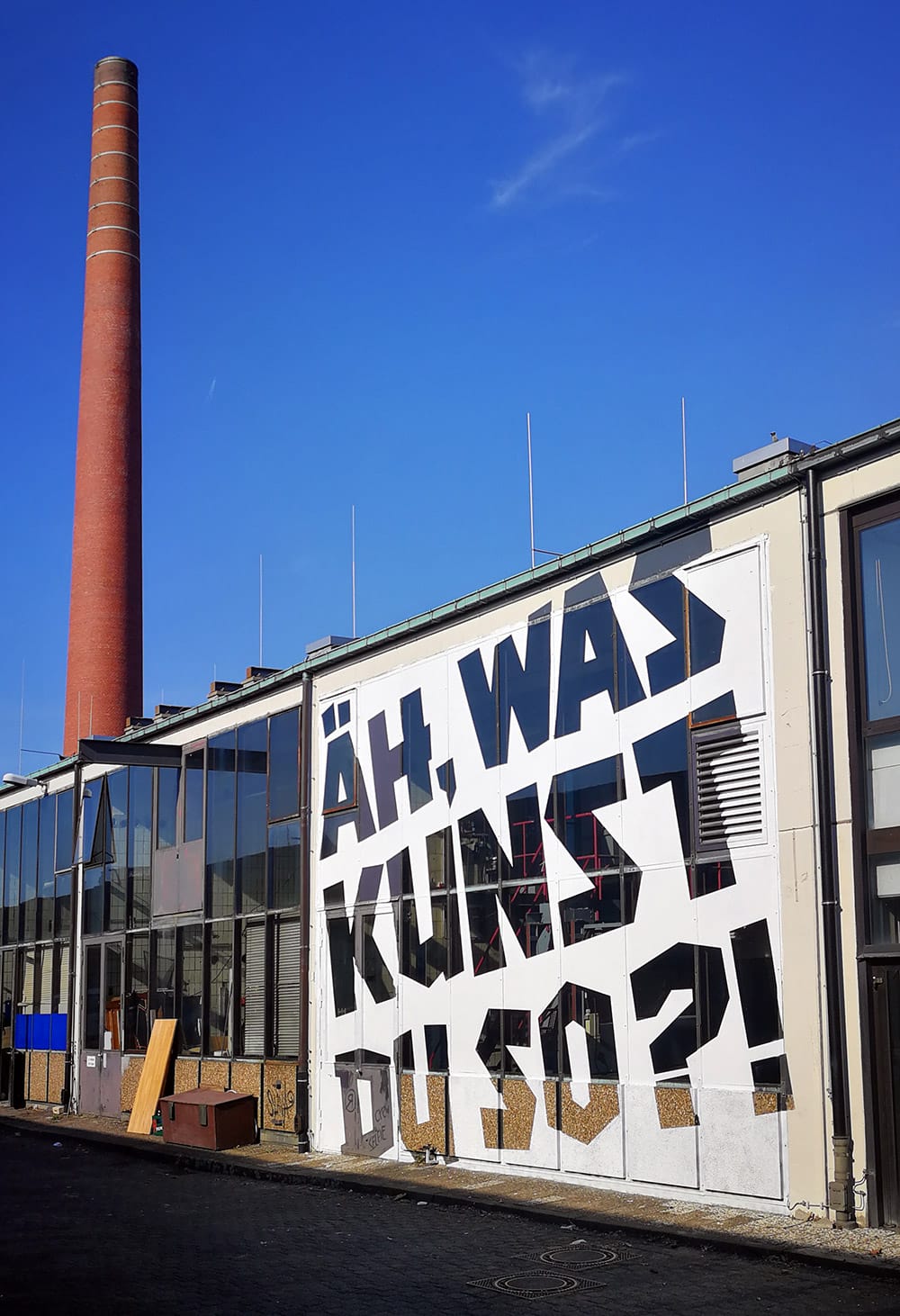
In the still relatively unknown art form of "tape art," adhesive tapes are used to create impressive works. A growing number of artists and art enthusiasts from the street art scene are using these materials to create their pieces and exhibit them at events like the "Tape Art Convention" in Berlin . Workshops and kits offer networking opportunities and paints for interested individuals, and a team of tape art experts is available to provide assistance if needed.
This video is embedded using YouTube's enhanced Privacy mode, which blocks YouTube cookies until you actively click to play the video. By clicking the play button, you consent to YouTube placing cookies on your device, which may also be used to analyze user behavior for market research and marketing purposes. For more information about YouTube's use of cookies, please see Google's Cookie Policy at https://policies.google.com/technologies/types?hl=de.
Tape art is a relatively new art form that is rapidly gaining popularity. Instead of using paints and brushes, tape artists use adhesive tape, also known as gaffer tape or duct tape , to create their artwork. The material is easy to obtain, and the design possibilities are endless.
Tape art pieces are often temporary (keyword: temporary vandalism ) and are frequently created for events or exhibitions. Berlin is an example of a city that is enthusiastic about tape art and regularly offers tape art workshops and events to promote this art form.
Tape art has the potential to blur the boundaries between urbanity and art, thereby transforming urban spaces. It also enables the use of art as a means of urban change and the promotion of urban culture.
The use of adhesive tape as the primary material is unconventional and therefore opens doors for artists who might otherwise have no or only marginal access to the art scene. The art form fosters contact between the local community and the artists by organizing collaborative art workshops and projects.
Tape art shows that art doesn't just have to take place in a gallery or museum, but also in public spaces, and that boundaries between urbanity and art should be blurred, because this can make our urban spaces more accessible and interesting.
What is meant by tape art? A brief definition and conceptual delimitation
Tape art is a form of street art and an urban art form that has gained increasing popularity in recent years. It involves adhesive tapes of different colors and widths to a surface to create art.
These surfaces can be walls, floors, or even vehicles. The artworks can have various motifs: abstract forms, portraits, landscapes, animals, or graphics—anything is possible.
This art form allows for playful creativity and the unleashing of one's imagination. Tape art is also a very flexible art form. It can be practiced almost anywhere and on almost any surface. The adhesive tapes used can be easily removed, making the artworks temporary.
Tape art is increasingly used for advertising purposes. Companies have their logos or slogans created in the form of tape art to generate attention and stand out from the competition. Overall, tape art is a young, exciting, and diverse art form that appeals to both experienced artists and amateurs.
Urbanity and art – an unexpected pairing
Tape art may be a relatively new art form, but its versatility has allowed artists to use it in unexpected ways, particularly to combine urbanity and art. It is thus a subgenre of the urban art movement, except that instead of spray cans and stencils, adhesive tape is used as the predominant material.
In cities like Berlin, there are numerous examples of tape art projects found in public spaces such as underpasses and bridges. But that's not all. Tape art events and conventions bring together artists and enthusiasts from around the world to experiment with new materials and colors and to work in teams to decorate boxes and walls with extraordinary designs.
Workshops and tape art kits also offer opportunities to learn the material and the art form, regardless of whether you're an experienced artist or an amateur. Selfmadecrew has undoubtedly found its place in the art world. This new form of street art opens up further possibilities for shaping urban space in a creative and sustainable way.
How Tape Art transforms urban space
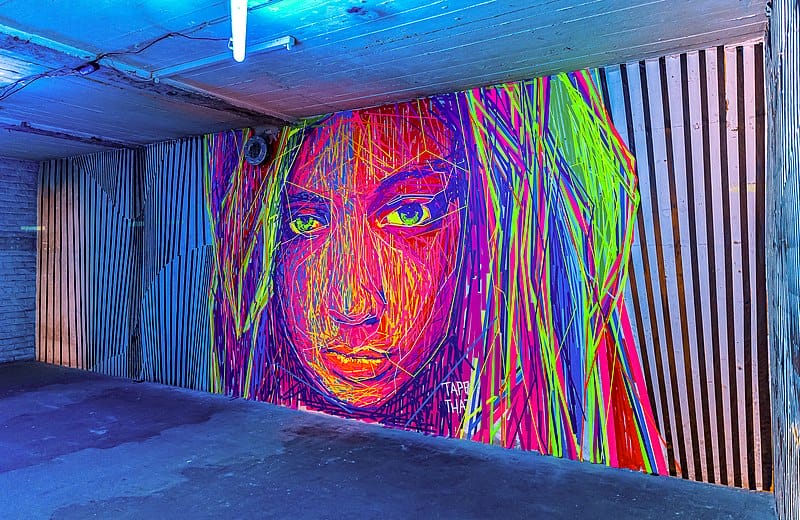
Tape art mural at the Transurban Festival in Cologne by Tape-That (2017), artist: Infra, materials used: fabric adhesive tape. Photo credits: Tape That: Laurenz H. Bostedt, CC BY-SA 4.0, via Wikimedia Commons
The crucial factor that distinguishes tape art from traditional sculptures and paintings in both public and private spaces is its versatility. Outdoor installations work just as well as indoor ones . This includes everything from doors and floors to gallery ceilings.
There are several advantages of tape painting that we felt were worth mentioning. Firstly, tape paintings can be applied quickly and efficiently without causing excessive noise, making them suitable for all temporary or small urban art installations .
Furthermore, unlike art created with spray paint, tape art leaves no permanent residue and can be easily removed without producing toxic odors. These tape painting installations require no covering or masking. The tape itself is relatively easy to use and can be applied to a wide variety of surfaces.
Surfaces
Surfaces on which tape art can be applied:
Stone
Wood
asphalt
Composite materials
Material
Glass
aluminum
plastic
Acrylic glass
walls
Cover
soils
Statues
Lanterns
Building
vehicles
and much more.
materials
materials can be used for tape art , as it is a free art form. However, there are a few things to consider when searching for suitable materials and surfaces. Duct tape (gaffer tape) is a popular choice for tape painting.
For delicate work indoors, materials with a smooth surface are increasingly being chosen.
The various types available can be used on different surfaces. As a general rule, the surface to which the tape is applied should be free of dust and grease to ensure good adhesion.
Which adhesive tape is suitable for tape art?
The adhesive tapetape , duct tape, or washi tape are best suited .
Masking tape or standard packing tape are also commonly used for tape art because they are very easy to remove yet adhere very well. Masking tape, for example, is relatively thin and can even be used on tight curves. It comes in various widths, making it suitable for a wide range of tape art projects. Masking tape is particularly good for preparing surfaces because it leaves no adhesive residue.
Gaffer tape, on the other hand, is thicker and more robust than masking tape. It's excellent for taping longer-lasting artwork or outdoor projects, as it's very durable. However, it's also quite difficult to remove. It's particularly well-suited for larger projects and when you prefer bolder colors.
Washi tape is a slightly thinner adhesive tape than the other two and has a particularly matte finish. It usually has a pattern or color gradient printed on it, making it especially suitable for decorative tape art projects. It's also very easy to remove and leaves no adhesive residue, although it doesn't stick as strongly as masking tape or gaffer tape.
Nowadays, there are special artist tapes , such as artist tape for canvases, from various brands, which are produced in different widths and in various striking and fashionable colors.
Where did tape art originate? A brief look back
This art form developed in the 1960s out of urban art. It emerged as an alternative to the widely popular spray paint , which dominated the urban art scene. Some accounts trace the origins of tape art back to the Tape Art Crew in Providence, Rhode Island, USA, in the late 1980s, where tape art was left in courtyards, on sidewalks, in abandoned buildings, and in public spaces.
This video is embedded using YouTube's enhanced Privacy mode, which blocks YouTube cookies until you actively click to play the video. By clicking the play button, you consent to YouTube placing cookies on your device, which may also be used to analyze user behavior for market research and marketing purposes. For more information about YouTube's use of cookies, please see Google's Cookie Policy at https://policies.google.com/technologies/types?hl=de.
These tape paintings were typically spread across a few surfaces and often depicted a sequence of episodes spanning several days. Once completed, the artwork would be removed within 24 hours to make way for new tape art, which would appear before sunrise.
Tape art quickly became very popular and spread beyond the USA to other countries, such as Canada, Australia and Europe.
Tape art remains a collaborative art form with life-size depictions, although the intention to largely remove the art after completion largely persists.
Beginnings in Germany and the evolution of adhesive art
El Bocho the wall of the Stadtbad Wedding as part of the exhibition “Urban Affairs Extended” , causing a great stir.
The Heyne art factory in Offenbach am Main opened the first group exhibition of its kind in Europe in early 2015, showcasing works by seven European tape artists and two collectives from Berlin. Tape artists like Max ZornArt Basel Miami with their projects . Berlin-based Polish artist Monika Grzymala exhibits her three-dimensional installations worldwide in prestigious galleries and museums, including the Kunsthalle Hamburg and the Albertina in Vienna.
In October 2016, the first international Tape Art Convention – an exhibition at the Berlin galleryNeurotitan – took place in Berlin. Besides the German artist collective Tape ThatBuff Diss, Slava Osinski, Selfmadecrew, Benjamin Murphy, and the aforementioned Max Zorn participated .
Since then, tape art has continued to evolve, and there are now internationally renowned artists and exhibitions. Tape art is often also referred to as "urban art" or "street art" because it is frequently found in public spaces or on buildings and walls in cities. A particularly impressive aspect is that the artworks are usually temporary and are removed after a certain period, which means that the artworks can be rediscovered and experienced again and again.
This brings us to one of the reasons why tape art has become so popular – unlike graffiti, legal! Over the years, tape art has evolved into a worthy counterpart to graffiti culture. However, protest art and performance art using adhesive tape retain a certain subversive and socio-critical character.
Over the past decade, tape artists and their work have garnered significant media attention. The growing media fascination with tape art has led to an influx of people increasingly interested in incorporating it into their private interiors. What began as a subversive art form soon evolved into a more accessible one.
There are still public installations using adhesive tape that continue to occupy their place in urban areas; then there are tape art pieces that hang on gallery walls, stand as three-dimensional sculptures, or exist as canvas paintings made with tape; tape art has become a collector's item; paintings with tape are used in architectural installations; three-dimensional image illusions made of layered packing tape have been presented as a form of urban trompe-l'œil . The use of the simple medium of adhesive tape has experienced a great boom worldwide and has given rise to a wide variety of forms.
There have been, and continue to be, interdisciplinary collaborations with various artists from the urban graffiti scene. Not to mention the collaboration between tape artists and digital art forms . In fact, the fusion of the two is now known as tape mapping , and it is the mixture of tape art and video mapping that brilliantly animates tape art with visual effects.
With the wide variety of tapes produced, there are now tapes that differ in structure, color, and shape. The selection ranges from colorful to transparent, from matte to glossy, from wide to narrow. The large variety of available adhesive tapes allows for the realization of diverse ideas. Tape art fosters a completely experimental art form. Today, we observe that tape art is most popular in cities like Berlin, where unique art projects continually emerge and attract attention.
Due to its ease of use, tape art is no longer just for professional artists. It has become a favorite for crafts, DIY projects, and interior decoration.
Nowadays, tape art is often used for brand advertising or as a marketing tool , and there are even companies that specialize in tape art.
Famous tape art artists and fabulous tape art
This still-young art form has already produced several renowned artists and art collectives who have created true masterpieces using adhesive tape. Their artistic achievements are no longer limited to wall illustrations.
Max Zorn
In the world of tape art, there are some famous names to watch. One of them is the Dutch artist Max Zorn. Zorn has been creating tape art, primarily street and urban art , since 2011. He has developed his own style, brown packing tape as his preferred medium and then cutting pieces of tape on acrylic glass with a scalpel to create portraits that are backlit.
This video is embedded using YouTube's enhanced Privacy mode, which blocks YouTube cookies until you actively click to play the video. By clicking the play button, you consent to YouTube placing cookies on your device, which may also be used to analyze user behavior for market research and marketing purposes. For more information about YouTube's use of cookies, please see Google's Cookie Policy at https://policies.google.com/technologies/types?hl=de.
Buff Diss – Tape Master Down Under
Since 2005, Australian artist Buff Diss sidewalks, trains, and industrial buildings with his unconventional use of adhesive tape. His work encompasses a wide variety of styles and thematic materials, from contour drawings and geometric shapes to intricate portraits of mythological figures.
Despite the transience of the chosen medium, the artwork itself leaves a lasting impression on those fortunate enough to see it.
The artist's emphasis on placement, attention to detail, and the inclusion of his surroundings results in interactive pieces that come to life not only through their environment but also through the people who become entangled in them.
In a 2013 interview with Fast Co.Create, Buff Diss shared that the switch from using paint to tape as his primary medium was purely accidental. The artist also revealed that he rarely sketches his work before creating it, explaining that he enjoys the directness of finding a space and responding to it without a preconceived notion of the work.
However, Buff Diss recently combined tape and drawing elements for his installation at the Two Wrongs pub in Melbourne. The artist drew inspiration from Dürer's Inferno series, the cover of Joy Division's Unknown Pleasures, and the background scenery from Street Fighter II
Buff Diss also recently collaborated with fashion photographer Tess Everett on a series inspired by Shakespeare's Ophelia. Titled "Ophelia's Rest," the series features models posing amidst an urban landscape filled with hypnotic, graphic patterns and floral details, all created by the artist using his favorite material.
This video is embedded using YouTube's enhanced Privacy mode, which blocks YouTube cookies until you actively click to play the video. By clicking the play button, you consent to YouTube placing cookies on your device, which may also be used to analyze user behavior for market research and marketing purposes. For more information about YouTube's use of cookies, please see Google's Cookie Policy at https://policies.google.com/technologies/types?hl=de.
Aakash Nihalani – Geometric Tape Art made in New York
New York street artist Aakash Nihalani is a big fan of geometric shapes.
The artist Nihalani uses neon-colored tape existing objects in NYC's public spaces into his "tape art" creations. Through his skillful handling of geometric shapes and vibrant colors, he imbues urban structures and constructions with a new vitality.
In his latest series, “Landline,” he goes even further, integrating people from Brooklyn into his artwork. He forgoes digital post-processing, relying instead on a perfectly calibrated viewing angle.
Below you can admire some impressive examples from this extraordinary series. Using adhesive tape as his tool, the artist Aakash Nihalani creates a variety of bodies and figures. By integrating them into photographs, he creates optical illusions that captivate the viewer. These works were created in the vibrant metropolis of New York.
Regarding his art, Nihalani states the following:
"I am trying to offer people a chance to step into a different New York than they are used to seeing, and in turn, momentarily escape from routine schedules and lives. We all need the opportunity to see the city more playfully, as a world dominated by the interplay of very basic color and shape."
He did a wonderful job.
This video is embedded using YouTube's enhanced Privacy mode, which blocks YouTube cookies until you actively click to play the video. By clicking the play button, you consent to YouTube placing cookies on your device, which may also be used to analyze user behavior for market research and marketing purposes. For more information about YouTube's use of cookies, please see Google's Cookie Policy at https://policies.google.com/technologies/types?hl=de.
El Bocho
Another remarkable work of art comes from the Berlin-based artist El Bocho. As part of the "Urban Affairs Extended" in 2009, he produced a tape art piece on the wall of the Wedding public swimming pool, using only adhesive tape.
El Bocho's work caused a great sensation.
This video is embedded using YouTube's enhanced Privacy mode, which blocks YouTube cookies until you actively click to play the video. By clicking the play button, you consent to YouTube placing cookies on your device, which may also be used to analyze user behavior for market research and marketing purposes. For more information about YouTube's use of cookies, please see Google's Cookie Policy at https://policies.google.com/technologies/types?hl=de.
Selfmadecrew
Behind the "Selfmadecrew" is a Berlin-based, globally active artist collective with a worldwide presence, primarily focused on urban art forms. Six artists are united by their shared passion for contemporary urban art.
The Selfmadecrew was founded in 2015 by Slava Osinski , a tape art and street art artist whose works had caused a stir both at home and abroad.
Duct Tape Art by the Selfmadecrew
Since its founding, the Berlin-based collective has been involved with different techniques and areas of contemporary art – in addition to tape art, the crew members also specialize in spray can art, both indoors and outdoors.
Live Painting Events
They organize live painting events and participate in many street art and public art projects.
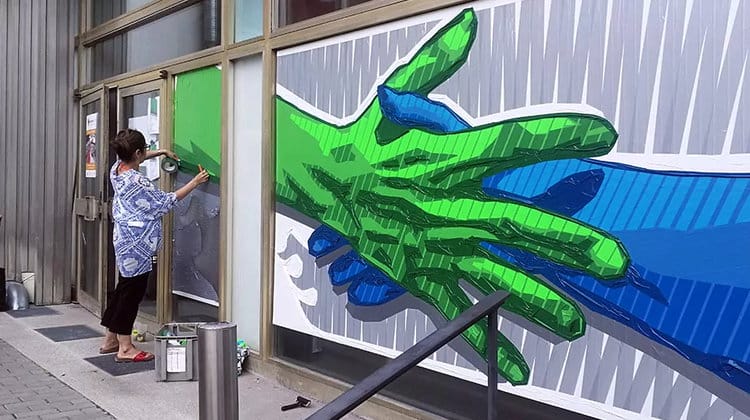
The following video, in the style of a tape art tutorial, shows how street art is created using gaffer tape by the Selfmadecrew. The video was filmed during a live show at the WelcomeCamp event in Berlin . The finished artwork measured 200 x 300 cm. After a proud six hours of applying the tape, the picture was complete.
This video is embedded using YouTube's enhanced Privacy mode, which blocks YouTube cookies until you actively click to play the video. By clicking the play button, you consent to YouTube placing cookies on your device, which may also be used to analyze user behavior for market research and marketing purposes. For more information about YouTube's use of cookies, please see Google's Cookie Policy at https://policies.google.com/technologies/types?hl=de.
They gained recognition and a high standing in the scene through their remarkable tape art and street art projects, as well as through collaborations with various partners such as the Federal Ministry of Education and Research , Urban Nation – Berlin Museum for Urban Art , the Goethe-Institut and many others.
Another live painting event for a good cause took place as part of an art project for the Long Night of Museums 2022 in the Hanseatic city of Lübeck.
Visitors to the Hanseatic Museum in Lübeck experienced the “Long Night of Museums” 2022 under the motto “Upside Down” . A highlight of the evening was the charitable live painting show by the Selfmadecrew, which was linked to a fundraising campaign for the war victims in Ukraine.
Thanks to their generous donations, the event's visitors were able to make a significant contribution. At the end of the evening, the resulting tape art artwork was raffled off among all donors. The Selfmadecrew, led by Slava Osinski, was inspired by Andy Warhol's Holsten Gate artwork and reinterpreted it for the event. Solidarity and compassion characterized the 2022 "Long Night of Museums," where every visitor had the opportunity to support the victims of the war in Ukraine.
The artists of the Selfmadecrew also donated their newly created artwork to the good cause.
Mural art on the prison wall of a functioning juvenile detention center in Berlin
In a fully functional juvenile detention center in Berlin, a unique portrait mural of the crew is painted on a prison wall. It's hard to imagine this being possible anywhere else in the world, but in Berlin it's a reality.
For this project, the artist collective immortalized a portrait of Helmut Hübener (1925-1942) , a member of the German underground resistance, who was executed Plötzensee prison
The artists didn't paint over the wall completely, however, as it was a prison wall. This alone was highly symbolic for the group of artists. Therefore, they chose to use only white paint – a color that represents innocence in many cultures.
This video is embedded using YouTube's enhanced Privacy mode, which blocks YouTube cookies until you actively click to play the video. By clicking the play button, you consent to YouTube placing cookies on your device, which may also be used to analyze user behavior for market research and marketing purposes. For more information about YouTube's use of cookies, please see Google's Cookie Policy at https://policies.google.com/technologies/types?hl=de.
Packing Tape Art against drugs and prostitution – Brown packing tape and light in the Huzur project with the Urban Nation Museum
Bülowstrasse in Berlin does not have the best reputation: prostitutes stand on the roadside, junkies loiter in dark alleys, and shady characters characterize the streetscape.
The Huzur senior citizens' center is located on the notorious Bülowstraße, of all places. Right next to the red-light district.
The dark foyer? A popular haunt for prostitutes, clients, and drug addicts. As a result, residents hardly dared to leave their own front door in the evenings.
Selfmadecrew , the Berlin artist Felix Rodewaldt and Slava Osinski – initiated by the Urban Nation Museum have impressively demonstrated that Bülowstraße can be different : with street art in the foyer.
The dreary Bülowstraße should become a real eye-catcher, a place of art, creativity and joy.
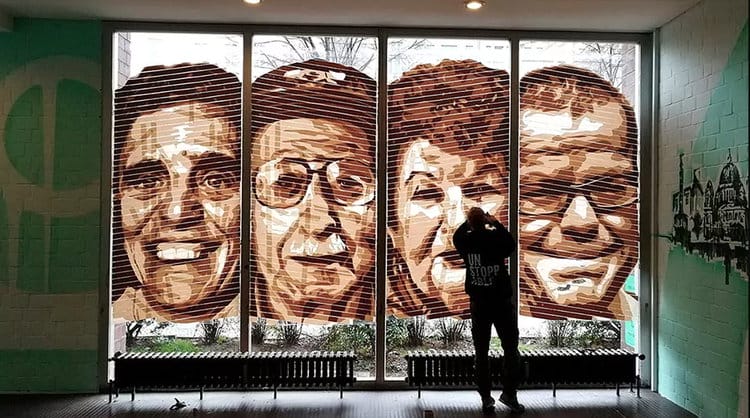
Packing Tape Art by the Selfmadecrew – Four portraits of the “Huzur” residents of the retirement home on Bülowstrasse, Berlin. In collaboration with URBAN NATION MUSEUM FOR URBAN CONTEMPORARY ART Berlin.
Artwork created with brown and colored packing tape is a specialty of the crew. This art technique only works in conjunction with light. Therefore, the works are always backlit, either with sunlight or artificial lighting such as LEDs or fluorescent tubes.
For smaller images, a custom lightbox is usually designed and built. In the following video, you can see the progress Slava Osinski has made in this technique over the past few years…
This video is embedded using YouTube's enhanced Privacy mode, which blocks YouTube cookies until you actively click to play the video. By clicking the play button, you consent to YouTube placing cookies on your device, which may also be used to analyze user behavior for market research and marketing purposes. For more information about YouTube's use of cookies, please see Google's Cookie Policy at https://policies.google.com/technologies/types?hl=de.
A wonderful, inclusive idea of the entire project team was that every resident of Huzur could participate in the creative transformation and get a taste of the street art process. The following "Behind the Scenes" video takes us along on the creation of this social street art project:
This video is embedded using YouTube's enhanced Privacy mode, which blocks YouTube cookies until you actively click to play the video. By clicking the play button, you consent to YouTube placing cookies on your device, which may also be used to analyze user behavior for market research and marketing purposes. For more information about YouTube's use of cookies, please see Google's Cookie Policy at https://policies.google.com/technologies/types?hl=de.
Commissioned art for brands and companies
Whether commissioned art or office design, graffiti or live event show at trade fairs, advertising campaign or marketing project – in the Selfmadecrew gallery you will find pictures and information about their previous collaborations with well-known brands, IT companies and lifestyle brands.
In this vibrant team, young entrepreneurs realize their ideas hand in hand with experienced and renowned artists. The creative minds of the Selfmadecrew constantly welcome new, young, and up-and-coming members into their collective, continually renewing themselves from within with innovative ideas and fresh perspectives.
Slava Osinski
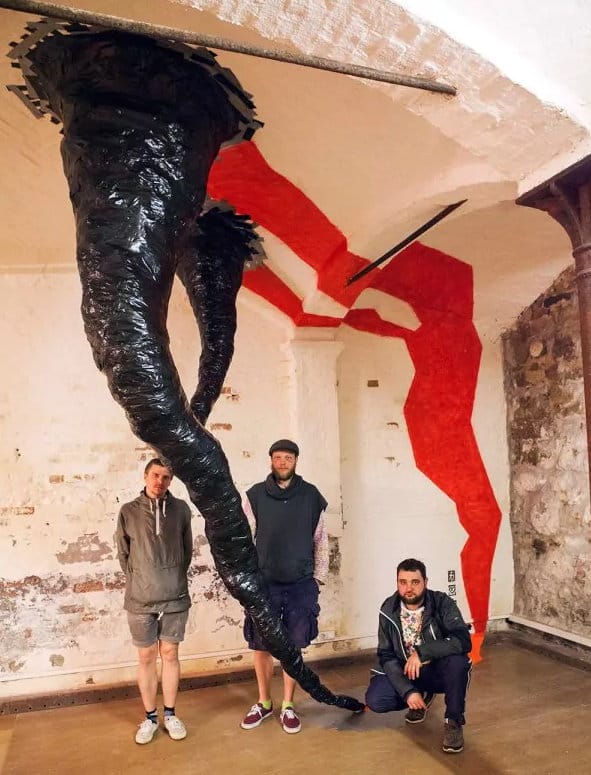
Besides his key role in the Selfmadecrew, Slava O. also established himself as a solo artist, gaining recognition beyond the scene. One of the most interesting tape art pieces in Berlin is Portable Tornado from 2014. This three-dimensional sculpture was created from over 450 rolls of packing and adhesive tape. The 3D sculpture exerts a powerful visual pull and evokes a fascination with the immense adhesive strength of tape rolls.
The immense structure is very imposing; it stands five meters tall and, at its widest point near the ceiling, reaches two meters in width. At its widest point, it has a diameter of almost two meters. Its creation took seven days. Slava O. created this sculpture during an event at the "Laboratorium Mensch" art festival in 2014.
This video is embedded using YouTube's enhanced Privacy mode, which blocks YouTube cookies until you actively click to play the video. By clicking the play button, you consent to YouTube placing cookies on your device, which may also be used to analyze user behavior for market research and marketing purposes. For more information about YouTube's use of cookies, please see Google's Cookie Policy at https://policies.google.com/technologies/types?hl=de.
The multifaceted and sometimes dramatic life story of Slava O. practically invites a closer look at his most formative life phases.
Vyacheslav “Slava” Osinski was born in 1978 in Ukraine (then the USSR) and completed his art studies there, acquiring techniques in drawing and linocut. In 1993, he began studying architecture, but had to abandon his studies in 1995 due to his emigration to Germany. He and his family arrived in Lübeck as quota refugees and were confronted with aggressive rejection and social hatred.
Slava also struggled with health problems that led to hearing loss, which worsened progressively. In 2003, he finally moved to Berlin and studied printing technology from 2004 to 2007.
His passion for painting and contemporary art eventually culminated in a fateful encounter with the German minimalist Stefan Müller in Berlin. This acquaintance quickly developed into a friendship. Subsequently, Slava became deeply involved with the challenges of contemporary art.
In 2010, he finally embarked on his own creative path and registered as a freelance artist. Since 2011, he has been active as a street artist and describes himself as a self-taught adventurer who is constantly searching for new possibilities and visual techniques. His first stencil works on the streets of Berlin appeared under the pseudonym “Ostap” (Ostapchenko) .
In 2013, Slava became an artist-in-residence at the Urban Spree gallery (Berlin) and was given his first studio there. Over the following two years, he was able to fully realize his ideas and produced several series in urban spaces, including “Spree Can” (2013-2018) , “Spreewald Underground” (2013-2018), “Art is…” (2014), “FAQlove” (2013-2015), and “Indulgence” (2013-2014).
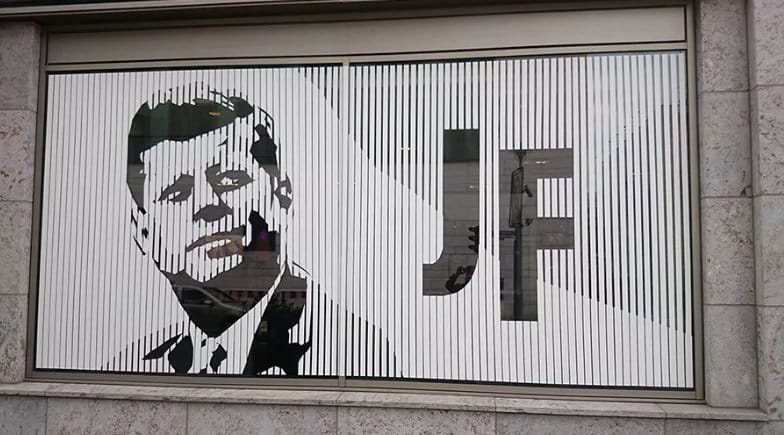
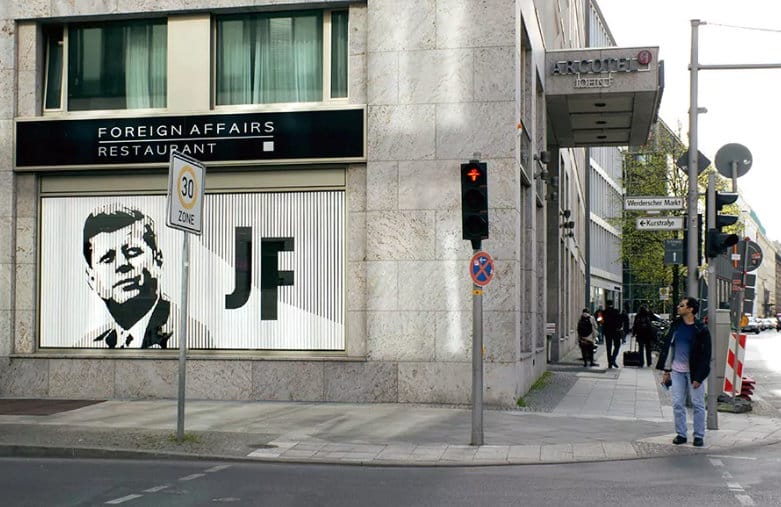
While experimenting with adhesive tape and the principle of a monochrome grid, new optical effects in 2015 with his JFK portrait
This artwork was created by skillfully applying white adhesive tape to the glass of a window pane. The background of the work was thus formed by the glass itself. The gap between the tape and the glass created a fascinating contrast that draws the viewer's eye.
From a greater distance, the glass appears darker than the white tape. Nevertheless, the artwork remains transparent through the gaps in the tape, offering a view of the outside. Natural light also enters through the window, illuminating the work in a unique way.
In the same year, the artist invented his own “brand” called “Selfmadecrew” to participate in legal projects. Since then, he and his crew have participated in numerous exhibitions and commissioned projects.
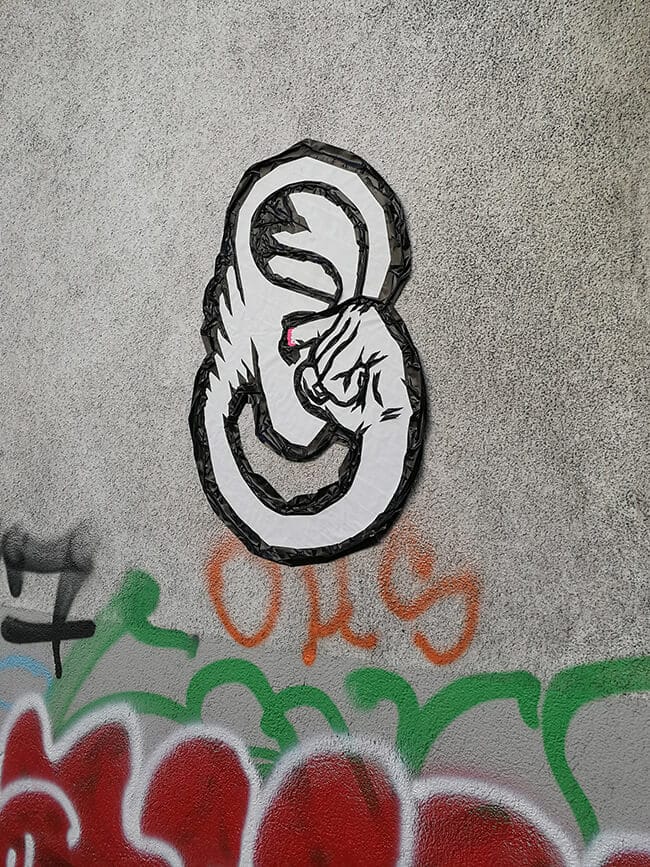
New Tape Street Art Series: Bananas as digital data carriers and autonomous self-care earlobe
Despite his involvement with the Selfmadecrew, Slava remains active as a solo artist, continuing to work closely with his roots in street art. Strolling through the streets of Berlin, one now encounters iconic tape art wall paintings in the stencil style of Banksy, which invite viewers to pause and reflect.
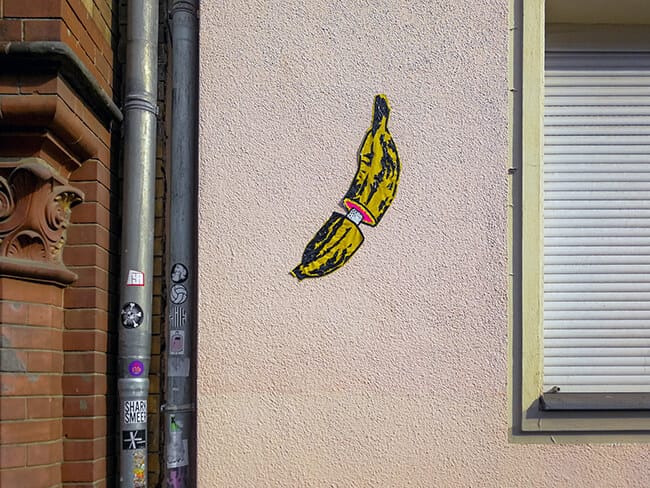
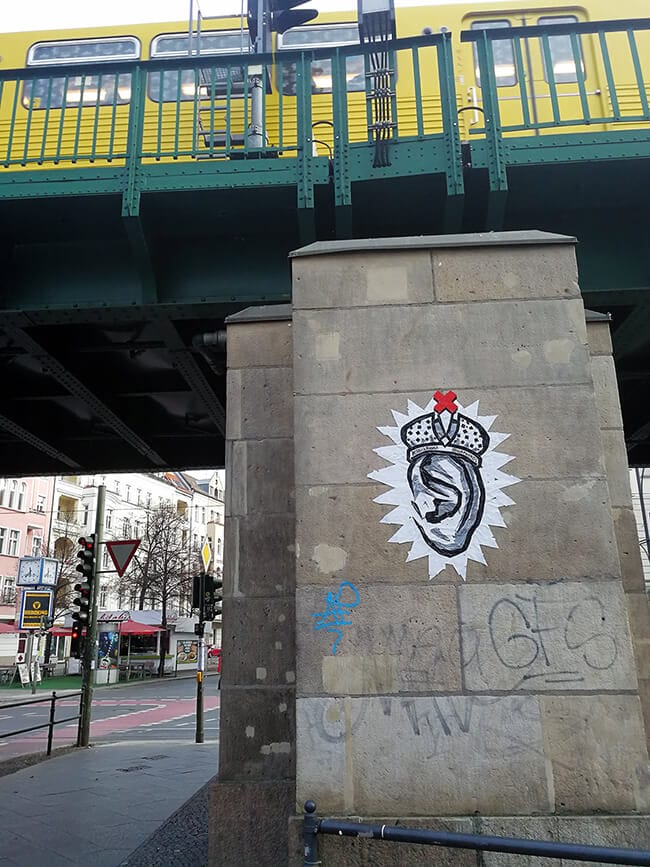
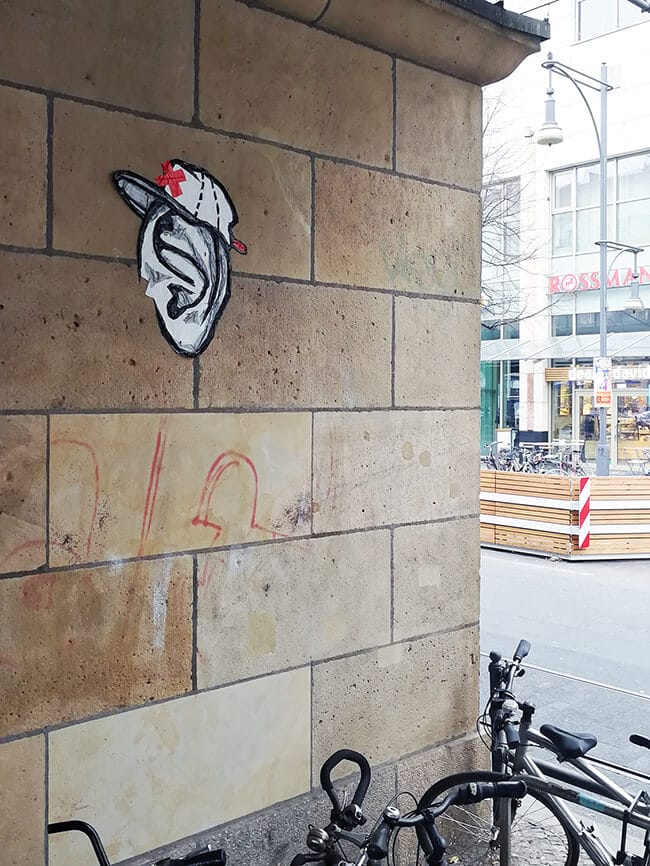
Among them is a banana created with duct tape that, when shared, reveals itself to be a digital storage device, and an ear that sometimes unashamedly picks its finger and at other times appears authoritatively as a self-crowned majesty or a rescuer wearing a nurse's cap. What does the symbolism in these works tell us?
Banana meat – Duct Tape Street Art by Slava and the Selfmadecrew
Duct Tape Street Art by Ostap
Duct Tape Street Art by Ostap, Berlin 2018
Duct Tape Street Art by Ostap, Berlin 2018
What is the meaning of the recurring Red Cross in Ostap's works? What message does the street artist want to convey with his murals? For many urban artists, tape street art is not just about aesthetics, but also about expressiveness and social relevance.
Therefore, artists like Ostap constantly experiment with new techniques and materials to make their works even more expressive. Tape street art is a way to express oneself creatively and simultaneously make a statement. Unlike graffiti, however, this art form can be created without damaging buildings or public property.
And so we will have to wait and see what new ideas and projects this talented artist will present to us in the future – but one thing is already certain: Tape Street Art has the potential to become the next major art movement in the urban environment!
Felix Rodewaldt – Kleben south of the Weißwurst equator
Some artists use pencils, others swear by brushes. But Munich-based Felix Rodewaldt also joins our illustrious list, relying on the unusual all-purpose weapon: adhesive tape. While others struggle to properly seal a package, the 27-year-old uses PVC, crepe, or fabric tape to give entire walls an extra dimension.
He covers them with stickers over a large area, constantly creating new patterns.
“I change the space and create movement with my art,”
says Rodewaldt. His works are often colorful and geometric, because the mathematical aspect is paramount in his tape art, which suits him well, as he admits that he cannot paint well.
Artworks: left, Felix Rodewaldt zigzag pattern and right, The Dixons window installation. Photo credits: NinaFoodieBerlin, CC BY-SA 4.0, via Wikimedia Commons
His clients are thrilled, and he has already received commissions from renowned companies and public authorities. Originally, the former art academy student from Munich worked with a completely different medium: stencils , a type of graffiti sprayed using stencils.
Later, he decorated the entrance to the “Hearthouse ,” a combination club and bar on Lenbachplatz, which had previously been bare and dark. But Rodewaldt knew how to remedy the situation and adorned the stairwell with a black and white herringbone pattern.
Although Rodewaldt now mainly works with adhesive tape, he still has good contacts with the graffiti scene.
“Some of my friends who do graffiti use my tape work as a basis for their stencils,”
He revealed this in an interview with the Munich newspaper Merkur . Therefore, he always sees his own works somewhat as a colored template for the works of his artist friends.
This video is embedded using YouTube's enhanced Privacy mode, which blocks YouTube cookies until you actively click to play the video. By clicking the play button, you consent to YouTube placing cookies on your device, which may also be used to analyze user behavior for market research and marketing purposes. For more information about YouTube's use of cookies, please see Google's Cookie Policy at https://policies.google.com/technologies/types?hl=de.
TAPE That
TAPE That is an artist collective based in Berlin. Their work ranges from simple, minimalist black and white murals to complex and colorful light and video installations.
These can be found in exhibitions, galleries, abandoned buildings, clubs, showrooms, pop-up stores, offices, events, or on trade fair stands and building facades. The collective creates artworks while drawing inspiration from the spatial conditions and incorporating them into the creative process.
The crew is fascinated by the idea of creating art from an everyday object that most people take for granted. Although based in Berlin, the tape artists regularly travel the world to raise awareness of tape art and establish it as a recognized art form
This video is embedded using YouTube's enhanced Privacy mode, which blocks YouTube cookies until you actively click to play the video. By clicking the play button, you consent to YouTube placing cookies on your device, which may also be used to analyze user behavior for market research and marketing purposes. For more information about YouTube's use of cookies, please see Google's Cookie Policy at https://policies.google.com/technologies/types?hl=de.
The significance of tape art for urban culture
Especially in urban areas like Berlin, there is a growing number of events, workshops, and conventions dedicated to tape art. The significance of tape art for urban culture lies in its ability to blur the boundaries between art and urban space.
Artists work with various materials such as paints and adhesive tapes to realize their ideas in hard-to-reach places. They often work in teams and use special kits and tapes to create their artworks. This collaboration and the use of unconventional materials fosters positive connections between those involved and contributes to a stronger community.
Furthermore, many artists use tape art as a means to transform the city and draw attention to local issues. Overall, tape art contributes to blurring the boundaries between urbanity and art, thus creating a new, dynamic art form.
Tape becomes not just a material, but also a melting pot, a team, and an art form that brings us all together. It's not just about creating artworks, but also about how they relate to people, the city, and the environment. Tape art gives us the opportunity to see the world around us in a different way and to work in a way that is enriching for all of us.
Owner and Managing Director of Kunstplaza . Publicist, editor, and passionate blogger in the fields of art, design, and creativity since 2011. Graduated with a degree in web design from university (2008). Further developed creative techniques through courses in freehand drawing, expressive painting, and theatre/acting. Profound knowledge of the art market gained through years of journalistic research and numerous collaborations with key players and institutions in the arts and culture sector.
Graffiti art / street art is an urban art form that has developed over time. It began in the 1970s in New York City when artists started spraying graffiti on public buildings and subway cars. Since then, graffiti art has evolved in many different directions.
Today, graffiti and street art are considered a vibrant art form that creates unique artistic expressions. Graffiti art has evolved into a global movement, connecting people from all over the world and having a major influence on popular culture and the art world in general.
In this section we feature numerous articles and information on the topics of Street Art , Mural Art , Graffiti Art and other urban art forms.
Street art can also be purchased as so-called urban art for your own four walls, by the way.
Art styles and movements
The art style or also the direction in artworks refers to the uniform expression of the artworks and cultural products of an era, an artist or an artist group, an art movement, or an art school.
This is a tool for categorising and systematising the diversity of art. It denotes similarities that distinguish it from others.
The term is thematically related to the Art Movement, but it should not be viewed solely within a temporal framework and is therefore much broader.
In this section, we would like to help you gain a better understanding of styles and movements in art.
We use technologies such as cookies to store and/or access device information. We do this to improve your browsing experience and to display (non-)personalized advertising. If you consent to these technologies, we can process data such as browsing behavior or unique IDs on this website. Refusal or withdrawal of consent may adversely affect certain features and functions.
Functional
Always Active
Technical storage or access is strictly necessary for the legitimate purpose of enabling the use of a specific service expressly requested by the subscriber or user, or for the sole purpose of carrying out the transmission of a message over an electronic communications network.
Preferences
The technical storage or access is necessary for the legitimate purpose of storing preferences that were not requested by the subscriber or user.
statistics
Technical storage or access that is solely for statistical purposes.Technical storage or access that is used solely for anonymous statistical purposes. Without a subpoena, the voluntary consent of your internet service provider, or additional recording by third parties, the information stored or retrieved for this purpose cannot generally be used to identify you.
marketing
Technical storage or access is required to create user profiles, to send advertising, or to track the user on one or more websites for similar marketing purposes.





 Fluffy high-pile rug, grey (200 x 290 cm)
225,00 €
Fluffy high-pile rug, grey (200 x 290 cm)
225,00 €