In a time when modern art dominates, it is exciting to observe how more and more artists and art lovers are rediscovering the heritage of Slavic painting .
This article explores the rediscovery of significant folk art from the Eurasian continent. After a brief overview of the Slavic peoples, we take a short look back at the history of Slavic folk art and then turn to contemporary art in the Slavic world.
The Slavs – An Excursion into a Large Ethnic Group
What are meant by Slavs?
Slavs are an ethnic group primarily located in Eastern and Central Europe . They represent one of the largest and oldest ethnolinguistic groups in Europe. They share a common Slavic language and a shared cultural identity .
The Slavic ethnic group comprises various subgroups, including Poles, Czechs, Slovaks, Sorbs, Russians, Ukrainians, Croats, Serbs, and Bulgarians. In total, there are over 300 million Slavs worldwide.
Historically, the Slavs were a significant part of European history. Over the centuries, they founded and influenced various empires and states. Slavic culture also had a strong influence on regional traditions, folklore, art , and literature.
The Slavs have a rich cultural diversity, which is reflected in their different customs, festivals, and culinary traditions.
Despite regional differences, there are also many commonalities, such as Slavic folk dances and traditional music. Today, Slavs live in various countries in Europe and in other parts of the world. They have their own languages and contribute to the diversity and cultural dynamism of the societies in which they live. The Slavs are thus an important and multifaceted ethnic group in Europe.
Who all belongs to the Slavic people?
The Slavs comprise various ethnic groups primarily located in Eastern Europe. They form one of the largest language families in Europe. The Slavic peoples include Russians, Poles, Czechs, Slovaks, Slovenes, Croats, Serbs, Bosnians, Montenegrins, Bulgarians, Macedonians, Ukrainians, and Belarusians.
These ethnic groups have different cultures, dialects, and traditions, but they also share many commonalities. The Slavic peoples have a long and complex history.
Their roots reach back to the 5th century, when the Slavs began to settle in various regions of Eastern Europe. Over time, different dialects and language varieties developed from the Slavic languages, which are now classified as East Slavic, West Slavic, and South Slavic.
The Slavs played an important role in European history, and their culture had a strong influence on the region. They produced significant literary works, music, art, and traditional festivals.
Furthermore, the Slavs have also contributed to the cultural richness of other nations, such as Russian literature or Slavic influences in German cuisine.
Who were the first Slavs?
The first Slavs were an Indo-European group who appeared in Eastern Europe in the 5th and 6th centuries AD. They probably originated in the area between the Baltic and Black Seas. However, the exact origin of the Slavs is not definitively established.
It is believed that the Slavic tribes evolved from an earlier Indo-European culture and eventually developed their own Slavic language and culture. The Slavs were first mentioned in historical records in the 6th century, when they came into contact with the Byzantine and Frankish empires.
The first Slavic tribes were primarily known as farmers and hunters who lived in small communities and practiced agriculture. They were also known for their craftsmanship, particularly in metalwork and pottery.
Over time, the Slavs spread to various regions, forming different Slavic tribes and peoples. They maintained close cultural, linguistic, and ethnic ties with one another and developed into a significant ethnic group in Europe. The arrival of the Slavs also had an impact on the political and social landscape of Europe.
They interacted with neighboring peoples, such as the Germanic tribes, and influenced the development of kingdoms, such as the Great Moravian Empire and the Principality of Poland.
Where does the term Slav come from?
The term “Slav” comes from ancient Greek and means “glory” . However, it was only used in the 6th century AD as a name for the Slavic peoples in Europe.
The term "Slav" is still used today to refer to the Slavic peoples of Europe, which include various nations such as Poles, Czechs, Russians, Serbs, Croats, Bulgarians, and many others. The term symbolizes their shared ethnic and linguistic heritage and their cultural traditions. Whether people of this ethnic group can be identified by Slavic facial features is a matter of debate, even though some characteristic traits can be discerned in their appearance.
Introduction to Slavic Painting
Origins and early stylistic influences
Slavic painting has a long and fascinating history dating back to the Middle Ages . In recent centuries, however, it has increasingly faded into the background and almost disappeared into oblivion.
Slavic painting is characterized by its distinctive stylistic elements, often inspired by nature and folklore . Traditional Slavic painters used earthy tones and a skillful combination of light and shadow to emphasize the beauty of their subjects.
In the Slavic regions of Eastern Europe and Russia, influences from the ancient Near East and Greece did not penetrate as deeply in early times. They were transmitted and transformed via the Byzantine Empire and the Eastern Church . Much of the folk art in the region was heavily influenced by the Byzantine style. Painting was no exception.
Christianization and icon painting
With the Christianization of Russia in the 10th century, the need arose to create religious art depicting figures from the Bible. Russian artists painted biblical scenes on wood, using egg yolk to mix the colors and egg white as a preservative.
The Novgorod School of Icon Painting produced the finest examples of icons, having escaped Mongol rule. It is considered the most productive and important icon school in the world. The most famous painters of this school were Andrey Rublev, Theophanes the Greek, and Dionysius.
Two centuries of Mongol rule also introduced further traditions from the East, characterized animal style
The characteristic elements of the themes and styles associated with icons were eventually banned in Russia in the mid-18th century and therefore declined.
Petrine art reforms
Peter the Great had a great interest in the visual arts, particularly architecture, but also in the fine arts . He attracted many artists to Russia, including Francesco Rastrelli . Peter the Great also paid scholarships to Russian artists and sent them abroad to study at the best art academies.
One of them was Ivan Nikitin , who became one of the first Russian painters to paint in perspective, as was common in the West. Traces of the Parsunas style be seen in his early works.
Nikitin is considered the founder of the Russian art tradition . Despite his success in adopting a more Western approach to painting, Nikitin was concerned about the increasing Westernization of Russian art and hesitated to abandon the tradition of icon painting. Other notable painters of this period include Andrei Matveyev, Alexei Antropov, Vladimir Borovikovsky , and Ivan Vishnyakov .
In 1757, during the reign of Elizabeth, daughter of Peter the Great, the Russian Imperial Academy of Arts founded, initially called the Academy of the Three Noble Arts. It was renamed the Imperial Academy by Catherine the Great.
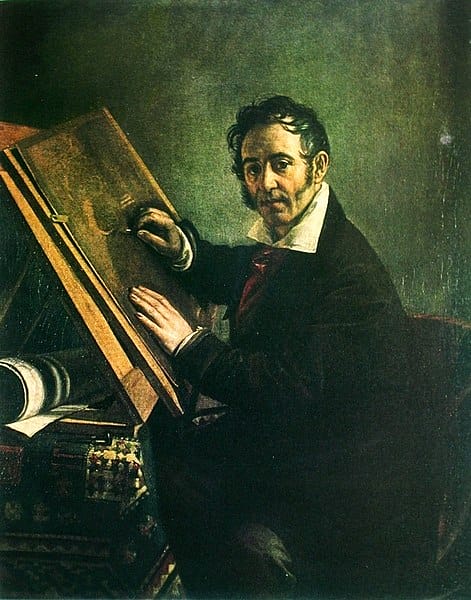
Western influences continued, and Romanticism left a lasting impression on 19th-century Russian artists. Ivan Aivazovsky, Orest Kiprensky, Vasili Tropinin, Alexei Venetsianov , and Carl Bryulov were among the best painters of this period.
In 1863, a revolt by some of the Academy's most talented students against the conservatism they were taught led to the founding of the Society of the Itinerant Art Exhibitions . Members of the Society began traveling the country, preaching social and political reforms and holding impromptu exhibitions of the artwork they had created during their travels. Among the itinerant artists were Ivan Kramskoy , Ilya Repin , and the "Tsar of the Forest," Ivan Shishkin .
Eventually, society disintegrated due to internal disagreements, and Russian art experienced a period of upheaval that lasted until the revolution. The emergence of abstract art caused a stir, giving rise to various abstract and semi-abstract movements. These included Russian Futurism , Rayonism, Constructivism , and Suprematism , the latter founded by Kazimir Malevich . Marc Chagall , known as one of the greatest Russian-Jewish artists of all time, explored various styles such as Fauvism , Surrealism , and Expressionism .
realism was also strongly pronounced at this time: Valentin Serov, Mikhail Vrubel, Alexander Golovin and Zinaida Serebriakova all created magnificent works.
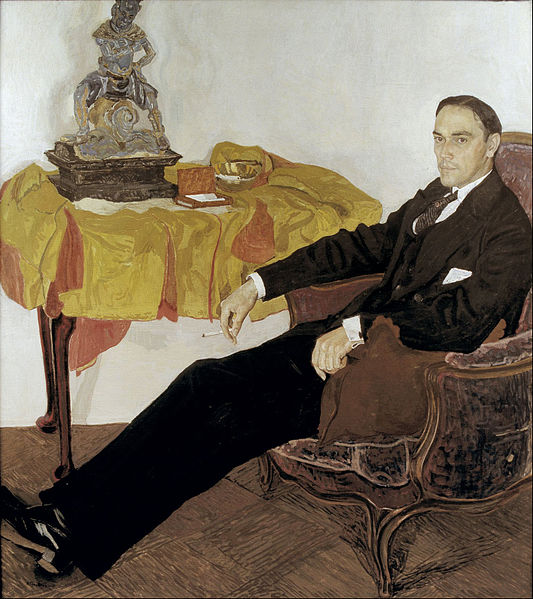
Alexander Yakovlevich Golovin – Portrait of Mikhail Ivanovich Terestenko
Polish painting of the 19th and 20th centuries – Artistic traditions halfway between Europe and Russia
Polish art has retained its own distinctive features in genre and style, it often reflects the figurative tendencies expressed in the movements of neighboring countries and continents such as Russia and Europe.
This is due to the fact that Poland did not yet exist as a state at the turn of the 20th century. It was divided between Austria, Russia, and Prussia, from which it received obvious artistic influences.
Nevertheless, Polish fine arts and literature have always been a central means of expressing and reinforcing the national spirit.
It was primarily through the avant-garde movements of the 20th century that Polish art was able to form its own identity and tradition, especially from 1917 onwards, when the first exhibition of Polish Expressionists was opened in Krakow.
This flourishing artistic environment, which established itself in the period between the two world wars, was characterized by many movements, such as: the Polish Expressionist , the Bunt group ; the Art Formists; the Futurists; the Cubists; the Suprematists; the Constructivists (Praesans) and the AR group ("Revolutionary Artists").
In addition to these movements, there were also prominent figures who left their mark on the history of Polish art, such as Witkacy , the creator of the artistic approach "Pure Form ," characterized by the creation of paintings that aim to convey the mystery of existence. Furthermore, Witkacy was one of the few avant-garde painters who painted commissioned portraits under the influence of drugs, resulting in images marked by distortion.
Slavic folk art in modern times
In modern times, these countries were mostly governed by communists. Their policies included promoting folk art, organizing artists into cooperatives, and even introducing handicrafts from one region to another.
Although this provided an incentive for the study of folk art, it tended to blur the distinction between purely folk art and the revived or commercialized product.
Even earlier, Russian folk art was exposed to foreign influences in a way that was atypical for other regions: In the 17th century, craftsmen from many parts of Russia were requisitioned to supply products for the national economy or to work on palaces, and they were also gathered around monasteries to make prescribed expenditures there.
Perhaps the best-known Russian products elsewhere are toys – intricate wooden constructions or colorful earthenware miniatures. It is believed that some of the Vyatka toys are remnants of idols made for private households, representing the countless local deities from the pre-Christian era.
Other notable art forms include ceramic tiles, wooden and ceramic figures, and bone carving in the Siberian tradition.
In Eastern Europe , where national borders were particularly unclear and the population comprised various minorities, studies of art can follow ethnic lines. Geography offers a range of diverse regions, as varied as coastal Dalmatia, Transdanubia, and the isolated Tatra Mountains.
Given the heavily wooded landscape, woodwork exceptional. It appeared in church architecture, architectural sculptures , vessels and implements, as well as in special forms such as the sculpted grave post; even a corn scuttle might be covered with rosettes.
The region was rich in festive arts and had strong ties to pre-Christian traditions and magical rites. In the former Czechoslovakia (now the Czech Republic and Slovakia ), there were distinctive wedding paintings and candlesticks. Alongside many ancient motifs such as vases and trees, suns and hearts, the rooster appeared as a protective symbol, which could be placed on roof edges or carved into cheese molds. Some of the artworks are strikingly primitive.
One of the complications that arises when studying Eastern European arts is the fact that the countries involved are culturally borderlands, with an affinity to Roman Catholic Europe in the west (exemplified by the ex-votos in brilliant Czech stained glass) and to the Byzantine Empire in the east. The arts described as Polish , including some of the finest decorative arts on paper, once extended far eastward, yet are in fact Northern European.
The Slav Epic by the Czech painter Alfons Mucha
The Slav Epic , in its original title Slovanská Epopej , occupies a special role in Slavic painting as a cycle of paintings and the main work of the Czech painter Alfons Mucha and will therefore be presented separately here.
It depicts the history of the Slavic peoples and consists of 20 large-format tempera-on-canvas paintings created between 1911 and 1928.
Alfons (also spelled Alphonse) Mucha (1860–1939) spent many years working on his artistic masterpiece.
The illustrator and decorator, known for his distinctive style, created numerous paintings , postcards, designs, advertisements, and illustrations. Alphonse Mucha was born in the town of Ivančice in Moravia, now part of the Czech Republic. He began his career in Moravia primarily painting theatrical landscapes.
Mucha later moved to Paris and continued his studies while producing advertising demonstrations and designs for theatrical scenery, initially referred to as the Mucha style. It later became known as Art Nouveau (New Art).
His works depicted elegant young women in neoclassical gowns, surrounded by lush flowers that formed a ring of light behind their heads. In contrast to modern poster artists, he used faded pastel colors. Alphonse Mucha's images came purely from within. It was his way of conveying a spiritual message.
Mucha's largest of his Slavic epic paintings, measuring over six by eight meters, depicts the history of the Slavic people. The idea originated in 1899 during work on the interior design of the Bosnian-Herzegovinian pavilion. To prepare for this commission, he traveled throughout the Balkans, researching their history and customs, and carefully studying the lives of the South Slavs in the regions allied with Austria-Hungary for the previous two decades.
This knowledge provided the inspiration for a new design, the creation of a legend for all Slavic peoples, which would illustrate the "joys and sorrows" of his own community and all other Slavs.
In 1909, he received sponsorship from a wealthy Chicago philanthropist, Charles Richard Crane. With Crane's keen interest in expanding political affairs in Eastern Europe and Slavic civilization, Mucha supported Mucha financially and morally for almost twenty years.
Between 1911 and 1926, Alphonse Mucha devoted most of his energy to creating the Slav Epic and was able to recount twenty major episodes from the Slavic past, from ancient to modern, ten episodes from Czech history, and ten more about historical episodes from more Slavic territories.
This video is embedded using YouTube's enhanced Privacy mode, which blocks YouTube cookies until you actively click to play the video. By clicking the play button, you consent to YouTube placing cookies on your device, which may also be used to analyze user behavior for market research and marketing purposes. For more information about YouTube's use of cookies, please see Google's Cookie Policy at https://policies.google.com/technologies/types?hl=de.
Mucha's first painting in the series was "The Slavs in Their Original Homeland ," which he completed in 1912. In 1924, he visited Mount Athos and was deeply fascinated by its ancient spiritual atmosphere. In his painting "Saint Athos," he employed the combination of real and symbolic imagery that he had already used in his first three paintings in the series.
He designed a lighting scheme to create a powerful image of the church interior. A circle of Russian pilgrims encircled the inner wall, bowing as they kissed the relics that the Igumen had presented to them before the iconostasis.
The transformation from the earthly to the heavenly sphere is achieved only through the magnificent athletic figures of the cherubim, which support replicas of the four Slavic monasteries on Mount Athos. The forms of the two angelic maidens hang above the iconostasis and symbolize faith and purity.
The spiritual scene concludes with a mosaic of Theotokos in the apse. By 1926, the entire series was completed with his final painting, "The Apotheosis of the Slavs ," which celebrates the triumphant victory of all Slavs, whose homelands finally became their own.
The artist died in Prague on July 14, 1939, after contracting pneumonia. He will never be forgotten for his unique and special paintings in this series.
Post-Revolution and ( unofficial) art of the Soviet Union
The Bolsheviks viewed art as a purely political instrument . After the 1917 revolution, artists were no longer allowed to create their usual art and were now expected to produce industrial design work.
This led to many artists leaving Russia, including Chagall, Kandinsky, and many others. Stalin declared social realism the only acceptable art form. Religious, erotic , political, and "formalist" art, including abstract, expressionist, and conceptual art , was completely banned.
The art created in the Soviet Union during the period from Stalin's death until the advent of Perestroika and Glasnost is referred to as unofficial art . This art is also known as nonconformist art , second avant-garde, or underground art .
It emerged as a counter-movement to Socialist Realism in literature, visual arts, and music. The underground artists were closely connected to illegal movements such as Moscow Conceptualism , the Leningrad Association for Experimental Art , and the Mitki Group in Leningrad. They also maintained contacts with hippies and rockers.
After Stalin's death, there was also a brief period of "thaw". Artists like Aleksandr Gerasimov , who had painted idealized portraits of Stalin, were now ostracized and considered embarrassing, and the government's views on art became more liberal.
This ended quickly, however, after the Manege Affair, when Khrushchev publicly argued with the sculptor Ernst Neisvestny about the function of art . The debate and the resulting end of the "thaw" led to a further development of underground nonconformist art. The artists knew they would not find public acceptance, but the impact was no longer as severe as before.
From the mid-1970s onward, increasing numbers of artists emigrated, encouraged by the more open borders and unwilling to remain in the restrictive atmosphere of the Soviet Union. Ernst Neizvestny moved to the USA in 1977.
Important works of Slavic painting from the 19th and 20th centuries
(You must have accepted cookies to view the Pinterest board)
The return of Slavic painting in the 21st century
The 1990s brought Russian artists an unprecedented freedom. Performance art emerged in Russia for the first time, and it was a time of experimentation and enjoyment. This enormous freedom was restricted in the new millennium, although Russian art is still flourishing.
Many artists have found a clientele both inside and outside of Russia, but there are concerns that increasing censorship makes it difficult to create authentic art.
Among the most famous contemporary Russian artists are the conceptual installation artists Ilya and Emilia Kabakov , the co-founder of Moscow Conceptualism Viktor Pivovarov , the installation artist Irina Nakhova, Alexei Chernigin and many more.
In the 21st century, we are witnessing a fascinating rediscovery of Slavic painting and its stylistic elements. After years of obscurity, this unique art form is enjoying a remarkable comeback. This renaissance presents both artists and art lovers with new opportunities and perspectives.
The combination of tradition and modernity plays an important role in contemporary Slavic painting, with artists using new techniques and materials to create their artworks.
Artists worldwide find inspiration in the works of the great Slavic painters of past centuries, drawing on their techniques and motifs. The popularity of Slavic paintings, art prints, and posters is steadily growing.
Slavic painting has undoubtedly found its place in the modern art world, offering a rich source of inspiration for both artists and art lovers. The English-language online portal RUSSIANART+CULTURE regularly provides information on the most important art exhibitions in Russia .
Slavic painting also has an influence on modern art itself. Many contemporary artists are guided by the works of the past and create artworks that combine traditional Slavic motifs and techniques with modern elements.
A vivid example of this resurgence of Slavic painting is the flourishing art scene in Prague . This city has a rich history of Slavic art and is today a center for modern artists who draw inspiration from the old masters.
In the city's galleries and museums, visitors can admire a diverse selection of Slavic art, from traditional paintings to contemporary works. The combination of traditional Slavic motifs with modern techniques results in unique and captivating artworks that celebrate the cultural diversity and beauty of the Slavic world.
Important museums for Slavic art and painting
The State Hermitage Museum, Saint Petersburg
The Pushkin Museum of Fine Arts, Moscow
The State Tretyakov Gallery, Moscow
The State Historical Museum, Moscow
The Vladimir and Suzdal Historical, Architectural and Art Museum, Vladimir
National Gallery in the Prague Trade Fair Palace, Prague
National Museum of the City of Wrocław
National Museum Krakow
The authoritarian turn: on the crisis of Polish institutions of contemporary art
We would have liked to end this article on a positive note. Unfortunately, however, we felt compelled to address the recent right-wing populist developments in the art scene in Eastern Europe.
The art world in Poland is traditionally heavily controlled by the state. Specifically, state subsidies push the art sector in certain directions. Currently, the right-wing populist Law and Justice (PiS) partyart directors throughout the country who adhere to its strictly conservative, far-right agenda.
The most visible impact of right-wing policies in contemporary art was the takeover of major museums and centers for contemporary art by directors loyal to the ruling party.
Among the most well-known and controversial cases are institutions that play a key role in the artistic ecosystem: the Zacheta National Art Gallery and the CCA Ujazdowski Castle in Warsaw, as well as the Art Museum in Łódź.
Since February 2022, artistic life in Poland has also been overshadowed by the brutal Russian invasion of Ukraine and the looming energy crisis. The despair caused by the politically motivated appointment of party loyalists to key leadership positions pales in comparison to the open, brutal war, in which missiles are falling on civilians just 400 kilometers from Warsaw.
Kuba Szreder – researcher, lecturer, independent curator and professor in the field of art theory at the Academy of Fine Arts in Warsaw – reported extensively CIMAM News .
Owner and Managing Director of Kunstplaza . Publicist, editor, and passionate blogger in the fields of art, design, and creativity since 2011. Graduated with a degree in web design from university (2008). Further developed creative techniques through courses in freehand drawing, expressive painting, and theatre/acting. Profound knowledge of the art market gained through years of journalistic research and numerous collaborations with key players and institutions in the arts and culture sector.
In art, the classification of artists and artworks into stylistic periods occurs. These are based on common characteristic features of the artworks and cultural products of an era.
The division into eras serves as a tool for structuring and classifying works and artists within a temporal framework and a cultural-historical event.
Knowledge of Art Periods And Movements plays a major role, especially in the art trade , as well as in art theory and classical image analysis.
In this section of the art magazine, we would like to help you gain a better understanding of these epochs, styles and movements.
Art styles and movements
The art style or also the direction in artworks refers to the uniform expression of the artworks and cultural products of an era, an artist or an artist group, an art movement, or an art school.
This is a tool for categorising and systematising the diversity of art. It denotes similarities that distinguish it from others.
The term is thematically related to the Art Movement, but it should not be viewed solely within a temporal framework and is therefore much broader.
In this section, we would like to help you gain a better understanding of styles and movements in art.
We use technologies such as cookies to store and/or access device information. We do this to improve your browsing experience and to display (non-)personalized advertising. If you consent to these technologies, we can process data such as browsing behavior or unique IDs on this website. Refusal or withdrawal of consent may adversely affect certain features and functions.
Functional
Always Active
Technical storage or access is strictly necessary for the legitimate purpose of enabling the use of a specific service expressly requested by the subscriber or user, or for the sole purpose of carrying out the transmission of a message over an electronic communications network.
Preferences
The technical storage or access is necessary for the legitimate purpose of storing preferences that were not requested by the subscriber or user.
statistics
Technical storage or access that is solely for statistical purposes.Technical storage or access that is used solely for anonymous statistical purposes. Without a subpoena, the voluntary consent of your internet service provider, or additional recording by third parties, the information stored or retrieved for this purpose cannot generally be used to identify you.
marketing
Technical storage or access is required to create user profiles, to send advertising, or to track the user on one or more websites for similar marketing purposes.


 "LovYa" dining chair made of solid wood, natural
299,95 €
"LovYa" dining chair made of solid wood, natural
299,95 €