In May 2016, an American teenager placed his glasses on the floor of an exhibition room at the San Francisco Museum of Modern Art , sparking a controversial debate with this simple act. This small provocation and the reactions to it vividly illustrate how glasses have become an object of discourse and a symbol in art.
The fascination with eyeglasses in art has evolved over centuries. For more than a hundred years, artists have used visual elements as a defining component of their public identity. Today, art and eyeglasses are inextricably linked – just think of Iris Apfel's distinctive glasses , which are as unique as she is.
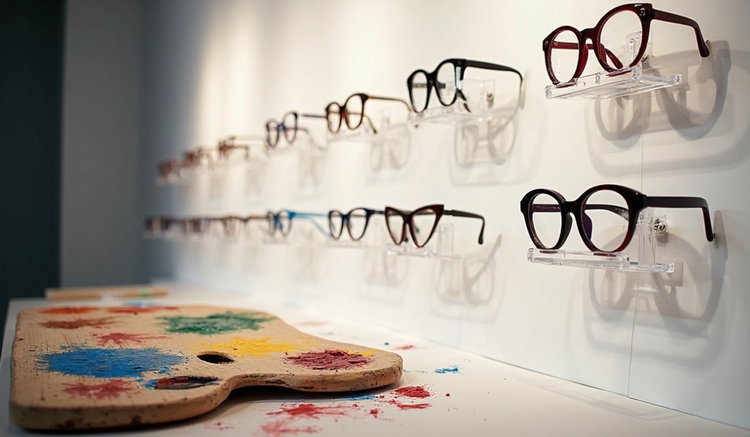
Glasses as a visual trademark in the art world. This image is for illustrative purposes and was created using image AI.
Glasses have changed dramatically over the years and are now essential accessories for artists and creatives to present themselves. They aren't always necessary for the main presentation, but they help define character and make things easier to understand.
For many artists, glasses are a way to express who they are. Glasses make us look good and help us feel like we belong. In a world where appearance is everything, the color, shape, and material of a frame say a lot about a person's personality and taste. For example, simple glasses can tell us that we are professional, while striking, bold frames express our creative side.
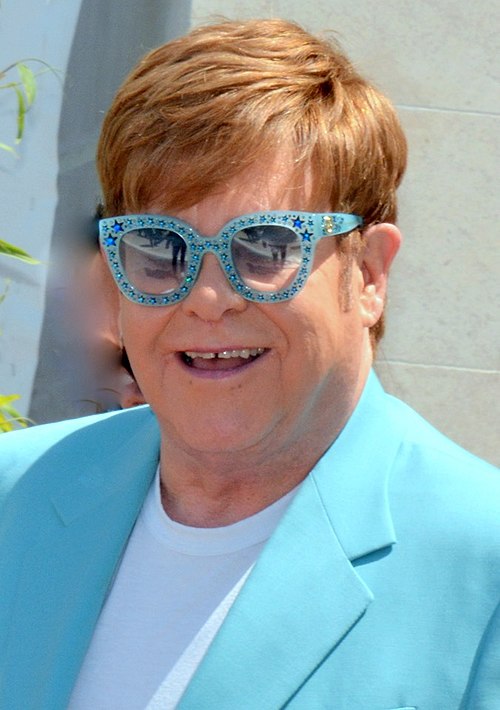
Musicians like Elton John, on the other hand, hid their shyness behind extravagant glasses – for him, the more unusual the glasses, the better. Similarly, the German rapper Thomas D once "Glasses Wearer of the Year," as his style was significantly shaped by the distinctive glasses that became his trademark from the beginning of his career. John Lennon's iconic round glasses are another example of how artists skillfully integrate them into their stage presence, making them an integral part of their artistic expression.
Elton John wearing distinctive glasses during a performance at the Cannes Film Festival 2019. Photographed by Georges Biard, CC BY-SA 3.0, via Wikimedia Commons
Glasses as a symbol of intelligence
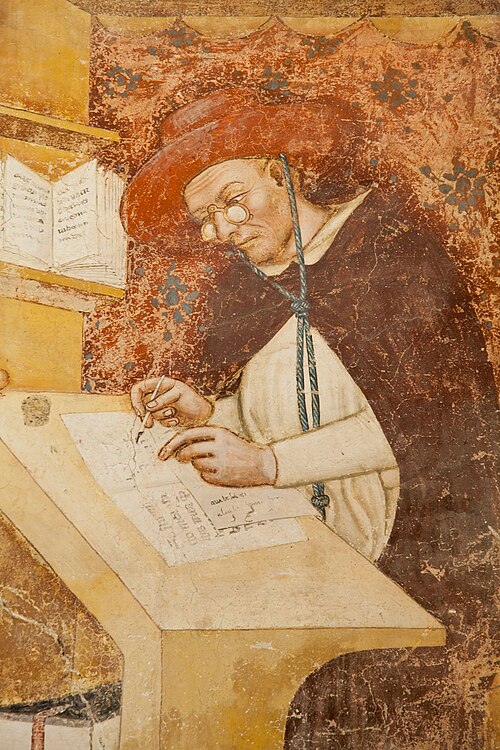
If the stereotype that glasses are a symbol of intelligence persists in popular culture, this can be attributed to the art history of this accessory. Traveling back to the late Middle Ages of the 14th century, the cost of this novel visual aid was so high that only the wealthiest people could afford it.
Those who wore them daily were often members of society considered intellectuals (scientists, writers, clergy, and philosophers), who could therefore read and write well into old age. For centuries, eyeglasses were associated with intelligence, as they were exclusively observed on people who possessed knowledge.
Consequently, eyeglasses became a means for painters to demonstrate their intellectual curiosity about their subject. This is why certain painters depicted their famous sitters wearing eyeglasses.
Portrait of Cardinal Hugo of Saint-Cher (d. 1263) by Tommaso da Modena, 1352, the first known (albeit anachronistic) depiction of spectacles in a painting (Ilardi, Vincent (2007) Renaissance Vision from Spectacles to Telescopes, Memoires of the American Philosophical Society, 259, American Philosophical Society, pp. 18–19)
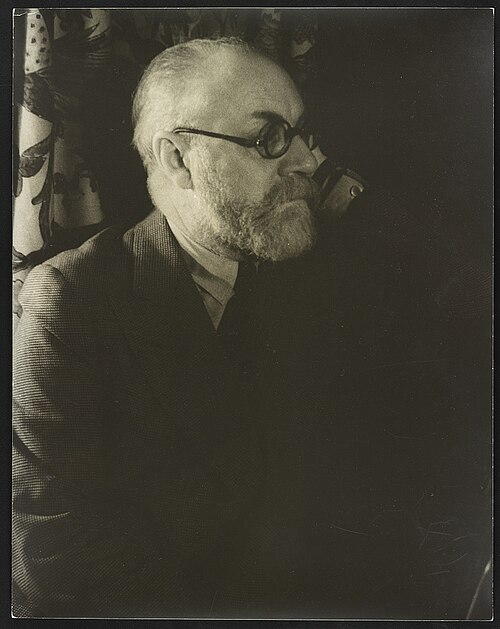
The renowned French painter Henri Matisse , one of the most celebrated artists of the modern era who died in 1954, had a profound influence on the global art scene with his significant works, created at the same time as Picasso. Alongside his creative pursuits, he was notably known for always wearing suits and distinctive glasses, which gave him an intellectual air whenever he left the house.
Photographic portrait of Henri Matisse with glasses (1933)
Iconic personalities from the art scene and their eyewear styles
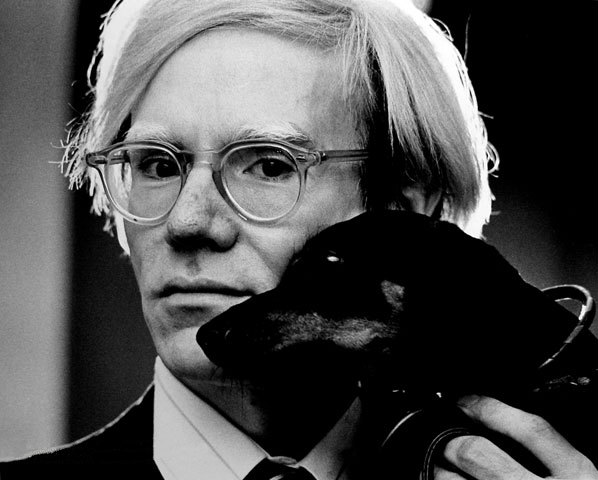
Andy Warhol was already aware that he was the undisputed monarch of pop culture. Transparent, round glasses were his "thing".
The American pop artist was a pioneer in both art and fashion. He undoubtedly helped fuel the current trend for fashionable eyewear with his messy, light blond hairstyle and chunky plastic frames.
Andy Warhol with his dachshund Archie, photographed by Jack Mitchell, CC BY-SA 4.0, via Wikimedia Commons
Especially during the wild seventies, artists recognized the value of glasses as a means of personal expression. David Hockney , now 85, made his round glasses an indispensable part of his artistic image. His characteristic style—checkered suits, patterned ties, and, not least, his distinctive round frames—gave him an unmistakable presence in the art world. Hockney now wears his glasses in various colors, including a striking yellow.
The collector Peggy Guggenheim (1898–1979) made a fashion statement with her iconic butterfly glasses. This unique model, actually inspired by bat wings, was designed especially for her by the artist Edward Melcarth. While cruising through Venice, she used the striking glasses to both attract attention and maintain a certain distance.
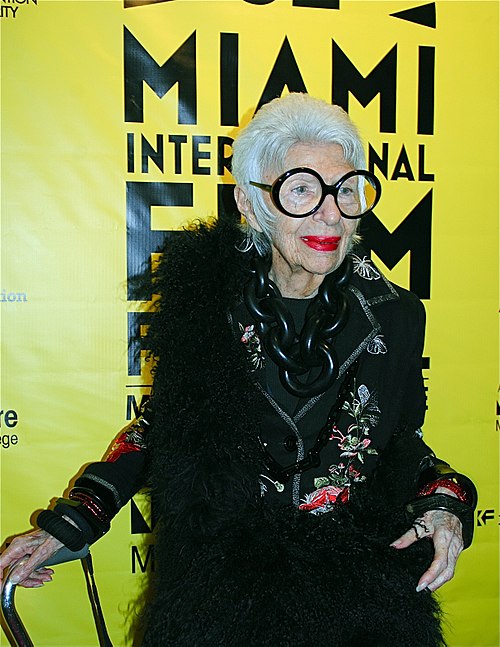
Iris Apfel at a public appearance at the O Cinema (Miami Beach) for the presentation of her film biography "IRIS" by Albert Maysles. Photo source: MiamiFilmFestival, CC BY-SA 2.0, via Wikimedia Commons
Iris Apfel is particularly known for her extravagant eyewear . Her oversized, round "owl-eye" glasses have become her unmistakable trademark. Even as a child, she was fascinated by glasses and began collecting them. Her philosophy:
It's not about what you wear, but how you wear it.”
At 97 years old, she signed a modeling contract, and at 100 years old, she designed her own eyewear collection.
Choosing round eyeglass frames often signals eccentricity and a free spirit. It's no coincidence that John Lennon, Janis Joplin, and Le Corbusier are among the most famous proponents of this expressive shape.
Julian Schnabel also liked to demonstrate that one is never too old to wear expensive glasses. The German-American painter and filmmaker became famous in the 1980s for his "record paintings" .
The relationship between artists and their glasses goes beyond mere functionality. These helpful accessories become an extension of their artistic identity, as illustrator Richard Haines confirms in the following statement:
My glasses became an extension of my identity as an artist.”
He chooses his glasses based on shapes and details – just like when drawing, where these elements mean everything.
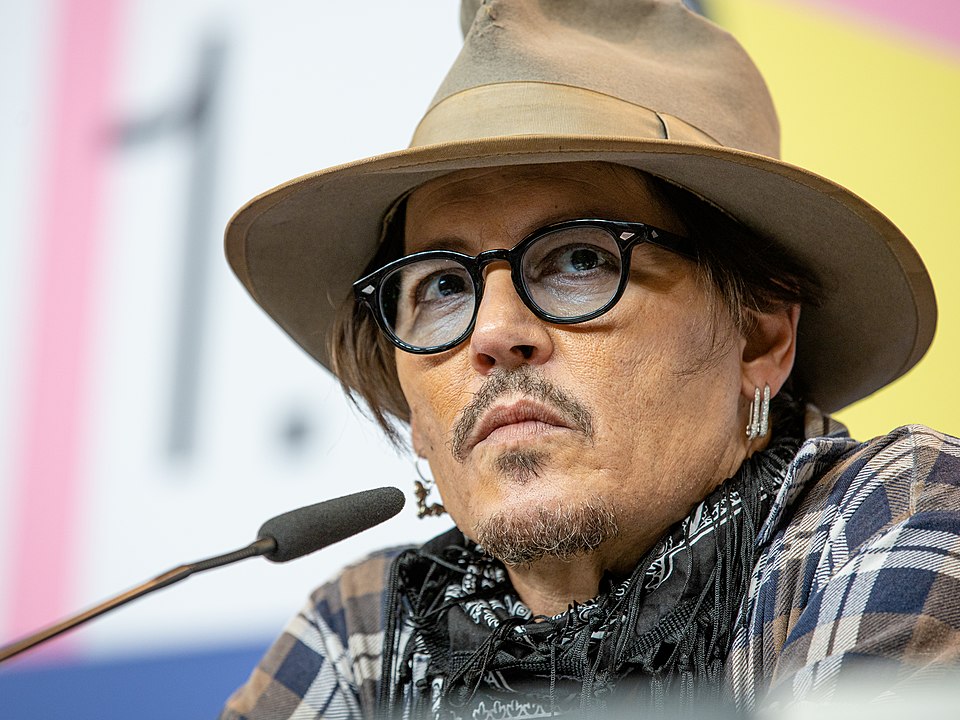
Johnny Depp doesn't just use glasses as props, but as a crucial element in shaping his characters. His choice of eyewear (at the 2020 Berlinale he wore anartfully crafted metal frame ) skillfully balances striking statement and understated elegance – a rare duality achieved by few. Indeed, in art, glasses often reflect the complex, multifaceted personalities that artists bring to life.
Actor Johnny Depp at the Berlinale 2020, photographed by Harald Krichel, CC BY-SA 3.0, via Wikimedia Commons
Let's remember..
Eyeglasses have thus evolved from simple visual aids into powerful symbols of artistic expression. While in the past they primarily represented erudition and dignity, today they serve as a personal statement and a distinctive trademark. The stories of David Hockney, Peggy Guggenheim, and Iris Apfel clearly demonstrate that the right pair of glasses can be far more than an accessory—it becomes an extension of the artistic vision.
Particularly noteworthy is the fact that artists consciously use their glasses to emphasize or even amplify certain aspects of their personality. John Lennon's round glasses signaled his free spirit, while Iris Apfel's striking "owl eyes" underscore her eccentric nature. At the same time, glasses allow the artist to literally view the world through a unique filter—a metaphor for the artistic gaze itself.
The relationship between artist and eyewear therefore extends far beyond the functional. Eyeglasses become a visual anchor by which viewers can connect with the wearer's personality. Ultimately, the choice of eyewear reflects the artistic soul – be it through minimalist frames that convey professionalism, or through extravagant models that symbolize creative freedom.
Owner and Managing Director of Kunstplaza . Publicist, editor, and passionate blogger in the fields of art, design, and creativity since 2011. Graduated with a degree in web design from university (2008). Further developed creative techniques through courses in freehand drawing, expressive painting, and theatre/acting. Profound knowledge of the art market gained through years of journalistic research and numerous collaborations with key players and institutions in the arts and culture sector.
We use technologies such as cookies to store and/or access device information. We do this to improve your browsing experience and to display (non-)personalized advertising. If you consent to these technologies, we can process data such as browsing behavior or unique IDs on this website. Refusal or withdrawal of consent may adversely affect certain features and functions.
Functional
Always Active
Technical storage or access is strictly necessary for the legitimate purpose of enabling the use of a specific service expressly requested by the subscriber or user, or for the sole purpose of carrying out the transmission of a message over an electronic communications network.
Preferences
The technical storage or access is necessary for the legitimate purpose of storing preferences that were not requested by the subscriber or user.
statistics
Technical storage or access that is solely for statistical purposes.Technical storage or access that is used solely for anonymous statistical purposes. Without a subpoena, the voluntary consent of your internet service provider, or additional recording by third parties, the information stored or retrieved for this purpose cannot generally be used to identify you.
marketing
Technical storage or access is required to create user profiles, to send advertising, or to track the user on one or more websites for similar marketing purposes.







 Organic wall mirror "Bosa", curved wooden frame (white, 46 x 61 cm)
39,00 €
Organic wall mirror "Bosa", curved wooden frame (white, 46 x 61 cm)
39,00 €


