In a world dominated by digital overload and fleeting advertising messages, brands are searching for new ways to build a deeper, more meaningful connection with their audience. The classic commercial, the glossy poster – they are all losing their impact in a society that values authenticity and real experiences over polished slogans.
This opens up a fascinating field of tension, a creative space where two seemingly separate worlds collide: that of contemporary art and that of strategic live marketing.
It's no longer just about selling a product, but about conveying an attitude, telling a story, and leaving a lasting impression on people's emotional memories. The staging of brand experiences is itself becoming an art form. This demanding task goes far beyond traditional advertising and requires a deep understanding of dramaturgy, aesthetics, and emotional impact. It is undertaken by specialized partners such as agencies event, who can translate a brand's vision into a tangible, immersive, and unforgettable experience.
The question that modern marketers and creatives are asking themselves is therefore: How can the power of art be used to not only send brand messages, but to make them tangible?
From slogan to sensory experience: The evolution of brand communication
The history of advertising is a constant quest for attention. In the past, it was enough to loudly and repeatedly proclaim the merits of a product. In the era of mass marketing, catchy slogans and visually appealing, but often superficial, campaigns dominated. But consumers have become more discerning. Today, they are better informed, more critical, and yearn for content that enriches them intellectually and emotionally.
The mere presentation of products gives way to the need to create a cultural context in which the brand is perceived as a relevant player. This is where the journey begins, moving away from pure information towards profound inspiration.
This shift is forcing brands to redefine their role. They must evolve from mere broadcasters to hosts, curators, and enablers. Live marketing events provide the ideal platform for this, as they allow for direct, multisensory interaction. However, a simple corporate event with logo banners and product samples is no longer sufficient.
This shift is forcing brands to redefine their role. They must evolve from mere broadcasters to hosts, curators, and enablers. Live marketing events. Photo by Carlos Gil @carlosgil83, via Unsplash
The real challenge lies in creating a space that takes visitors away from their everyday lives and makes them part of a larger narrative.”
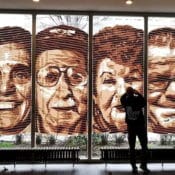
It is precisely at this point that the boundaries blur, and we move into the creative territory between art installation and brand stage: where contemporary art and live marketing meet. Contemporary art offers the perfect vocabulary for this: by definition, it is subversive, thought-provoking, breaks with conventions, and speaks to people on a level that goes far beyond the rational.
The artist as visionary, the brand as modern patron
Collaborations between artists and brands are not an entirely new phenomenon. Consider the legendary BMW Art Cars, where icons like Andy Warhol, Roy Lichtenstein , and Jeff Koons transformed automobiles into rolling sculptures. However, the nature of these collaborations has fundamentally changed. Previously, the artist's name often served purely as a seal of approval, lending a product an air of exclusivity and cultural prestige.
The automobile is a popular vehicle for brand communication. Photo by Wiseman Mabasa @@ndzlama66, via Unsplash
Today, it's about a partnership on equal footing, a co-creationwhere artistic integrity is preserved and the brand demonstrates the courage to engage in an open, creative process. The artist becomes the catalyst, translating a brand's core values into a universal, aesthetic language.
For the brand, this means taking on the role of a modern-day patron. Instead of simply stamping its logo onto a work of art, it invests in the creation of culture. It enables the realization of ambitious projects – from immersive light installations and interactive sculptures to entire temporary museums – that would not be possible without its financial and logistical support.
A prime example is the elaborate staging by fashion brands like Louis Vuitton , which not only commission artists like Yayoi Kusama for product designs, but also transform entire store facades and pop-up worlds into their signature dotted landscape. The brand thus becomes a stage for art , and the art imbues the brand with a new, unexpected depth and relevance.
Itis this bold step that makes the crucial difference and elevates a campaign from a mere advertising measure to a cultural event.
Staging strategies: When art becomes a brand experience
The true mastery of a powerful brand experience lies in curatorial and dramaturgical staging. Photo by niko n @niko_nguyen_10, via Unsplash
Simply placing a work of art in a space is not enough to create a powerful brand experience. True mastery lies in the curatorial and dramaturgical staging. It's about crafting a coherent journey for the visitor, where every aspect – from the spatial design and lighting to the sound and interaction – contributes to the central message.
The art installation is not merely decoration, but the emotional anchor point of the entire experience. The central question is always: How is the abstract idea of the brand translated into a physical, sensory reality? The space between art installation and brand stage—where contemporary art and live marketing intersect—demands precise strategic planning.
To successfully manage this complex fusion, several key elements must be considered. It's an interdisciplinary interplay of artistic understanding, brand strategy, event management, and technological innovation. Successful implementation transforms passive viewers into active participants, creating moments that are not only seen but also felt and remembered. The impact of such experiences extends far beyond the moment itself, as they are shared and discussed on social media, thus amplifying their reach.
Key elements of a successful art-marketing collaboration
Authenticity and fit: The chosen art form and artist must credibly align with the brand's values and identity. A forced collaboration will be immediately recognized as such by the public.
Immersive storytelling: The experience must tell a clear story. The visitor should feel like they are stepping into another world where the brand is the invisible but ever-present host.
Interactivity and participation: Modern art installations often invite interaction. When visitors can become part of the artwork – be it through movement, touch, or digital input – a much stronger personal connection is created.
Spatial dramaturgy: The physical space is the canvas. Architecture, lighting design, and soundscape must be carefully coordinated to create the desired atmosphere and focus attention on the central elements.
Media extension: The event must be designed from the outset to generate visually impressive and shareable moments. A well-thought-out social media strategy is crucial to maximizing reach.
Exclusivity and accessibility: A successful production often balances between the feeling of experiencing something special and exclusive, and the openness to address and invite a wider audience.
The Measurability of the Intangible: The ROI of Art in Marketing
One of the biggest challenges for marketing managers is justifying investments in projects whose success cannot be measured by simple sales figures or click-through rates. How do you measure the return on investment (ROI) of an art installation? The answer lies in redefining key performance indicators (KPIs).
While traditional marketing focuses on direct conversions and leads, experience-oriented marketing contributes to long-term, intangible values such as brand image, customer loyalty, and cultural relevance. The challenge lies in making these "soft" factors measurable.
The value of such experiences manifests itself on several levels. Firstly, in the immediate media attention: How many press articles, blog posts, and social media posts were generated? This can be quantified using the so-called "Earned Media Value ." Secondly, in the quality of the interaction: How long did visitors stay? What was the emotional tone of the online discussions (sentiment analysis)?
And most importantly: How has the brand's perception changed among the target audience? This can be measured through surveys before and after the event. The shift from purely quantitative to qualitative metrics is a crucial step in capturing the true value of the symbiosis between art and brand.
Owner and Managing Director of Kunstplaza . Publicist, editor, and passionate blogger in the fields of art, design, and creativity since 2011. Graduated with a degree in web design from university (2008). Further developed creative techniques through courses in freehand drawing, expressive painting, and theatre/acting. Profound knowledge of the art market gained through years of journalistic research and numerous collaborations with key players and institutions in the arts and culture sector.
We use technologies such as cookies to store and/or access device information. We do this to improve your browsing experience and to display (non-)personalized advertising. If you consent to these technologies, we can process data such as browsing behavior or unique IDs on this website. Refusal or withdrawal of consent may adversely affect certain features and functions.
Functional
Always Active
Technical storage or access is strictly necessary for the legitimate purpose of enabling the use of a specific service expressly requested by the subscriber or user, or for the sole purpose of carrying out the transmission of a message over an electronic communications network.
Preferences
The technical storage or access is necessary for the legitimate purpose of storing preferences that were not requested by the subscriber or user.
statistics
Technical storage or access that is solely for statistical purposes.Technical storage or access that is used solely for anonymous statistical purposes. Without a subpoena, the voluntary consent of your internet service provider, or additional recording by third parties, the information stored or retrieved for this purpose cannot generally be used to identify you.
marketing
Technical storage or access is required to create user profiles, to send advertising, or to track the user on one or more websites for similar marketing purposes.








 Luxurious "Lucky Bunny" table lamp with black satin shade
88,00 €
Luxurious "Lucky Bunny" table lamp with black satin shade
88,00 €