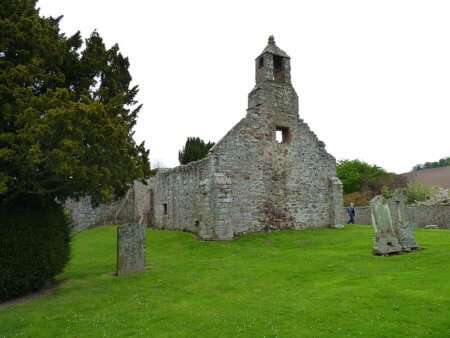
The ruins of Abdie Church near Newburgh, Scotland, date back to the Middle Ages (consecrated in 1242); however, even then, it was built on a site steeped in history. This site was already marked by the Lindores Stone, a Pictish symbol stone from the 7th century AD.
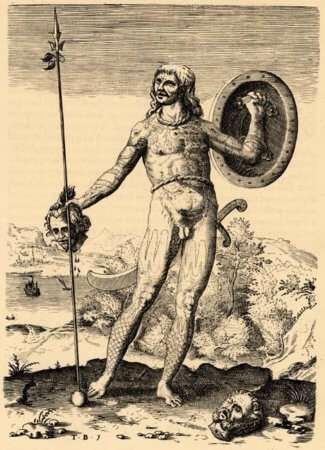
The Picts got their name from the Romans, who called every native Scotsman a "Pict" who opposed their will to conquer with a weapon and was tattooed (that's where the name comes from, the Picts are simply the "painted ones", even though several peoples with different cultural traditions fought together against the Romans).
Ruins of Abdie Church – photographed by James Allan
Little remains of the culture of these Picts, only a few late picture stones and stelae with inscriptions and ornaments, such as the 1.70 m high and 56 cm wide Lindores Stone, which today stands in a place of honor in a small building at the cemetery entrance of the Abdie Church area.
The stone is dated to the 7th century AD and was decorated by Pictish stone carving artists with three typical symbols: a circle with a crossbar and two small, also circular ears, commonly interpreted as a cauldron; a collection of crescent moons and two staffs. You can view the original along with interpretations at kurzelinks.de/63qk
The Picts survived the Romans, but not the constant fighting with neighboring Scots; in 843 AD their kingdoms were annexed by the first Scottish king, Kenneth I MacAlpin, and incorporated into Scotland (Alba). The language and cultures of the British Celts merged into those of the Gaelic-Irish Celts.
The Trvve Picture of One Picte by Theodor de Bry
Besides the British Celts, there were also Angles, Jutes, and Saxons on the island, who first became Anglo-Saxons and then Britons. The Scots were sovereign for 864 years; in 1707, they were united with the British to form the Kingdom of Great Britain through the Act of Union (partly because the Scottish state was on the verge of bankruptcy due to its attempt to establish a Scottish colony in Panama).
With Brexit, England is currently heading more towards bankruptcy, which is why it could well be that the Scots will soon become independent again after little more than 300 years…
We use technologies such as cookies to store and/or access device information. We do this to improve your browsing experience and to display (non-)personalized advertising. If you consent to these technologies, we can process data such as browsing behavior or unique IDs on this website. Refusal or withdrawal of consent may adversely affect certain features and functions.
Functional
Always Active
Technical storage or access is strictly necessary for the legitimate purpose of enabling the use of a specific service expressly requested by the subscriber or user, or for the sole purpose of carrying out the transmission of a message over an electronic communications network.
Preferences
The technical storage or access is necessary for the legitimate purpose of storing preferences that were not requested by the subscriber or user.
statistics
Technical storage or access that is solely for statistical purposes.Technical storage or access that is used solely for anonymous statistical purposes. Without a subpoena, the voluntary consent of your internet service provider, or additional recording by third parties, the information stored or retrieved for this purpose cannot generally be used to identify you.
marketing
Technical storage or access is required to create user profiles, to send advertising, or to track the user on one or more websites for similar marketing purposes.







 J-Line Bulldog with Cigar (Version B), Animal Bust in Antique Bronze Look
84,90 €
J-Line Bulldog with Cigar (Version B), Animal Bust in Antique Bronze Look
84,90 €