Since time immemorial, art has always sought ways to make the invisible visible, to express the unspeakable, and to make the unattainable tangible. One of the most captivating forms of expression is the depiction of ancient myths and mythological beings. These multifaceted and symbolic creatures not only stimulate the imagination but also offer profound insights into the cultural and social structures of bygone eras.
From the Sphinx in ancient Egypt to contemporary pop culture, mythological creatures have been a cherished theme in art for centuries. They have constantly evolved and adapted to different cultures, styles, and technologies. In Chinese culture, for example, the dragon power and strength, while the unicorn in European folklore symbolized purity and grace.
Creative minds, staging multifaceted human experiences within the world of myth, draw upon dark folktales, depictions from ancient mythology, and fantastical scenarios. They immortalize gods, monsters , and heroes. Through these works, timeless questions and universal themes brought to light, stimulating conversation and challenging our imagination.
The American publicist Joseph Campbell once put it very aptly:
Mythology is not a lie, mythology is poetry, it is metaphorical. It has been well said that mythology is the penultimate truth – penultimate because the ultimate cannot be put into words. It is beyond words. Beyond images. Beyond the Buddhist wheel of becoming. Beyond this limiting edge
In this article, we will explore the captivating journey of mythological beings – particularly from ancient Greece – in art, analyzing their cultural relevance, the methods by which they are brought to life, and their function in fiction and popular culture.
The roots of mythological depictions reach deep into ancient civilization. The ancient Greeks and Romans illustrated their myths and legends on vases, murals, and sculptures . These works of art served not only decorative purposes but often also had religious and didactic functions. An example from ancient Greece is the famous amphora of Exekias , which depicts the scene of Ajax and Achilles playing dice
This scene not only offers insight into mythological narratives, but also bears witness to the everyday activities and value system of the time.
Achilles and Ajax were engrossed in a dice and pawn game. Reference: Véronique Dasen, "Achilles and Ajax: When Agony Combines Chance," Revue du MAUSS, 2005. Image source: Sailko, CC BY-SA 3.0, via Wikimedia Commons
Another important work from ancient Greece is the Parthenon frieze. This masterpiece of high relief illustrates various mythological scenes, including the birth of Athena from the head of Zeus. The Parthenon itself is dedicated to Athena, the patron goddess of the city of Athens, and its reliefs are emblematic of the worship of the gods and the importance of myths in the daily lives of the Greeks.
Parthenon West Frieze Block VI Image source: Niko Kitsakis, CC BY 4.0, via Wikimedia Commons
Historical context in ancient Greece
The art and architecture of ancient Greece are not only testimonies but also vibrant reflections of the achievements and aesthetic sensibilities of this remarkable civilization. From the Archaic to the Hellenistic period, Greek culture unfolded in an impressive progression, with each phase contributing in its own way to the emergence of diverse artistic and architectural expressions.
The historical context of Greek art and architecture is inextricably interwoven with the political, social, and religious structures of society. The Greek appreciation of humanism, proportion, and harmony finds powerful resonance in its works, which strive to capture and reflect the beauty and order of the natural world.
During the Archaic period, a clearly defined style emerged, characterized by the development of the Doric and Ionic orders in architecture as well as the emergence of kouros and kore statues in sculpture. This artistic evolution reached its zenith in the Classical era, marked by the majestic construction of the Parthenon and the flourishing of sculptures and ceramics depicting mythological scenes with unparalleled realism and emotional depth.
The Hellenistic period opened up new dimensions of artistic creation, characterized by more dynamic and opulent forms, as exemplified in the works of Lysippusand the impressive construction of the Great Altar of Pergamon .
Eros draws his bow, statue by Lysippos (c. 390–300 BC). Image source: After Lysippos, CC BY-SA 3.0, via Wikimedia Commons
With this extraordinary development, Greek art invites us to delve deeper into the cultural heritage that continues to inspire artists and thinkers to this day.
Themes and Motifs – The Role of Mythological Beings in Art
Mythological themes and motifs permeated Greek art and architecture in multifaceted ways, reflecting the deeply rooted cultural values, religious beliefs, and human experiences of the society of that time. The gods and goddesses, heroes, and mythical creatures were not only objects of worship but also served as complex allegories for philosophical concepts and natural phenomena.
Temples were lavishly decorated with friezes and metopes depicting impressive scenes from mythology – be it the majestic exploits of Hercules or the dramatic events of the Trojan War. Pottery, too, often illustrated the heroic deeds of both divine beings and mortal heroes in great detail.
These themes and motifs created a narrative frameworkthat profoundly connected the Greeks with their deities and the larger order of the universe. The rich symbolism invited deeper engagement with the stories and their meaning, opening a window to the central questions of their existence.
Mythological beings like centaurs, sirens , and minotaurs are not only fantastical creatures but also highly symbolic metaphors. The Minotaur, half-man, half-bull, for example, embodies bestiality in humanity and is often seen as a symbol of the unconscious. Depicting such beings allows artists to explore complex psychological and spiritual themes. Picasso frequently used the Minotaur in his work to illustrate his own inner struggles and human frailties.
Art is the lie that allows us to recognize the truth
Quote by Pablo Picasso
A remarkable example of the depiction of mythological beings is Raphael 's famous fresco "The Triumph of Galatea ." It shows the nymph Galatea riding across the sea in a shell chariot, surrounded by a multitude of sea creatures and putti. This work embodies Renaissance art through its perfect harmony and idealized beauty.
Original Title: The Gleaners, 1857 | Year: 1857 | Medium: Oil on canvas | Dimensions: 84 × 111 cm | Style: Realism | Location: Musée d'Orsay, Paris
Mythological Beings – Of Gods, Heroes and Creatures
gods
Across every continent, culture, and throughout the centuries, depictions of gods a striking range of naturalistic approaches. These pictorial representations allow the divine to be integrated into the human sphere, elevating these immortals to captivating figures who nonetheless possess an aura of divine power and dignity. The timeless appeal of such boundless figures has always provided artists with a rich source of inspiration.
A prime example is Zeus, the god of the sky in ancient Greek mythology . As a central figure in mythological art, he functions not only as ruler and protector, but also as the father of all gods and humans. He is frequently depicted with a thunderbolt, which impressively underscores his authority and divine power.
Athena , the goddess of wisdom and war, is also a significant muse. Her statue, the Athena Parthenos, has inspired countless artists. Rembrandt's "Pallas Athena" (1657) transcends powerful stonemasonry, presenting the goddess in the ornate style of the Dutch Golden Age . Her influence extends to works such as Sandro Botticelli's "Pallas and the Centaur" (1482) and Peter Paul Rubens ' "Minerva Protecting Peace from Mars" (1629) .
Of course, an analysis of art and mythology cannot omit the incomparable Venus de Milo – a figure that even inspired Salvador Dalí to creative heights
The depiction of gods was not limited to a specific period in art history . The figurative painter Francis Bacon is known for his crude, disturbing imagery, which is why Greek mythology provides rich inspiration for his tormented, monstrous figures. This is particularly evident in Three Figures and Portrait(1975), where the bird-like creature with the snarling human mouth is associated with the Furies, the goddesses of vengeance and justice.
Heroes
Powerful, intelligent, and perhaps even seductive – the allure of the hero remains timeless. They are ubiquitous in today's film world and have served as inspiring, strong, and impressive figures throughout art history.
Hercules embodies these ideals and is frequently depicted performing his Twelve Labors. These depictions can be found on ancient Greek vases and sculptures, such as the Farnese Hercules, as well as in the epic works of the Spanish painter Francisco de Zurbarán. His painting "Hercules and the Lion of Nemea" shows the naked Hercules performing one of the twelve labors by smothering the Nemean Lion—in a style that blends realism with Italian High Renaissance and Iberian Baroque art.
Francisco de Zurbarán: Hércules lucha with the león de Nemea (1634)
The Italian master of the late Renaissance, Jacopo Tintoretto, was also inspired by Hercules and created his work "The Origin of the Milky Way" (1575–1580). This painting tells the myth that Hera nursed Heracles; he suckled so hard that she had to push him away, causing her milk to spray across the sky and create the Milky Way – at the same time, she bestowed supernatural strength upon Hercules.
The Origin of the Milky Way by Jacopo Tintoretto (c. 1575)
The French Symbolist Gustave Moreau was also fascinated by the Hercules myth and gave free rein to his creativity in "Hercules and the Lernaean Hydra." The seven-headed Hydra , a serpent-like monster, represents the antagonist of the painting, while Hercules stands upright, ready to sever the Hydra's seventh, "immortal" head.
Hercules and the Lernaean Hydra, 1875–1876, by Gustave Moreau – Art Institute of Chicago Gustave Moreau, CC0, via Wikimedia Commons
Creatures, monsters, beasts
Tales of monsters and beasts are a fascinating tapestry of fantasy and dark dreams. These stories, as captivating as the legends themselves, have inspired numerous artists and diverse artistic styles. The Minotaur, an impressive creature of Greek mythology with the body of a man and the head and tail of a bull, lives not only in a labyrinthine prison but also in the minds of many creative minds.
George Frederic Watts' work "The Minotaur" captures the creature waiting anxiously for the arrival of its young victims by ship – a haunting image that reinforces the oppressive atmosphere of this mythology.
The Minotaur by George Frederic Watts (1885)
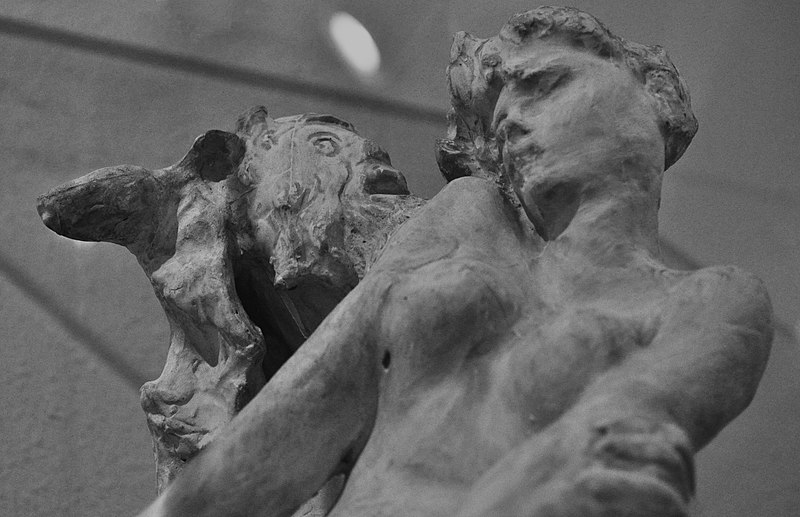
Pablo Picasso's Minotaur Ravishing a Female Centaur (Minotaure amoureux d'une femme-centaure), (1933) integrates the figure into his shockingly bestial universe, while Auguste Rodin, in his statue of a sacrificing virgin who falls into the clutches of the Minotaur, immortalizes the dramatic scene.
Auguste Rodin, The Minotaur (detail), ca. 1886. Plaster. Maryhill Museum of Art, Maryhill, Washington, USA Image source: Joe Mabel, CC BY-SA 4.0, via Wikimedia Commons
The tale of Medusa has also captured our imagination; the image of this Gorgon with snakes for hair has immortalized her death at the hands of Perseus in numerous dramatic sculptures. Caravaggio was so strongly inspired that he painted two impressive versions of Medusa: the first in 1596 and a second around 1597.
Myths and monsters from around the world are not limited to ancient or Greek mythology. Other artists were also inspired by this diversity of themes, including the French Post-Impressionist Paul Gauguin. When he moved from France to Tahiti in 1895, he drew inspiration from his new surroundings and frequently incorporated gods and stories from Polynesian mythology into his works.
Marc Chagall found similar inspiration in Russian folklore for many of his vibrant, dreamlike artworks. Paula Rego, on the other hand, was fascinated by folk tales and legends; her prints are based on the stories of the Pendle witches, and her paintings transport us to the world of Portuguese fairy tales.
J.M.W. Turner also incorporated narratives from classical mythology into his atmospheric landscapes, which are ideally suited as backdrops for battles between heroes and monsters. See for yourself Turner's masterful use of light and shadow in his works "Sea Monsters and Vessels at Sunset" (1845) and "Sunrise with Sea Monsters" from the same year.
This deep connection between art and myth is an invitation to further explore timeless themes.”
Other popular mythological creatures from ancient Greece
Greek mythology is rich in fascinating beings and creatures. Here are some more of the most famous mythological beings from ancient Greece:
Centaurs: Half-human, half-horse, centaurs embody the duality of civilization and savagery. They are known for their raids and ferocity, but also for their wisdom, as in the case of the centaur Chiron, who served as a teacher to various heroes.
Sirens: These seductive sea creatures are known for their enchanting song, which can lure sailors to their deaths. In art, they are often depicted as women with the bodies of birds.
Gorgons: The Gorgons are monsters with snakes for hair, the most famous of whom is Medusa. Her gaze could turn anyone who looked into her eyes to stone. Perseus killed Medusa and used her head as a weapon.
Minotaur: This creature, half man, half bull, inhabited the labyrinth of Knossos and fed on human sacrifices. Theseus managed to defeat the Minotaur and escape from the labyrinth.
Hydra: The Hydra was a multi-headed serpent monster that lived in the swamp of Lerna. For every head that was cut off, two new ones grew back. Heracles defeated the Hydra as part of his twelve labors.
Pegasus: The winged horse Pegasus sprang from the neck of Medusa when she was killed by Perseus. Pegasus is a symbol of freedom and was often ridden by Bellerophon.
Chimera: This fire-breathing creature has the head of a lion, the body of a goat, and the tail of a snake. The Chimera is a symbol of the menacing and the unbelievable and was defeated by Bellerophon.
Nymphs: These nature spirits are often associated with specific natural phenomena, such as rivers, trees, or mountains. They are known for their beauty and their ability to interact with both gods and humans.
Harpies: Hybrid creatures, part woman and part bird, known for their cruel nature. In some myths, they are sent as punishments or signs of the gods' wrath.
Satyrs: These forest- and nature-loving beings, half-human, half-goat, are known for their merriment and their association with the wine god Dionysus. The satyrs of ancient myths embody the exuberant, wild aspect of nature.
Cerberus: The three-headed dog that guards the entrance to the underworld. He prevents the dead from escaping and the living from entering. Heracles had to tame Cerberus and bring him to the surface as part of his twelve labors.
Fates (Moirai): These three goddesses, known as Clotho, Lachesis, and Atropos, determine the fate of every individual from birth to death. They spin, measure, and cut the thread of life, thus symbolizing the inevitability of fate.
Echidna: Half woman, half snake, known as the mother of many other monsters in Greek mythology, including the Hydra and the Nemean Lion. She symbolizes the threatening and the alien.
Krinis: Another fascinating figure is Krinis, the guardian spirit of the springs. Krinis/Napaen symbolizes the vitality and purity of nature and its spiritual aspects.
Manticore: The manticore, a creature with the head of a man, the body of a lion and the tail of a scorpion, symbolizes the terrifying aspects of the wilderness.
Mythological representations across the Art Periods And Movements
Mythological art in the Renaissance
The Renaissance is a periodbrimming with mythological allusions. Artists like Botticelli, Michelangelo , and Leonardo da Vinci were heavily inspired by ancient myths. Botticelli's "The Birth of Venus" not only depicts the goddess of love in all her beauty but also symbolizes the rebirth of classical antiquity during the Renaissance. These paintings were often commissioned by wealthy and educated patrons who saw in the depicted myths a reflection of their own values and aspirations.
Sandra Botticelli – An Italian painter of the early Renaissance with masterpieces such as "The Birth of Venus" that quickly became the face of Florentine art and were later rediscovered in the late 19th century.
Another iconic work of the Renaissance is Michelangelo's "David." Although David does not originate directly from Greco-Roman mythology, his depiction as an idealized, naked hero heavily influenced by ancient imagery. In this work, Michelangelo combines biblical and mythological elements to portray the human body as a vessel of divine power and beauty.
Michelangelo's David, created in Florence between 1501 and 1504, is the first monumental statue of the High Renaissance and is considered the most famous sculpture in art history.
Leonardo da Vinci also explored mythological themes, as in his painting "Leda and the Swan." This work, which unfortunately survives only in copies and sketches, depicts the mythological scene in which Zeus, in the form of a swan, seduces the beautiful Leda. Da Vinci's work explores the human and divine yin and yang, both imbued with a deeper spiritual meaning.
Mythological beings in the Baroque period
In the Baroque period, mythological depictions reached a new dimension. Caravaggio and Rubens employed the dramatic chiaroscuro techniqueto emphasize the intensity and pathos of mythological scenes. Rubens' painting "The Rape of the Daughters of Leucippus" is a prime example of the dynamic and emotional power of this era. The portrayal of mythological figures in extreme poses and moments of heightened tension was intended to place the viewer directly into the action and evoke an emotional response.
Another masterful work from this era is Caravaggio's "Narcissus."This painting depicts the young Narcissus, who is in love with his own reflection in the water. Caravaggio uses his characteristic interplay of light and shadow to heighten the dramatic and tragic nature of the story.
Narcissus by Caravaggio (ca. 1600)
An impressive example of Baroque sculpture is Gian Lorenzo Bernini's "Apollo and Daphne." This sculpture captures the moment when Daphne, pursued by Apollo, transforms into a laurel tree. Bernini succeeds in immortalizing the movement and drama of this transformation in marble, drawing the viewer deeply into the mythological narrative.
Bernini's sculpture "Apollo and Daphne" in the Galleria Borghese. Image source: Gian Lorenzo Bernini, CC BY-SA 3.0, via Wikimedia Commons
The rediscovery of myths in the 19th century
In the 19th century, with Romanticism and Symbolism, mythological themes regained great importance. Artists such as Gustave Moreau and Arnold Böcklin created works that delve deep into the human psyche, often highlighting dark and mysterious aspects of mythology. Moreau's "Jupiter and Semele" is an outstanding depiction, captivating with its richly detailed and eccentric imagery, and leaving a lasting impression on the viewer through both its beauty and its uncanny atmosphere.
Arnold Böcklin's "The Isle of the Dead" is another masterpiece of symbolism, heavily inspired by mythological and spiritual themes. The somber and melancholic depiction of a solitary boat sailing towards a mysterious island has captivated generations of artists and viewers and remains one of the most iconic and mystical representations of Romanticism.
Another remarkable example is the work of John William Waterhouse, a leading representative of the Pre-Raphaelites. His paintings, such as "Hylas and the Nymphs" or "The Lady of Shalott," draw directly on mythological and literary sources and combine them with an intense, almost photographic attention to detail as well as a supernatural romanticism.
Hylas and the Nymphs (1896). Oil on canvas, 132.1 x 197.5 cm (52 x 77.7 in). Manchester Art Gallery
Modernist approaches and the Surrealists
With the rise of Modernism and Surrealism , artists began to interpret mythological themes in new and sometimes even revolutionary ways. Salvador Dalí, with his pronounced penchant for the bizarre and fantastical, was heavily inspired by mythological motifs. His painting "The Persistence of Memory" contains subtle allusions to time and mortality, themes deeply rooted in many ancient myths and legends. Surrealists often used the symbolic power of myths to explore the unconscious and create new levels of reality.
Another notable example is the work of Giorgio de Chirico. His metaphysical cities and mysterious figures, as in "The Mystery and Melancholy of a Street," are heavily inspired by classical myths and explore the theme of isolation and the transcendent in a modern, urban environment.
Max Ernst, another prominent Surrealist, created a powerful and provocative reinterpretation of religious and mythological themes in his work "The Virgin Chastising the Infant Jesus Before Three Witnesses ." Through his distinctive collage technique and dream logic, he created a world that is both familiar and deeply unsettling, appealing to the viewer on a subconscious level.
The significance of mythological art in the present day
Today we are witnessing a renaissance of mythological art, whether through reinterpretations in film, literature, or digital media. Artists like Jeff Koons and Damien Hirst often draw on mythological themes to address contemporary concerns. These modern myths continue to speak to universal human themes and offer us a bridge between past and present.
A notable modern work is Damien Hirst's sculpture "The Unknown Soldier," which blends the ancient mythology of heroism with contemporary themes of war and memory. Jeff Koons' works, such as the enormous "Balloon Dog," often employ the lightness and playfulness of Pop Art to confront modern consumerism with ancient themes.
Another example from the recent past is Prometheus depiction," 's Anselm Kiefer. His large-scale paintings and installations address the theme of titanic and mythical violence, connecting it to the horrors and traumas of the 20th century. Kiefer's work illuminates not only ancient myths but also their enduring relevance and impact on our modern world.Palette with Wings" (1985)
Anselm Kiefer exhibition at the Stedelijk Museum in 1987. In the background, the work of Anselm Kiefer, which is now in the private collection of Gabriele Quandt-Langenscheidt. Rob Croes / Anefo, CC0, via Wikimedia Commons
The persistence and re-evaluation of these old stories in today's art world shows how deeply rooted and enduring the power of myths is.
An eternal mirror of the human soul
The depiction of ancient myths and mythological beings in art is more than just a journey into the past. It is a reflection of our own hopes, fears, and dreams. These artistic testimonies help us to better understand our own humanity and offer us timeless wisdom that remains relevant across millennia.
Let us be inspired by these stories and immerse ourselves in the fascinating world of myths, which still have so much to tell us today. The next time you stand in a museum and gaze upon a centaur, a nymph, or the Greek pantheon, remember: you are not just seeing art, but the eternity of human experience.
[su_note note_color=”#f2f2f2″]
Sources, expert support and further information:
Lars Olof Larsson: Ancient Myths in Art. 100 Masterpieces, Reclam 2020, ISBN-13: 978-3-15-019671-7
Antikenmuseum Basel and Sammlung Ludwig: Animalistic! Animals and Hybrid Creatures in Antiquity (accompanying publication to the exhibition, 2021), https://issuu.com/antikenmuseumbasel/docs/brosch_ren_tierisch_inhalt_komplett_compressed/38
Anthony Grafton, Glenn W. Most and Salvatore Settis: The Classical Tradition
Paul Zanker: The Power of Images in the Age of Augustus
John G. Pedley: Greek Art and Archaeology
John T. McMahon: The Greek Influence on Western Culture
ArtSpace: 7 Mythical Beasts From Across Art History That Will Haunt Your Dreams, https://www.artspace.com/magazine/art_101/book_report/7-mythical-beasts-from-across-art-history-53098
Dan Mobbs on Invaluable: Art and Mythology: Gods, Heroes, and Monsters in Ancient Narratives, https://www.invaluable.com/blog/art-and-mythology-gods-heroes-and-monsters-in-ancient-narratives/
Owner and Managing Director of Kunstplaza . Publicist, editor, and passionate blogger in the fields of art, design, and creativity since 2011. Graduated with a degree in web design from university (2008). Further developed creative techniques through courses in freehand drawing, expressive painting, and theatre/acting. Profound knowledge of the art market gained through years of journalistic research and numerous collaborations with key players and institutions in the arts and culture sector.
In art, artists and artworks are categorized into stylistic periods. These are based on common characteristic features of the artworks and cultural products of a given era.
The division into eras serves as a tool for structuring and classifying works and artists within a temporal framework and a cultural-historical event.
Knowledge of Art Periods And Movements plays a major role, especially in the art trade , as well as in art theory and classical image analysis.
In this section of the art blog, we would like to help you gain a better understanding of these eras, styles , and movements.
Art styles and movements
The art style or style of artworks refers to the uniform expression of the artworks and cultural products of an era, an artist or group of artists, an art movement or art school.
This is a tool for classifying and systematizing the diversity of art. It denotes similarities that differ from others.
The term is thematically related to the Art Movement, but it should not be viewed solely within a temporal framework and is therefore much broader.
In this section, we would like to help you gain a better understanding of styles and movements in art.
We use technologies such as cookies to store and/or access device information. We do this to improve your browsing experience and to display (non-)personalized advertising. If you consent to these technologies, we can process data such as browsing behavior or unique IDs on this website. Refusal or withdrawal of consent may adversely affect certain features and functions.
Functional
Always Active
Technical storage or access is strictly necessary for the legitimate purpose of enabling the use of a specific service expressly requested by the subscriber or user, or for the sole purpose of carrying out the transmission of a message over an electronic communications network.
Preferences
The technical storage or access is necessary for the legitimate purpose of storing preferences that were not requested by the subscriber or user.
statistics
Technical storage or access that is solely for statistical purposes.Technical storage or access that is used solely for anonymous statistical purposes. Without a subpoena, the voluntary consent of your internet service provider, or additional recording by third parties, the information stored or retrieved for this purpose cannot generally be used to identify you.
marketing
Technical storage or access is required to create user profiles, to send advertising, or to track the user on one or more websites for similar marketing purposes.







 J-Line decorative figure "Large Christmas elf" with long coat and pointed hat, 60cm (cream/gold)
69,00 €
J-Line decorative figure "Large Christmas elf" with long coat and pointed hat, 60cm (cream/gold)
69,00 €


