The kaleidoscope aims to structure dry material and "infuse it with fun," making it more tangible and turning learning (which is often perceived as unpleasant today) into a pleasure and an opportunity for understanding.
First, an overview of the broader context is provided, which is then highlighted in detail using individual, concise examples (often focusing on the slightly eccentric excesses of a topic).
Right now we're talking about art history, starting with how scholars who study art history categorize their subject matter. Art historians divide the history of art into four major periods, for which certain, but by no means fixed, core dates have been established:
1. Prehistory and early history of art: 60,000 BC (first tools) – 3100 BC (first advanced civilizations with writing)
2. Art History of Antiquity: 3100 BC (first advanced civilizations with writing) – 500 AD (end of Antiquity, beginning of the Middle Ages)
3. Art History of the Middle Ages: 500 AD (end of Antiquity, beginning of the Middle Ages) – 1500 AD (end of the Middle Ages, beginning of the Modern Era)
4. Modern Age: 1500 AD (end of the Middle Ages, beginning of the modern era) – today
Medieval art includes art that was created between approximately 500 AD and approximately 1500.
As discussed earlier, dates should never be taken too precisely – in the West, the Middle Ages begin with the decline of antiquity, which had already been spanning several centuries. Here are a few dates to choose from that have been used, or are used, to mark the end of antiquity over the last few centuries:
The division of the Roman Empire into East and West in 395 AD (a popular approach in older research)
The deposition of the last Western Roman Emperor Romulus Augustulus in 476 AD.
The defeat of Syagrius (last independent "Roman" ruler in Gaul) against the Frankish king Clovis I in 486/87
Founding of the first Benedictine monastery (Monte Cassino Abbey in Latium, Italy) and prohibition of Plato's Academy (critical school of philosophy) 529
Death of the Eastern Roman Emperor Justinian I, who had banned the school of philosophy, 565
Lombard invasion of Italy 568
Beginning of the Islamic expansion 632
For younger researchers, the last three events more accurately describe the end of antiquity; for the eastern part of the Roman Empire, older research also considered the start of the Islamic conquests as the end of antiquity/beginning of the Middle Ages.
Overall, the beginning of the Middle Ages therefore placed quite variably somewhere between 500 and 700 AD . If one considers primarily the Western cultural sphere, as traditional (Western-influenced) art history does, the Middle Ages are a dark period.
The ancient cultures of the Romans and Greeks, so admired by classical art historians, had been history for some time:
the Greeks enjoyed a flourishing culture for at least 1000 years (1300 to 300 BC) until a ruler named Alexander (July 20, 356 BC – June 10, 323 BC) set out to conquer the surrounding region. Alexander the Great . The sequence of his battles forms a large part of what modern history lessons teach about this period.
His successors simply couldn't agree on who should defend the Greek empire after Alexander's death against the many enemies he had created for it. Thus, Alexander's "Greek world empire" fragmented into four smaller kingdoms, which either dissolved themselves or fell under the rule of the Romans, who were just then rising to great power.
The Roman Empire followed an almost identical pattern: first kings ruled, then a period of republican rule, then emperors, and then more and more territories were conquered. Until the vast empire split into East and West Rome, after which it was all downhill, with all the events mentioned above that mark the end of antiquity.
The Middle Ages followed, a time of war and conflict, a harsh era in which not only the artistic culture of antiquitybut also many social achievements perished. People struggled with political unrest and the resulting high crime rate, with disease and cold, and with incomes too low to make ends meet.
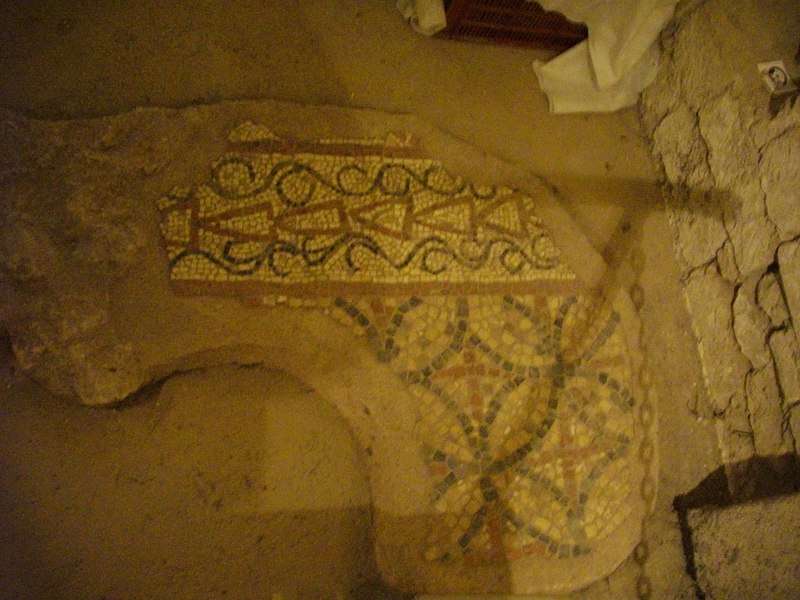
Merovingian mosaic in the Cathédrale Sainte-Croix d'Orléans (Loiret, France) by Fab5669 [CC BY-SA 4.0], via Wikimedia Commons
People back then were exploited by the nobility and clergy, just as people today are exploited by unregulated financial corporations; if culture existed, it was the domain of the nobility and the church (this is already happening today, with the world's most beautiful paintings disappearing at auction for six-figure sums among the ever-richer rich of the world).
The period between the end of antiquity and the rise of humanism (15th century) is therefore perceived by later generations looking back as a time of decline in education and culture : there were hardly any artists among ordinary people – and thus hardly any free art: what the nobility and the church wanted painted did not have the slightest range of variation that artists in free societies develop.
This uncertain, arduous and unfree condition lasted for an entire millennium, thus forming a distinct epoch in art history , which art historians divide into different periods :
The Early Middle Ages, 5th century to mid-11th century, is also called the Pre-Romanesque period in art history
around 500 – 750 Merovingian art
It encompasses everything that the Frankish kingdom produced in terms of art under the Merovingian kings , folk art of the various peoples of the Frankish kingdom, and remnants of the artistry of a vanished Western Roman Empire.
Examples: Handwritten books, metal belt buckles and book spines, painted book illustrations (especially animals)
750–900 Carolingian art
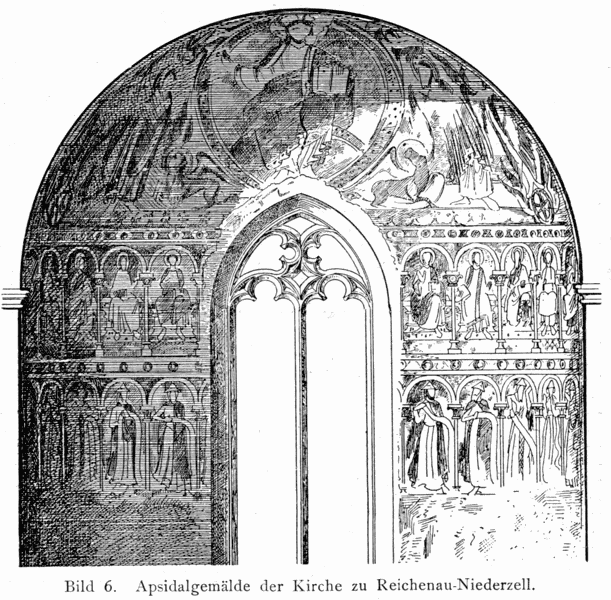
Karl Künstle (1859-1932): The art of the Reichenau Monastery in the 9th and 10th centuries and the newly discovered Carolingian painting cycle at Goldbach near Überlingen.
Charlemagne was born in 748 , became King of the Franks in 768, and Emperor in 800. Charlemagne envisioned a contented and productive society. He supported education and understood the importance of art and culture for the intellectual vitality of a people; he sought a cultural revival of the Frankish Empire. What he achieved is what we now call the "Carolingian Renaissance ." The art of this Renaissance (French: rebirth) draws on late antique, early Christian, and Byzantine traditions in culture and art.
Examples: Godescalc Gospels (magnificent manuscript with gold and silver on purple parchment), beginning of an outstanding architectural style
950–1050: Ottonian art
The Ottonians were originally called Ludolfingians and came to power with Henry I in 919, but because Otto I (the Great, 936–973, Emperor from 962), Otto II (Emperor 973–983) and Otto III (983–1002, Emperor from 996) followed from 936 onwards, they are called that.
The last Ludolfing was indeed also a Henry (II, emperor from 1014), but he died in 1024 without an heir. In any case, the Ottonians (with an interlude: a Conradine, Conrad I) inherited the empire and the love of art from the Carolingians, ushering in the "Ottonian Renaissance".
Examples: Goldsmithing, reliefs in illuminated manuscripts
High Middle Ages, mid-11th century to mid-13th century.
1000–1250 Romanesque
Here it becomes more artistically rich, which is why the Romanesque period is divided into Early Romanesque (around 1000–1024) , High Romanesque (1024–1150) and Late Romanesque (1150–1250)
Examples: clearly visible in sacred architecture. Romanesque churches show a number of further developments of early Christian basilicas, which are considered Romanesque features:
Ground plan of a Christian cross, basic dimension square
Cross vaults or barrel vaults
Massive walls, pillars and columns, round arches at arcades, windows, portals
Basilicas have three naves: a raised central nave + two lower side aisles.
The church is divided into a nave as the meeting place of the congregation and a transept as the area for the clergy
fresco painting
1130–1200 Early Gothic
Romanesque precursors of Gothic architecture in Germany: In 1130, an early Romanesque basilica had to make way for St. Peter's Cathedral in Worms, which was built by 1181. The Romanesque cross by Master Imervard from 1150 depicts a triumphant Christ without a crown of thorns and with a strongly elongated body; this remained typical in Gothic art as well.
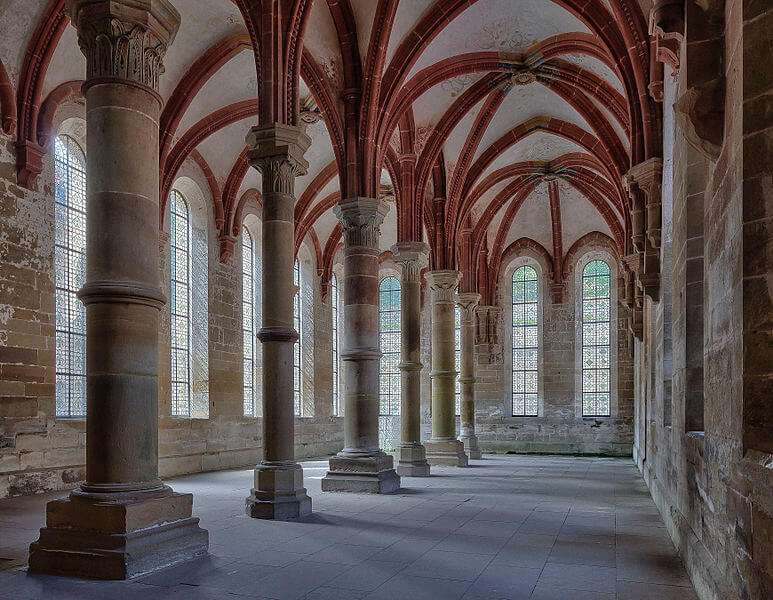
Monks' refectory, Maulbronn Monastery, dining hall of the monks, Early Gothic; UNESCO World Heritage Site by Harro52 [CC BY-SA 3.0], via Wikimedia Commons
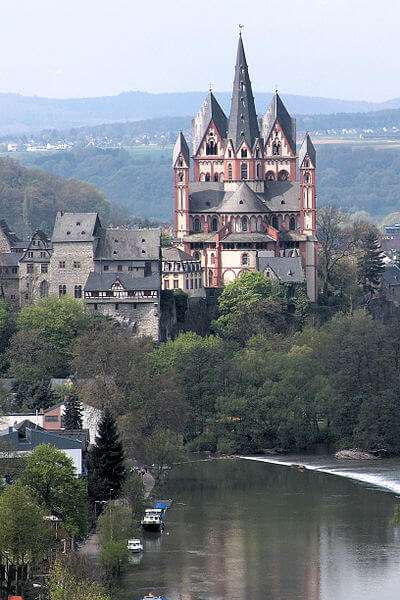
Gothic architecture began in France around 1130, with the abbey church of Saint-Denis considered its foundational building. The "Early English Style" of Gothic architecture emerged around 1180, while in Germany, Gothic architecture didn't arrive until around 1250. Limburg Cathedral (built between 1190 and 1235) is a well-known example of the transition from Romanesque to Gothic.
Limburg Cathedral, also known as St. George's Cathedral, stands majestically above the old town of Limburg, next to Limburg Castle. The building is considered one of the most accomplished examples of late Romanesque architecture. However, elements of early Gothic architecture are also evident. [ Image by Super-Grobi [CC BY-SA 3.0], via Wikimedia Commons]
1200–1250 High Gothic
The "typical artistic characteristics" of Gothic architecture are terms that describe its architectural features. Although the distinctive forms of Gothic architecture transformed all genres of art, including crafts, they include the following: clustered columns, three-story nave walls, facades with one or two towers, stained glass windows instead of frescoes, a rectangular floor plan, high ceilings, ribbed vaults, the optical illusion of broken walls, skeleton construction, pointed arches, and ornamentation such as sculptural decoration, ribs, and flying buttresses.
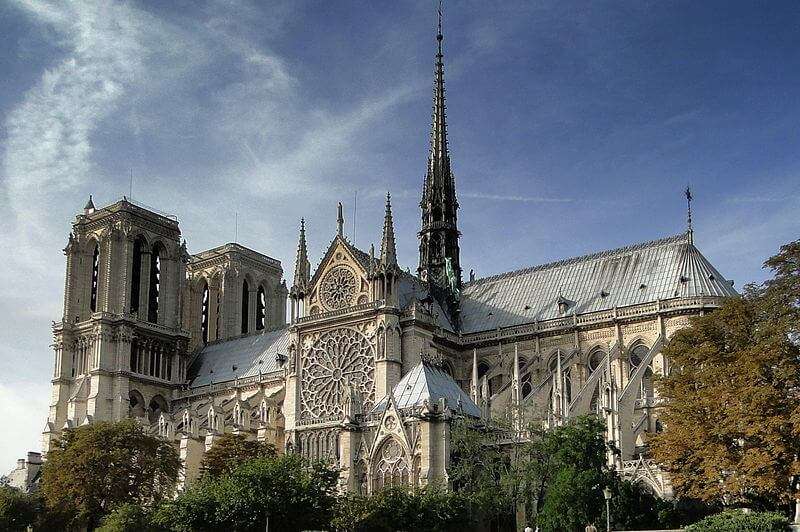
Examples: Notre-Dame Cathedral in Paris (construction began in 1163, lasted 150 years), and Notre-Dame Cathedral in Chartres (construction from 1194 to 1260) is also a magnificent example of French Gothic architecture.
Notre-Dame de Paris by Skouame [CC BY-SA 3.0], via Wikimedia Commons
Late Middle Ages (Late Gothic), mid-13th century – around 1500
In religious architecture , hall churches with naves of equal height and single-nave hall churches are added, while secular buildings with town halls and burgher houses, city gates and fountains are increasing.
Examples: The tomb of Emperor Henry II (973–1024) and his wife Kunigunde (c. 980–1033) in Bamberg Cathedral by Tilman Riemenschneider (c. 1460–1531), Cologne Cathedral (construction 1248 to 1880, with a construction period of a leisurely 632 years, surpasses any endless construction site of our time), St. Mary's Church in Lübeck (from 1250), Marienburg Castle (from 1270, the largest brick building in Europe); painters Giotto (c. 1267–1337), Jan van Eyck (1390–1441, "inventor of oil painting"), Rogier van der Weyden (1399–1464, Rogier da la Pasture), Hans Memling (1433/1440–1494).
Late Gothic art extends into the modern era, with artists such as Filippo Brunelleschi (1377–1446, architect and sculptor) and Donatello (around 1386–1466, sculptor) as intellectual forerunners of the early Renaissance that followed – the first section of the 4th epoch of art history, the art of the modern era.
The beginning of the modern era is, of course, no more precisely in the year 1500 than the beginning of the Middle Ages was in the year 500, even if that is conveniently simple. Art lovers, in particular, who enjoy reading about it (which is most people), will insist that the modern era began almost exactly in 1450. For it was in that year that Johannes Gutenberg typeset and printed his first books.
Incidentally, even though the art history of the Romanesque and Gothic periods is entirely dominated by architecture (we had so much catching up to do when the "Dark Ages" finally began to brighten up a bit), and the average artist of that time was either paid by a nobleman or the Church, they had little artistic freedom. Nevertheless, artists took liberties, sometimes quite obviously, sometimes barely perceptible.
There are world chronicles that mutate into a kind of science fiction with biblical figures, knights and Trojans; there is a painter of venerable images of saints in which cucumbers keep appearing, perfectly ordinary, stupid, green cucumbers… The kaleidoscope aims to discover as many of these oddities as possible so that art is truly enjoyable.
In art, artists and artworks are categorized into stylistic periods. These are based on common characteristic features of the artworks and cultural products of a given era.
The division into eras serves as a tool for structuring and classifying works and artists within a temporal framework and a cultural-historical event.
We use technologies such as cookies to store and/or access device information. We do this to improve your browsing experience and to display (non-)personalized advertising. If you consent to these technologies, we can process data such as browsing behavior or unique IDs on this website. Refusal or withdrawal of consent may adversely affect certain features and functions.
Functional
Always Active
Technical storage or access is strictly necessary for the legitimate purpose of enabling the use of a specific service expressly requested by the subscriber or user, or for the sole purpose of carrying out the transmission of a message over an electronic communications network.
Preferences
The technical storage or access is necessary for the legitimate purpose of storing preferences that were not requested by the subscriber or user.
statistics
Technical storage or access that is solely for statistical purposes.Technical storage or access that is used solely for anonymous statistical purposes. Without a subpoena, the voluntary consent of your internet service provider, or additional recording by third parties, the information stored or retrieved for this purpose cannot generally be used to identify you.
marketing
Technical storage or access is required to create user profiles, to send advertising, or to track the user on one or more websites for similar marketing purposes.





 Maritime metal wall relief mirror "Boat Tour", gold-colored accents
89,00 €
Maritime metal wall relief mirror "Boat Tour", gold-colored accents
89,00 €