The fusion of art and technology continually opens up fascinating new possibilities. Modern printing technologies are currently shaking up the art world and creating innovative ways for artists to express themselves and market their art.
This article explores how technological advances in printing increase the accessibility and diversity of art.
From 3D printing to digitalprinting processes – the symbiosis of art and technology holds enormous potential. The world where creativity meets innovation promises exciting developments for the future of art.
Digital printing presses use variable data to individualize and personalize printed images , a practice employed in both fine art and advertising. Impact printing encompasses all printing technologies that utilize printing plates. Lithography and offset printing .
This technology is used not only for fine art prints and posters, but also for printing magazines, newsletters, tabloids, and books. Large, high-speed web or sheetfed offset presses are characteristic of this process.
Lithography, which is both an art form and a high-performance process, is characterized by its precision and efficiency. The use of printing plates enables consistent quality and high print runs. Offset printing, a specialized form of lithography, ensures that both everyday reading materials and sophisticated book art are produced in the highest quality.
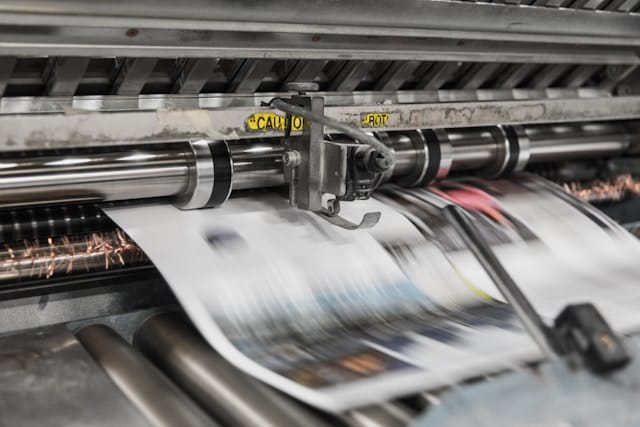
Traditional printing techniques in the art world, such as offset, lithography, or screen printing, are being expanded by modern printing technologies. Photo by Bank Phrom @bank_phrom, via Unsplash
The technological advancements in digital printing presses are particularly impressive. The use of variable data now makes it possible to tailor printed materials precisely to individual needs and preferences. This not only increases efficiency but also opens up new creative possibilities for designing personalized experiences.
Digital printing technologies are making their way. Photo by Geri Sakti @msgr, via Unsplash
Overall, it is clear that both traditional and modern printing methods have a firm place in the world of art and media production. They serve different needs and markets, but together they support the endeavor to create high-quality and appealing printed products.
Screen printing is another highly sought-after printing method for high-quality artwork . When screen printing is mentioned, many inevitably think of Andy Warhol and his iconic series of Campbell's soup cans or portraits of Marilyn Monroe.
In fact, this technique, originally used extensively in advertising graphics in the USA, reached its peak in Pop Art . After the Second World War, screen printing, also known as serigraphy , found its way to Europe and was used there by numerous artists as a creative means of expression. This remains the case today.
In the following video, Petra Natascha Mehler demonstrates screen printing as an artistic printing technique. A film by Matthias Toying, commissioned by the Museum of Printing Arts Leipzig , and supported by the Dresden State Art Collections – Saxon State Office for Museums.
3D printing and digital printing techniques are currently revolutionizing the way artworks are created and reproduced. These innovations open up entirely new possibilities for artists to realize their ideas and make their works accessible to a wider audience.
The boundaries between traditional and digital techniques are increasingly blurring, leading to exciting developments in the art world. You can see more about this here .
Fine art as a growth market – The increasing demand for art prints
In recent years, art prints have experienced a continuous increase in demand. This has been driven by the widespread adoption of digital technologies, growing consumer interest in art, and the global expansion of the creative industries .
Current market trends indicate that high-quality and durable prints are becoming increasingly popular, as they both stand the test of time and capture the essence of the artist.
The increasing demand for art prints is driven by various factors:
Affordability : Thanks to technological advances, printing artwork is now more accessible and affordable than ever before. Both artists and collectors can now enjoy high-quality prints at a fraction of the cost of traditional methods such as lithography or screen printing.
Personalization : In a world increasingly focused on personalization, consumers seek unique artworks that reflect their individual preferences. Art prints offer greater flexibility and control over the final result, enabling effective collaboration between artists and clients and leading to the creation of exceptional artworks.
Digital Distribution : The rise of e-commerce and digital sales platforms allows artists and photographers to reach a wider audience and market their work efficiently. This further fuels the demand for high-quality printed reproductions . Market analysis indicates that the demand for art prints will continue to rise as artists, photographers, and collectors seek to leverage the unique possibilities of cutting-edge printing techniques to create lasting and meaningful works of art.
New possibilities through advanced printing methods
Modern technologies are fundamentally revolutionizing the world of art prints. We highlight some innovations that are taking the production of art prints to a new level.
Pigment inks
Pigment inks have replaced traditional dye-based inks, which are prone to fading due to environmental factors such as UV radiation and humidity. Pigment inks offer superior color brilliance and improved archival quality compared to their predecessors.
Cartridges of a modern inkjet printer . Image by tookapic, via Pixabay
This allows both artists and collectors to benefit from high-quality prints without sacrificing the aesthetic or emotional impact of the artwork.
High-resolution inkjet printers
The printing of high resolutions using inkjet printers has made enormous progress in recent years.
Modern devices can reproduce details, textures, and color depths with unprecedented quality. One example of this is the ability of today's inkjet printers to print at over 2800 dots per inch (dpi) – a remarkable increase compared to models from just 10 years ago.
This precision allows artists and photographers to reproduce their works with remarkable accuracy and sharpness.
Given the constant evolution of technology, further advancements in the field of fine art printing are to be expected. These developments will make it possible to create prints with even higher resolution, bringing the reproduction even closer to the character of the original artwork.
3D printing and mixed media
A highly fascinating trend in the future of fine art printing is the increasing connection between 2D and 3D artworks , made possible by advances in 3D printing technology .
Although 3D printing has mainly found its way into the fields of sculpture and industrial design, it is also present in the world of fine art, enabling artists to create innovative mixed-media works that combine traditional 2D prints with 3D elements.
A fabric-like structure is created in a 3D printer. Photo by Tom Claes @tomspentys, via Unsplash
This experimental approach to art printing opens up new perspectives for artistic expression and collaboration, and challenges conventional conceptions of what constitutes a print or a work of art.
3D printing allows for the creation of complex shapes and structures that would be difficult to achieve using conventional methods. Digital printing techniques enable precise color reproduction and the use of a wide variety of materials.
As early as 2020, impressive results could be achieved using 3D printing, as demonstrated by the SwissOlaf Egner of Seremik four years ago on YouTube with the printing of a ceramic object:
This allows creative visions to be implemented in novel ways and artistic boundaries to be expanded.
Sustainable and environmentally friendly practices
In the fine art printing industry, awareness of environmentally conscious practices is increasingly becoming a central concern. Faced with the pressing challenges of climate change , more and more companies are recognizing the need to reduce their ecological footprint and integrate sustainable alternatives. This includes not only the careful sourcing of sustainable raw materials but also the implementation of innovative and environmentally friendly production processes.
Sustainable and environmentally conscious business practices have also arrived in the art print industry. Photo by Gints Gailis @gintsgailis, via Unsplash
A crucial step in this direction is choosing materials that are both high-quality and environmentally friendly. This means that printing companies are increasingly using paper and inks from certified, sustainable sources, such as responsibly managed forests or recycled materials. Such raw materials not only contribute to reducing deforestation but also promote a resource-efficient economy.
Furthermore, environmentally friendly production processes in importance. These include the use of technologies and procedures that reduce energy consumption and minimize the use of harmful chemicals. Modern printing techniques thus contribute to offering environmentally friendly solutions that are both economically and ecologically sound.
Another key aspect is minimizing waste throughout the entire manufacturing and distribution process. Companies are increasingly relying on strategies for waste prevention and reduction, as well as material recycling. These measures not only make material consumption more efficient but also promote the responsible use of resources.
Overall, it is evident that a shift in thinking is taking place in the art printing industry – a shift that is leading to a more sustainable future. Choosing environmentally conscious practices is not only an ethical responsibility, but can also positively impact brand image and attract new customer groups.
It is time for all players in the industry to pull together and commit to environmentally friendly solutions.
Collaborations between artists and technicians
The collaboration between artists and technical experts leads to groundbreaking art projects. Interdisciplinary teams contribute their skills and perspectives to create innovative art forms. Artists contribute their creative vision, while technicians provide the necessary know-how to realize this vision using modern printing technologies.
These collaborations result in unique works that blur the lines between art and technology.
The influence on art fairs and the art market
Modern printing technologies are changing the way art fairs and the art market operate. Digital printing processes allow artworks to be reproduced more quickly and cost-effectively, increasing the accessibility and distribution of art.
Art fairs are increasingly relying on digital presentation formats and interactive elements to attract visitors. Online platforms and social media are playing an ever-greater role in the marketing and sale of artworks.
Education and training in the field of art and printing technology
Art and design schools are increasingly integrating modern printing technologies into their curricula. Students learn how to use 3D printers , digital printing processes, and specialized software. They acquire skills that open up new possibilities in artistic production.
By combining traditional artistic techniques with modern technologies, students are optimally prepared for the demands of the art market. The program fosters creativity, technical understanding, and the ability to think innovatively.
The transformation of the art world through printing technology
Modern printing technologies such as 3D printing and digital printing processes are revolutionizing the art world. They offer artists new opportunities to realize their visions and expand the boundaries of what is possible. Collaborations between artists and technicians are giving rise to innovative art forms that prioritize sustainability and efficiency.
These developments not only change the way art is created, but also influence art fairs, the art market, and the training of young artists. The symbiosis of art and technology opens up fascinating perspectives for the future of the art world.
Owner and Managing Director of Kunstplaza . Publicist, editor, and passionate blogger in the fields of art, design, and creativity since 2011. Graduated with a degree in web design from university (2008). Further developed creative techniques through courses in freehand drawing, expressive painting, and theatre/acting. Profound knowledge of the art market gained through years of journalistic research and numerous collaborations with key players and institutions in the arts and culture sector.
We use technologies such as cookies to store and/or access device information. We do this to improve your browsing experience and to display (non-)personalized advertising. If you consent to these technologies, we can process data such as browsing behavior or unique IDs on this website. Refusal or withdrawal of consent may adversely affect certain features and functions.
Functional
Always Active
Technical storage or access is strictly necessary for the legitimate purpose of enabling the use of a specific service expressly requested by the subscriber or user, or for the sole purpose of carrying out the transmission of a message over an electronic communications network.
Preferences
The technical storage or access is necessary for the legitimate purpose of storing preferences that were not requested by the subscriber or user.
statistics
Technical storage or access that is solely for statistical purposes.Technical storage or access that is used solely for anonymous statistical purposes. Without a subpoena, the voluntary consent of your internet service provider, or additional recording by third parties, the information stored or retrieved for this purpose cannot generally be used to identify you.
marketing
Technical storage or access is required to create user profiles, to send advertising, or to track the user on one or more websites for similar marketing purposes.






 Dining chair "Lana" with bouclé upholstery & swivel function (sand)
235,00 €
Dining chair "Lana" with bouclé upholstery & swivel function (sand)
235,00 €


