Imagine stepping into a space where the light itself applies the colors and the shadows create contours. In the complex interplay of artistic production, studio lighting plays a central role, shaping the backdrop against which colors come to life and details tell their stories. But what constitutes optimal studio lighting?
Is it the gentle embrace of natural light or the even glow of LED technology? From the coziness of an incandescent bulb to the color of the walls: every element blends together to create the artist's perfect color palette.
Let us explore the secrets of lighting in the artist's studio , where every ray of light contributes to the creation of the art.
Lighting has a crucial influence on the perception of nuances, hues, and the overall appearance of your artwork. Insufficient lighting can lead you to try to conceal flaws, often resulting in colors or values appearing either too dark or too bright.
Therefore, it is essential to develop brightness , color temperature , and the color rendering index (CRI)
Let's examine these aspects in detail so you can make informed decisions and design the ideal lighting solution for your workspace. The right light not only creates the optimal atmosphere for your creativity but also fosters a deeper connection to your work.
What you should pay attention to: An overview
Optimal color temperature: Learn why a spectrum between 5,000 and 5,500 Kelvin is essential for artists.
Natural vs. artificial light: Explore the constant reliability of artificial lighting compared to the unpredictable nature of daylight.
Color Rendering Index (CRI): Understand why a high CRI (ideally > 95) is crucial for reproducing true colors.
Light consistency: Discover why mixing LED tubes with different color temperatures might not be ideal.
Advantages of LED lights: Explore the benefits of LEDs in terms of energy efficiency and color fidelity.
Achieving even lighting: Learn how to strategically arrange light sources to achieve even illumination.
The role of shadows: Observe how shadows lend depth and appeal to artworks. This is particularly important in sculpture.
Lighting direction : Recognize how the correct alignment of light can highlight texture and detail.
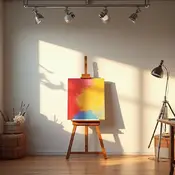
Setting up a bright studio – tips and tricks for visual artists. AI-generated image by beasternchen on Pixabay.
The crucial question: Is natural light or artificial lighting more advantageous for an art studio?
The question of whether natural light or artificial lighting is more advantageous for artists is one that many creatives grapple with. Numerous artists appreciate the unique qualities of natural light, which offers a dynamic color palette and changing shades throughout the day. However, the inconsistency caused by changing times of day and weather conditions can present significant challenges.
In contrast, artificial light, especially LED lights with a high color rendering index (CRI), represents a reliable alternative. According to the American Lighting Association, high-quality LEDs can achieve values of 95 to 100. This approaches the ideal value of natural light (100) and thus ensures authentic color rendering, which is essential for many artistic disciplines.
The consistency offered by artificial light is particularly valuable for artists working in fields where precise color accuracy is essential. Furthermore, artificial lighting allows for targeted control over brightness and direction, enabling artists to create a consistent working environment regardless of the time of day or year.
While the debate about the merits of natural versus artificial light continues intensely, the color rendering index (CRI) remains a crucial criterion for selecting suitable artificial light sources in art studios. Thus, choosing the right lighting becomes not just a matter of personal preference, but also a fundamental aspect of artistic practice.
Brightness: Optimize the lumens for your art studio
Brightness, measured in lumens, is the first and crucial aspect you should adjust and optimize in your art studio. Artists typically require significantly more light than in conventional living spaces to accurately perceive the fine details and true colors of their work.
If your workspace is too dark, you might over-brighten your artwork to compensate for the darkness. Conversely, an overly bright room can make your work appear too dark, causing important nuances to be lost.
The artists we interviewed typically work with a brightness of approximately 2,400 to over 4,000 lumens , depending on the available natural light. These values can be adjusted flexibly by either integrating additional light sources or changing the intensity of the bulbs used. Two key factors should be considered when adjusting the brightness:
Proximity/Distance:The distance between your light source and your workspace plays a crucial role. The closer the light is positioned to your work surface, the more intense it appears. Adjustable studio lights can be very useful here; they allow you to move the light source closer or further away as needed.
Diffusion:The type of light – whether diffuse or directional – also influences the design of your work environment. Diffused light, such as that produced by lampshades, spreads the light evenly and reduces harsh shadows. However, this can also mean that the overall brightness decreases; to compensate for this, it might be necessary to strategically combine multiple light sources.
Artist's studio with large windows – tips for a creativity-promoting atmosphere
We all know the feeling: one moment we're sipping our coffee, and the next we're completely absorbed in our current artwork. Many hours slip by, and we only look up when the sun sets and darkness About us .
To ensure we enjoy spending time in our new studio, it should be as inviting as possible and offer excellent painting conditions. This means, first and foremost, that it should be a sufficiently large room with several windows. The Braas roof window guide explains to those with available space under their roof how to replace their old windows.
The windows allow plenty of natural light into the studio, so we need to use less artificial light. This not only saves on expensive electricity but also influences the results of our artistic work. Colors appear quite different in sunlight than in the dim light of a desk lamp .
Artists can also create a relaxed atmosphere through soundproofing elements. This prevents street noise from penetrating the interior of the studio, garden shed, etc. We can concentrate on our art and are not distracted.
Depending on your artistic style, you'll need various piecesof furniturein your studio. For example, if you prefer oil painting, you should have an easel and shelves with plenty of storage space. This is where you can keep brushes, canvases, and other supplies.The shorter the distance to your tools, the more efficient your daily routine will be.
Wall hangings and floor protectors prevent artists from having to repaint their studios, especially those who like to paint with large movements and use brooms and other objects as tools.
Since painters also spend time at their desks, a computer corner with a laptop, desk, and ergonomic office chair is essential. Here, emails can be answered and phone calls made. Finally, we need a dedicated space where we can take orders and process sales.
Those who enjoy drawing will benefit from a drawing table with shelves . Magazines and journals can also be stored here for inspiration. Large worktables are suitable for unusual projects and large canvases.
What is the optimal color temperature for lighting in an art studio?
A crucial aspect is the color temperature itself, measured in Kelvin (K). This determines how warm or cool your artwork is perceived: Lower temperatures (around 2,700 K) produce a warm, yellowish light, while higher temperatures (from 5,000 K) emit a cooler, daylight-like light.
Numerous experts agree that a color temperature range of 5,000 to 5,500 Kelvin offers near-perfect harmony and comes extremely close to natural daylight. These values are not chosen arbitrarily; they are based on sound scientific studies that demonstrate that such temperatures produce a neutral, balanced light that faithfully reproduces the colors of a work of art.
The Illuminating Engineering Society points out that daylight at midday, under clear skies, falls within this range. This provides artists with a natural reference point to replicate in their studios. In comparison, typical residential lighting often ranges from 2,700 K to 3,000 K, highlighting the differences in color perception. Painting in this lower Kelvin range with soft white light frequently results in unintentionally bluish tints in the artwork.
These cooler light temperatures (i.e., higher Kelvin values) allow for finer differentiation of hues and shades – an essential requirement for artists who rely on precise color accuracy.
Key indicator: the color rendering index (CRI)
The Color Rendering Index (CRI) is a key indicator of how accurately a light source reproduces the color spectrum of different objects compared to daylight. In artists' studios, where precise color perception is paramount, a CRI of 90 or higher strongly recommended. This ensures an authentic representation of colors as they truly are.
Imagine an artist working on a vibrant portrait: Under lighting with a CRI of 85, subtle reds might appear less intense, while a CRI of 95 impressively brings out the depth and brilliance of the color palette.
A striking example of the relevance of CRI can be found at the National Gallery of Art : Here, high CRI lighting is used to ensure that the colors of the artworks are reproduced accurately. Especially in an environment where even slight color variations can affect the overall perception of a work of art, a high CRI is crucial.
To achieve a high CRI, it is often necessary to select the appropriate LED tubes. One could also ask whether combining different color temperatures could further optimize color accuracy.
A high CRI (90 or more) not only guarantees a clear and accurate perception of the colors in your artwork, but also prevents a dull or blurry appearance. Therefore, aim for light bulbs with a CRI of 95 or higher in your studio. Lighting with a low CRI can make it difficult to differentiate between similar colors, such as black and navy blue, or warm and cool tones, which can ultimately compromise the precision of your artistic work.
Why you should choose LED lights
Choosing LED lighting for art studios offers numerous advantages that promote both the creative process and sustainable practices within the art world. LED lights are distinguished by their excellent energy efficiency , consuming approximately 50% less energy compared to fluorescent lamps, as confirmed by the Energy Star program . Furthermore, they can achieve an impressive lifespan of up to 50,000 hours, making them significantly more durable than conventional lighting options and thus both economical and environmentally friendly.
Another outstanding advantage of LEDs is their high color rendering index (CRI), which guarantees impressive color accuracy. This not only supports the creative process but also has a positive impact on the evaluation and presentation of artworks. The combination of these advantages makes LEDs the preferred choice for environmentally conscious artists and gallery owners.
Can the combination of LED lights with different color temperatures be successfully implemented?
The idea of integrating LED tubes with different color temperatures is undoubtedly exciting, but it also presents a number of potential challenges. Color temperatures such as 4,000 K and 6,500 K can create an inconsistent lighting atmosphere, causing colors to vary from one area to another. This variation often leads to inconsistencies in the perception of artwork.
Lighting experts, including renowned LED manufacturers, strongly advise against this approach. They recommend using a uniform color temperature to ensure consistent color rendering throughout the studio. This avoids the visual clutter that can result from mixed color temperatures and ensures that artists perceive a harmonious color palette. This is essential for precise artistic creation as well as the evaluation of artwork.
Uniform lighting in the artist's studio
Consistent lighting plays a significant role in an artist's studio. The image is for illustrative purposes and was created with the AI image tool ImageFlash.
To create even lighting in an art studio , you should think beyond simply preventing shadows. The goal is to design a harmonious space where every element of a work of art can be perceived clearly and without distortion. This often requires a thoughtful arrangement of multiple light sources within the studio. Experts recommend strategically placing lights approximately two meters apart to ensure that no area of the studio remains in darkness, especially in larger spaces.
The use of diffusers plays a crucial role; they ensure that the light is distributed more gently, thus avoiding harsh shadows and bright hotspots that could obscure details. This arrangement mimics the evenly distributed light often found in professional galleries.
The goal is to illuminate artworks in such a way that their true colors and structures are recognizable from every angle. Such a lighting concept not only supports the creative process but also improves the presentation of the works and allows the viewer to experience the art as the artist intended.
The meaning of shadows
Skillfully used, shadows can not only highlight details but also create a specific atmosphere or even convey a captivating narrative. In sculpture, shadows play a crucial role, bringing the contours and nuances of the form to life and offering the viewer a new perspective on the artwork.
Lighting specialists often use directional light to create precise shadows that visually enhance the three-dimensionality of the artwork. In painting, however, it is important to minimize unwanted shadows while simultaneously using them selectively to effectively highlight textures and layers. This delicate balance requires not only sophisticated lighting techniques but also careful arrangement that takes into account the angle and intensity of the light.
Mastering the interplay of shadows allows artists to precisely control their visual effects, adding an extra layer of sophistication and depth to their work. Furthermore, effective shadow control depends heavily on the direction from which the light shines – an aspect that underscores the complexity of studio lighting design and encourages artists to find innovative ways to showcase their work.
The correct alignment of the lighting
The lighting design in an art studio is crucial for the perception and presentation of the artwork. North-facing windows, for example, are highly sought after in many studios because they provide soft, indirect daylight that remains relatively constant throughout the day. This lighting minimizes glare and shadows, making them particularly suitable for artists who value and require a consistent light source.
Furthermore, when using artificial lighting, side light sources help to highlight the textures and fine details of artworks without overwhelming the work with excessive brightness. Thoughtful lighting brings out the physical qualities of materials such as canvas and brushstrokes and is of great importance to artists working with techniques that place particular emphasis on subtle nuances.
In environments where the complex interplay of light and shadow can influence or even impair the visual effect of a work of art, careful lighting becomes even more important.
The ambiance in the studio: quickly and easily transformed into a feel-good oasis
fumes from the acrylic paints dissipate in no time, and we can take off our protective clothing and respirators. A fresh orange scent brightens our mood after a long day and helps us forget our backache. The lamps create the perfect ambiance and bathe our studio in a special light.
The rule here is: anything goes. So we can place plants in our studio, hang posters on the walls, create a hygge atmosphere , design gallery walls, collect art, or stack materials all the way to the ceiling. Because in our sanctuary, the only thing that matters is that we feel comfortable.
With our guide to the optimally lit artist's studio
There's no question about it: as ambitious artists, we spend a lot of time in our studios. Therefore, we should pay particular attention to making our workspace appealing, optimally lit, and inviting.
Our short guide will help you optimize the lighting in your studio to enhance the perception of your artwork and boost your creative process. Remember: even minor adjustments can have a significant impact!
Sources, expert support and further information:
Marianne Vander Dussen:How to Light Your Art Studio: A Complete Guide for Artists , https://mariannevanderdussen.com/blogs/news/how-to-light-your-art-studio-a-complete-guide-for-artists
BenQ:Art Studio Lighting: How to Illuminate Your Art Studio Like a Pro , https://www.benq.com/en-us/knowledge-center/knowledge/art-studio-lighting.html
Lee Down : How to Optimize Your Art Studio with the Proper Lighting , https://artsartistsartwork.com/how-to-optimize-your-art-studio-with-the-proper-lighting/
Will Kemp : Art Studio Lighting Design (how to avoid being kept in the dark) , https://willkempartschool.com/art-studio-lighting-design/
American Lighting Association : Light Your Home , https://alalighting.com/Light-Your-Home
Owner and Managing Director of Kunstplaza . Publicist, editor, and passionate blogger in the fields of art, design, and creativity since 2011. Graduated with a degree in web design from university (2008). Further developed creative techniques through courses in freehand drawing, expressive painting, and theatre/acting. Profound knowledge of the art market gained through years of journalistic research and numerous collaborations with key players and institutions in the arts and culture sector.
We use technologies such as cookies to store and/or access device information. We do this to improve your browsing experience and to display (non-)personalized advertising. If you consent to these technologies, we can process data such as browsing behavior or unique IDs on this website. Refusal or withdrawal of consent may adversely affect certain features and functions.
Functional
Always Active
Technical storage or access is strictly necessary for the legitimate purpose of enabling the use of a specific service expressly requested by the subscriber or user, or for the sole purpose of carrying out the transmission of a message over an electronic communications network.
Preferences
The technical storage or access is necessary for the legitimate purpose of storing preferences that were not requested by the subscriber or user.
statistics
Technical storage or access that is solely for statistical purposes.Technical storage or access that is used solely for anonymous statistical purposes. Without a subpoena, the voluntary consent of your internet service provider, or additional recording by third parties, the information stored or retrieved for this purpose cannot generally be used to identify you.
marketing
Technical storage or access is required to create user profiles, to send advertising, or to track the user on one or more websites for similar marketing purposes.






 Braided jute rug "Bombay", natural (multiple sizes)
28,00 € – 185,00 €
Braided jute rug "Bombay", natural (multiple sizes)
28,00 € – 185,00 €


