The right light can transform excellent art into something spectacular. Artists should therefore carefully consider their studio lighting. Regarding color temperature, this varies from warm household incandescent bulbs (2,500 K – 3,000 K) to cool northern light (7,500 K – 10,000 K). Most artists find their optimal range at 5,000 K – 5,500 K, which harmonizes well with natural daylight.
Color temperature isn't the only factor that matters. The color rendering index (CRI) indicates how colors appear under artificial light, rated from 1 to 100, with 100 being perfect. Serious artists should look for a CRI of 90 or higher . High-quality LEDs can achieve impressive values between 95 and 100. Brightness levels also make a significant difference, with options ranging from soft 450-lumen bulbs to bright 1600-lumen fixtures.
Your workspace could be a converted garage that cost 500 euros, or a simple room with a fold-down desk. The key is finding the optimal balance between natural light, artificial lighting, and what you can afford. This article specifically examines lighting options directly from wholesalers that are both affordable and practical.
Lighting in the artist's studio: Understanding the basics of light
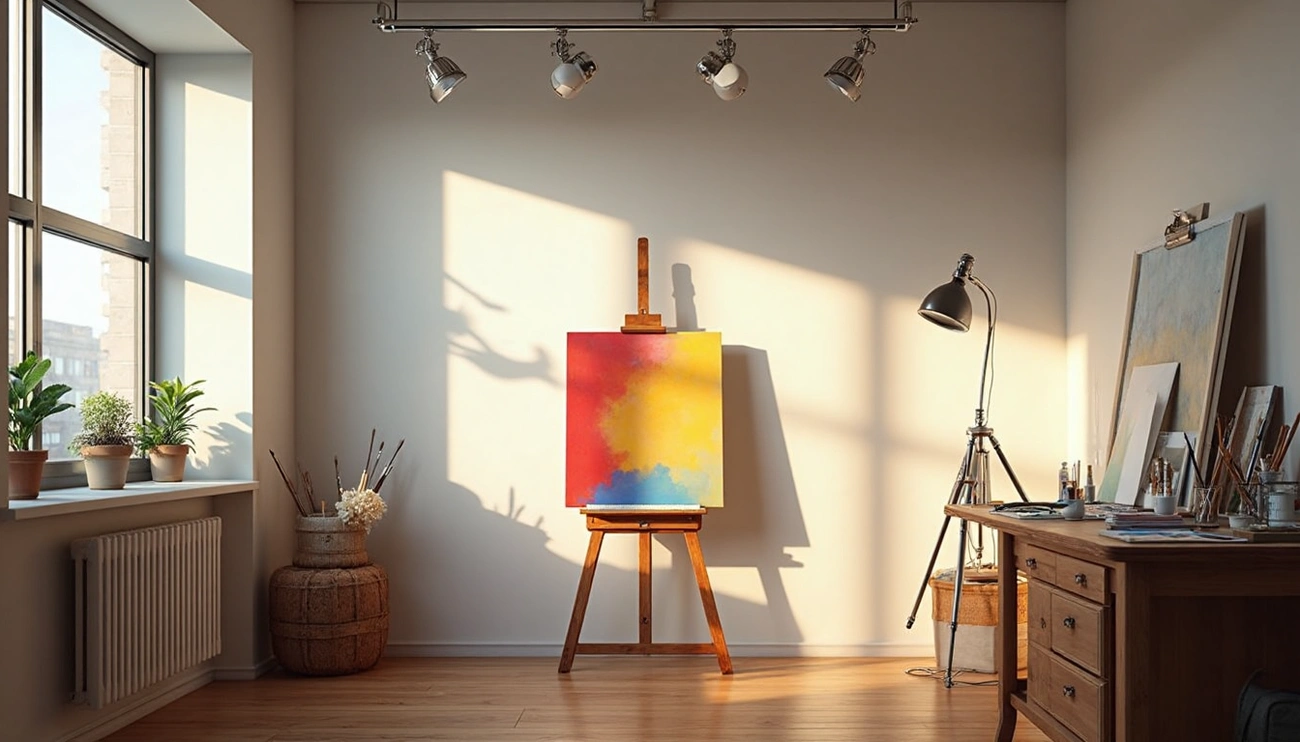
Optimal lighting in an artist's studio begins with understanding the fundamentals of light. This image is for illustrative purposes and was generated using AI.
Light is essential to how artists see and create their art. Professional painters know that lighting isn't just about brightness. They must learn to manage three significant factors that influence how artworks appear during their creation and on display.
The influence of color temperature on art
Color temperature , measured in Kelvin (K), tells us how warm or cool light appears. Scientists discovered this measurement by heating carbon to different temperatures, which produced light of varying colors. When the temperature is lower (2,500 K – 3,000 K), the light is yellowish and warm. When the temperature is higher (5,000 K – 6,500 K), the light is cooler and bluish-white.
Artists quickly discovered that the temperature of the colors on their canvas significantly impacts how they appear. Warm lighting makes blues and other cool hues look lifeless, so painters often add too much blue to compensate. Cool lighting makes warm colors lose their deep brilliance.
Many professionals use light between 5,000 K and 5,500 K because it appears like natural daylight. This range has the most balanced color spectrum and produces what experts describe as "the purest white point ." This temperature range is useful for artists who cannot access natural light. They can see colors clearly without having a preference for warm or cool tones.
What is CRI and what role does this index play?
The color rendering index (CRI) shows how effectively a light source reproduces colors compared to natural light. Color temperature tells us about the light itself, while the CRI tells us how the colors of things appear in that light. This difference is important for painters who need to get colors exactly right.
CRI uses a scale from 0 to 100, where 100 corresponds to natural sunlight. Professional artists choose studio lighting with a CRI of 95 or higher. Different CRI values mean different things:
CRI 95–100: Incredible color rendering that makes colors appear natural, bright, and lifelike. This is ideal for art studios and galleries.
CRI 90–95: excellent color reproduction, where most colors “stand out” and are easy to distinguish.
CRI 80–90: Good, but not great for professional art use
CRI below 80: Colors appear dull or desaturated because the reproduction is inadequate.
When the CRI is low, it is difficult to distinguish similar colors, especially dark ones like deep brown. Under low CRI lighting, reds often appear washed out or brownish, which poses a significant challenge.
How brightness (measured in lumens) affects how well we can see
For painters, the quality of the paint is just as crucial as the brightness . We use lumens to measure brightness, not watts, which simply indicate how much energy is consumed. For example, 450 lumens could come from a 40-watt incandescent bulb, a 29-watt halogen lamp, or a 9-watt LED, which uses less energy.
Art studios require more light than other spaces. Artists often create art that is too bright for regular lighting when working in dark rooms. If things are too bright in some areas, they can appear too dark in others.
For intricate work, professional artists require 1,500 to 2,000 lux . However, artists can create traditional paintings well with lighting between 250 and 450 lux.
Clever painters adjust the lighting in their studio depending on where they will be displaying their finished works. This method helps ensure that their artwork looks good everywhere, whether it's in a gallery, a home, or elsewhere.
Evaluation of your current lighting in the art studio
Before purchasing new lighting, you should know everything about your current studio setup. This test will help you make smart changes to your workspace.
Check the availability of natural light
With a pristine CRI of 100, natural light offers the best color fidelity. Take some time to observe how the light changes at your location throughout the day. North-facing windows let in the most natural light year-round. They remain at 6500 K throughout the year, with only a slight variation over the seasons. East- and west-facing windows change more significantly throughout the day.
However, there are also difficulties that can arise with natural light. Even the most magnificent north-facing windows cannot guarantee perfectly stable conditions. On overcast days, the color temperature can drop to as low as 6000 K, while on clear early evenings it can reach up to 10,000 K. What's outside your window is also important. A nearby red structure could make the incoming daylight in your studio appear redder than it actually is.
Many painters forget about reflected light, which is another reason. Windows create reflections on walls and ceilings. These distortions in light can make strong contrasts in your work appear less harsh. You'll notice this more if you want to create dramatic lighting effects in your paintings.
Identify shadow areas and dark spots
Shadows are important in an artist's studio . They influence both how you create artwork and how it looks when finished. When things block light and make surfaces black, they cast shadows. Self-shadows are the dark patches on the objects themselves. Both types can help make art appear three-dimensional.
Throughout the day, look for places where shadows are causing problems.
Shadows that make it difficult to see the color palette
Light that is not evenly distributed across the screen
Parts of the body that block light at work
Lamps and screens on devices near your desk intensify shadows. The closer the lights are to each other, the sharper the edges of the shadows become. If you don't know how to manage these active shadows, they can be distracting.
Evaluate the color accuracy under the current lighting conditions.
The way colors appear can vary greatly depending on the light. Two colors that look the same under artificial light might appear different in daylight. Metamerism is the term artists use for this effect.
Here are some ways to check how accurate your colors are:
Use color charts like Spyder Checkr to find differences in the light you have now.
Compare colors that you would normally use with both studio lights and natural light.
To identify errors, take photos of your work under different lighting conditions.
Unfavorable lighting conditions can create color problems. These difficulties are caused by the narrow color palette of the light source. Colors often appear artificial or cooler under neon lights. Incandescent bulbs emit more yellow and red wavelengths, which makes them appear warmer.
The real test comes when you present your finished work. Many artists are disappointed when a piece that looked great in their studio appears darker or duller elsewhere. This usually means you need to adjust the lighting in your studio to match where your work will be displayed to potential clients.
The best lighting solutions directly from the wholesaler
Artists who earn their living from their craft need light sources that reveal true colors without ruining their work or exceeding their budget. To obtain the highest quality wholesale lighting solutions, you need to find a balance between quality, lifespan, and low prices.
Advantages and disadvantages of LED lamps for an art studio
LED lamps are becoming increasingly popular among professional artists because they last an incredible 50,000 hours. This means they last for about ten years before needing to be replaced. Traditional lamps had to be changed twice a year, while LEDs last for over ten years.
Advantages:
LEDs consume 80% less electricity than conventional light bulbs, therefore they are more energy efficient.
Minimal heat emission: reduces the risk to sensitive works of art.
Low levels of UV radiation protect expensive works from damage.
Instant stability: Gives you an even color immediately when you turn it on.
Disadvantages:
Higher initial costs: More money is needed upfront.
Some products have different color temperatures between batches.
Problems with dimming: Not all LEDs work with conventional dimmers.
Quality differences: Many LEDs on the market do not have the high CRI required by art studios.
Halogen, LEDs and compact fluorescent lamps
Each type of lighting technology has its own advantages.
Halogen lamps excel at displaying colors, but they get very hot and require good ventilation. These lights make colors appear vibrant and bring out the finer details in artwork by using warm temperatures (2800 K – 3000 K). The main disadvantage of halogen lamps is their high energy consumption and the emission of UV rays, which can damage sensitive materials.
Fluorescent lamps emit a daylight white color temperature that works well in creative studios. Even so, their CRI values are barely in the 80s and their R9 values are far from 50, meaning they are not suitable for professional artistic use. These lamps are thermally unstable, meaning their color and brightness change with the lamp's temperature. They typically take an hour to reach their full brightness.
Many high-quality LEDs have CRI values of 95 or higher, demonstrating the superiority of LED technology. LEDs with a CRI of at least 90 and an R9 of at least 50 should be used in professional studios.
Why wholesale lighting makes sense for creative projects
Whether you're designing an art exhibition or setting up your personal studio, standard light bulbs won't always suffice. You need reliable options for a consistent result throughout the space.
Access to a wide range of color temperatures and CRI-rated lighting (essential for art viewing).
Large orders for spacious rooms or multiple rooms.
Consistency: same tone, same performance, in every unit.
Professional advice on lighting various materials — canvas, stone, metal , textile.
Fair prices, even for smaller independent projects.
Lighting as a creative tool
Soft ambient light can make an installation feel intimate. Sharp, focused beams can highlight form and detail. Even the shadows they cast can become part of the story. That's why artists and designers are increasingly considering lighting as an integral part of the concept itself—not just a technical afterthought.
Wholesalers who understand this creative process are rare, but valuable. They offer not only products, but also insights.
What to look for in a lighting partner:
A well-curated catalog featuring both functional and atmospheric lighting.
Flexible ordering, whether you need 5 or 500 items.
Responsive support – someone who understands lighting beyond lumens and watts.
Worldwide or EU-wide shipping that respects your schedule.
An excellent example is Bank of Lamps – a wholesaler that collaborates with both professionals and creatives, providing access to modern, efficient lighting solutions with style and consistency.
How to choose the best lights for your art spaces
Lighting fixtures bring your spaces to life and influence how light interacts with your art. The mounting systems you choose affect everything from the way shadows fall to the flexibility of your studio's workspace.
Track lighting or pendant lights
The adjustable position makes track lighting systems the most flexible option for artists. These ceiling-mounted tracks keep your floor space clear and allow you to direct the light exactly where you want it. The fixtures can rotate a full 180 degrees to perfectly aim the light.
Many artists use three lights: two on each side of their head, directed at the canvas, and one on their palette.”
Pendant lights direct light precisely onto specific areas. These lamps hang in one place, unlike track lighting systems, which are easily moved. Pendant lights are well-suited for studios with consistent workflows, as lighting needs remain constant. Pendant lights with swivel hooks are a good alternative for artists on a budget, as they are more widely available than fixed installations.
Flexible installations and swag hooks
You don't need to rewire standard pendant lights to make them adjustable with swivel hooks . These hooks, which attach to the ceiling, can safely hold lights up to 10 pounds each. Hooks are available in black, white, polished copper, and brushed nickel, allowing you to match your studio's decor.
There are various types of hooks, such as pinch, round, and T-swag hooks, each with its own specific use. Pinch hooks keep cables neatly tucked between two panels, round hooks offer a traditional touch, and T-swag hooks are used to hang larger decorative lamps. If you install your hooks directly into the ceiling joists or wooden studs, they will stay securely in place.
Wall lights with movable arms
Wall-mounted lights are ideal for studios with limited space. Swivel-arm wall lights can move in and out and rotate to direct light onto specific artwork. These lights help solve lighting problems when there isn't much space on the table.
For best results, the bottom edge of your wall light shade should be at eye level. Look for models with three-way sockets or dimming options so you can adjust the brightness. Architect's arms or gooseneck designs that bend and move smoothly are a popular choice for wall lights among artists. Some models can be installed either by plugging in or by direct wiring, allowing them to grow and evolve with your studio.
Creating a functional studio that inspires
Sometimes I use a medium I don't like, just to see what happens. It's an experiment to test my existing ideas and tastes… I don't think artists should only use what's easiest and most convenient for them. The unknown is a challenge and an opportunity to develop a new language.
— Ai Weiwei , Chinese artist, activist and one of the most important living artists
A well-designed workspace offers more than just good lighting. It influences how artists interact with the world around them and how they create art.
Creative interiors: Combining elegance and function
A suitable creative studio needs its own space that reflects your style while also being functional. With the right table, chair, and lighting, you can even transform a corner of a room into an excellent workspace. Placing things that inspire you, such as fresh flowers, plants, or thought-provoking pictures, in the room will boost your creative energy.
Many professional artists say that spaces should be designed to foster art. One designer removed the carpet and painted the floorboards white. This gave them a clean base without having to worry about paint splatters. Some people prefer loose vinyl planks to concrete floors. These planks last a long time, and it's easy to replace damaged sections.
Matching the color of cables and lights
Your studio space will look much tidier if you carefully coordinate your lighting . There are over 75 different cable colors to choose from, which can either match your current decor or contrast with it. Light blue and white tones combined with natural materials give a room an airy, beachy feel. If you like the mid-century style , you might enjoy neutral browns and beiges.
The colors of the fixtures have a greater impact than those of the cables because they occupy more space in the room. Slate, linen, ochre, pine, or rust finishes could be good choices for artists who prefer earthy colors that complement a paint palette. Of course, these small details add up. When the colors harmonize, the studio becomes a pleasant place to work for hours.
How to distribute light evenly
A well-designed studio eliminates irritating dark spots and shadows. To maximize natural light, position your desk near a window. Sheer curtains block harsh shadows and glare, making direct sunlight less uncomfortable. Light-colored furniture, mirrors, and white walls reflect light within the room, brightening dark corners.
Using more than one light source helps reduce eye strain when working for extended periods. For detailed work, general room lighting and dedicated task lights work well together. Floating shelves serve two purposes: they display your artwork and provide flexible workspaces without taking up floor space. Pegboards mounted on the wall are a great way to store tools without drilling too many holes in the walls.
Closing remarks
Good lighting not only influences how artists interpret their work, but also how others see it. There are three main factors that make the difference between mediocre and great studio lighting. The correct brightness levels, color temperature (ideally 5,000 K–5,500 K), and color rendering index (ideally 95+) are all things to pay attention to. Artists who take the time to learn these basics create more precise work. When their work is seen elsewhere, they also won't have to expect so many color surprises.
The design of a studio serves more than just a purpose; it also shapes the creative process. Color-coordinated furnishings, well-organized workspaces, and ample light sources eliminate distracting shadows, creating a space conducive to reflection. Artists should view lighting in their studios as both a tool and a ally in their work.
You might not think that light is as crucial as artistic skill or high-quality materials. But experienced artists know better. Sublime art begins with ideal studio lighting. The best wholesale lighting options strike a balance between quality, price, and durability. It helps artists bring their true vision to life and share it with the world.
Good lighting not only displays the art, it becomes part of it!
Owner and Managing Director of Kunstplaza . Publicist, editor, and passionate blogger in the fields of art, design, and creativity since 2011. Graduated with a degree in web design from university (2008). Further developed creative techniques through courses in freehand drawing, expressive painting, and theatre/acting. Profound knowledge of the art market gained through years of journalistic research and numerous collaborations with key players and institutions in the arts and culture sector.
Category for interior design,residential design, object furnishings, product and material innovation.
Here you will find everything that makes an interior designer's heart race. We present to you the latesttrendsand developments in the world of home design, as well as innovative products and materials for unique space design.
Our goal is to provide our readers with inspiration and help them creatively redesign or completely transform their living spaces.
We place great importance on ensuring that our articles are not only esthetically pleasing but also include practical tips.
We also introduce you to successful interior designers – from newcomers to the most well-known names in the industry – so you can be inspired by their projects and get to know their working methods.
Whether it's about making the most of a small space or furnishing your home with new furniture in the trendy industrial style: With us, you will find all the information you need on the topic of interior design!
We use technologies such as cookies to store and/or access device information. We do this to improve your browsing experience and to display (non-)personalized advertising. If you consent to these technologies, we can process data such as browsing behavior or unique IDs on this website. Refusal or withdrawal of consent may adversely affect certain features and functions.
Functional
Always Active
Technical storage or access is strictly necessary for the legitimate purpose of enabling the use of a specific service expressly requested by the subscriber or user, or for the sole purpose of carrying out the transmission of a message over an electronic communications network.
Preferences
The technical storage or access is necessary for the legitimate purpose of storing preferences that were not requested by the subscriber or user.
statistics
Technical storage or access that is solely for statistical purposes.Technical storage or access that is used solely for anonymous statistical purposes. Without a subpoena, the voluntary consent of your internet service provider, or additional recording by third parties, the information stored or retrieved for this purpose cannot generally be used to identify you.
marketing
Technical storage or access is required to create user profiles, to send advertising, or to track the user on one or more websites for similar marketing purposes.





 J-Line "Ethnia" plastic flower pot, brown (Ø 20 cm)
21,00 €
J-Line "Ethnia" plastic flower pot, brown (Ø 20 cm)
21,00 €