For several months now, the evolutionary leap in artificial intelligence has been clearly noticeable in the art world. AI art has since become a hot topic, generating both significant profit expectations and considerable uncertainty and anxiety among creative professionals.
copyright debate surrounding artificially generated art and the rights to generative AI art and the use of image generators was recently reignited when a US ruling delivered a landmark verdict on the matter.
The fact is that art created by artificial intelligence is inexorably making its way into the art world, producing an unprecedented flood of AI-generated images created entirely by it – artworks without a human creator.
It's no wonder, then, that a lot of questions arise. Let's try to answer the most frequently asked ones for you briefly:
These are artworks created with the assistance of artificial intelligence. Unlike traditional art, where artists create a work with their own hands, here the product is created by artificial intelligence.
AI Art has become increasingly popular in recent years. The image Théâtre D'opéra Spatial caused a stir online after winning first place in an art competition.
Today, AI art is usually associated with digital images created on a computer and later printed or engraved on canvas. However, the possibilities of artificial intelligence are not limited to painting. AI can also be used in other art forms, such as sculpture , music , and architecture.
How does AI work in art?
The creation of art through artificial intelligence is an interesting phenomenon that is now possible thanks to special programs.
A well-known tool used for this is Stable Diffusion . Other programs such as Midjourney,Crayion, orDALL-E 2 allow the creation of impressive images.
These so-called text-to-image generators only require a short description of the desired image content in order to generate a large number of possible images.
The use of artificial intelligence thus creates unique works of art that impress in a gentle and calm way.
What is an AI image?
Until very recently, creating images and graphics required extensive knowledge of image editing using Photoshop and similar tools.
But since the advent of Canva , the tide has turned, and artificial intelligence has once again revolutionized the graphic design and image creation market. AI-based image generators allow users to create stunning images .
What can AI do? Generative AI art and exploring the limits of AI art
An AI-based image generator is a type of artificial intelligence capable of creating new images or editing existing ones in a unique way. The AI tool uses extensive data to recognize patterns and create visual masterpieces based on them. This application is extremely versatile, ranging from realistic portraits to abstract artworks and intricate drawings.
What is the difference between an AI and an AI?
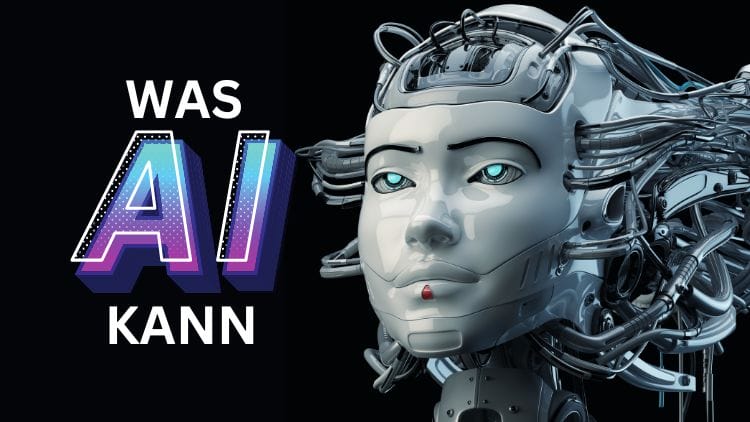
You've probably read about artificial intelligence many times and come across the abbreviations AI and KI . But what do they actually mean, and are there any differences between them?
The answer is surprisingly simple: KI is the abbreviation for artificial intelligence , while AI stands “Artificial intelligence”
Ultimately, it's the same concept. You'll encounter KI more frequently in German-speaking regions, while AI is more common in English-speaking contexts.
How can AI art be recognized?
Thanks to AI algorithms, it is possible to realistically replicate existing images and recognize patterns and features. Generative Adversarial Networks (GANs) used for this purpose.
Compared to conventional photos, AI-generated images several distinguishing features , such as a lack of shadows or unnatural perspectives and body shapes avoid misinformation or manipulation through AI-generated images ( deepfakes
AI-generated images exhibit some key differences compared to conventional photographs. In particular, the color intensity is often more pronounced, and the colors appear richer and more vibrant.
There are also differences in contrastAI-generated images often have a higher dynamic range than conventional photos.
Furthermore, AI-generated images are often sharper because they are based on a higher pixel count . However, it's important to note that AI-generated images can sometimes appear unnatural, as they are based on an algorithm and not an actual subject.
Another distinguishing feature is the play of shadows , which in conventional photos is often more natural and based on actual lighting conditions, while in AI-generated images it can appear more irregular and unnatural.
Also note the precise body proportions in AI-generated images of people. Sometimes the AI struggles to render hands and feet equally realistically and symmetrically. Generally, the faces are very smooth and perfectly symmetrical.
An effective method for finding AI-generated images is the use of tools such as Google Reverse Image Search .
This involves uploading the image, after which the search engine compares it with millions of images in its database to filter out similar results.
If the uploaded image is an artificial creation, no matches may be found, or the results may not be consistent with the image. This is a likely indication that the image may have been artificially generated.
Are AI-generated images protected by copyright?
Once artificial intelligence, through training with various works, is able to generate its own content, questions arise regarding copyright. Is it possible for applications like ChatGPT, Midjourney, Dalle-E, or Lensa to be considered authors of works?
Section 2, paragraph 2 of the Copyright Act states this clearly:
For the purposes of this law, works are only personal intellectual creations.
Only human creators can therefore create copyrighted works. Artificial intelligences cannot be considered authors. Likewise, users who submit a request to an AI application cannot be considered creators of the content.
Even if technical aids such as cameras or image editing programs are allowed, the human contribution to the result must be decisive.
Can artificial intelligence truly be creative?
Professor Dr. Sebastian Stober – Professor of Artificial Intelligence at Otto von Guericke University Magdeburg – has strong confidence in the ability of artificial intelligence (AI) to be creative. The Magdeburg-based researcher explains that for him, creativity means adopting a new perspective – and that AI is indeed capable of achieving this independently.
In an FKT interview, he comments on the creative capabilities of AI as well as its limitations as follows:
I think AI can be creative. Creativity means combining things in new ways that weren't previously connected. For me, creativity means adopting a new perspective – and AI can certainly do that independently. In that sense, it can be an inspiration for new approaches. This becomes even clearer in the field of art. If I look at art in its purest form, then there's always someone who wants to express something with it. Artificial intelligence doesn't do that. AI can generate a soundtrack for a home video in the background. That's applied art – without the ambition to create something inherently beautiful or to formulate a specific statement as an artist
Where can artificial intelligence be found in everyday life?
Although the development of artificial intelligence is still in its infancy, it is already present in many areas of our daily lives. We frequently encounter it, smartphonesNumerous apps use algorithms that, strictly speaking, are not directly related to AI.
They merely describe an if-then process that reacts to a specific user action. But AI goes a step further. It is a special collection of algorithms capable of reacting to unforeseen events and unstructured data. Unlike other algorithms, it can classify and process this data.
A well-known example of AI's use in everyday life is facial recognition on your smartphone , as is the case with Apple's Face ID. This biometric method allows your face to be captured three-dimensionally using infrared technology and a projector with 30,000 infrared dots.
In this way, all features of your face are captured and compared with stored data using algorithms. This ensures that only you can access the phone when you unlock it via facial recognition.
Another excellent example of the use of artificial intelligence (AI) in everyday life is digital voice assistants like Siri or Alexa . These intelligent tools come in handy when, for example, you need directions to a specific restaurant where you want to have lunch, or you want to get a weather forecast for your planned weekend trip.
The AI-powered speech processing and speech generation of Siri, Alexa, Cortana or Google Home enables these assistants to quickly and easily provide you with the information you need and to support you in your everyday life in the best possible way.
Netflix, too, relies on artificial intelligence. When you use the popular streaming service, AI is employed to suggest movies or series that you might enjoy. This involves analyzing your previous viewing habits, resulting in a highly personalized experience.
The time of day and the programs you typically watch at that time are taken into account. Approximately 80 percent of the movies and series watched on Netflix are influenced by AI.
An overview of the 10 most important AI applications
Mobile phone with facial recognition technology
Social Media
Emails or messages
Google Search
Digital voice assistants
Smart home devices
Commuter traffic
Banking transactions
What are the four types of artificial intelligence?
The world of artificial intelligence is divided into four categories . These relate to its ability to perceive its environment, develop self-awareness, remember its past, and improve itself through learning processes.
The first two types, also known as Artificial Narrow Intelligence (ANI) , have already been implemented.
The two more advanced types, three and four, together form Artificial General Intelligence (AGI) and Artificial Super Intelligence (ASI) .
The development of AGI and ASI is still in full swing, but they have the potential to be as intelligent as, or even smarter than, humans.
Here is an overview of the 4 types:
Type 1: Artificial intelligence with reactive machines (reactive machine)
In addition to the sources already listed in the article, we used the following information resources to answer these questions:
Wertgarantie – What isAI Art? These are the most important facts , https://www.wertgarantie.de/ratgeber/elektronik/unterhaltung-freizeit/news-trends/was-ist-ki-kunst-das-sind-die-wichtigsten-fakten
Mindverse – How to recognize AI-generated images! , https://www.mind-verse.de/post/so-erkennen-sie-ki-generierte-bilder
Copyright.de – Artificial Intelligence (AI) in Copyright Law: What rights exist? , https://www.urheberrecht.de/kuenstliche-intelligenz/
XING – Artificial Intelligence in Everyday Life: The 10 Most Important AI Applications at a Glance , https://www.xing.com/news/insiders/articles/kunstliche-intelligenz-im-alltag-die-10-wichtigsten-ki-anwendungen-im-uberblick-3861076
Owner and Managing Director of Kunstplaza . Publicist, editor, and passionate blogger in the fields of art, design, and creativity since 2011. Graduated with a degree in web design from university (2008). Further developed creative techniques through courses in freehand drawing, expressive painting, and theatre/acting. Profound knowledge of the art market gained through years of journalistic research and numerous collaborations with key players and institutions in the arts and culture sector.
In this magazine section, you will find numerous reports and articles about the use of artificial intelligence (AI) in art,design and architecture.
It's not just about the question of how AI can be used in these areas, but also about the impact this has on creative creation.
For while some experts believe that the use of AI will lead to a revolution in art and design, there are also voices from within the industry itself that are skeptical of AI art and AI-powered image generators.
An early example from 2016 of the use of AI in art is the project “The Next Rembrandt” . Here, software was developed that created a new painting in the style of the Dutch painter based on data analysis – without human intervention.
The result was surprisingly realistic and clearly demonstrated the potential of this technology even back then.
What does this development mean for traditional crafts? Will they become obsolete or can new opportunities be created?
These questions occupy many people both within and outside the industry alike.
In any case, the connection between art and artificial intelligence offers us exciting insights into possible future scenarios.
We warmly invite you to embark on an adventure of discovery with us!
Art Dictionary and Glossary
Like any subject area, art also has a wealth of specialised terminology, expressions, abbreviations, and foreign words.
In this section, we would like to introduce you to some of the most important and common terms from time to time.
You will be able to learn and deepen your understanding of a range of information, definitions, liturgical terms, notes, common technical terms and their abbreviations, as well as concepts from art theory, art history, and art philosophy.
We use technologies such as cookies to store and/or access device information. We do this to improve your browsing experience and to display (non-)personalized advertising. If you consent to these technologies, we can process data such as browsing behavior or unique IDs on this website. Refusal or withdrawal of consent may adversely affect certain features and functions.
Functional
Always Active
Technical storage or access is strictly necessary for the legitimate purpose of enabling the use of a specific service expressly requested by the subscriber or user, or for the sole purpose of carrying out the transmission of a message over an electronic communications network.
Preferences
The technical storage or access is necessary for the legitimate purpose of storing preferences that were not requested by the subscriber or user.
statistics
Technical storage or access that is solely for statistical purposes.Technical storage or access that is used solely for anonymous statistical purposes. Without a subpoena, the voluntary consent of your internet service provider, or additional recording by third parties, the information stored or retrieved for this purpose cannot generally be used to identify you.
marketing
Technical storage or access is required to create user profiles, to send advertising, or to track the user on one or more websites for similar marketing purposes.



 Minimalist ceramic sculpture of a couple, "Romance"
57,50 €
Minimalist ceramic sculpture of a couple, "Romance"
57,50 €