culturaland creative industriesrepresent an extremely dynamic and rapidly growing sector. With an impressive contribution to the national economy of €174 billion in 2019, it has established itself as the country's second-largest industry, directly behind the automotive sector.It employed approximately 1.2 million people in the creative sector, including roughly 258,790 self-employed freelancers and entrepreneurs.
This diverse industry encompasses areas such as the music industry, the book and art market, the film and broadcasting industry, the performing arts, the design industry, the architecture market, the press market, the advertising market, and the software and games industry.
To sustainably promote the cultural and creative sector, the German Federal Government launched Cultural and Creative Industries InitiativeFederal Competence Center for Cultural and Creative Industries in Berlin. These measures aim to significantly increase competitiveness in this sector and to optimally utilize and further develop its potential for new jobs.
Despite this comprehensive initiative, creative professionals still face the challenge of securing financial support for their projects working as freelancersconstruction financing required for building or renovating suitable premises.
Creative professionals often face the challenge of securing funding when working as freelancers. Photo by Jakub Żerdzicki @jakubzerdzicki, via Unsplash
Much of this requires upfront financing. However, creative professionals often shy away from visiting a bank, especially if they lack the necessary capital or collateral to obtain a conventional loan.
Freelancers and creative professionals, in particular, who are aiming for the next step in their careers should contact banks. Taking out a loan to finance one's own business, as in other economic sectors, carries certain risks. It is therefore important to consider several crucial aspects before taking this step.
Anyone looking for a loan is often faced with a multitude of providers, each seemingly promising the best terms. However, in many cases, borrowers may recognize interest rate traps too late or hand over their personal data to dubious bogus lenders.
to conduct thorough research and a well-founded loan comparison before deciding on a loanconsumer protection , and organizations like Stiftung Warentest offer you the opportunity to compare loans quickly and easily, giving you a clear overview of the various loan terms.
It is also recommended alternative financing options . Numerous online lenders offer various types of loans, including instant loans, installment loans, and many more. It is important to remember that a loan is much more than just a signature and a large sum of money. Experienced consumers know that loans come with risks, such as overestimating costs, over-indebtedness, and uncontrolled spending.
For this reason, borrowers are strongly advised to first gather comprehensive information, seek second opinions, and be particularly vigilant when searching for a loan. In addition, there are also loan-like financing options that can be provided by friends, family members, or other unknown lenders.
If you decide to take out a private loan , it is advisable to record all agreements in detail in a contract and to negotiate both possible risks and suitable solutions.
Loan programs for freelance artists, self-employed professionals and start-ups in the creative industries
In addition to conventional borrowing from banks and credit institutions,KfW (Kreditanstalt für Wiederaufbau) offers tailor-made loans and start-up loans specifically for self-employed artists, freelancers and company founders.
This institution presents itself as an indispensable partner for creative minds by providing a comprehensive range of support programs designed to facilitate entry into self-employment.
Klaus Müller of KfW Capital emphasizes:
Creative professionals have been drivers of growth in Germany for years. That's why they need funding for their great ideas. We also want to encourage them with our subsidized loans. Ultimately, that's our legal mandate.”
Applications for these subsidies are submitted easily through your bank. A key feature is the so-called liability waivers, which reduce the bank's risk of default and thus significantly influence the loan decision. Among the numerous advantages of these KfW subsidies are not only favorable interest rates and long repayment terms, but also a grace period for the first few years. This is particularly important because the financing needs of many creative entrepreneurs are often only in the range of a few thousand euros, and no formal minimum amounts are required.
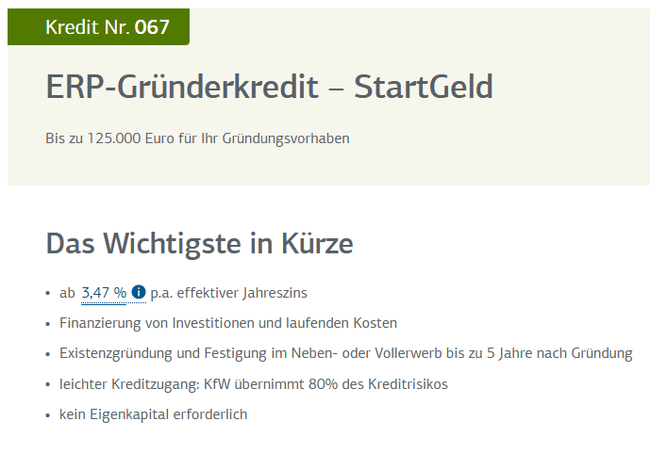
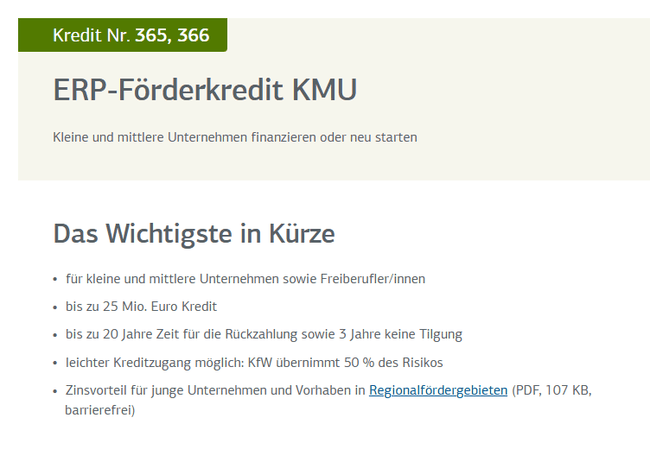
For creative professionals, options include the ERP start-up loan – StartGeld (No. 067)and theERP promotional loan for SMEs with or without risk assumption (Nos. 365, 366).
ERP Start-up Loan – StartGeld (No. 067) – Up to €125,000 for your start-up project
ERP promotional loan for SMEs with or without risk assumption (Nos. 365, 366)
A key feature of these programs is the possibility of a second chance : Even if you have already experienced a failed startup, you can access KfW funding products again, provided that previous KfW loans have been fully repaid. In this way, KfW supports not only innovative ideas, but also the unwavering entrepreneurial spirit of artists and freelancers on their path to success.
Loans for artists: Application process at German banks and credit institutions
Basic requirements
If you decide to take out a loan from a bank or credit institution, it is crucial to find out about the requirements and the offer.
The basic requirements for all German lenders are being of legal age, having full legal capacity, an official residence in Germany, and a current account with a German bank. In addition, proof of income, creditworthiness, and credit rating is required.
Income situation
After verifying the basic requirements, the applicant's income situation is analyzed. Freelance artists, in particular, often have difficulty proving regular income, which complicates the loan application process.
Nevertheless, it is not impossible for artists to obtain a loan – if all requirements are met and there are no negative characteristics, there is a possibility of approval by the credit institutions.
Review of the applicant's SCHUFA entries
A key criterion for loan approval is the credit check , which primarily uses the SCHUFA score . This score reflects the applicant's creditworthiness: a low score indicates good credit, while a high score points to negative aspects.
Artists should optimize their SCHUFA credit report to obtain better loan terms. Even with a negative or problematic score, loan options are available, for example through "SCHUFA-free loans" that use alternative assessment methods.
Loan collateral
A key element of creditworthiness assessment is the ability to provide both personal and material collateral. Collateral becomes particularly crucial for loans without a SCHUFA credit check.
Banks accept various types of collateral:
Personal credit security
This form of loan security involves naming a second borrower and providing a guarantee. The guarantee can be divided into two categories: a full guarantee and a partial guarantee . With a full guarantee, the co-applicant is directly involved in the loan agreement and commits to paying the monthly installments just like the primary applicant. In contrast, with a partial guarantee, the guarantor agrees to cover the loan in the event of a default by the primary applicant.
The guarantor thus acts as a third party who only needs to take action if the borrower becomes insolvent. It is important to note that guarantees can often be issued subject to certain conditions.
This means that the guarantor is only obliged to pay once all enforcement measures have actually been carried out and the borrower in question no longer possesses any realizable assets.
Tangible loan security
Unlike personal collateral, this type of loan does not involve a third party in the loan process. Tangible collateral can include one or more mortgages , which can be enforced in the event of loan default. With a mortgage, the lending bank receives a lien on the house or property, which can be enforced if the loan is not repaid.
Furthermore, valuable items such as jewelry, Watches , vehicles, stocks, or securities can also serve as tangible collateral for a loan. Since such collateral can often entice banks to approve an application more readily, it is advisable to consider this option. However, ensure that you are prepared to lose your possessions if necessary. Additionally, special surety bonds be beneficial for obtaining extra protection.
Home financing for the self-employed: A guide for creative professionals
Home financing for the self-employed: A guide for creatives. Image created with the AI image generator ImageFlash.
Financing a home or commercial property is a significant life step for many people. However, for the self-employed and freelancers, this process can present a particular challenge. Despite being capable entrepreneurs and creative minds, they often encounter obstacles when it comes to securing financing .
In this section, we examine the key aspects of construction financing for self-employed individuals, provide practical tips, and offer valuable insights that could help you successfully overcome this hurdle. We received significant expert support from the construction financing specialists at BAUFi Germany .
Why is home financing more complicated for self-employed people?
The primary reason lies in the uncertainty of their income. Unlike employees who receive fixed monthly salaries, the earnings of self-employed individuals fluctuate considerably. Banks and credit institutions view this as an increased risk and are therefore often more cautious when granting loans.
What exactly makes the situation risky?
Self-employed individuals don't have guaranteed long-term contracts or regular paychecks. Their revenues can be subject to seasonal fluctuations or affected by economic conditions. These uncertainties make it more difficult for banks to assess their creditworthiness.
Optimal preparation for bank meetings is therefore of even greater importance for this group.
Financial preparation: A must for the self-employed
If you are self-employed and seeking financing for a construction project, thorough preparation is essential. This includes:
Annual financial statements and tax assessments: Banks typically request annual financial statements and tax assessments for the last two to three years to assess your financial stability and performance.
Business analyses (BWA): The BWA provides an overview of current business figures and helps to document the economic situation of your company.
Business plan and forecasts: A detailed business plan and future sales forecasts can help convince the bank of the long-term stability of your company.
High equity stake: A higher equity stake reduces the risk for the bank and improves your chances of obtaining a construction loan.
Choosing the right credit institution
Not all banks have the same criteria or risk tolerance. Therefore, it is essential to find a bank or loan broker with experience working with self-employed individuals.
What should you pay attention to when making your choice?
Experience in dealing with self-employed individuals: Some banks have developed special programs and criteria for self-employed individuals and are therefore more willing to grant them loans.
Personal consultation: Take advantage of the opportunity for individual consultation. An experienced consultant can help you better understand the requirements and optimally prepare your documents.
Flexibility of terms: Check whether the bank offers flexible repayment terms, such as the option for extra payments or adjustments to the monthly installments. This flexibility can be crucial if your business has fluctuating income.
Utilize funding opportunities
Self-employed individuals can also benefit from various government funding programs and grants. Programs such as KfW promotional loans (see section above) offer low-interest loans and repayment subsidies. Furthermore, repayment-free periods are often granted until the loan is fully repaid.
What funding is available?
KfW promotional loans: The KfW Development Bank offers numerous promotional programs specifically for house construction and energy-efficient renovation.
Regional funding: Find out about regional funding programs that may be tailored to your specific situation and location. You may beeligiblemicro-mezzanine fund at the state level
Home ownership Riester: Self-employed individuals can also benefit from home ownership Riester subsidies under certain conditions. This can provide additional financial support through government allowances and tax breaks.
Credit check: Preparation is key
A crucial step in securing a mortgage is the credit check. This involves analyzing your past financial behavior. Self-employed individuals should ensure their Schufa entries and other creditworthiness data are positive.
How can you improve your credit rating?
Pay off debts: Where possible, you should reduce existing debts to improve your credit rating.
Regular payment habits: Make sure your bills and loans are always paid on time.
Schufa self-disclosure: Request a self-disclosure report from Schufa regularly to ensure that all entries are correct and up-to-date.
Strategies for successful construction financing
Despite the challenges, self-employed individuals can successfully obtain construction financing by following a few key strategies:
Complete documentation: Ensure that your financial situation is clearly and comprehensibly documented. All relevant documents should be organized and easily accessible.
Sustainable corporate management: If your company can demonstrate stable and growing revenues, this will have a positive impact on lending.
Professional advice: If necessary, consult a financial advisor or mortgage broker specializing in home financing for the self-employed. Numerous tips on home financing for the self-employed can be found on the BAUFi Germany advice page . Experts are also available there for free video or telephone consultations.
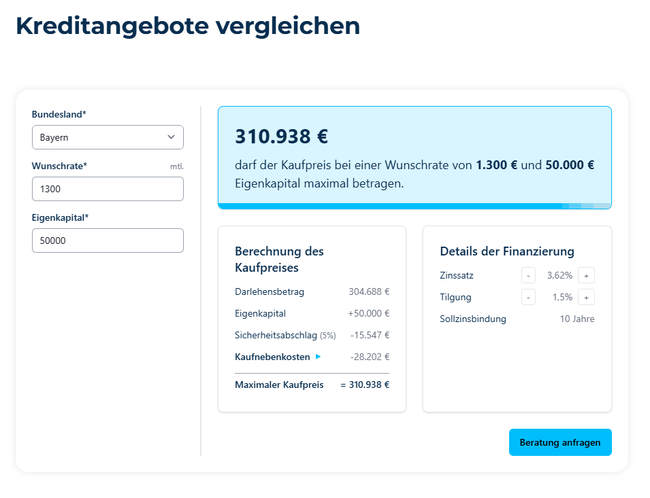
With the loan calculator from BAUFi Germany, you can enter your individual values and compare loan offers
Risks and protection
Risk mitigation is also an important issue, generally applicable to all types of financing. Self-employed individuals should consider potential income losses and how to protect themselves against them.
What types of insurance make sense?
Disability insurance: This insurance protects you from the financial consequences of becoming unable to work.
Life insurance: Term life insurance can financially protect the family in the event of death and also serve as security for the loan.
Daily sickness allowance insurance: This insurance ensures that you have a regular income even in the case of long-term illnesses.
Avoid common mistakes when financing a construction project
Financing a home is undoubtedly more complex for the self-employed than for those with permanent employment. Many make certain mistakes that can reduce their chances of securing financing or lead to financial problems.
Here are the most common mistakes in construction financing for self-employed individuals:
1. Inadequate preparation of the documents
A common mistake is the inadequate preparation of the necessary documents. Missing annual financial statements, tax assessments, or business analyses (BWA) can delay or even invalidate the application.
Solution:Gather all relevant financial documents and ensure they are up-to-date and complete. Meticulous documentation is absolutely essential.
2. Insufficient income documentation
Self-employed individuals often have irregular incomes, making it difficult to demonstrate a stable financial situation. Without a clear overview of your income and expenses, the bank may reject your application.
Solution:Create detailed income forecasts and provide a historically verifiable income history. This can convince the bank that your income is stable enough despite fluctuations.
3. Misjudgment of financial capacity
Self-employed individuals often underestimate the financial burden of financing a construction project. Unforeseen costs or loss of income can quickly lead to financial difficulties.
Solution:Realistically assess your financial capacity and include buffers for unforeseen expenses. Sustainable financial planning is crucial here.
4. Insufficient equity capital
A common mistake is taking out a mortgage with too little equity. Banks prefer borrowers who can contribute a higher equity stake, as this reduces the bank's risk.
Solution:Try to provide at least 20-30% equity. This increases your chances of loan approval and can also lead to better terms.
5. Failure to consider funding programs
Many self-employed individuals overlook existing funding programs that could help them with construction financing. This can be a missed opportunity for more favorable terms or additional financial support.
Solution:Thoroughly research government funding programs such as KfW loans or regional subsidies. These can often be combined with your construction financing and lead to significant cost savings.
6. Lack of comparison of loan offers
Another common mistake is to rely on the first offer without thoroughly comparing different loan offers. This can lead to paying higher interest rates or receiving less flexible terms.
Solution:Compare different offers and use loan brokers who have experience with self-employed individuals. This will help you find better terms and lower interest rates.
7. Neglect of insurance
Many self-employed individuals neglect to take out the necessary insurance policies to secure repayment of their mortgage in case of illness or disability. This poses a significant risk that can lead to serious financial problems.
Solution:Take out disability insurance, term life insurance, and possibly daily sickness allowance insurance. These policies can help secure your loan and ensure your financial stability.
8. Insufficient liquidity reserves
Self-employed individuals often plan on a tight budget and lack sufficient cash reserves to cover their ongoing business expenses and mortgage repayments. This can become problematic during economically challenging times.
Solution:Create sufficient liquidity reserves to bridge financial gaps. A reserve of three to six months' operating costs is recommended.
9. Neglect of creditworthiness
A common mistake is not having a sufficient understanding of one's own creditworthiness. Negative entries in the Schufa (German credit agency) or other credit reports can jeopardize your loan application.
Solution:Regularly request your Schufa credit report and check your credit status. Correct any incorrect entries and work on improving your credit rating.
10. Ignoring market conditions
Self-employed individuals who fail to consider current market conditions can easily fall into a financial trap. Interest rate trends and property prices significantly impact the overall cost of your mortgage.
Solution:Closely monitor the real estate market and interest rate trends. If necessary, wait for a more favorable time or adjust your financing strategy accordingly.
By avoiding these common mistakes, self-employed individuals can significantly increase their chances of securing successful financing for a construction project. Careful preparation, realistic planning, and professional advice are their best allies in this endeavor.
Set realistic goals, take advantage of government funding opportunities, and compare different offers to find the best financing for your dream home.
Creditworthiness is the key issue – these tips will help you improve your credit rating
Creditworthiness, also known as credit rating, is a crucial factor when applying for a mortgage. Improving creditworthiness can be a particular challenge for self-employed individuals, but it is not impossible.
Here are some practical tips to improve your credit rating and increase your chances of a successful loan application:
1. Meticulous financial accounting
Maintain complete and meticulous bookkeeping. Keep your income and expenses up-to-date and traceable at all times. Clean bookkeeping impresses the bank and demonstrates your professionalism.
Here's how to do it:
Use accounting software to document your finances clearly and regularly.
Keep all receipts and invoices and organize them systematically.
2. Tax compliance
Make sure you pay all your taxes on time and in full . This shows your bank that you are reliable and responsible in managing your financial obligations.
How to do it:
Create a tax calendar to avoid missing any deadlines.
Consult a tax advisor to optimize your tax payments and ensure you meet deadlines.
3. Reduction of existing debt
Reduce existing loans and debts before taking out a new loan. A low debt-to-income ratio significantly improves your credit score.
How to do it:
Prioritize paying off your debts and plan for regular payments.
Avoid taking on new debt and consumer loans that could strain your financial situation.
4. Positive Schufa entries
Make an effort to build a positive credit history. Regular and punctual payments play a key role in this.
How to do it:
Make sure you always pay your bills on time.
Take advantage of the opportunity to regularly obtain a free Schufa self-disclosure report and correct any errors immediately.
5. Verifiable stable income
Document your income clearly and transparently. Show the bank that your income is stable and sustainable despite being self-employed.
How to do it:
Prepare detailed business analyses (BWA) and sales forecasts.
Show previous year's figures and current business figures to demonstrate continuity in your revenue.
6. Plant capacity utilization and order situation
Regularly update your business forecasts and demonstrate a healthy order book. This will positively influence the assessment of your revenue and thus your credit rating.
How to do it:
Have a list of current and future orders ready.
Ensure a steady pipeline of projects and clients.
7. Diversification of revenue
A more diversified income base has a stabilizing effect. If your income comes from multiple sources, this reduces the risk of income fluctuations.
Develop a strategy to penetrate different market segments.
8. High equity ratio
A high equity stake conveys security to the bank and demonstrates your financial strength. This can facilitate loan approval.
How to do it:
Save up specifically for your equity before applying for a construction loan.
Use any existing assets as additional security.
9. Professional appearance and consultation
A professional demeanor and sound advice can also positively influence your credit rating. Banks value working with well-prepared and professionally acting clients.
How to do it:
Prepare all documents carefully and present them in a structured manner.
Take advantage of the expertise of a financial advisor who can help you prepare your loan application.
10. Regular review and adjustment
Regularly review your financial situation and adjust your strategies to improve and maintain your credit rating.
How to do it:
Conduct regular financial analyses and adjust your approach as needed.
Keep track of your various liabilities and income.
Good preparation leads to successful financing
Solid planning and optimal preparation are the cornerstones for successful financing. Image was created with the AI image generator ImageFlash.
Improving your credit rating requires time, commitment, and a clear strategy. Careful financial management, transparent income, and professional advice can sustainably strengthen your creditworthiness. Implement the tips mentioned above to maximize your chances of securing a mortgage.
By addressing these aspects and acting accordingly, you will not only appear more confident and convincing when applying for a construction loan – or financing in general – but you will also create a solid foundation for your financial future.
Securing financing as a freelancer in the creative industries doesn't have to be an insurmountable obstacle. With strategic planning, professional advice, and the right funding opportunities, you can maximize your chances of successful financing.
We wish you every success!
Sources, expert support and further information:
Nadine Oschmann from BAUFi Deutschland:Home financing for the self-employed: Tips, https://baufi-deutschland.de/baufinanzierung-fuer-selbststaendige/
KfW Bank , Promotion of the Creative Industries , https://www.kfw.de/%C3%9Cber-die-KfW/Newsroom/Themen-kompakt/Kreativwirtschaft/
Westdeutsche Zeitung Guide:More Room for Creativity: Financing for Artists, https://www.wz.de/ratgeber/geld-und-recht/mehr-raum-fuer-kreativitaet-finanzierung-fuer-kuenstler_aid-71142701
Owner and Managing Director of Kunstplaza . Publicist, editor, and passionate blogger in the fields of art, design, and creativity since 2011. Graduated with a degree in web design from university (2008). Further developed creative techniques through courses in freehand drawing, expressive painting, and theatre/acting. Profound knowledge of the art market gained through years of journalistic research and numerous collaborations with key players and institutions in the arts and culture sector.
A fundamental need for every artistically creative person is likely to be the ability to live off their art.
To secure one's own existence, it is essential to earn money with art. In fact, nowadays—contrary to the majority perception—many artists can live well from their creative work. Nevertheless, a significant majority of all freelance artists still rely on additional sources of income (e.g., teaching courses, commissioned work, side jobs, etc.).
Recognition as an artist often does not bring immediate financial security. Therefore, artists are often also life artists.
The opportunities to make a living from one's own art have, however, grown significantly due to the internet and social media. As an artist, however, you must be versatile and flexible to succeed. A certain degree of perseverance is also essential.
Customer relations and self-marketing are also important pillars for success as an artist .
In this section, we compile numerous articles, information, tips, and advice to help you make a living from your art.
We use technologies such as cookies to store and/or access device information. We do this to improve your browsing experience and to display (non-)personalized advertising. If you consent to these technologies, we can process data such as browsing behavior or unique IDs on this website. Refusal or withdrawal of consent may adversely affect certain features and functions.
Functional
Always Active
Technical storage or access is strictly necessary for the legitimate purpose of enabling the use of a specific service expressly requested by the subscriber or user, or for the sole purpose of carrying out the transmission of a message over an electronic communications network.
Preferences
The technical storage or access is necessary for the legitimate purpose of storing preferences that were not requested by the subscriber or user.
statistics
Technical storage or access that is solely for statistical purposes.Technical storage or access that is used solely for anonymous statistical purposes. Without a subpoena, the voluntary consent of your internet service provider, or additional recording by third parties, the information stored or retrieved for this purpose cannot generally be used to identify you.
marketing
Technical storage or access is required to create user profiles, to send advertising, or to track the user on one or more websites for similar marketing purposes.
















 J-Line Cozy Rattan Armchair "Ana", handcrafted weave
465,00 €
J-Line Cozy Rattan Armchair "Ana", handcrafted weave
465,00 €