Almost all the great sculptures in art history have their permanent place in museums, squares, or churches. Anyone wanting to see Rodin's "The Thinker" or "Atlas with the Celestial Sphere" travels to Paris or Naples. For centuries, however, there has been a second way to bring such works into one's own home. Small bronze replicas make familiar motifs tangible, and they stand on desks, mantelpieces, and bookshelves.
This article presents classics that have proven particularly successful as bronze figures, explains their history and shows how you can recognize a carefully crafted replica.
Bronze reproduces fine details from the model very accurately
Copper with a tin content produces a metal that, when molten, flows into even the smallest recesses of a mold and hardly yields after cooling. This property is what gives bronze its role in sculpture, from Greek god statues to the workshops of the 19th century. The classic process uses a lost-wax casting method. It begins with a wax figure, which is then covered with a heat-resistant shell. Once this shell is fired in the kiln, the wax evaporates, and the molten metal takes its place. After the shell is broken open, an image remains that even preserves the sculptor's tool marks.
Art historians classify cast bronzes as sculptures because they originate from a constructed model, whereas a sculpture is carved from stone or wood. This and other basic concepts are explained in a concise overview of frequently asked questions about sculptures
Rodin's "The Thinker" began as a figure above the gates of Hell
For a bronze portal of the planned Paris Museum of Decorative Arts, Auguste Rodin in 1880 on a Gates of Hell depicting scenes from Dante's Divine Comedy. At the very top, above the door panels, sits the Thinker. The figure was originally intended to represent the poet himself, contemplating his work. Rodin later exhibited the figure as an independent work and had an enlarged version cast.
Auguste Rodin, "The Thinker", 1881–1882, sculpture (bronze), Musée Rodin, Paris, France. Image source: Thibsweb, Public domain, via Wikimedia Commons
One copy was placed in front of the Panthéon in Paris in 1906; the most photographed one today stands in the garden of the Musée Rodin. The forward-bent posture with the chin resting on the hand is effective even in the small format because the tension is present throughout the entire body.
Justice carries scales, sword, and blindfold
The Roman goddess of justice is among the motifs frequently found in law offices, notaries' offices, and lawyers' studies. The scales represent the weighing of arguments, the sword the enforcement of judgment. The blindfold was added only in the early modern period and symbolizes a judgment without regard to the person.
Fountain of Justice in Regensburg. Image source: Dietmar Rabich / Wikimedia Commons / “Regensburg, Fountain of Justice — 2026 — 4446” / CC BY-SA 4.0
Hugo Rheinhold's monkey with a skull comments on the evolution debate
Hugo Rheinhold's monkey with skull. Image source: Darwin Monkey, Public domain, via Wikimedia Commons
In the early 1890s, the Berlin sculptor Hugo Rheinhold created a work depicting a monkey sitting on a stack of books and contemplating a human skull. The work addressed the debate surrounding Darwin's theory of evolution and quickly became popular
Soon, numerous casts were produced, finding their place in scholars' studies and libraries. The blend of humor and serious questioning makes the figure a popular motif for studies to this day.
Atlas has carried the celestial sphere since antiquity
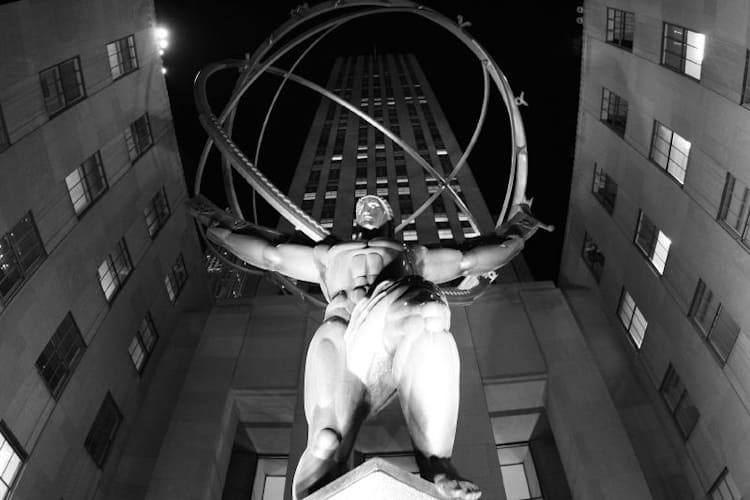
“Atlas” sculpture at night, 5th Avenue, New York City Image source: Jeff Pearce, CC BY 2.0, via Wikimedia Commons
After the Titans' defeat by Zeus, Atlas was condemned to forever hold up the heavens. The most famous depiction is the so-called Farnese Atlas in the National Archaeological Museum in Naples, a Roman marble copy based on a Greek original. The globe on his back shows constellations and is considered one of the oldest surviving depictions of the heavens of this kind.
Modern bronzes often replace the solid sphere with an armillary sphere. Its interlocking rings represent the equator, tropics, and ecliptic, and make the figure appear significantly lighter.
Small bronze sculptures based on larger models have a long tradition
Young noblemen from England, France, and Germany concluded their education in the 18th century with a Grand Tour to Rome, and many commissioned miniatures of the admired antiquities. Even Michelangelo's David, originally made of marble, received a bronze copy in the 19th century. This bronze copy still stands today in Florence's Piazzale Michelangelo.
Motifs from antiquity, the Renaissance, and the Baroque were particularly popular. Gian Lorenzo Bernini, for example, made marble so kinetic in works like "Apollo and Daphne" that the figures appear to float. Those wishing to delve deeper into this period will find an excellent starting point in the article on stylistic features and artists of the Baroque era .
Weight, patina, and base reveal the quality of a replica
There can be significant differences in material and workmanship between two figures with the same motif. Some characteristics can be checked simply by looking at the product photos and specifications:
Material: Solid bronze figures have a noticeable weight, even in small ones. Artificial bronze is usually a resin casting with metal powder and is significantly lighter.
Casting: Information on the lost-wax casting process suggests finely detailed faces, hands, and wrinkles.
Patina: A hand-applied patina shows gradations from golden brown to dark brown instead of a uniform color coating.
Base: Stone or marble under the figure lowers the center of gravity and prevents it from tipping over when touched.
Dimensions: Height and weight should be specified so that you can choose the figure to fit the planned location.
Those looking to buy high-quality bronze figures will find various online vendors. Antik 2000 's selection includes, for example, Rodin's Thinker, Rheinhold's Monkey with Skull, Atlas with Armillary Sphere, and Justitia in several heights up to 65 centimeters.
For antique originals, documented provenance is what counts
Besides newly cast replicas, historical bronzes are also traded, such as small sculptures from the 19th century or supposedly antique pieces. A close look at the documentation is worthwhile here. An original without complete proof of provenance may turn out to be a forgery or an illegally excavated artifact.
of the Cultural Property Protection Act prohibits the sale of cultural propertythat has been lost, unlawfully excavated, or illegally imported. Such sales contracts are void. A newly cast replica of famous works circumvents this uncertainty because its provenance is unambiguous.
The design should suit the room and the people in it
The choice of a famous figure says something about the place where it stands. Rodin's Thinker and Reinhold's Monkey are suitable for libraries and reading rooms because both depict contemplation. Atlas with his celestial globe complements a globe or old maps. Musical motifs, such as a cellist or an angel with a harp, find their place next to the piano.
A figurine makes a good gift when it evokes memories of a profession, passion, or a shared museum visit. Occasional dusting is sufficient for its upkeep; bronzes don't require polishing or cleaning agents.
Closing remarks
Famous sculptures in bronze form connect art history with interior design. The Thinker, Justitia, Rheinhold's monkey, and Atlas each carry their own story, which can be retold with every glance. Crucial to the enjoyment of a sculpture are genuine materials, a clean casting, and a carefully cultivated patina.
A well-cast figure can survive moves and decades and can later be passed on to the next generation.
Owner and Managing Director of Kunstplaza . Publicist, editor, and passionate blogger in the fields of art, design, and creativity since 2011. Graduated with a degree in web design from university (2008). Further developed creative techniques through courses in freehand drawing, expressive painting, and theatre/acting. Profound knowledge of the art market gained through years of journalistic research and numerous collaborations with key players and institutions in the arts and culture sector.
Category for interior architecture, interior design, room design, home design, commercial furnishing, product and material innovation.
Here you'll find everything an interior designer's heart desires. We present the latest trends and developments in the world of home design, as well as innovative products and materials for creating unique spaces.
Our goal is to provide our readers with inspiration and help them creatively redesign or completely transform their living spaces.
We place great importance on ensuring that our articles are not only esthetically pleasing but also include practical tips.
We also introduce you to successful interior designers – from newcomers to the most well-known names in the industry – so you can be inspired by their projects and get to know their working methods.
Whether it's about making the most of a small space or furnishing your home with new furniture in the trendy industrial style: With us, you will find all the information you need on the topic of interior design!
Manage privacy
We use technologies such as cookies to store and/or access device information. We do this to improve your browsing experience and to display (non-)personalized advertising. If you consent to these technologies, we can process data such as browsing behavior or unique IDs on this website. Refusal or withdrawal of consent may adversely affect certain features and functions.
Functional
Always Active
Technical storage or access is strictly necessary for the legitimate purpose of enabling the use of a specific service expressly requested by the subscriber or user, or for the sole purpose of carrying out the transmission of a message over an electronic communications network.
Preferences
The technical storage or access is necessary for the legitimate purpose of storing preferences that were not requested by the subscriber or user.
statistics
Technical storage or access that is solely for statistical purposes.Technical storage or access that is used solely for anonymous statistical purposes. Without a subpoena, the voluntary consent of your internet service provider, or additional recording by third parties, the information stored or retrieved for this purpose cannot generally be used to identify you.
marketing
Technical storage or access is required to create user profiles, to send advertising, or to track the user on one or more websites for similar marketing purposes.