Macramé , an old classic of knotting techniques a new surge in popularity and is rapidly gaining in popularity among craft enthusiasts and hobby artists.
This term might initially bring to mind colorful friendship bracelets, Wolfgang “Wolle” Petry, hanging flower baskets from the eighties , or knotted wall hangings made of thick sisal twine, right?
Whether as a decorative element in the home or as a piece of jewelry on the body – macrame is versatile and easy to make yourself.
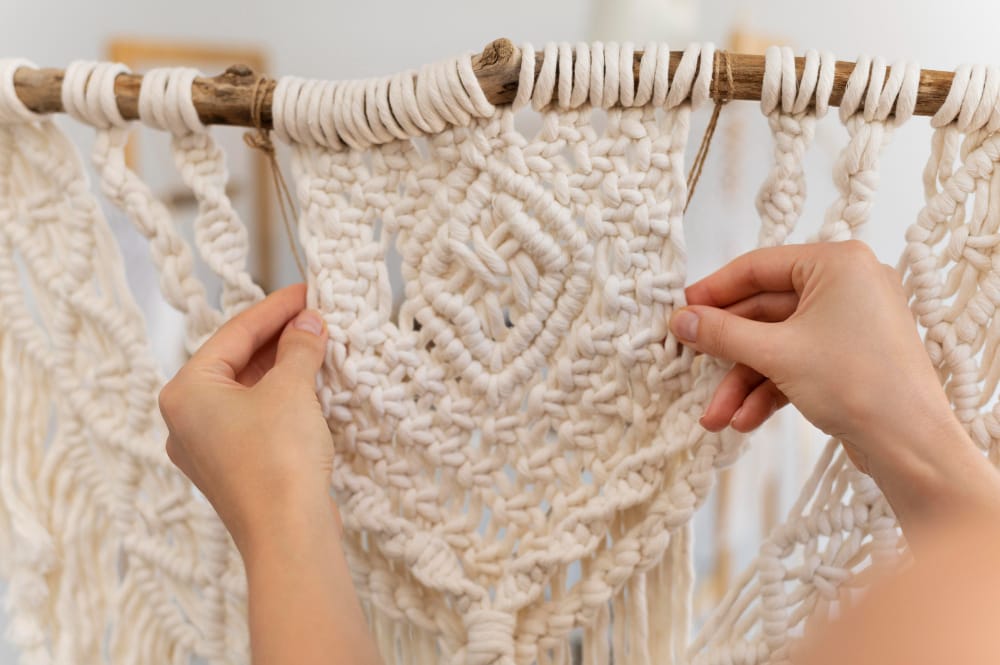
Macrame can be used to create wonderful decorative elements for the home. Image source: Freepik
With this article, we want to show you that there's much more you can do with this oriental knotting technique and that numerous incredibly creative concepts, techniques, ideas, and projects have developed in this area of handicrafts. Thanks to the internet, these are also spreading rapidly across the globe, allowing for a wide variety of cultural influences.
Besides classic wall hangings and bracelets, you'll find a wide variety of macrame products, including pendants of all kinds, belts, watch straps, necklaces, wind chimes, furniture, clothing, and decorative items in every imaginable form. The possibilities for using macrame are virtually limitless.
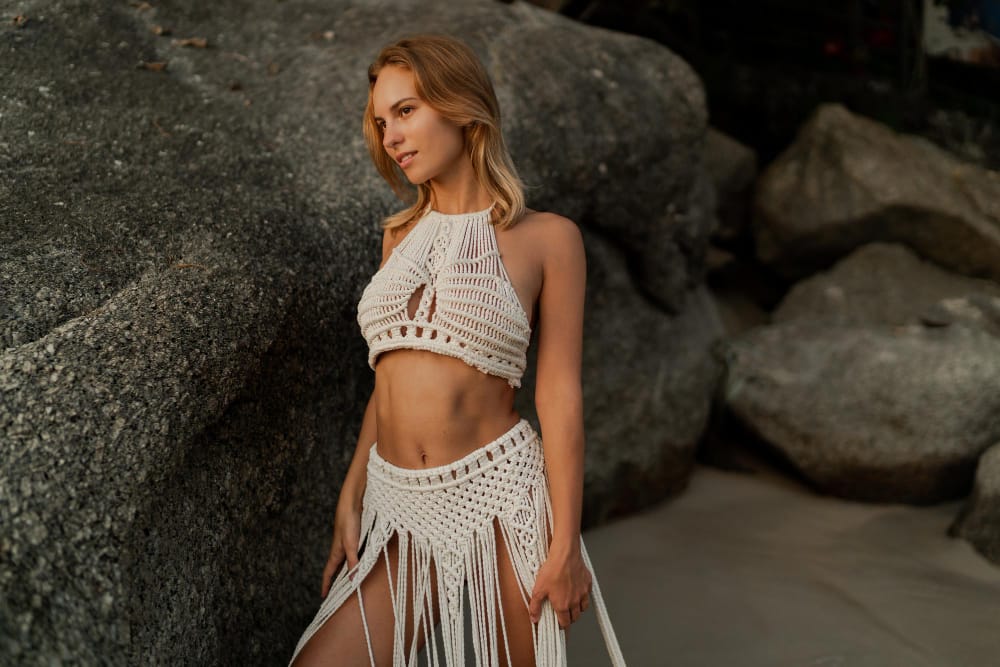
Macramé can also be used to create artistic garments. Image source: svetlanasokolova, via Unsplash on Freepik
This is repeatedly demonstrated in the creativity and diversity of the application of this knotting technique.
There are numerous tutorials and books on macrame that can help you learn basics of knotting techniquessupplies such as macrame yarn or sock yarn readily available online or at your local craft store.
With a little practice, you can create impressive works of art that enhance any room and underline your personal style. Anyone who enjoys crafting and needlework will surely find pleasure in this gentle form of knitting and crocheting.
And who knows, maybe macramé knotting will even become a relax in between other activities?
The term originates from Spanish (macramé) and refers to a knotting technique from the Orient used to create ornaments, patterns, or textiles . The Spanish word "macramé" itself comes from the Arabic "migramah," which in Arabic usage means something like . "
This technique finally reached Europe with the Crusaders and the Moors (via Spain). Since then, it has experienced several periods of great popularity, during which some very delicate knotted pieces were created. The last golden age in Germany, which you may still vividly remember, was in the 1970s. The pieces from this decade were often quite rustic.
For several months now, this wonderful form of handicraft has been experiencing a strong resurgence and is once again enjoying enormous demand.
The most common forms are:
Chinese macramé, which is said to bring good luck for the New Year
Macramé owls, a traditional form of macramé
Tablecloths, belts, wall hangings
Latin American macramé, especially jewelry (bracelets, necklaces, etc.)
Uniform decorations, rank insignia
Materials and tools for macrame handicrafts
Creating macrame pieces requires certain materials and tools.
Which yarn is best for macrame?
the right yarn is crucial. There's special macrame yarn made from cotton or juteSock yarn or other types of wool can also be used, but it's important to make sure they're not too thin and can be knotted easily.
Traditional macrame yarn is made of cotton and comes in two varieties: braided or twisted . Twisted yarn can consist of either a single twisted strand or, typically, three to four twisted strands that are themselves twisted together. This is often referred to as 3-ply yarn.
Ms. Friemel (more information and link below) describes herself as a passionate crafter and a big macrame fan. She uses twisted yarn because the ends of this type of yarn can fray and it is often cheaper.
Braided yarn, on the other hand, lends a more serene feel to macrame knotting, in her opinion, and is particularly easier to handle for beginners. If you still prefer twisted yarn, the DIY expert recommends starting with the 3-ply version.
Besides the right yarn, there is also a wide range of accessories such as crochet hooks , knitting or knotting accessories , as well as books with instructions and inspiration.
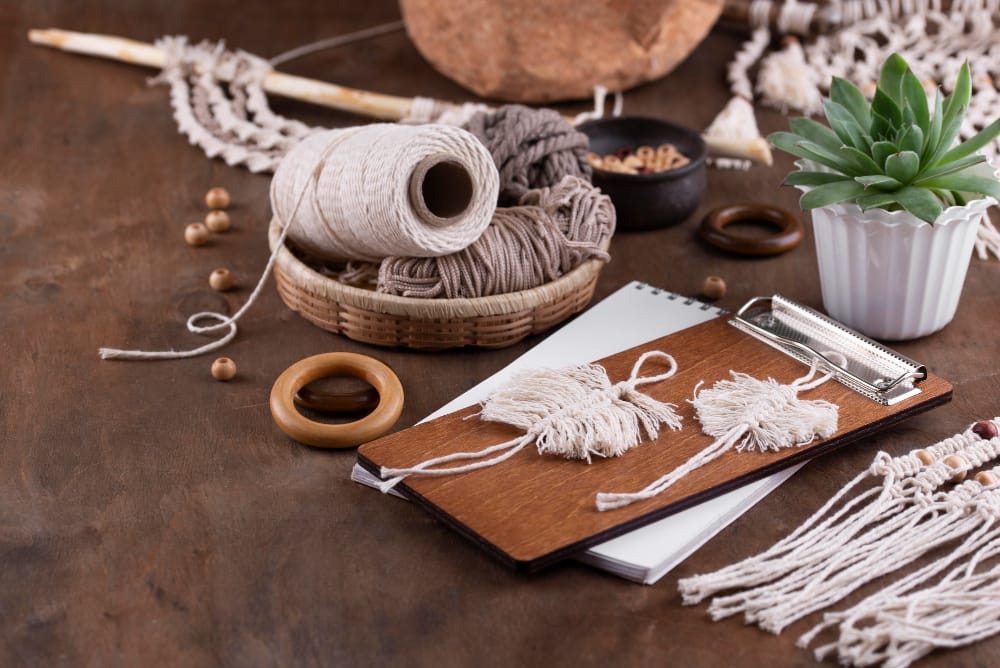
Materials and tools for macrame crafting. Image source: Freepik
Bobbiny , a Polish company specializing in handcrafted yarns, are particularly popular with macrame enthusiasts Bobbiny's 3mm single-twist yarn . It impresses not only with its color, appearance, and wonderful feel, but also with its environmentally friendly production.
Their website offers various types of yarn as well as practical accessories.
Those new to the world of macrame will find numerous ways to make their first steps easier and to be creative.
How long should the thread be for macrame?
In macrame, the length of the cords depends on the project. Generally, the cords should be at least two to three times as long as the finished macrame piece. For example, if you want to make a wall hanging one meter long, you should use cords at least two meters long.
Another crucial factor is the thickness of the cords. The thicker the cord, the shorter it can be. Therefore, if you use thicker cords, they can be shorter than the recommended twice-the length of the finished macrame. It's also important to remember that a few centimeters can be lost at the ends when knotting a macrame piece.
Therefore, you should always add a few extra centimeters to the thread lengths. If you are unsure what length is needed, you can refer to instructions or tutorials and experiment if necessary.
However, the general rule is: it's better to use a little more material than too little – it can always be shortened or cut off!
Basic knots and techniques in macrame
Macrame involves a variety of knots and techniques that one should master to create attractive and authentic pieces. Among the basic macrame knots are the square knot , the double square knot , and the slash knot .
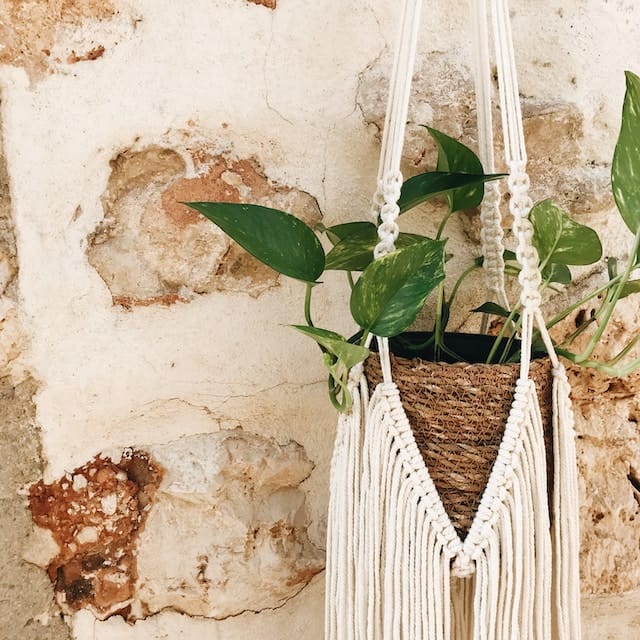
Playful hanging planter using the macrame technique. Photo by rocknwool @rocknwool, via Unsplash
These knotting techniques can be used to create beautiful wall hangings , plant hangers , or bracelets . Whether you're a beginner or advanced, with the numerous tutorials and books on macrame, everyone can find a suitable challenge.
Carrying thread and working thread
In principle, this knotting technique distinguishes between two threads. The threads that support the knots are called carrier threads . The threads that form the knots are called working threads .
A basic rule is: support threads never form loops. The difference is clearly visible in a hanging flower basket, where the flower pots are held by the support threads and decorated by the working threads.
In macrame, these two types of cords are also called active (working) and passive (carrier) cords. The active cords are used to tie the knots, while the passive cords guide the direction of the knots and thus act as a guide.
In some projects, there may be a switch between functions. If no switch occurs, the passive cables are significantly shorter than the active ones.
You can also see the basics of knotting techniques clearly demonstrated in the following video:
The anchor knot
Every macrame project begins with this knot, also often called the anchor knot . The anchor knot is used to attach the knotting yarn to a guide cord, rings, or wooden dowels.
Here's how it works: Form the yarn into a loop and guide it from the front, for example around a wooden stick, so that the closed end faces downwards. Then, bring the loose ends over the stick and through this loop, and then pull everything tight.
You can also use this node in reverse. Depending on the project, either the forward or the reverse version is more suitable.
Dilara from Westwing shows us a simple step-by-step macrame tutorial that will help any beginner quickly understand the principle of basic knots and become a pro in no time:
Half knot and double half hitch
Essentially, in macrame, based on the anchor knot, there are only two basic knots. One of them is the half knot.
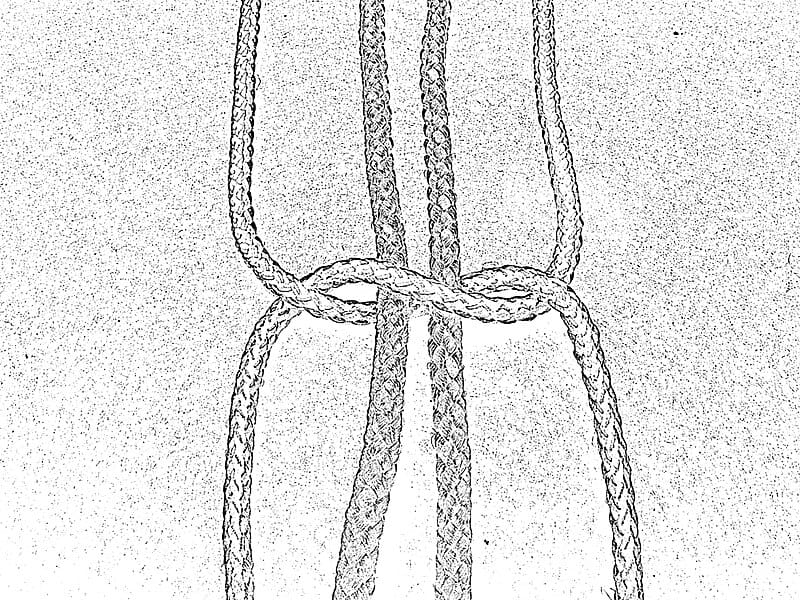
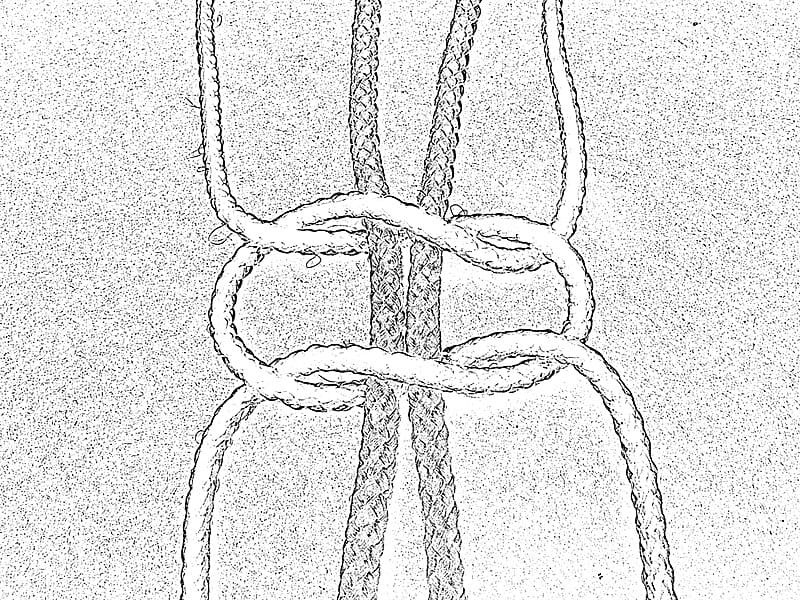
Half knot (tied to the left) Source: Here4u on German Wikipedia [CC-BY-SA-3.0], via Wikimedia Commons
Half knot (placed on the right) by FilmRob [CC BY-SA 3.0], via Wikimedia Commons
and secondly, the half hit
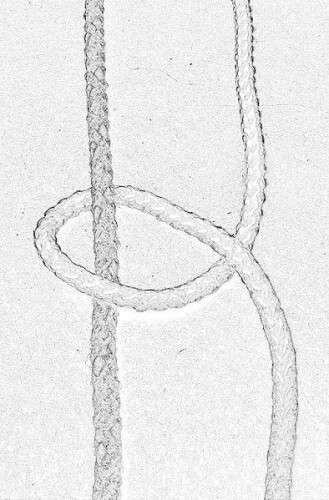
Half hit left laid by Jomegat [CC BY-SA 3.0], via Wikimedia Commons
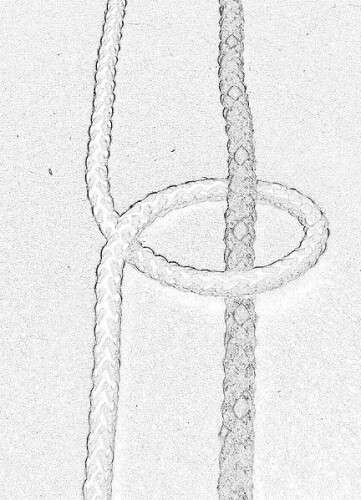
Half hit, placed on the right by Jomegat [CC BY-SA 3.0], via Wikimedia Commons
These knots are a variation of the previously presented anchor knot. They consist of two half hitches around the leader line, tied one after the other. The double half hitch is well-suited for tying longer horizontal or vertical lines.
This is how to tie a left-handed knot:
Begin by guiding the left end (working line) over the right end (guide line) to the right. Then, from right to left, go back under the guide line, so that the working line forms a loop or half hitch. Next, guide the working line under the guide line to the right and then back over it to the left. Finally, pull everything tight! Of course, this also works well starting from the right side.
In the following video, YouTuber Larissa from"Gemischte Tüte" show you in detail how to tie the knot called the "Double Half Hitch" both horizontally and diagonally to the left and right in a descending direction. This particular knot is frequently used in the making of macrame dreamcatchers or wall hangings.
Square knot, wave knot and rib knot
Building upon these two basic knots, more complex knots are then tied. These include the square knot (also known as the reef knot, flat knot, or Solomon knot), the wave knot (also known as the granny knot), and the rib knot .
left-handed square knot
Old woman's knot (started on the left over the right)
square knot
The square knot is an essential knot in macrame and is considered a standard knot. This knot allows you to create a surface using a variety of cords.
Here's how it's made:
To tie a left-handed square knot, take the outermost left cord and pass it over the two stationary center cords to the right. Then take the outermost right cord and pass it under the center cords to the left.
Next, reverse the process: Guide the left cord under the center cords to the right, and the right cord over them to the left. Then, as usual, tighten everything securely.
From these few knots, such as square knots and slip knots/rib knots, you can already make many cool macrame pieces, such as wall hangings , decorative elements and other accessories like hanging planters, pacifier chains or yoga mat straps (see video).
Rib nodes
The rib knot offers a great way to highlight and visually define specific knot areas. It is suitable for various shapes, but requires concentration and practice to achieve a consistent result.
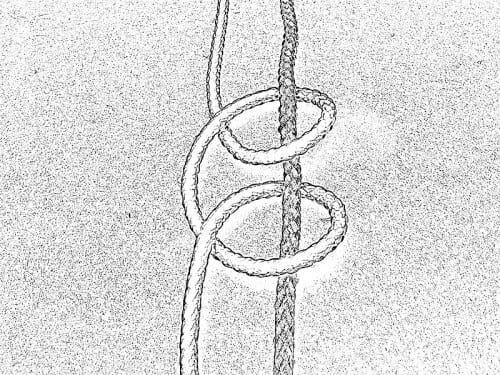
Rib knot (forward knot) by Jomegat [CC BY-SA 3.0], via Wikimedia Commons
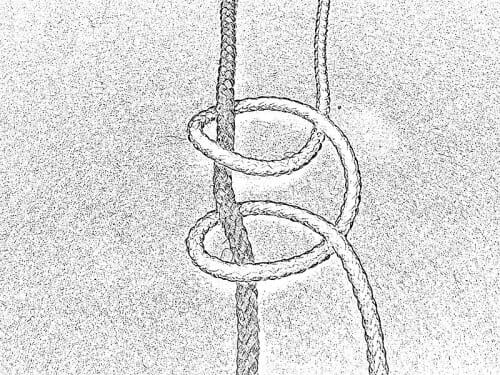
Rib knot (back knot) by Jomegat [CC BY-SA 3.0], via Wikimedia Commons
Here's how:
Start by laying the leftmost guide cord over the other cords. Then take the nearest cord and form the first loop by first bringing it up over the guide cord and then down behind it.
Use the same cord in a similar way to form a second loop. Then pull both loops tight, holding the guide firmly in place.
Repeat this process with the third cord to create two more loops. Continue in this way until you reach the end of the row. If you wish to tie an additional row below, lay the guide cord parallel to the first row from right to left, and then continue knotting adjacent cords together using the same principle.
wave nodes
The fascination of the wave knot lies in the fact that by consistently adhering to a knotting rhythm, a helix or spiral is automatically formed.
Macrame wave knot: Single knot with loop to the right
Macrame wave knot: right-turning spiral knot
Here's how:
To create a counter-clockwise twisting line, guide the leftmost line over the middle lines to the right, and the rightmost line under the middle strands to the left. Repeat this process continuously. The line will twist on its own.
Of course, you can also do the exact opposite to create a right-handed twisting cord. With this knot, it's crucial to pull it tight so that a uniform spiral is formed.
The following video summarizes the basic knots for you in a clear and concise way:
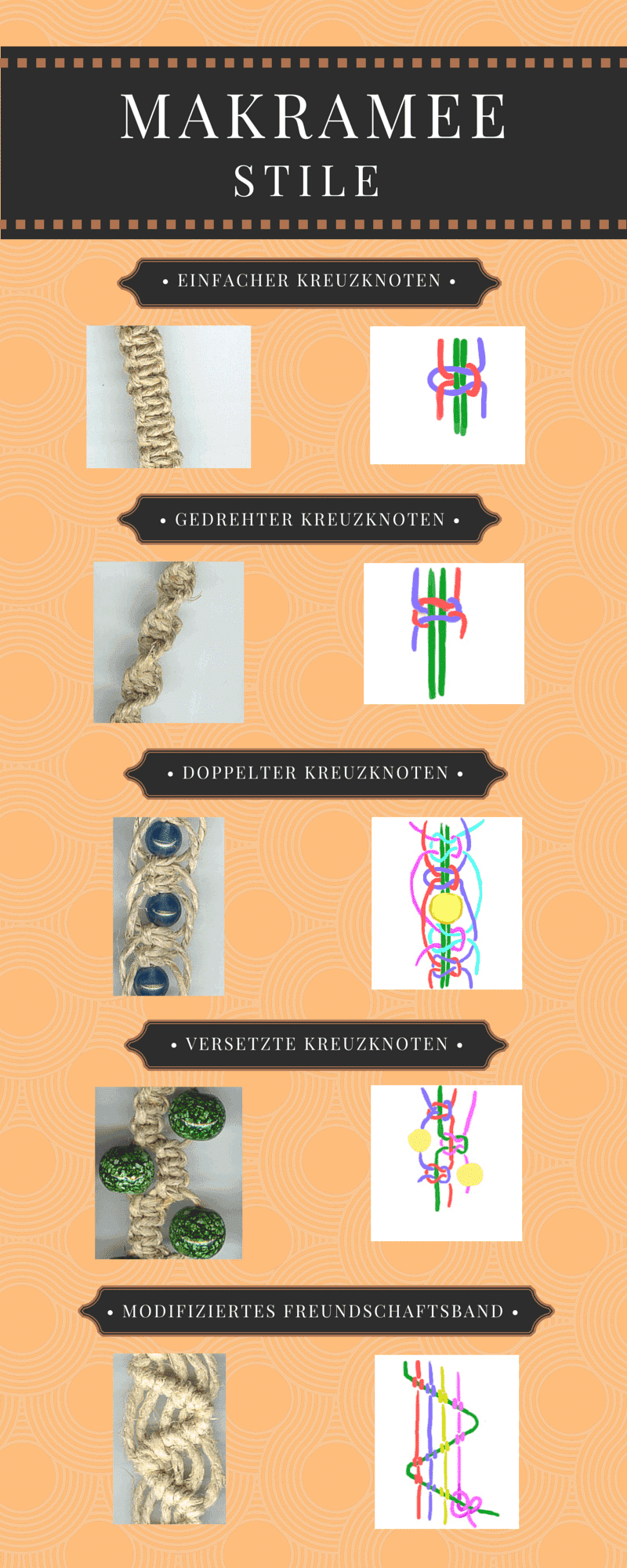
Macrame styles
The following infographic shows some popular and frequently used styles and techniques.
Furthermore, there are so-called decorative knots , which are used somewhat less frequently.
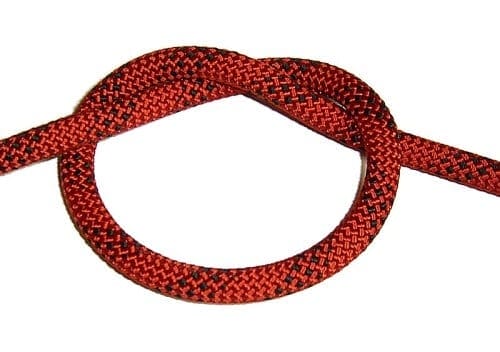
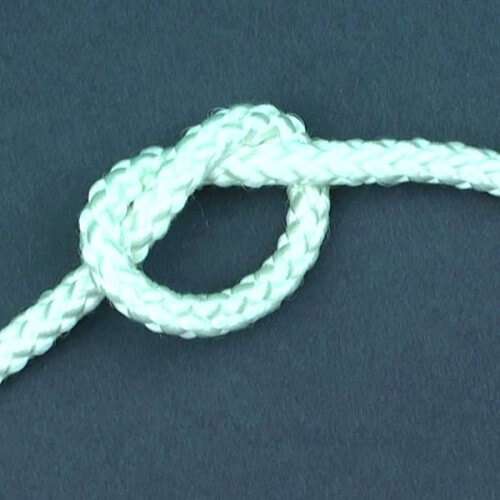
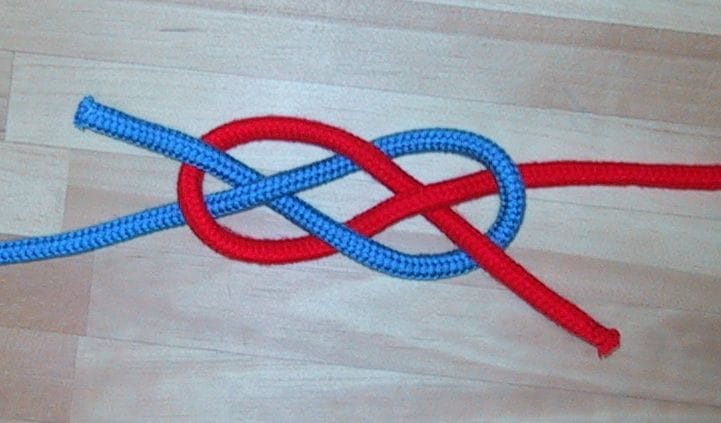
The rope hitch is a knot used for joining two ends, but also for decorative purposes. Image source: Chris 73 / Wikimedia Commons
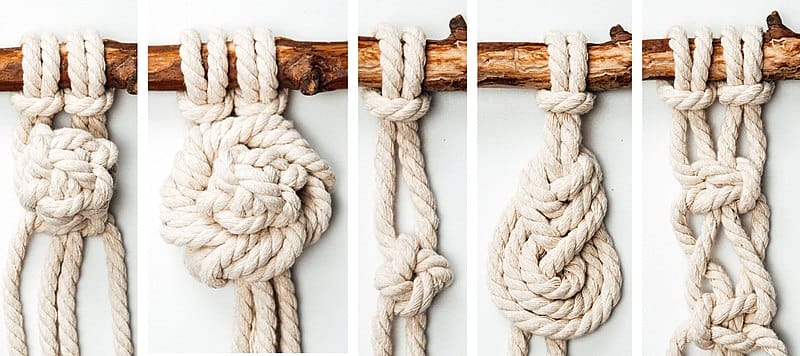
These include the rope knot ( Josephine knot or pretzel knot ), which primarily serves as a decorative knot, as well as berry knot , rose knot , cross knot , pipa knot and change knot (in the following illustration from left to right).
Five decorative macrame knots side by side on a branch. Image source: Arabella Oberstedt, CC BY-SA 4.0, via Wikimedia Commons
Video instructions and tutorials
Whether you are reading about this knotting technique for the first time and have simply become curious, or whether you are already an old hand in this field: The following videos will certainly hold one or two exciting suggestions for you that you have not yet encountered.
Amateur artists demonstrate the most important tricks and showcase their favorite techniques and works.
Knotting techniques
Creative macrame projects – the best video tutorials
How about sharing some of your handcrafted creations to bring joy to others? Handmade gifts have a special charm. The joy you feel while creating them shines through in every knot, and this positive energy comes alive when you give them away.
And who knows, perhaps your projects will inspire creativity in others as well. Here we've compiled some of the best video tutorials available online to guide you step-by-step in bringing your macrame ideas to life.
DIY Macrame Boho Lantern
Even more boho-chic ideas
Curtains and wall hangings
Keyring with small loop
DIY macrame bag without fringe
Dreamcatcher
Colorful Tree of Life as a dreamcatcher
pennant chain
Hanging lantern / flower basket
Easter decoration – small, cute macrame bunnies
Christmas decoration – small DIY Christmas tree as a wall hanging
Macrame jewelry: bracelets, necklaces, earrings & more.
Free macrame tutorials from DIY professionals
A wonderful starting point for those wanting to delve into the DIY world of oriental knotting techniques is Frau Friemel's craft blog. There, Liesa shares her passion for DIY projects and shows how to make all sorts of attractive things yourself.
Her repertoire encompasses everything from home decor to handmade jewelry . In recent years, this crafty woman has developed a particular passion for macramé, which has become her most outstanding area of expertise.
Arabella Mandarella also offers a wealth of instructions, tips, and project inspiration. Free step-by-step tutorials for hanging planters, dreamcatchers, macrame feathers, and keychains are featured on the LieblingsgarnMrs. Greenhouse shares her favorite patterns with her readers.
Macrame instructions for hanging planters and bracelets can also be found at the DIY portal and magazine Handmade Kultur .
Even more projects, tutorials and inspiration…
Haven't had enough yet? Then continue here with a wealth of wonderful and creative application examples to look at, admire and recreate…
(You must have accepted cookies to view the Pinterest board)
Owner and Managing Director of Kunstplaza . Publicist, editor, and passionate blogger in the fields of art, design, and creativity since 2011. Graduated with a degree in web design from university (2008). Further developed creative techniques through courses in freehand drawing, expressive painting, and theatre/acting. Profound knowledge of the art market gained through years of journalistic research and numerous collaborations with key players and institutions in the arts and culture sector.
Like any subject area, art also has a wealth of specialised terminology, expressions, abbreviations, and foreign words.
In this section, we would like to introduce you to some of the most important and common terms from time to time.
You will be able to learn and deepen your understanding of a range of information, definitions, liturgical terms, notes, common technical terms and their abbreviations, as well as concepts from art theory, art history, and art philosophy.
We use technologies such as cookies to store and/or access device information. We do this to improve your browsing experience and to display (non-)personalized advertising. If you consent to these technologies, we can process data such as browsing behavior or unique IDs on this website. Refusal or withdrawal of consent may adversely affect certain features and functions.
Functional
Always Active
Technical storage or access is strictly necessary for the legitimate purpose of enabling the use of a specific service expressly requested by the subscriber or user, or for the sole purpose of carrying out the transmission of a message over an electronic communications network.
Preferences
The technical storage or access is necessary for the legitimate purpose of storing preferences that were not requested by the subscriber or user.
statistics
Technical storage or access that is solely for statistical purposes.Technical storage or access that is used solely for anonymous statistical purposes. Without a subpoena, the voluntary consent of your internet service provider, or additional recording by third parties, the information stored or retrieved for this purpose cannot generally be used to identify you.
marketing
Technical storage or access is required to create user profiles, to send advertising, or to track the user on one or more websites for similar marketing purposes.














 J-Line Symbolic Face Sculpture "Face Butterflies" with butterflies, polyresin (gold)
145,00 €
J-Line Symbolic Face Sculpture "Face Butterflies" with butterflies, polyresin (gold)
145,00 €