In a world where cosmetics glitter on every corner of the drugstore, high-end brands face a fundamental question: How do you convey a value that isn't immediately visible, but must first be felt? The answer doesn't lie in the cream's formula. It lies in the psychology of product design.
“Quiet Luxury” on the vanity: When minimalism screams
Gone are the days when luxury meant slapping as much gold ostentation and huge logos as possible onto a plastic cover. Today, anyone who's anyone in the executive suites of design agencies from Paris to New York is embracing what industry insiders are discussing as "Quiet Luxury" or "Stealth Wealth .
Exclusivity in 2026 is defined by omission. Bottles and jars increasingly resemble architectural sculptures or collector's items from an art gallery. Brands like Chanel and Dior have cultivated this approach for decades, but the new generation of beauty labels is taking it to a new level. It's all about monochrome color palettes, matte surfaces that don't show fingerprints, and typography so subtle you almost need a magnifying glass. The message to the buyer is clear: We don't need to shout to stand out. Those who know us already know.
The "click" phenomenon: What really triggers the Reddit community
Anyone wanting to know if a luxury brand's design stands up to real-world use doesn't look to glossy magazines, but rather to Reddit. In subreddits like r/MakeupAddiction or r/BeautyGuruChatter, hundreds of thousands of beauty enthusiasts dissect the packaging down to the smallest detail. And here it becomes clear: consumers are merciless when the price doesn't match the feel of the product.
“If I’m paying 40 euros for a lipstick, I don’t want it to feel like a gumball machine toy,” writes one user in a viral thread about “Luxury Packaging Disappointments”.
The community is particularly focused on weight and audible feedback. A lightweight lipstick made of thin plastic is immediately rejected by connoisseurs. It's labeled "cheap ," even if the formula is revolutionary. The holy grail of the Reddit community is the sound of a magnetic closure. That satisfying, thumping click is the acoustic proof of quality. It conveys a sense of security—the product won't dry out, it won't open uncontrollably in your handbag—and simultaneously exudes mechanical precision. It's the proverbial "thud"effect, otherwise only heard from the doors of a premium German sedan.
Furthermore, platforms like TikTok have solidified the phenomenon of the "shelfie" —the aesthetically arranged cosmetics shelf in the bathroom. Cosmetic products are no longer mere items to be hidden away in a drawer. They are almost like pieces of furniture. An exclusive design must be photogenic; it must exude luxury in the background of a video without distracting from the creator's face.
A look behind the scenes: What the professionals say
Meanwhile, on LinkedIn, packaging experts and brand strategists are debating the future of luxury packaging, particularly under the pressure of the sustainability debate of the last two to three years. For a long time, the prevailing view was: sustainable looks like an eco-shop – brown paper, rough cardboard, imperfect. But that has radically changed.
Elena Rostova, a freelance packaging designer for premium brands based in Milan, explains in a professional interview:
The biggest challenge in modern product design is fusing sustainability with sensory luxury. Heavy glass used to be simply heavy. Today, we develop refillable systems where the outer pot is made of mouth-blown glass or heavy resin and is meant to last a lifetime. Refilling is minimalist. This transforms the product itself into an heirloom. This greatly increases its exclusivity, as the customer develops a long-term relationship with the object
It's about a new kind of value. Exclusivity today also means longevity. If the jar of a face cream is so substantial and aesthetically pleasing that you want to use it as a jewelry box after you've finished the cream, then the design has achieved its goal.
Cosmetics wholesale: When exclusivity really pays off for a retailer
Now that we know which factors convey luxury and exclusivity in product and packaging design, it is worthwhile for retailers to take a look at the supplier side.
Exclusive terms with a cosmetics supplier may seem attractive. A company can obtain better prices, access to a brand, priority deliveries, or additional bonuses. However, this type of partnership does not always guarantee real added value.
For a salon, shop, online retailer, or distributor in Europe, it's important to evaluate more than just the discount. You should understand the purchase volumes, contract terms, documentation, supply reliability, product conformity, and the actual demand in your target market.
Let's look at when exclusive terms are advantageous and when it might be better not to rush into signing an agreement.
Cosmetics wholesale: When exclusivity really pays off for a retailer
What do exclusive cosmetic supply terms mean?
Exclusive cosmetic supply terms represent a special type of partnership between a company and a supplier. They can offer clear advantages, but often also include certain restrictions.
Most often, exclusivity includes:
Special wholesale prices;
Access to a specific brand;
the right to sell products in a defined country, region or distribution channel;
Priority deliveries;
Marketing support;
Staff training;
Bonuses based on purchase volume.
At the same time, a cosmetics supplier may require a minimum order volume, regular orders, or exclusivity with competing brands. Therefore, it is important to carefully review the agreement, not just the commercial offer.
For companies operating in the European market, it is also important to check whether their products are properly prepared for sale in the EU. This includes compliant labeling, product documentation, product safety assessment, and the presence of an EU-certified responsible person where required.
When an exclusive collaboration with a cosmetics supplier makes sense
Exclusivity can be useful if it gives your company a real competitive advantage.
For example, a salon can source professional wholesale cosmetics at more favorable terms. A business can gain access to a brand unavailable to competitors. A distributor can benefit from a stable supply and stronger supplier support in a specific European market.
Exclusive cooperation makes sense if:
The brand already has market demand;
The margins cover the business obligations;
The supplier guarantees product availability;
EU-compliant product documentation is provided;
The contract terms are transparent;
The company can achieve its purchasing targets;
The supplier offers training or marketing support;
The products are suitable for sale in the respective European country or channel.
By 2026, a professional B2B cosmetics distributor in Europe will be expected to offer more than just products. Companies increasingly expect stable inventory levels, regulatory documentation, transparent delivery terms, and support and assistance with product range decisions.
A good exclusivity agreement isn't just about lower prices. It's a partnership that helps companies sell more, reduce risks, and strengthen their market position.
When you should not agree to exclusive terms
Not every exclusive offer is advantageous. Sometimes it creates more risks than benefits.
Be wary if a cosmetics supplier demands a substantial purchase volume but cannot guarantee a stable supply. It can also be risky to sign an agreement if the brand is still unknown to your target audience or if the products are not fully prepared for the European market.
You should avoid exclusivity if:
the minimum order quantity is too high;
the delivery times are unclear;
the supplier does not provide any documentation;
Compliance with EU regulations has not been confirmed;
the agreement includes excessive penalties;
there are no return or exchange options;
Cooperation with competing brands is prohibited;
the exclusivity period is too long;
The termination conditions are not clearly defined.
It is particularly risky to commit without analyzing the sales potential. If the products don't sell, your company could face frozen cash flow, excess inventory, and the risk of expired goods.
Supplier agreements should clearly define delivery terms, product quality requirements, compliance responsibilities, and the obligations of both parties. This significantly reduces business risks.
What to check in a contract with a cosmetics supplier
Don't focus solely on the price before signing an agreement. The contract should clearly explain how the partnership will function.
Minimum order quantity
The minimum order volume should correspond to your actual sales potential. If a salon, shop, or retailer cannot realistically sell this quantity, exclusivity can quickly become a burden.
It is often better to start with a test phase. This allows you to assess demand, sales speed, customer reaction, and the actual commercial potential of the brand.
Exclusivity period and territory
The agreement should clearly define where exclusivity applies. This could include a country, a region, a distribution channel, a customer group, or a specific marketplace.
The contract duration also plays a role. For a first partnership, long-term commitments without review options are generally not advisable.
Payment and return terms
Pay attention to prepayment terms, payment delays, bonuses, stock returns, and compensation for defective products.
This is particularly important for wholesale cosmetics. Some products may sell quickly, while others sell more slowly. Inventory management should therefore be discussed in advance.
Documentation and product legality
Professional cosmetic suppliers should confirm the origin of the products and provide relevant documentation, labeling, and evidence of compliance with European market requirements.
For cosmetics placed on the EU market, companies should pay attention to the Product Information File, the Cosmetic Safety Report, the CPNP notification, correct labeling, and the EU Responsible Person. These details are particularly important when brands are imported or distributed from outside the EU.
Exclusive agreements without proper documentation can pose a serious risk, even if the prices seem attractive.
How to evaluate a cosmetics supplier before signing a contract
Before agreeing on exclusivity, evaluate the proposal as a business decision.
Ask yourself the following questions:
Is there demand for the brand in the European target market?
What is the actual profit margin after deducting expenses?
Can we meet the purchasing requirements?
Is product documentation available?
Are the EU conformity requirements covered?
Are deliveries stable?
Does the supplier offer support?
Can the conditions be reviewed after 3–6 months?
What happens if sales don't turn out as expected?
If the answers are unclear, avoid rushing.
A reliable wholesaler of cosmetic products should be prepared to explain terms, provide documentation, and assist with product selection.
How beauty companies could benefit from collaborating with Sparcos
Sparcos could be a worthwhile partner for salons, beauty shops, beauticians, online retailers and companies that deal in professional wholesale cosmetics in Europe.
For companies, it is essential to collaborate not just with a supplier, but with a partner who understands market needs. This includes the product range, purchasing conditions, documentation, delivery consistency, and consulting support.
Partnering with Sparcos could be relevant if you are looking for the following:
Wholesale cosmetics for salons;
professional wholesale cosmetics;
Cosmetics supplier for businesses;
Product range consultation;
transparent purchasing conditions;
Assistance in selecting suitable brands;
Cosmetic supply solutions for the European market.
Before starting a collaboration, it's worthwhile to discuss the terms and conditions, expected quantities, documentation, product compliance, and preferred working model. This helps companies choose not only a competitive price but also a partnership model that aligns with their goals.
Exclusive supply terms can be advantageous – but only if they offer a genuine business benefit. A reliable cosmetics supplier for businesses won't pressure customers with restrictive conditions. Instead, they'll explain the process, help with selecting the right product range, offer transparent terms of cooperation, and support companies in building a stable cosmetics portfolio for the European market.
You can also use this practical guide to cosmetics suppliers and legislation to understand which documents, compliance points, and supplier responsibilities should be reviewed before entering into a partnership. This is particularly important for companies that want to sell cosmetics in Europe and avoid risks related to unclear product origin, labeling, or regulatory requirements.
Owner and Managing Director of Kunstplaza . Publicist, editor, and passionate blogger in the fields of art, design, and creativity since 2011. Graduated with a degree in web design from university (2008). Further developed creative techniques through courses in freehand drawing, expressive painting, and theatre/acting. Profound knowledge of the art market gained through years of journalistic research and numerous collaborations with key players and institutions in the arts and culture sector.
We use technologies such as cookies to store and/or access device information. We do this to improve your browsing experience and to display (non-)personalized advertising. If you consent to these technologies, we can process data such as browsing behavior or unique IDs on this website. Refusal or withdrawal of consent may adversely affect certain features and functions.
Functional
Always Active
Technical storage or access is strictly necessary for the legitimate purpose of enabling the use of a specific service expressly requested by the subscriber or user, or for the sole purpose of carrying out the transmission of a message over an electronic communications network.
Preferences
The technical storage or access is necessary for the legitimate purpose of storing preferences that were not requested by the subscriber or user.
statistics
Technical storage or access that is solely for statistical purposes.Technical storage or access that is used solely for anonymous statistical purposes. Without a subpoena, the voluntary consent of your internet service provider, or additional recording by third parties, the information stored or retrieved for this purpose cannot generally be used to identify you.
marketing
Technical storage or access is required to create user profiles, to send advertising, or to track the user on one or more websites for similar marketing purposes.









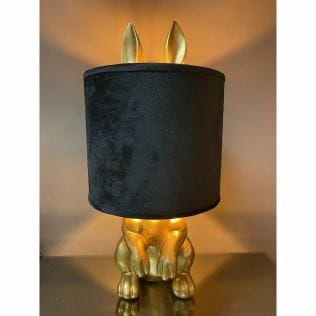
 Luxurious "Lucky Bunny" table lamp with black satin shade
88,00 €
Luxurious "Lucky Bunny" table lamp with black satin shade
88,00 €