Both in their design and their representation, abstract paintings challenge accepted "reality." They address a range of themes that inspire us to challenge our knowledge and explore new perspectives outside our comfort zone.
Abstract art lacks the typical reference points that provide the viewer with orientation; it lacks clearly identifiable elements. One of the elements that makes abstract photography both difficult and fascinating is this lack of contextualization.
Normally, the topic is only hinted at or gently expressed, instead of being clearly and precisely presented.
Abstract art is non-representational and does not attempt to depict or convey anything "concrete" or "real" . Therefore, the photographer must rely on other elements of composition and structure to give the image meaning and weight.
The toolbox of abstract photographers
Shapes, colors, textures, perspective, movement, and light are the tools of the trade for abstract photographers. Photography by Meagan Carsience @mcarsience_photography, via Unsplash
Abstract photographers generally emphasize lines and curves , colors , textures , and geometric forms, as well as their relationships and interactions. Therefore, the internal structure and the actual form of an abstract photograph are of great importance.
Abstract photographers deliberately employ methods and techniques such asperspective,movement, andlightto transform our perception of the world into unexpected and often difficult-to-recognize images.
Abstract photography is non-representational. It can explore the texture or details of everyday objects, or it can inspire you to think about something completely different
Professor and photographer Tina Tryforos in an interview with Adobe .
What is abstract photography?
There is no set guide to creating abstract images, however, there are some basic principles that artists can experiment with to steer their photographs into the realm of abstraction.
Photographs typically depict the real world, while abstract images offer a new perspective. Photographer Tryforos consistently encourages beginners to think less concretely about their surroundings. She inspires them to discover the unknown, to reflect differently on light and shadow, and to pay attention to shapes, patterns, and repetitions.
From a formal perspective, abstract photography is a technique for expressing ideas and emotions through photographed elements, without the intention of creating a classical or realistic image. By avoiding and going beyond the usual representations of an object, scene, or specific element, it reveals details that are often overlooked and stimulates the viewer's imagination
Joachim Rodriguez y Romero (my understanding of abstract photography)
The exact definition of abstract photography, or abstract artworks in general, is not simple and will likely never be definitive. Abstract photography is conceived or represented outside of our usual perception of reality.
A wide variety of themes can serve as inspiration for abstract photography . Such photographs can prompt us to reflect, step outside our comfort zone, and even encourage us to question what we see.
While realistic or "traditional" photography is often a literal depiction of the world, abstract photography represents the exact opposite. An art critic or viewer does not necessarily have to "understand" or try to "decipher" .
What do you see? Abstract photography aims to evoke emotions and stimulate thought. Photography by Esmee @lunemoon, via Unsplash
Abstract photography is meant to evoke emotions and stimulate thought. The meaning of such artworks can be perceived differently by each viewer.
Various art movements, visual artists, and photographers have experimented with different degrees of abstraction. Some abstract artists create works that are still relatively representational, while others dedicate themselves entirely to pure abstraction.
When you delve into abstract photography, you'll quickly discover that there are no usual common reference points. Often, the viewer will find that they see nothing that is immediately identifiable.
Abstract artworks often lack a generally understood context. Therefore, it is difficult to evaluate them using traditional art standards. This lack of context is one of the reasons why abstract photography is so fascinating, but also why it remains challenging for some viewers to understand or appreciate.
Independent, unbiased and free thanks to your click
Links marked with asymbol are affiliate links. We only recommend products we use (or would use) ourselves. If you visit affiliate links in our content, we may receive a commission on your purchase (at no extra cost to you). This helps fund the free editorial content we provide to you (more details here).
Why was abstract photography created?
Artistic photography unites the striking and unusual in conceptual, technical, and photographic terms, with the image increasingly moving away from the mere representation of reality. Abstract photography was born in the 19th century as a technical attempt to capture the hidden facets of reality.
Artistic abstraction from the early 20th century primarily served as a source of inspiration for abstract photography. Artistic photography largely developed as a response to the revolutionary ideas of Picasso , Kandinsky, Braque, and others.
The Cubist, Futurist, and Surrealist masterpieces, as well as the avant-garde photographers, all aspired to be part of this movement, which left a profound impression. Bold artists like Jaroslav Rössler, Man Ray , André Kertész, and László Moholy-Nagy dared to distort light, perspective, organic materials, and classical representations. The abstract paintings they created profoundly shaped the history of photography and inspired others to create their own abstract artworks .
Leda i el cigne (1946, Leda and the Swan) by László Moholy-Nagy Image source: MOHOLY-NAGY, László, CC BY-SA 4.0, via Wikimedia Commons
The Plexiglas work, which depicts the Greek myth of Leda and the Swan, aims to create a frame through the figure that plays with perspective and light.
According to a famous quote by Moholy-Nagy, photographers should “not seek the ‘image’ or the aesthetics of tradition, but rather find the ideal means of expression to create independent images.”
Key elements, methods, stylistic devices and characteristics
We've already discussed the toolbox of abstract photographers. In this section, let's delve a little deeper and expand the six building blocks of form, color, texture, light, perspective, and movement to include composition, simplicity, harmony, and mystery.
Although this style of modern photography lacks concrete definitions and guidelines, abstract photography can become deeper and more engaging through the integration of certain elements. Utilizing these elements can help create meaningful abstract photographs that evoke emotions in the viewer.
01 Composition
Although some common rules of composition in photography don't always apply, a successful abstract photograph is usually characterized by a clear, structured design. Intensive thought about arrangement, placement, and the harmonious balance between shapes, patterns, textures, and even colors defines an abstract work of art.
Semi-abstract photography “Mirror – Maria – 3136” (2016) by Robin Cerutti
These elements significantly influence the visual impact of the image, create and reinforce its focal point, and affect the viewer's perception. A well-composed photograph skillfully utilizes these visual components to achieve a common goal and result.
Even if certain conventions of composition are disregarded, it is still important to keep aesthetics
Many abstract photographs feature a structured design and incorporate the use of geometric shapes as well as creative depth of field . Therefore, it is crucial to harmoniously combine proportions, shapes, and colors.
For abstract photography, captivating compositions are essential to maintain the viewer's interest longer than in realistic depictions. The elements should be revealed gradually and always pose questions for the viewer. In abstract images, nothing is as it first appears.
Among the most prized – and expensive – works of art are peculiar, yet visually compelling photographs of objects that seemingly tell no clear story. Nevertheless, they motivate the viewer to speculate on a deeper level and remain captivated.
02 Forms
Form is the shape or structure of the object(s) that constitute the main part of the image – think of it similarly to composition and consider it the main structure of a work of art. Form defines the visual arrangement and interplay of elements within the image, whether through clear geometric shapes or organic, flowing lines.
Digital photography “Space #1” (2013) by Shinji Ichikawa
It is a central aspect of image composition, carrying not only aesthetic but often also symbolic meaning. Through the deliberate choice and arrangement of forms, artists can evoke emotional responses, add narrative layers, and guide the viewer's eye within the artwork.
03 colors
Color attracts the viewer and holds their attention for longer. Exciting colors lend depth and tension to the overall image, intensifying the visual impression and amplifying the emotional response. In an art context, vibrant color palettes not only offer aesthetic appeal but often reveal deeper meanings and moods that shape the work and stimulate interpretation.
Abstract photography “Twisted Soul Vertigo” (2024) by Eric Deper
The skillful use of color can play a crucial role in creating a narrative depth that encourages the viewer to linger and reflect.
04 Textures
Texture adds depth to an image and captures the viewer's attention by creating an atmosphere of intrigue and mystery. By incorporating contrasting textures, you can break up the artwork and encourage your audience to look more closely and question what they see.
Here, the textures and the curved shape of the photographed building create a fascinating effect. Photo by Kirill @kirillz, via Unsplash
Textures evoke in viewers the desire to reach out and touch them, creating a stronger emotional connection to the work.
05 Simplicity / Simplification
At first glance, abstract photographs may appear somewhat confusing and chaotic. However, once you understand the effects of "abstraction ," you will realize that the process actually involves a significant subtraction or simplification of the photograph .
Distracting and superfluous elements that do not evoke emotions and could irritate the viewer are removed from the image. Especially because what is depicted in the image is not immediately recognizable, this results in a clearer abstract work that is visually more vibrant and easier to interpret.
06 Perspective
Just as composition determines how the subject is presented in an abstract image, so too does the viewpoint. When choosing the right viewpoint, you must look for the best angle that complements your subject and keeps distractions out of the picture.
Aerial view “Baltic_Ice_II_Helsinki_011” (2024) by Bernhard Lang
Apart from being shot from an unusual angle, some abstract images are even mirrored or rotated during post-processing to obtain different views and orientations.
07 Light / Exposure
Lighting is a crucial element in virtually every style of photography. Depending on how it's used, it can emphasize, dramatize, or highlight the shape, details, or specific areas of a subject. The direction and intensity of the light source also play a significant role in guiding the subject's presentation and establishing the mood for the shot.
Abstract photography “light of life 68” (2019) by Santhosh CH
You will find that many of the most mysterious and fascinating abstract paintings feature silhouettes, backlighting, and interesting plays of light and shadow.
08 Movement / Dynamics
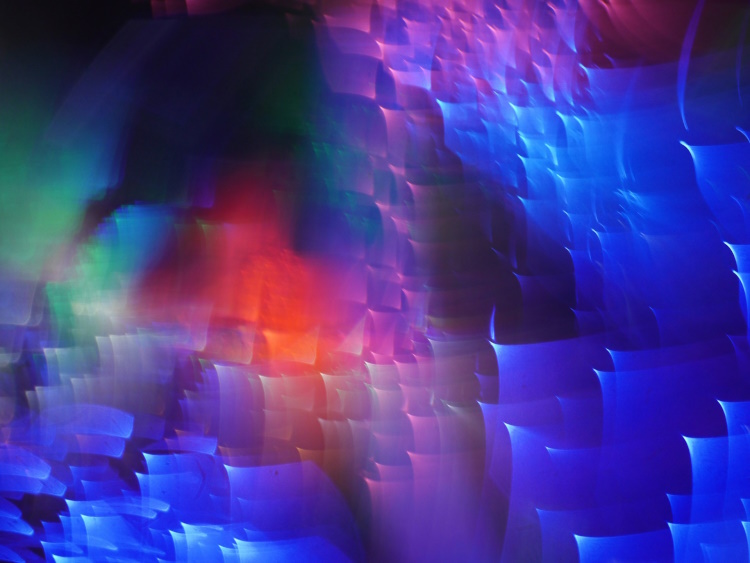
Traditional photographs are created using short exposure times, capturing individual, frozen moments. If you want to add dynamism to your image, you can achieve a certain abstraction through longer exposure times .
Abstract photography “the light of life 45” (2019) by Santhosh CH
By keeping the camera shutter open for an extended period, you can create long-exposure photographs, for example, to capture the motion blur of a car driving across the road. By holding the camera steady while the shutter is open, you can capture the vehicle's movement and leave the rest of the scene static.
In the image, the car then appears as a colored stripe, while everything else remains clearly recognizable. Consider also exploring motion blur of continuously moving objects like water or smoke to transform ordinary things into something ethereal.
Semi-abstract photography “Mirror – Juliette – 7441” (2023) by Robin Cerutti
In an abstract image, photographic elements are often minimalist , yet they contribute significantly to the visual balance and proportions. Consider an image with intense colors: here it is essential to contrast strong tones with more subtle colors.
Abstract photography “Fluidité en Turquoise et Violet” (2021) by Cristina Stefan
This prevents the colors from competing for the viewer's visual attention, creating clarity instead of confusion.These colors coexist harmoniously, complementing each other and supporting the image's focus. The result is a coherent and harmonious abstract photograph that offers deeper insights into the art of photography.
Semi-abstract nude photography “CONQUISTADORA Y CONQUISTADA” (2016) by Hugh Arnold
Abstract images evoke emotional responses and imaginations by containing an element of mystery and intrigue. In this way, abstract art conveys a sense of wonder to the viewer. This, in turn, motivates and encourages them to appreciate even the most complex yet inviting works of art.
The art of abstraction allows both artists and viewers to go beyond the obvious and explore personal interpretations.
Black and white photograph “Out of Shadows – NYC” (2018) by Joseph Cela
Consider, for example, the works of Jackson Pollock or Wassily Kandinsky, whose explosive richness of color and dynamic forms have an almost hypnotic effect. Here, the viewer is captivated not by recognizable objects, but by pure emotion and form. This allows for a deeper, more individual engagement with the art.
Abstract photograph “Scarpia” (2021) by Corinna Rosteck, multiple exposure on aluminum Dibond
The lack of perspective and clear lines in abstract paintings encourages viewers to project their own reality onto the image. Historically, abstract art broke with conventions and opened new doors in the art world. Exhibitions of these works offer a fantastic opportunity to delve deeper into this impressive art movement and develop personal interpretations.
When confronted with an abstract work of art, it is helpful to take your time and let the image work its magic. Allow the colors, shapes, and textures to absorb you and let your thoughts flow freely. This not only fosters a better understanding of the art but also enriches your personal perception and appreciation of the creative expressions of others.
Double Exposure Photography “Aya Seed” (2017) by Corinna Rosteck
In the following video from Adorama TV, professional photographer Doug McKinlay a quick overview of the various possibilities of abstract photography:
Different subjects of abstract photography
Abstract landscape photography
Landscape photography is a creative approach that focuses on capturing impressive and pristine natural landscapes to draw the viewer into the scene. This art form can be characterized as partially abstract or semi-representational.
Abstract landscape photography has a connection to reality, but is often only vaguely recognizable as a landscape. The main goal is to depict landscapes in innovative ways, with each artist pursuing their own individual style.
This form of representation differs fundamentally from real perception or conventional travel photography .
(Semi-)abstract nature photography
Abstract nature photography presents another fascinating dimension of semi-abstract photography. This art form draws on the realities and beauty of nature, but interprets them in a unique way that highlights particular details.
While this form of photography captures reality, it can do so in a way that completely distorts the original subject and sets it apart from concrete reality. However, this does not mean that this type of photography is indistinct or blurry. Rather, it is often precise, vibrant, structured, and clear, yet without aiming to provide a conventional representation of nature.
Nature photography can take the form of extreme close-ups, unconventional perspectives, or aerial shots from great heights, capturing the natural world in a completely unconventional way. This special perspective gives abstract photography its fascinating appeal.
Abstract Expressionism in Photography
Abstract Expressionism is one of the most important art movements of the 20th century. Within this broad field of art, abstract expressionist photography is considered a specific subcategory. This art style largely distinguishes itself from representational art and semi-abstract movements of past eras and is among the first completely abstract art forms.
The Abstract Expressionist movement, which emerged in the 1940s and 1950s, was characterized by two main currents: the German and the American Expressionists. Prominent artists and painters such as Jackson Pollock , Mark Rothko, and Willem de Kooning were among the American representatives.
The abstract expressionist movement was characterized by dynamic brushstrokes, splashes of paint, and spontaneous markings on the paintings. While the painters of this era became well-known figures, the styles of abstract expressionism are also reflected in photography.
The abstract forms of expression were predominantly non-figurative. Inspired by existentialist philosophy, they emphasized the creative process of art as more important than the final artwork.
In abstract expressionist photography, the focus is on the abstract arrangement of forms. These non-representational forms are depicted through positive and negative shapes in an image, rather than presenting a recognizable subject.
Renowned photographers of Abstract Expressionism include Aaron Siskind, Cy Twombly, Richard Pousette-Dart , and many others. As with numerous modern art movements, the painters of Abstract Expressionism were also inspired by innovative abstract photographers, while conversely, abstract painters also influenced photographers.
Paintings by Cy Twombly in the Paris Stock Exchange exhibition, Pinault Foundation, April 2023. Image source: Emilio Luque, CC BY-SA 4.0, via Wikimedia Commons
Many artists of this period created both photographic and painted works.
Abstract street photography
Abstract street photography uses reflections, blur, shadows, silhouettes, and colors to convey the feeling of an event rather than simply recording it. This contrasts with open street photography, which aims to capture a specific moment. Similar to geometric street photography, its aesthetic is generally more subtle.
So if you are a reserved photographer, this form of street photography might be just right for you.
A pioneer of abstract street photography was Saul Leiter (1923-2013). His compositions often had a painterly quality. It is therefore not surprising that he began his career as an artist. He experimented with various techniques to give his images an abstract touch.
For example, he photographed through small openings, resulting in negative space. He liked taking pictures in bad weather, which occasionally led to minimalist images. He also captured reflections that created distortions. He used depth of field unconventionally, allowing vibrant colors to stand out in blurred objects.
Some of his works produced an almost collage-like effect, especially the photographs of signs, as he frequently used a 150mm lens which created this flattening effect.
Other famous representatives of this subject are the Brazilian Gustavo Minas , Sarah van Rij and Aleksandr Babarikin .
Creative abstract photography represents a style of photography that conveys ideas and emotions through visual staging . It goes beyond simply depicting scenes and employs techniques more commonly found in painting, such as composition, emotion, subtraction, balance, subtlety, zoom, blur, texture, and especially lighting.
A creative photographer can, for example, enlarge a surface texture, thus detaching it from its original context. This leaves it unclear where the texture comes from or what exactly it represents. The viewer is thus encouraged to reflect on the meaning of the image and instead begins to speculate and imagine how the surface might feel.
A fascinating aspect of abstract art lies in its openness to different interpretations. Because abstract photography lacks a universally understood point of reference, each viewer experiences a work of art in their own individual way.
This perspective creates space for unbridled associations. Due to its abstract nature, which by definition is abstracted from concrete reality, each viewer has the opportunity to derive a personal story and meaning from a work.
Famous abstract photographers
Several artists have created groundbreaking works in this genre, distinguished by innovative techniques and unique perspectives. Some of the most renowned and respected abstract photographers (in addition to those already mentioned in the article) are:
Ola Kolehmainen– This Finnish photographer is known for his minimalist and geometric compositions, which often transcend architectural structures into a new, abstract dimension.
Harry Callahan– Callahan was one of the pioneers of modern photography and often experimented with multiple exposures and abstract forms to evoke profound emotional reactions.
Angie McMonigal– The American artist creates fascinating abstract images that depict urban landscapes and architecture in innovative ways. Her photographs offer a fresh and often surprising perspective on everyday structures.
Jackie Ranken– This New Zealand-based photographer uses nature as her canvas, transforming ordinary landscapes into impressive abstract works of art through skillful composition and exposure techniques.
Frances Seward– Seward's work is characterized by the use of intense colors and organic forms, often reminiscent of paintings. Her abstract photography is a fascinating fusion of nature and fantasy.
Matthieu Venot– The French photographer captures the essence of architectural details and isolates them in his images, transforming everyday criteria into impressive geometric works of art.
Alexander Jacques– Jacques is known for his abstract photographs of urban structures, which are striking due to unusual perspectives and graphic elements.
Andrew S. Gray– This artist uses a combination of photography and digital manipulation to create stunning abstract works that are both surreal and visually impressive.
These artists and many others have created groundbreaking works through their unique approach and innovative use of the camera, pushing the boundaries of photography and inspiring the viewer to see the world with new eyes.
Why not visit an exhibition or browse through the wide variety of abstract photographs to enrich your own creative journey?.
Is abstract photography something for you?
As we already know, photography is an art form strongly influenced by individual perception. The diversity of people's views and reactions is fascinating. To immerse yourself in the world of photography and truly understand what it's all about, you have to experience it yourself!
A major advantage of abstract photography is its affordability. There's no need to acquire expensive props or travel – everything can be done comfortably from home.
To make it easier for you to get started, thanks to the information and support of iPHOTOGRAPHY , Adorama , Jane Trotter of Abstracted Reality,Tina Tryforos,Canon and Adobe, compiled a collection of helpful tips and hints to stimulate your creativity and guide you in the right direction.
Tips for beginners
01 Let's start with everyday things
The creative reinterpretation of objects defines abstract photography. Starting your photography journey by experimenting with everyday objects in your own home can help you develop your skills. The doors to abstract thinking open, and artistic inspiration can be found everywhere when you can view the familiar from a new perspective.
Although practically anything can be a fascinating subject for your artistic photographs, it will seem surprising. Boldly take any object or collection of objects—from a lonely houseplant to the worn cutlery in your kitchen—and photograph it in an innovative yet striking way.
Go outside and capture the morning dew, wade through the November fog, explore nearby forests, or discover the architectural forms of your surroundings.
Every detail can serve as a source and inspiration for abstract artworks.
02 Close-Ups / Get up close to your subjects
Prepare yourself for macro and close-up photography . An interesting approach to abstract photography is to magnify a familiar subject. Artists like Aaron Siskind explore multiple scales to fully examine and draw attention to the intricacies of an object.
Many photographers use macro lenses to simplify the subject
Tryforos tells us that by using a macro lens, you can explore these details in detail. Remember to take a macro photo of sand on the beach.
If you look at the fine structures of sand, sugar, salt or snow in isolation and concentrate on the shadows, texture and lighting of the individual grains, an impressive abstract image emerges.
Flowers and jewelry are other popular subjects in macro photography. And by including abstract elements, you can reveal a whole new side to these objects.
03 Use design elements to your advantage
The use of various photographic elements such as lines, shapes, textures, patterns, and colors can encourage viewers to look at and interpret your photos in diverse and profound ways. Lines and curves cleverly guide the eye through the image, potentially leading it to the main subject of the photograph.
Architectural photography offers inspiring principles that you can apply to the buildings in your surroundings.
Patterns and textures have a captivating effect and can surprise your viewers when viewed up close, revealing their origin. The targeted use of color can highlight specific aspects or lend your image a striking visual impact.
Discover these elements in your surroundings and use them to create appealing abstract images.
04 Explore the world of textures and the interplay of light and shadow
Experimenting with the texture and tonality of your images can be very exciting. In abstract photography, you have the opportunity to transform a picture of an old piece of furniture with peeling paint or the grid of a drain into something completely new, focusing on patterns, colors, light, and textures. Different textures can evoke different moods and emotions in the viewer.
Therefore, consider what kind of atmosphere you can create simply by using colors and shapes.
Nature photography, in particular, offers a fantastic platform for playing with different textures. Aerial photographs of the ocean, for example, can transform the colors and shapes of the waves into fascinating patterns. Even the geometric contours of an industrial building can, from a certain angle, resemble intricately patterned fabrics.
No matter what subject you want to capture: If you take it out of its usual context and focus on its textures and colors, you can create impressive abstract works of art.
05 Photographing through objects
Using an improvised “lens filter” allows you to create extraordinary and abstract images. Colored filters and gels can help you avoid time-consuming post-processing of your photos to give them a captivating color palette.
Abstract street photography “MANHATTAN RAIN” (2016) by Florian Innerkofler
For example, on a rainy day, try photographing through transparent glass, water , or even a car window to create interesting distortions and refractions of light, resulting in unusual yet aesthetically pleasing images. Experiment boldly with different objects to discover how they can influence your photographs.
Semi-abstract photography “mirror – alban” (2018) by Robin Cerutti
By skillfully altering both the direction and intensity of the light source, numerous effects can be achieved. Subject highlights are emphasized through targeted lighting, which also helps to center the image. Placing a strong light source to the side creates shadows that accentuate texture.
Although it reduces the drama, even and diffuse lighting allows the viewer to examine several areas of the image more closely, rather than just one spot.
Position the light source slightly behind the subject to play with backlighting and silhouettes. These methods offer different approaches to controlling light and shadow, adding complexity, mystery, and appeal to your photos.
07 Capture movements
While abstract photographers approach the subject from a different perspective, many photographers question the blurriness of the subject. Deliberately move your camera at the moment when you capture a remarkable blend of different colors, lines, and patterns.
Depending on the direction of movement, this can resemble the brushstroke techniques of painting. Move the camera from left to right, starting in a specific way. Also try circular and wiggling movements. Experiment with these methods to see how your data sets change and ultimately identify trends.
To properly capture motion blur, make sure a shutter speed of at least 1/10 of a second or faster. If your photo appears overexposed, you can switch to shutter priority mode or reduce the ISO and aperture.
08 Reduction – Remove distracting elements
It is generally advisable to omit certain aspects of an image to organize the shots. It is recommended to try several strategies and carefully consider which components apply to your image.
Furthermore, it's important to always clearly explain the reasons behind certain judgments. Eliminating irrelevant elements can help your visitors focus more on the main subject and examine it more closely. This will draw even more attention to your image.
09 Create abstract landscapes
The combination of abstraction and landscape photography might initially seem paradoxical. Although abstraction attempts to transcend the concrete, realistic landscape photography captures the beauty of the surroundings.
Nevertheless, nature can inspire one to combine these two techniques and create astonishing abstract landscapes. Recognizable landscapes can be transformed into striking abstract works through the use of aerial photography, deliberate camera movements , or scale occlusion . A remarkable example of this is the rapid panning of the camera along a forest, which blurs the colors and makes the outlines of the branches disappear.
These methods make it possible to view ordinary scenes from new perspectives and transform them into abstract works of art. These image tests not only provide fresh perspectives on familiar subjects but also expand the creative scope of landscape photography.
Let nature motivate you to reach artistic heights and discover the aesthetic power of abstract forms.
10. Experiment with different recording styles
To effectively implement this advice, you first need to know exactly how your camera works. You can modify your results as you wish if you understand precisely how different camera settings can affect your photos. Creative experimentation with this know-how can significantly expand your photographic possibilities; you could play with depth of field, image blur, or unusual perspectives . You can change the white balance , rotate your images, or try entirely different artistic approaches.
Your greatest advantage here is your willingness to experiment. Try out different techniques from product photography, outdoor photography, or even sports photography to achieve unique and abstract results.
This tip gives you the freedom to fully unleash your creativity. Seize the opportunity to develop your creativity and explore new photographic avenues.
11 ICM Technique (Intentional Camera Movements) / The Camera Blur Effect
A carefully planned camera pan, combined with a shutter speed of 1/15 of a second, transforms an ordinary street scene into a captivating blur ( the blur effect or ICM technique ). Photographers usually tend to avoid camera shake, but deliberate movements during exposure can create unique streetscapes and capture the special atmosphere of a particular location.
Street photography veteran Olga Karlovacmakes extensive use of the blur effect during her forays through streets, paths and alleys.
The crucial factor here is choosing a shutter speed that is slow enough to create blur, yet fast enough to capture the impression of people and shapes. A good starting point is to set your camera's Shutter Priority (Tv) mode to a shutter speed of 1/15 of a second. Begin with an ISO sensitivity of 100 and adjust it according to the lighting conditions until the exposure meets your expectations.
Then press the shutter button and simultaneously make a precise, quick movement with the camera. A vertical movement is particularly recommended for scenes with people, as it preserves their outlines. Alternatively, you can also try sideways movements or quick rotations.
In Shutter Priority (TV) mode, it is also possible to set the ISO value to “Auto” – this is possible on most cameras – which allows you to concentrate fully on the shutter speed.
12 Double Exposure
The traditional technique of double exposure, prized since the 19th century, allows one image to be placed over another, producing stunning results.
Modern cameras like the Canon EOS 90D ( available on Amazon ) have special multiple exposure modes that allow you to create this effect while shooting. By activating the appropriate mode, selecting the number of exposures, and taking the shot, you can preview the effect in real time on the screen. This gives you the opportunity to make targeted adjustments and achieve the most interesting combination.
Abstract double exposure “The Fusion” (2015) by Ruslan Bolgov, atmospheric black and white photography
When choosing subjects and scenes for your double exposures, keep in mind that bright areas can only remain the same or become more intense, never darker. This means that dark buildings and shapes against a bright background, such as the sky, can result in powerful images.
13 Overlaying multiple frames
Why stop at double exposures? Explore the creative potential of the multiple exposure mode into advanced cameras like the Canon EOS 90D or the full-frame mirrorless Canon EOS RP ( available on Amazon ). This allows you to take multiple shots and combine them into a single, atmospheric, and artistic image.
The Canon EOS RP system camera – with RF 24-105mm F4-7.1 IS STM lens – enables creative multi-exposure photography.
Imagine you set yourself a goal: to create a remarkable architectural photograph that doesn't just show a single building, but captures the entire atmosphere and character of a place. To achieve this, you could, for example, take five different pictures, slightly varying your angle and lens zoom.
These nuanced changes in composition contribute to each image having its own unique perspective and mood.
The true magic unfolds during the shooting process: the images are harmoniously layered, creating a stunning multiple exposure effect. This technique not only allows you to capture more of what your lens sees, but also to create a creative expression that transcends the boundaries of conventional photography.
It is a way to tell stories visually and capture emotions – an invitation to the viewer to delve deeper into your image.
14. Capturing Reflections and Mirror Images
Reflections also offer a multitude of possibilities for creating captivating images. While reflections can produce vibrant and dynamic pictures, you should still pay attention to what you include within the frame. Ensure that the overall composition appears harmonious and not simply chaotic.
Working with reflections offers the opportunity to explore and experiment with different surfaces. It's fascinating to observe how light hits water or glass, opening up a new dimension in your photography.
Semi-abstract photography “Mirror – Geneviève” (2012) by Robin Cerutti
The reflection of buildings in a puddle or the distortion of faces in a window can introduce unexpected and creative elements into your photographs. Through skillful composition and the targeted use of reflections, you can achieve interesting visual effects that guide the viewer's eye and challenge their perception.
Remember that reflections are not just a picture of reality, but also reflect your own interpretation and artistic vision. Experiment with different angles, exposure settings, and focus points to create unique and exciting images.
Reflections are like a game of light and shadow that the photographer skillfully masters – therefore, use this creative tool to further develop your photographic art.
15 Silhouettes and shadows
When we photograph silhouettes and shadows, especially of people, we can capture some truly astonishing, pure expressions – precisely because we lack the details of what the subjects look like. You can also get quite creative and abstract with this approach, for example by combining two shadows: What are the objects? Who knows? What do they look like? The choice is yours.
Abstract photography “L'Ombre de la femme voilée” (2014) by Souhayl A
A similarly creative approach can also be applied to architectural photography. By focusing on the basic shapes of buildings and structures and capturing them as silhouettes or shadowy outlines, you create a fascinating representation of urban landscapes.
Abstract street photography “The woman in the hat #11E” (2017) by Souhayl A
The contrast between light and dark can dramatically enhance the visual impact of your images while simultaneously creating a certain mysterious atmosphere. Experiment with different angles and lighting conditions to strategically use the effects of silhouettes and shadows to create distinctive photographic works.
16 Pareidolia sought
Pareidolia, as described by the Cambridge Dictionary, refers to a situation in which someone sees a pattern or image of something that doesn't actually exist—for example, a face in a cloud. Photographing such pareidolia presents an entertaining and fascinating challenge, involving the search for objects that look astonishingly like other things.
Pareidolia photograph “baumkörper03” (2020) by Friedemann Baader
It's probably easiest to spot faces or animals in seemingly unrelated objects. This kind of photographic game not only provides creative fun but also sharpens our eye for the often overlooked details of our surroundings.
Try it out for yourself, and you'll be surprised by the hidden patterns and figures that suddenly reveal themselves.
17 Post-production – Make the most of the possibilities of post-production
Creating great abstract images requires not only skill with the camera but also crucial post-processing. Whether you're using a DSLR or digital camera in combination with Adobe Photoshopabstract image after shooting .
Adjust the saturation of your images, experiment with RGB curves, or increase the contrast. Try transforming an ordinary image into an abstract work of art using only post-processing tools. Dodge and Burn, for example, can be used to enhance the drama.
Besides the option to unleash your creativity and create your own unique abstract works, post-processing offers the chance for individual customization. There are no limits when editing abstract photographs.
Abstract photographers are explicitly encouraged by professionals to digitally develop their works – be it by recoloring, cropping, reshaping, distorting or mirroring images.
Sources, support, inspiration and further information:
Adobe:Think outside the box with abstract photography, https://www.adobe.com/creativecloud/photography/discover/abstract-photography.html
Tina Tryforos , https://www.tinatryforos.com/
Jane Trotter:Definition of Abstract Photography , https://abstractedreality.com/definition-of-abstract-photography/
iPHOTOGRAPHY : What is Abstract Photography? , https://www.iphotography.com/blog/what-is-abstract-photography/
Affiliate Links Disclaimer: with a - symbol are affiliate links. As a general rule and without exception, we only recommend or link to products that we use (or would use) ourselves and all opinions expressed here are our own. Our product reviews and recommendations are independent and based on research, expert opinions, and/or product testing. If you click on affiliate links in our content, we may receive commissions for your purchases (at no extra cost to you), but we never receive any compensation or payment for the content of our recommendations. This is how we finance our editorial work and the magazine articles we provide to you free of charge (details in our Editorial Standards ). Read the full PrivacyPolicy .
Owner and Managing Director of Kunstplaza . Publicist, editor, and passionate blogger in the fields of art, design, and creativity since 2011. Graduated with a degree in web design from university (2008). Further developed creative techniques through courses in freehand drawing, expressive painting, and theatre/acting. Profound knowledge of the art market gained through years of journalistic research and numerous collaborations with key players and institutions in the arts and culture sector.
The art style or also the direction in artworks refers to the uniform expression of the artworks and cultural products of an era, an artist or an artist group, an art movement, or an art school.
This is a tool for categorising and systematising the diversity of art. It denotes similarities that distinguish it from others.
The term is thematically related to the Art Movement, but it should not be viewed solely within a temporal framework and is therefore much broader.
In this section, we would like to help you gain a better understanding of styles and movements in art.
We use technologies such as cookies to store and/or access device information. We do this to improve your browsing experience and to display (non-)personalized advertising. If you consent to these technologies, we can process data such as browsing behavior or unique IDs on this website. Refusal or withdrawal of consent may adversely affect certain features and functions.
Functional
Always Active
Technical storage or access is strictly necessary for the legitimate purpose of enabling the use of a specific service expressly requested by the subscriber or user, or for the sole purpose of carrying out the transmission of a message over an electronic communications network.
Preferences
The technical storage or access is necessary for the legitimate purpose of storing preferences that were not requested by the subscriber or user.
statistics
Technical storage or access that is solely for statistical purposes.Technical storage or access that is used solely for anonymous statistical purposes. Without a subpoena, the voluntary consent of your internet service provider, or additional recording by third parties, the information stored or retrieved for this purpose cannot generally be used to identify you.
marketing
Technical storage or access is required to create user profiles, to send advertising, or to track the user on one or more websites for similar marketing purposes.





 Maritime canvas painting "Coast Bird", hand-painted on metal
The original price was: €245.00215,00 €The current price is: €215.00.
Maritime canvas painting "Coast Bird", hand-painted on metal
The original price was: €245.00215,00 €The current price is: €215.00.


