We encounter "Memento Mori" today in many forms, from classical art to modern music albums by Depeche Mode and Feuerschwanz . This Latin expression has been reminding us humans for hundreds of years not to forget our mortality.
Skulls, sand watches , extinguished candles, and withered flowers – all these motifs can be found in memento mori art , which prompts us to reflect on the transience of life. The word "vanitas," which also frequently appears in this context, originates from the Judeo-Christian concept that everything on earth is transient. The term "memento mori" can be understood as an invitation to live life more intensely because it is so fleeting and fragile.
But memento mori is not merely a historical phenomenon. In contemporary pop theory, the paradigms of recycling and synthetic retro trends a current topic—a culture that cannot let go of its own waste. Moreover, museums are often referred to today as “cruise ships of culture” when it comes to their environmental impact. This modern interpretation shows how the old concept is acquiring new meanings in our time.
Memento Mori: What transience in art teaches us about life. Image serves illustrative purposes and was created with the help of an image AI.
The Latin expression runs like a red thread through art history, and its meaning goes far beyond a mere reminder of death.
Origins and levels of meaning
The expression originates from ancient Rome, where it was part of a strange ritual. During victory parades, a slave would stand behind the general holding a gold or laurel wreath above his head while constantly whispering words of warning:
“Memento mori.” (Remember that you will die.)
“Memento te hominem esse.” (Remember that you are a human being.)
“Respice post te, hominem te esse memento.” (Look around you and remember that you too are only human.)
This practice served as a gesture of humility, ensuring the general's triumph wouldn't go to his head. The proverb was forgotten for a time after the fall of Rome, but it was revived in the Christian world in the 10th century. There, it evolved into a symbol of vanitas – the transience of all earthly things.
What is the difference between memento mori and vanitas?
There are still small but important differences between the two ideas, even though they are very similar. Vanitas, which in Latin "vanity" or "empty appearance ," is a Christian concept that emphasizes the futility of striving for earthly goods and beauty. The word originates from the Book of Ecclesiastes and urges people to abstain from certain sins and vanities.
On the other hand, memento mori is more universal. It is less a warning than a reminder—not of specific sins, but of the fundamental fact that everything is transient and death is certain. Memento mori transcends cultures because it originates in the ancient Greco-Roman world and is not tied to any particular religion.
But these subtle lines are often difficult to discern in art. Hidden memento mori messages are common in still lifes from the 17th and 18th centuries. The Baroque period is exemplary of the vanitas motif, which depicts life and death side by side.
Why death is so present in art
It is no coincidence that death is a recurring theme and symbol in art. Knowing that we will die is a significant part of what makes us human. This urge has been particularly strong during times of collective trauma. For example, the terrible plague that swept through Europe in the 14th century, killing approximately one-third of the population, reinforced the concept of memento mori.
When we engage with death in art, we can understand the incomprehensible. Art is like a dance for life, and it helps us to change our view of death and even to perceive it as a "delightful elixir of rejuvenation."
This theme was therefore very popular in medieval art . The Dance of Death paintings, depicting skulls, clocks, watches decaying bodies, were meant to remind people that life is short and that they should prepare for the afterlife. Ultimately, the symbolism of death of our own mortality, but in a strange way, it also reminds us how precious life is.
Memento mori in art history
The artistic journey of memento mori spans thousands of years and vividly illustrates how different eras have conceived of the idea of mortality. The history of death symbolism is profound and diverse, ranging from ancient ceremonies to complex paintings.
Roman tradition and ancient roots
The roots of Memento Mori reach back to ancient Rome. There, the slave in question would walk with the victorious commander during his victory parade and whisper a cautionary message to him (see above). This was a symbolic act that demonstrated how fleeting even the greatest honors are.
Rediscovery in monasteries during the Middle Ages
The memento mori motif was forgotten when the Roman Empire collapsed. It reappeared only in a manuscript by Noker of Zwiefalten from Hirsau Abbey in 1070, during the Cluniac Reform . This movement arose because the Church was in a dire state during the 10th century. Many popes had committed terrible acts, causing people to lose faith in the Church. The reform called for greater piety, stricter regulations for the clergy, and a return to the idea that life is short.
In the late Middle Ages, many works of art appeared that typically depicted death and decay in a dramatic manner. But the warning of one's own mortality also included a call to live a good life and earn the "treasures of the heavenly kingdom ." The concept of memento mori became particularly entrenched in people's everyday lives in the wake of the Black Death, which swept across Europe in the mid-14th century.
Baroque vanitas still lifes as a highlight
During the Baroque period, memento mori art reached its zenith. The vanitas still life became the most typical type of Baroque still life. This style of painting reached its peak in the 1620s, which was also the time of the terrible Thirty Years' War (1618–1648).
Ingvar Bergström divided his still lifes into three groups: symbols of earthly existence (books, musical instruments, money), symbols of transience (skulls, sand watches , extinguished candles), and symbols of rebirth (ears of wheat, laurel, ivy). The paintings were “private devotional images” that helped people contemplate death and eternal life.
The example of Holbein's "The Ambassadors"
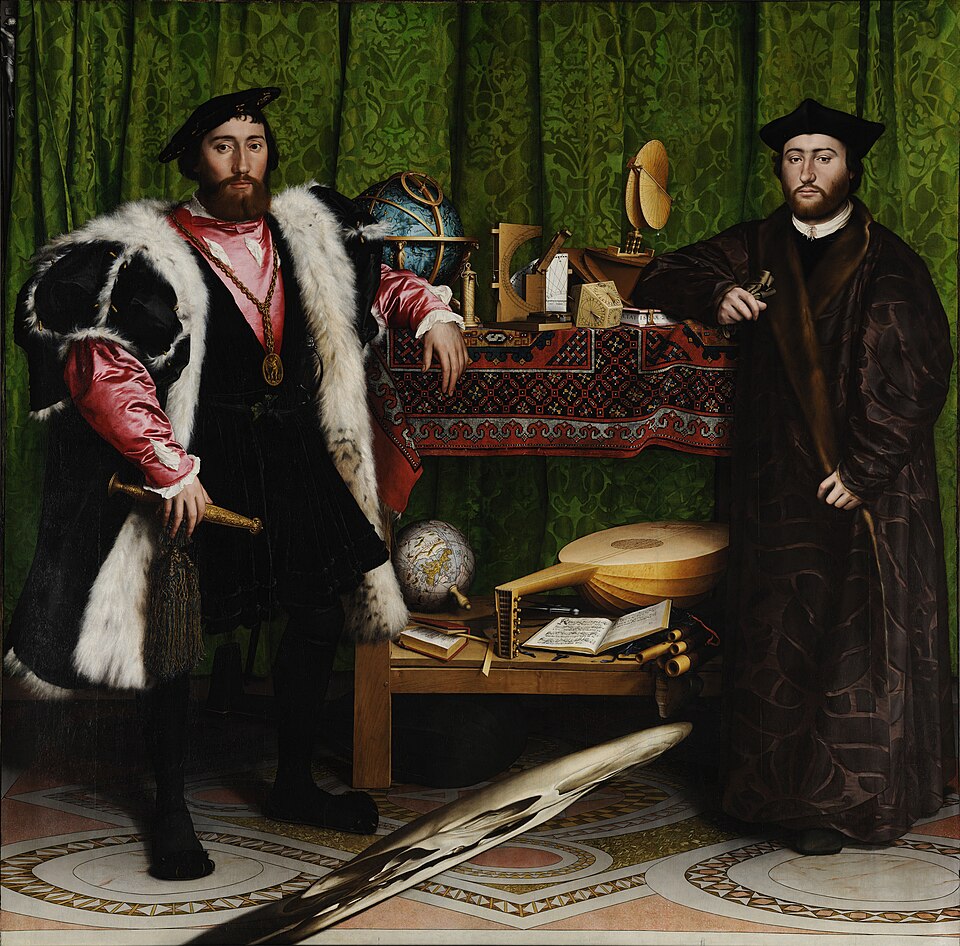
Hans Holbein's painting "The Ambassadors" from 1533 is a magnificent example of memento mori art. It depicts Jean de Dinteville, the French diplomat at the court of Henry VIII, and Georges de Selve, the Bishop of Lavaur. We see a deformed skull in the foreground of the painting, which can only be properly viewed from a specific angle. This anamorphic skull serves as a powerful reminder of how fleeting power and wealth can be.
The Ambassadors is a well-known painting by Hans Holbein the Younger, created in the spring of 1533 in London.
Furthermore, the painting contains another, easily overlooked memento mori symbol: in the upper left corner, almost entirely hidden behind a green curtain, is a silver crucifix. These details make "The Ambassadors" a prime example of how artists wove memento mori symbolism into their works – as a subtle yet powerful reminder of the mortality of even the most powerful people.
Memento mori today: between pop culture and protest
In our time, the memento mori motif has undergone a transformation. The concept can be found in popular art forms as well as in political protest movements.
Depeche Mode and Feuerschwanz: Music as modern vanitas
The theme of mortality also shapes the modern music landscape. This is particularly evident in the work of Depeche Mode , whose 2023 album was titled “Memento Mori” (as reported by WELT ).
Curiously, much of the material was written before the death of their bandmate Andrew Fletcher, giving the album an additional emotional depth. Martin Gore explained the title as a reminder "that we are all mortal," while Dave Gahan elaborated: "That we have to die! Every one of our songs is a memento mori, even the old ones."
In fact, Depeche Mode's music was always vanitas music, comparable to dark wave or heavy metal . The German band Feuerschwanz adopted this concept. Their album "Memento Mori" combines medieval folk-rock elements with a confrontation with human mortality. The album sings "in typical Feuerschwanz fashion of great adventures, past battles, and glorious deeds" (source: Feuerschwanz Bandcamp) , while simultaneously prompting reflection on one's own existence.
Art actions against climate change
Furthermore, the protest against climate change reached the art world. In 2022, environmental activists from the "Just Stop Oil" began gluing themselves to famous paintings to protest the lack of radical climate policies. These actions began in Glasgow, where activists sprayed the words "Just Stop Oil" on museum walls and glued their hands to the frame of a landscape painting ( REPUBLIK: The Landscape Painting as Memento mori ).
One participating art student explained: “No painting is worth more than the life of my six-month-old nephew.No sculpture can feed a baby .” These forms of protest deliberately use the shock effect, demonstrating how easily even universally known works could be destroyed. Many of these landscape paintings ironically depict scenes “that no longer exist or soon will no longer exist”—a modern memento mori for vanishing ecosystems.
Museums as political actors in the Anthropocene
At the same time, museums are becoming more political. For example, the Royal Ontario Museum in Toronto has appointed the first “Curator of Climate Change .” This change shows that more and more people are becoming aware of the climate crisis. Nevertheless, museums face a difficult situation: Julie's Bicycle , a non-governmental organization, conducted a study and found that museums have a disturbingly large ecological footprint, accounting for 41% of the CO2 emissions from all cultural activities.
In response, London's Tate Modern announced in 2019 that it would play a unique role in bringing about meaningful social change. It pledged to reduce its CO2 emissions by 50% by 2023 and to be carbon neutral by 2030. Artists like Lisa Jackson using new technologies such as virtual reality to create idealized visions of the future, such as "nature reclaims the city of Toronto .
In this conflict between art and politics, the memento mori motif, which has existed for hundreds of years, takes on a new, urgent meaning. It reminds us not only of our own mortality, but also of how fragile the world is in which we live.
What Memento mori teaches us about life
The Memento Mori principle offers profound wisdom that has inspired people for millennia and encouraged them to live more mindfully.
Knowing that you will die
According to Stoic philosophy, death is nothing to fear; it is simply the end of life. In a strange way, this perspective can lead us to live more fully and authentically. Marcus Aurelius expressed this quite clearly:
“If a god were to tell you that you would die tomorrow or the day after at the latest, you could only rejoice in this ‘day after tomorrow’ if there is nothing noble in you.”.
Memento Mori is indeed a powerful tool for self-reflection and purposeful action. We often forget about death in our daily lives, even though it is inevitable. However, reflecting About us own mortality makes us aware that we don't have all the time in the world and urges us to live more intensely.
Appreciating the moment
Whatever the case, life is good.”
Goethe wrote , contrasting the Christian memento mori with his emphatic “memento vivere” (“remember to live”) . For him, appreciating the beautiful moment was a fundamental principle:
"Man is truly only meant to act in the present.".
Already in medieval Europe, and continuing today in most East Asian spiritual traditions, there is a close connection between the art of living and the themes of transience. Seneca emphasized that life only gains value through the awareness of one's own mortality, as it encourages us to view the present moment as a gift.
An ethical compass in everyday life
In practical life, this concept can serve as an ethical guideline. By regularly reminding ourselves of our mortality, we are encouraged to reconsider our priorities and focus on what is essential. Marcus Aurelius advised:
Don't act as if you have thousands of years to live. Death is hanging over your head. As long as you live, as long as you can, be a righteous person
The value of this attitude is particularly evident in interpersonal relationships. We perceive minor arguments or disagreements with family members or friends differently and are more readily willing to reconcile. Anyone who contemplates death inevitably encounters profound questions: What is death? Is death a good or an evil? How should I rationally respond to my own impending death?
This perspective can ultimately help us to lead a life that is meaningful not only to ourselves but also to others.
How artists work with the motif today
The contemporary art world is reinterpreting the motif in fascinating ways, focusing on modern media and current social challenges.
Contemporary interpretations of vanitas
Contemporary artists have taken up and redefined the traditional vanitas motif. Exhibitions such as "Vanitas Contemporary" present outstanding examples of international art and photography, ranging from depictions of social decadence and advertising aesthetics to abstract image metamorphoses.
Modern vanitas paintings use new forms of expression alongside classic symbols such as skulls, with artists likeTarek,SkepaandYkstreetart simplifying the motif, while others create more detailed depictions.
Digital Art and Virtual Reality
In the digital age, allegories of death are also finding new forms of expression. Projects like Forevermidi 's “Digital Memento Mori” serve as a significant reminder in virtual environments that are often dedicated to idealization and an unrealistic self-image.
Furthermore, artists like Lisa Jackson use virtual reality to create utopian visions of the future. In her film “Biidaaban: First Light,” nature reclaims the city of Toronto, thereby also healing wounds from the colonial past.
Eco-Art and sustainable exhibitions
Environmental themes have further enriched the subject matter. Under the overarching theme of “Memento Mori,” works addressing current issues such as the fragility of creation and ecological changes have been exhibited in Linz's Ursuline Church . Following the years of the pandemic, these exhibitions represent “a strong sign of life from outstanding young artists .
Example: Liz Larner and recycled sculptures
Californian artist Liz Larner has created a striking example of modern memento mori art with her recycled sculptures. At the Kunsthalle Zürich , she presented an installation made from plastic waste she had fished out of the sea. Her work, “Meerschaum Drifts,” consists of children's toys, bags, and packaging fused together.
Larner investigates why some objects sink in water while others float. Her art combines established and unorthodox perspectives with a detailed knowledge of history, form, and material, while simultaneously drawing attention "a catastrophe that we cannot control."
Why Memento mori is more relevant than ever
Looking at the history of memento mori through the centuries, a remarkable continuity emerges: the seemingly somber motif ultimately reveals itself as an affirmation of life. While the forms of representation have changed – from the whispering slave in triumphant Rome to Baroque still lifes, and on to digital art and environmental activism – the core message remains unchanged. Indeed, this age-old wisdom is gaining even greater urgency in light of the climate crisis.
Recognizing mortality by no means implies renouncing life. Quite the contrary: it is the awareness of our own finitude that gives the moment its true value. “Memento vivere” – remember to live – thus becomes the logical consequence of memento mori. Stoic philosophy teaches us that this realization can be liberating. Those who accept their own mortality live more consciously, more authentically, and often more generously.
What is particularly fascinating is how contemporary artists take up and reinterpret this motif. Whether through recycled plastic waste in Liz Larner's work or digital vanitas depictions, they hold a mirror up to us while simultaneously pointing out new paths forward. In doing so, they extend the memento mori concept to our entire environment: what is threatened today could be irretrievably lost tomorrow.
Ironically, it is precisely contemplating mortality that leads us to greater vitality. Those who don't repress the thought of death live more intensely. Those who acknowledge the fragility of our existence often find deeper connections with others. Regardless of whether we subscribe to a religious worldview or not, the memento mori reminds us that our time is limited. This realization makes every encounter, every sunset, every work of art more precious.
Owner and Managing Director of Kunstplaza . Publicist, editor, and passionate blogger in the fields of art, design, and creativity since 2011. Graduated with a degree in web design from university (2008). Further developed creative techniques through courses in freehand drawing, expressive painting, and theatre/acting. Profound knowledge of the art market gained through years of journalistic research and numerous collaborations with key players and institutions in the arts and culture sector.
Conceptual art is an artistic style that was coined in the 1960s by the US artist Sol LeWitt (in English-speaking countries: Conceptual Art).
The origins of conceptual art lie in minimalism , and with it the theories and tendencies of abstract painting further developed.
What is special about this style is the fact that the execution of the artwork is of secondary importance and does not have to be carried out by the artist themselves. The focus is on the concept and the idea, which are considered equally important for the artistic work.
In this section of the art blog you will find numerous articles and content about this topic, as well as about artists, exhibitions and trends.
Art Dictionary and Glossary
Like any subject area, art also has a wealth of specialised terminology, expressions, abbreviations, and foreign words.
In this section, we would like to introduce you to some of the most important and common terms from time to time.
You will be able to learn and deepen your understanding of a range of information, definitions, liturgical terms, notes, common technical terms and their abbreviations, as well as concepts from art theory, art history, and art philosophy.
The art style or also the direction in artworks refers to the uniform expression of the artworks and cultural products of an era, an artist or an artist group, an art movement, or an art school.
This is a tool for categorising and systematising the diversity of art. It denotes similarities that distinguish it from others.
The term is thematically related to the Art Movement, but it should not be viewed solely within a temporal framework and is therefore much broader.
In this section, we would like to help you gain a better understanding of styles and movements in art.
We use technologies such as cookies to store and/or access device information. We do this to improve your browsing experience and to display (non-)personalized advertising. If you consent to these technologies, we can process data such as browsing behavior or unique IDs on this website. Refusal or withdrawal of consent may adversely affect certain features and functions.
Functional
Always Active
Technical storage or access is strictly necessary for the legitimate purpose of enabling the use of a specific service expressly requested by the subscriber or user, or for the sole purpose of carrying out the transmission of a message over an electronic communications network.
Preferences
The technical storage or access is necessary for the legitimate purpose of storing preferences that were not requested by the subscriber or user.
statistics
Technical storage or access that is solely for statistical purposes.Technical storage or access that is used solely for anonymous statistical purposes. Without a subpoena, the voluntary consent of your internet service provider, or additional recording by third parties, the information stored or retrieved for this purpose cannot generally be used to identify you.
marketing
Technical storage or access is required to create user profiles, to send advertising, or to track the user on one or more websites for similar marketing purposes.







 Anatolian tile necklace with glass cabochon pendant
26,90 €
Anatolian tile necklace with glass cabochon pendant
26,90 €


