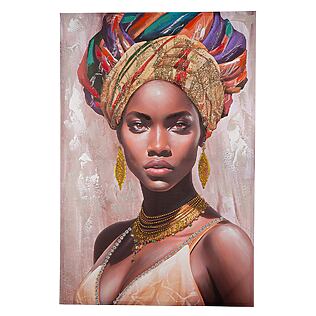
When we think of a painting or picture, we automatically picture a rectangular format, like a window.
One of the first considerations a painter will have is what format the new painting should have. These considerations relate on the one hand to the size of the painting and on the other hand to the aspect ratio, i.e., whether it should be square, portrait, or landscape format.
Sometimes, the opposite can also be true: you consider what would be best painted on whatever format happens to be lying around in the studio. In any case, the format has a significant influence on the overall effect of the image. My subsequent remarks refer primarily to the aspect ratio when I talk about format.
EARLY AWAKE Otto, The Dogma
It's obvious that expansive landscapes make sense in a horizontal format, while a vertical format is chosen for depicting a narrow street or a mountain section. Portraiture, too, almost always uses a vertical format. In various European countries, different economic and social conditions led to the development of distinct rectangular formats with characteristic aspect ratios. A book could easily be written about their variations, sizes, origins, and effects on the viewer.
Surprisingly, however immense the artistic revolutions and upheavals in representation have been over time, the rectangular format itself has hardly been questioned in painting. This is true if we disregard the special case of round formats, which have been used for centuries.
An image evokes both conscious and unconscious emotions in the viewer. The format is particularly effective on a subconscious level. Anyone interested in art should take the time to calmly examine various geometric and abstract forms and pay attention to the feelings each one evokes.
Both the shape and the name of the oval are derived from the egg, which for us represents the epitome of security. The circular shape evokes feelings of perfection, of oneness with life, the universe, or God.
While the rectangular format provides us with stability and security, allowing us to position ourselves, it also limits our thinking and emotions and should therefore be questioned in art.
The rectangular format seems to be a dogma in painting.
We find almost exclusively images whose sides are at a precise 90-degree angle to each other. I think images whose angles deviate from this would initially disturb the viewer. Especially if the deviations from the 90-degree angle were only slight, this would trigger a vague sense of unease.
But shouldn't art also disturb us, push us out, urge us, pull us out of our rectangular thinking, towards an unpredefined feeling?
However, only a few painters deviated from the rectangular format.
One prominent example is the American abstract painter Frank Stella (1936-2024) with his Shaped Canvases, who gave his paintings a wide variety of geometric forms and also left the wall surface, allowing them to project into the room and thus blurring the boundary between painting and sculpture.
The German painter Gerhard Hoehme (1920 to 1989) also partially broke away from the rectangular picture format and the surface with his works.
The Italian Informel artist Emilio Vedova (1919-2006) cut polygonal slabs, some taller than a person, to use as picture supports, which he joined together at irregular angles. His primary aim was not to create sculptures, but to add the appeal of the third dimension to his paintings.
The German painter Imi Knoebl (born 1940) expands the boundaries of painting both into space and from the rectangular format by layering various monochrome objects and formats, but I would classify many of his objects as sculpture rather than painting.
The work of the Spanish painter Angela de la Cruz (born 1965) consists largely of works in which she literally breaks with the tradition of the format by breaking the frames and loosening the canvas, and partly rearranging both and thus transforming them into mostly three-dimensional objects.
But that was the extent of the questioning of the dogma of the rectangular format and the flat representation in painting.
While it may have been argued in earlier times that a rectangular frame was the most stable shape and the easiest to manufacture and stretch fabric over, this argument no longer holds true. With current technology, it is easily possible to produce and stretch fabric over frames in any conceivable shape. Furthermore, any imaginable shape can be milled from wood or plastic panels.
Arguments are often based on our visual habits. The image has always been like a window, and windows are rectangular. Therefore, the rectangular format is maintained because customers expect a picture to be rectangular; anything else would be unsettling. Furthermore, the entire art supply chain is geared towards rectangular images. These are easy to produce, transport, store, and hang, and their surface area is easy to calculate.
I think these are the same arguments that have been used throughout history to maintain the status quo, which is convenient for all involved, and to prevent innovation and development.
I find it particularly problematic to argue based on our visual habits,because, like so many habits that developed over decades and centuries and eventually proved harmful, it may also be unhealthy and sensible for us, in the broadest sense, not to deviate from this "rectangular" visual habit. But that would mean challenging a dogma.
The right angle is inorganic and not conducive to human form. It hardly ever occurs in visible nature. But in engineering, it provides the most stable connection. And so, wherever possible, right angles were used in technical works. Even the force of gravity dictated the right angle as the optimal function of statics.
All the technical arguments that apply to the rectangular image format can therefore be made even more strongly, and to a far greater extent, in architecture. Because there, it's about the stability of buildings and the risk to human life.
Yet architecture, even a hundred years ago, not only attempted but began to break free from right angles. Rudolf Steiner recognized that humans don't truly feel comfortable with right angles and cannot develop freely under their dominion. In the work of brilliant architects like Zaha Hadid, one finds only rounded forms and no angles at all. Today, we see buildings that spontaneously make us think: "How can that be stable?" The technical challenges of deviating from right angles in architecture were a thousand times greater than those of abandoning the rectangular format in painting.
And yet, to this day, painting has not taken the step of abandoning the right angle. Among many other phenomena, this is one of those that leads me to speak of the archaic form of the art market.
Otto Frühwach was born in Munich in 1960. Artistically active in his youth, he worked independently and as an entrepreneur in various cultural and economic sectors until the age of sixty, though his heart remained firmly planted in the realm of art. Since turning sixty, he has placed active artistic creation at the center of his life, working with a wide variety of techniques and materials to create his paintings. His work is diverse, transcending genres and styles.
“I view art initially as a world tour, which I have embarked on using a wide variety of means of transport. I am open to everything. Afterwards, I will decide where I will settle down.”
We use technologies such as cookies to store and/or access device information. We do this to improve your browsing experience and to display (non-)personalized advertising. If you consent to these technologies, we can process data such as browsing behavior or unique IDs on this website. Refusal or withdrawal of consent may adversely affect certain features and functions.
Functional
Always Active
Technical storage or access is strictly necessary for the legitimate purpose of enabling the use of a specific service expressly requested by the subscriber or user, or for the sole purpose of carrying out the transmission of a message over an electronic communications network.
Preferences
The technical storage or access is necessary for the legitimate purpose of storing preferences that were not requested by the subscriber or user.
statistics
Technical storage or access that is solely for statistical purposes.Technical storage or access that is used solely for anonymous statistical purposes. Without a subpoena, the voluntary consent of your internet service provider, or additional recording by third parties, the information stored or retrieved for this purpose cannot generally be used to identify you.
marketing
Technical storage or access is required to create user profiles, to send advertising, or to track the user on one or more websites for similar marketing purposes.


 J-Line Sustainable Christmas Tree in Modern Style Made of Foldable Paper (White)
124,00 €
J-Line Sustainable Christmas Tree in Modern Style Made of Foldable Paper (White)
124,00 €