When an artist looks at their work with some distance, they might say: "I think that painting turned out well." Or they might be critical: "I need to work on that again." Dietmar Deiwick said: "I can't even remember painting that."
Unsurprisingly, the distance was enormous, both in time and space: Dietmar Deiwick, a trained color lithographer and digital printer, found himself confronted with two works from his early period, painted 45 years ago in Nepal. The Berlin native had stayed in a spartan artists' residence in Kathmandu at the time. He remained there for five months, and upon returning to Germany, he left four paintings in a small local gallery.
Now, for his 70th birthday, his children organized an exhibition – the first of his life – and for it, they tracked down two of the four works that had been thought lost and brought them to Berlin. "I often have no idea at the beginning what my paintings will look like," Deiwick describes his approach. "I let myself be surprised." He visualizes his own imagination and the moment.
It was probably the same back then, 45 years ago: a fantasy landscape, at least in parts. Mountains in the background, a landslide in the foreground, a dark blue organic wall or border to the right – next to it, a more pristine world with a dugout canoe on a lake. The future of the environment, descending in layers, becoming increasingly confined with a wall you can feel at your back.
"The Blue Curtain ." It's painted in oil, but unvarnished. "The colors were more vibrant back then, even darker," Deiwick recalls. He now wants to restore its former vibrancy, clean the work—and finally varnish it. To finish the work he started back then.
Dietmar Deiwick – “The Blue Curtain”
“The Blue Curtain” (oil), left behind in Kathmandu 45 years ago, now returned from the end of the world: The colors have suffered over time, but the critique of the progressive environmental destruction is timeless.
Dietmar Deiwick – “Metropolis”
Deiwick's paintings oscillate between landscape and urbanity – here the work "Metropolis" (acrylic).
Dietmar Deiwick – “Camping 3000”
"Camping 3000" (acrylic): Deiwick often maritime landscapes– many of them on the Baltic Sea coast. The paintings were and are not for sale.
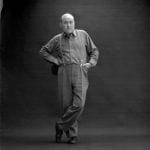
Deiwick on his knees
Dietmar Deiwick was surprised: The signature on his works and the gallery's name were the only clues for the search in Nepal. The artist himself would no longer have been able to describe the paintings in detail after 45 years.
About the artist
Dietmar Deiwick was born in Naila, Upper Franconia, in 1947. He grew up in Berlin, where he still lives today. After an apprenticeship as a color lithographer in Berlin-Kreuzberg, he embarked on study trips to India, Tanzania, Nepal, and Afghanistan between 1970 and 1973.
Back in Germany, he worked as a technical lithographer in the field of composition. He married in 1975 and had two children, to whom he passed on his artistic talent. He worked with color and graphics throughout his life, and since the 1990s also digitally; he taught computer courses. He retired several years ago and has since been able to devote more time to painting.
Owner and Managing Director of Kunstplaza . Publicist, editor, and passionate blogger in the fields of art, design, and creativity since 2011. Graduated with a degree in web design from university (2008). Further developed creative techniques through courses in freehand drawing, expressive painting, and theatre/acting. Profound knowledge of the art market gained through years of journalistic research and numerous collaborations with key players and institutions in the arts and culture sector.
We use technologies such as cookies to store and/or access device information. We do this to improve your browsing experience and to display (non-)personalized advertising. If you consent to these technologies, we can process data such as browsing behavior or unique IDs on this website. Refusal or withdrawal of consent may adversely affect certain features and functions.
Functional
Always Active
Technical storage or access is strictly necessary for the legitimate purpose of enabling the use of a specific service expressly requested by the subscriber or user, or for the sole purpose of carrying out the transmission of a message over an electronic communications network.
Preferences
The technical storage or access is necessary for the legitimate purpose of storing preferences that were not requested by the subscriber or user.
statistics
Technical storage or access that is solely for statistical purposes.Technical storage or access that is used solely for anonymous statistical purposes. Without a subpoena, the voluntary consent of your internet service provider, or additional recording by third parties, the information stored or retrieved for this purpose cannot generally be used to identify you.
marketing
Technical storage or access is required to create user profiles, to send advertising, or to track the user on one or more websites for similar marketing purposes.




 Luxurious 3D wall art "World" made of MDF + resin behind glass, handcrafted
395,00 €
Luxurious 3D wall art "World" made of MDF + resin behind glass, handcrafted
395,00 €


