Few subjects have captivated painters as long as the set table. In the 17th century, Dutch artists painted bread, pewter plates, half-empty glasses, and crumpled cloths with a devotion as if they were creating portraits. This genre is still known today as still life, and its paintings reveal more about setting a festive table than many a decorating guide.
Those who set the table for Christmas Eve or Christmas dinner for family and friends face the same challenge as the painters of old. Many things need to come together in a limited space without overwhelming the eye.
The so-called "banketjes," still lifes of meals by painters like Pieter Claesz or Willem Claesz Heda, appear casual at first glance. A knife protrudes over the edge of the table, a lemon is half-peeled, the tablecloth lies in folds. In fact, much of it is carefully composed. The paintings follow a strict order of a few color tones, clear contrasts in height, and a uniform lighting. Heda often worked almost monochromatically, with gray, silver, ochre, and off-white, thereby achieving a tranquility that a colorful table rarely possesses.
Still life with a gourd, roast poultry, silver salt cellar and stoneware jug (1627), by Pieter Claesz
Willem Claesz Heda – Breakfast with Lobster (1648)
A few decades later, painters like Willem Kalf for the opposite approach. Their opulent still lifes depict porcelain, nautilus cups, tropical fruits, and heavy carpets in rich colors. Here, too, order holds the picture together. A dark background swallows everything unimportant, and only a few objects are truly illuminated.
Willem Kalf – Still life with Wanli sugar bowl, circa 1678
Two approaches can be derived for the Christmas table setting. One is a quiet, minimalist table with just a few colors. The other is an opulent version, where a dark, calm background supports the abundance. Things usually get tricky in between, when a little bit of everything ends up on the table.
The reason for the picture: tablecloth and tabletop
Every painting begins with the ground, and on the table, the tablecloth on this role. It determines how bright the entire arrangement appears and how clearly the plates, glasses, and branches stand out against it. A white tablecloth is the classic choice because it reflects the candlelight and the porcelain appear almost to float. Champagne tones appear warmer by candlelight and harmonize well with gold and brass. A deep burgundy, on the other hand, functions like the dark background in Kalf's painting. It recedes into the background and makes light-colored tableware shine all the more brightly.
The table setting is characterized by the elegant contrast between the dark green linen napkin, the matte gold cutlery, and the simple plates on a light background. Vibrant red berries, natural fir branches, and delicate gold accents complete the arrangement, lending it a rustic yet festive elegance. Photo by Kateryna Hliznitsova @kate_gliz, via Unsplash
It's important to consider the blanket as a continuous surface, not as a pattern. A large check or a printed Christmas fabric already tells its own story, against which everything else must compete. A solid-colored, tightly woven fabric with a clean drape, on the other hand, leaves room for whatever is printed on it.
The tabletop itself can also form the basis. Solid wood with a visible grain has enough character to get by with just a few fir branches in the middle and simple plates.
A warm, rustic ambiance, where amber-colored glasses and a multi-layered table runner on the wooden table set the cozy tone. Small fir branches with red ribbons on the plates, along with arranged tangerines and tall red candles, add natural, traditional color accents. Photo by Andrej Lišakov @lishakov, via Unsplash
A palette of three tones
Many painters deliberately limited their palette, and a panel painting benefits from the same discipline. Three colors are usually sufficient: a base tone, a companion, and an accent
The traditional red and green pairing is a popular choice for Christmas. As a complementary contrast, it creates a strong effect, but can quickly become overwhelming. It can be toned down by using darker shades of both colors – fir green instead of grass green, and burgundy instead of bright red. For a lighter look, combine white with champagne and add a single green accent of fresh twigs.
Here we see a fresh red and white contrast, where bright red napkins with checkered bows, a central red candle, and a matching floral arrangement create bold accents against the light background. Playful details such as a rustic wooden slice, a snow-covered decorative tree, and a miniature gold bicycle add a charming, individual touch to the festive table setting. Photo by Libby Penner @libby_penner, via Unsplash
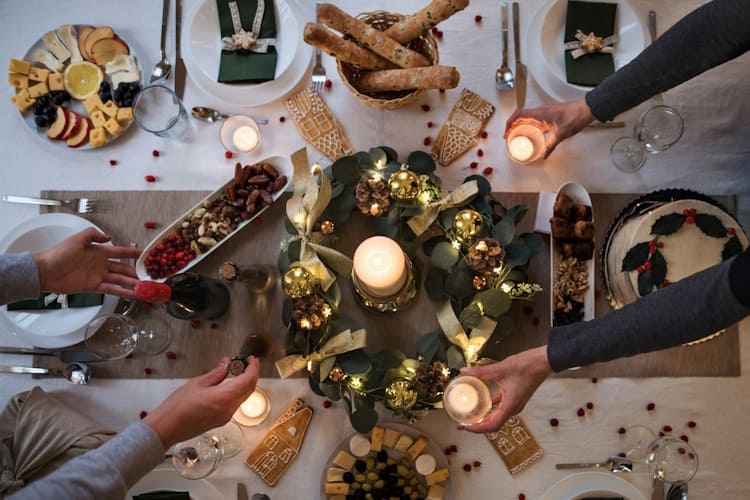
A festive table with a lavish green wreath, adorned with fairy lights and gold baubles, as its radiant centerpiece. Edible elements such as lovingly decorated gingerbread houses and scattered red berries are charmingly integrated directly into the decoration, creating a particularly inviting and family-friendly atmosphere. Photo by Getty Images @gettyimages, via Unsplash
Cloth napkins play a special role because they are repeated at every place setting. On a white tablecloth, dark green or burgundy napkins create twelve evenly spaced points of color for twelve guests, dividing the length of the table. On a dark tablecloth, the effect is reversed. Then, light-colored napkins carry the light to the ends of the table. Precisely because napkins are so frequently used, it's worthwhile to decide on their color first and then select candles, ribbons, and branches accordingly.
A festive table setting with a botanical nature theme, featuring a floral-patterned tablecloth and a lush fir garland adorned with dried orange slices. Charming details like striped napkins decorated with white ribbons and delicate snowflake ornaments add a rustic-elegant touch. Photo by Natalie Behn @natalie_behn, via Unsplash
A festive table setting with a striking contrast, featuring a vibrant red napkin tied with a traditional checkered bow and elegant gold cutlery on light-colored porcelain. Playful and rustic details complete the arrangement, such as a thick wooden slice serving as a base for the floral arrangement, snow-covered decorative trees, and a small gold miniature bicycle. Photo by Libby Penner @libby_penner, via Unsplash
Repetition and an interruption
A still life thrives on repetition and deliberate disruption. On the table, the place settings set the rhythm: equal spacing, identical plates, identical napkins. Approximately 60 to 70 centimeters of width per place setting gives each guest ample space and allows the rhythm to unfold calmly. The break in this pattern belongs in the center. This could be a group of candles of varying heights, a shallow bowl of apples and walnuts, or a few branches with cones.
Christmas table decorations with a fairytale woodland motif, where hanging branches interwoven with countless fairy lights form a luminous canopy above the table. On the table itself, dark green ceramic trees, mushrooms, and small animal figurines nestled among moss and simple white candles enhance this enchanting, nature-inspired atmosphere. Photo by Dragon White Munthe @fotomagi, via Unsplash
A warm, elegant color scheme combines a dark brown tablecloth with a light runner and deep green cloth napkins. Shiny gold accents, such as tall candlesticks, pearl necklaces, and delicate decorative stars, lend the arrangement a festive, luxurious touch. Photo by Kateryna Hliznitsova @kate_gliz, via Unsplash
The painters staggered their objects vertically so that the eye would wander, from the reclining knife to the plate and finally to the tall glass. A similar rule applies at the table, albeit with one caveat: guests must be able to see each other across the center. Low arrangements that remain below eye level, and slender, tall candles above them, keep the line of sight clear. Anything that ends precisely at face level creates the illusion of a wall.
A table setting with an elegant, Scandinavian aesthetic, featuring a lush centerpiece of white blossoms and eucalyptus bathed in the warm glow of fairy lights and tall, simple candles. Patterned party poppers and lovingly decorated plates in soft shades of gray and white harmoniously complete the festive yet cozy overall look. Photo by Anita Austvika @anitaaustvika, via Unsplash
Symbols that no one needs to explain
In old still lifes, many objects carried meaning. The half-peeled lemon is often interpreted as a symbol of superficial beauty, bright on the outside and sour on the inside. The burnt-down candle represents transience, while precious tropical fruits signify wealth and long-distance trade. Educated viewers could read many of these symbols like a text.
The Christmas table also has its own symbolic language, and it still works today without explanation. Evergreen branches represent life in the middle of winter. Apples are reminiscent of the Tree of Paradise, with which the decorated Christmas tree is often associated. Oranges and nuts were long considered precious gifts and are still a staple on the festive plate in many families.
Those who bring such things to the table are not merely decorating. They are tapping into a visual tradition that guests unconsciously recognize. A few apples on a pewter plate sometimes say more than a dozen store-bought figurines.
Light like in an artist's studio
No element transforms a painting as dramatically as light. Dutch painters typically let it enter from one side, often from a window on the left, and used it to model every glass and every crease. In the evening, candlelight takes on this role. It looks most beautiful when the ceiling light is dimmed or switched off completely and only a few warm lamps are used in the room. Bulbs with a color temperature of around 2,700 Kelvin or less best match the color of the flame.
Highlights emerge where light strikes glass, silver, or brass. A few polished candlesticks, wine glasses with thin rims, and perhaps an old family heirloom spoon diffuse the light across the table. Matte fabrics provide the contrast. They absorb the light, making the shiny objects stand out even more. This interplay between matte and glossy surfaces is what gives the cloths in old paintings their three-dimensionality, and it works just as well on the dining table.
The napkin as a sculptural element
In still life painting, the crumpled cloth is often the true test of the painter's skill. The folds reveal the material, weight, and light all at once. At a festive table, the napkin becomes a miniature sculpture, and for this, it needs a fabric that holds its shape. Densely woven fabrics like gabardine are easy to fold and usually retain their shape even throughout a long evening. Zeltpro's napkins, for example, are made of this fabric and measure 40 x 40 centimeters, a size sufficient for most classic folds.
Elaborate designs aren't necessary at all. A simple roll with a sprig of rosemary or fir, a simple fan in a glass, or a flat rectangle with the place card on it often looks more elegant than a folded star. The crucial thing is that all the napkins are folded the same way. Only through repetition does a piece of fabric become a design element.
The table as a photo before the guests arrive
Anyone wanting to capture the table setting should do so before the bell rings. In the minutes leading up to it, it's closest to the painted model. The candles are just lit, the glasses are still empty, and everything is in its proper place. For a still-life style photo, it helps to turn off the overhead lights and work only with candles and a lamp to the side. The best way to photograph it is from a slight angle, perhaps while standing next to the table, rather than directly from the front.
A carefully chosen detail often has a stronger impact than the entire table setting. A single place setting with napkin, glass, and a sprig of fir, cropped at the edge of the frame, is more reminiscent of a painting than a tablescape of twelve places. It is precisely here that it becomes clear whether the background, palette, and lighting harmonize. What looks chaotic in a photograph usually also looks jarring at the table.
What remains after the festival
A still life on canvas remains, but a set table inevitably falls apart by dessert time. What's left behind are wax on the tablecloth, a red wine stain, and crumpled napkins. Especially with textiles meant to withstand many celebrations, it's worth considering their care. Fabrics that can be washed at 40 degrees Celsius can be cleaned after the party without much effort.
It's best to let wax harden completely before carefully removing it. Any remaining residue can be removed with kitchen paper and a warm iron, provided the care label allows it. Red wine stains should be treated with cold water as quickly as possible before they set. Some tablecloths also have a stain-resistant finish, causing liquids to bead up and roll off. This takes a lot of the worry out of damaging the fabric.
An image that is allowed to dissolve
The difference between a painting and a banquet table is ultimately a beautiful one. A still life captures a moment, while a banquet table is meant to be used. Working with a calm background, a clear palette, good lighting, and a recurring motif creates a picture that still works even when glasses have been moved and napkins unfolded. Perhaps that is the most important lesson from old paintings: order doesn't mean rigidity. It provides a framework within which chance can flourish.
Owner and Managing Director of Kunstplaza . Publicist, editor, and passionate blogger in the fields of art, design, and creativity since 2011. Graduated with a degree in web design from university (2008). Further developed creative techniques through courses in freehand drawing, expressive painting, and theatre/acting. Profound knowledge of the art market gained through years of journalistic research and numerous collaborations with key players and institutions in the arts and culture sector.
We use technologies such as cookies to store and/or access device information. We do this to improve your browsing experience and to display (non-)personalized advertising. If you consent to these technologies, we can process data such as browsing behavior or unique IDs on this website. Refusal or withdrawal of consent may adversely affect certain features and functions.
Functional
Always Active
Technical storage or access is strictly necessary for the legitimate purpose of enabling the use of a specific service expressly requested by the subscriber or user, or for the sole purpose of carrying out the transmission of a message over an electronic communications network.
Preferences
The technical storage or access is necessary for the legitimate purpose of storing preferences that were not requested by the subscriber or user.
statistics
Technical storage or access that is solely for statistical purposes.Technical storage or access that is used solely for anonymous statistical purposes. Without a subpoena, the voluntary consent of your internet service provider, or additional recording by third parties, the information stored or retrieved for this purpose cannot generally be used to identify you.
marketing
Technical storage or access is required to create user profiles, to send advertising, or to track the user on one or more websites for similar marketing purposes.












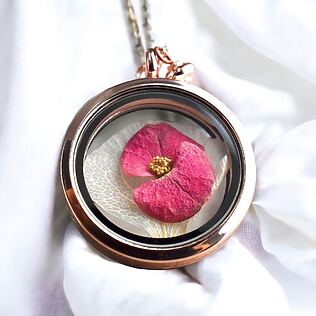
 Rose gold-plated necklace made of 925 sterling silver with preserved Christ's thorns flower / hydrangea leaf in a glass medallion
42,90 €